France runs one of the strongest public higher education systems out there. Low tuition, high academic standards, and real research output, all in one place. Big names like PSL University, Sorbonne University, Université Paris-Saclay, Université Paris Cité, and Aix-Marseille University keep pulling in students from every corner of the world.
Public universities in France give you world class degrees without draining your savings. Fees stay low because the government picks up a big chunk of the cost. Add strong research, English taught programs, and easy scholarship access, and you get a solid deal for international students.
In this article, we cover the top public universities in France, what you will actually pay, which courses are worth chasing, how the application process works, and which scholarships can cut your costs further. Everything you need before you hit that apply button.
Public Universities in France for International Students
France has close to 70universities in France, and close to 70 of them are public. This city hosts over 400,000 international students every year, and public universities take in a big share of that number. Some universities stand out purely because of how international-friendly they are, not just their rankings. Here is a closer look at which ones fit international applicants best.
Universities With English-Taught Programs
Around 1,700 English-taught programs now run across French higher education, and public universities keep adding more each intake. These universities lead the pack for English medium options:
Université Paris-Saclay: Strong English-taught master's in engineering and physics
Sorbonne University: English-taught programs in science and select humanities tracks
Université PSL: English options across research-focused master's degrees
Université Grenoble Alpes: English-taught courses in engineering and management
Most of these sit at master's level, not bachelor's. A handful of joint programs and double degrees also run fully in English, so check a university's international office page before ruling anything out.
Universities Popular Among International Students
Some universities simply pull in more international students than others, often because of their location, size, or global tie-ups. These names come up the most:
Sorbonne University: Large international student body, strong exchange partnerships across Europe
Aix-Marseille University: France's biggest public university by student count, wide mix of nationalities
Université Paris-Saclay: Heavy international presence in STEM and research programs
Université Grenoble Alpes: Popular with students who want a smaller city, lower living costs, and strong engineering ties
Paris-based universities naturally attract more international students just due to size and visibility. But cities like Grenoble and Strasbourg offer a quieter, cheaper alternative without dropping the academic quality.
Public Universities in France and Their Popular Courses
Students head to France for many reasons, but a handful of subjects always top the list. If you want a deeper look atcourses to study in France, this section gives you a quick starting point. France produces thousands of engineering and business graduates every year who go straight into global companies. Here is where most international students focus their applications.
Engineering and Technology
Engineering remains one of the biggest draws for international students applying to public universities in France. These universities lead this space:
Institut Polytechnique de Paris: Home to École Polytechnique, strong across all engineering branches
Université Paris-Saclay: Runs over 200 research labs, popular for physics and applied engineering
Université Grenoble Alpes: Known for mechanical and electrical engineering, close to major tech industries near the Alps
Business and Management
Business programs at public universities often connect closely with grande école networks and industry partners. These names stand out:
Université Paris-Saclay: Strong management and finance tracks alongside its science base
Université Paris Cité: Growing business and international management programs
Aix-Marseille University: Business and economics programs with strong regional industry ties
Computer Science and Data Science
Tech-focused programs have grown fast across French public universities over the last few years. These universities lead this field:
Université Paris-Saclay: One of France's strongest names in computer science and AI research
Institut Polytechnique de Paris: Data science and AI programs backed by École Polytechnique's research output
Université PSL: Computer science programs tied to top research institutions like ENS
Science and Other Popular Fields
Beyond engineering and tech, a few public universities lead clearly in science, medicine, and humanities. Here is where each one stands out:
Sorbonne University: Leads in humanities, law, and natural sciences
Université Paris Cité: Strong medicine and life sciences programs
Aix-Marseille University: Well known for medicine and law together
Université de Strasbourg: A go-to name for law and life sciences in Europe
Money is usually the first thing students check before anything else, and it is often the deciding factor when planning tostudy in France. The good news is public universities in France stay far cheaper than private colleges or universities in US and UK. Here is exactly what you will pay.
Tuition Fees for International Students
For the 2026 to 2027 academic year, here is what non EU students pay at public universities:
Bachelor's: around €2,902 a year (₹3.2 lakhs a year)
Master's: around €3,941 a year (₹4.3 lakhs a year)
PhD: around €380 a year (₹42,000 a year), same fee for every nationality
Is Education Free at Public Universities in France?
A lot of students search for free public universities in France, so let's clear this up properly. Education here is heavily subsidized, but it is not completely free for international students. Here's the real picture:
EU, EEA, and Swiss students pay very low fees, sometimes under €200 a year (₹22,000 a year)
Non EU students pay more, but still far less than US, UK, or Australia
Some universities waive fees for a portion of their non EU students every year
PhD students across all nationalities pay the same low fee
Always check directly with your shortlisted university. Fee waivers are more common than most students realize, and it costs nothing to ask.
Admission Requirements for Public Universities in France
Getting into a public university in France is not as hard as people assume, but it does follow a strict process. Requirements shift a bit depending on your course, your university, and whether you are applying for a bachelor's, master's, or PhD.
Here is what most public universities in France actually expect from international applicants.
Academic and Language Requirements
Every course has its own entry bar, so check this early before you fall in love with a university. For a bachelor's program, you need to have finished class 12 or an equivalent qualification. For a master's, universities look for a relevant bachelor's degree with a solid academic record, and some competitive programs at Sorbonne or PSL even run entrance interviews. Language rules depend entirely on how your course is taught:
French taught course:DELF or DALF at B2 level, sometimes higher for law or medicine
English taught course:IELTS around 6.0 to 6.5, or TOEFL around 80 to 90
Native English speakers: often exempt from language tests altogether. Some universities also accept applicantswithout an IELTS score if they meet other English proficiency proof.
Documents Required for Admission
Public universities in France are strict about paperwork, and missing even one document can delay your application by weeks. Keep these ready well before your deadline:
One or two recommendation letters from professors or employers
Portfolio, only required for art, design, or architecture courses
Proof of financial means, since universities need to see you can support yourself
Get certified translations done early if your documents are not in English or French. Original documents are sometimes still asked for at enrolment, so keep physical copies safe too.
How to Apply to Public Universities in France?
The application process for public universities in France runs through a few set routes, and picking the right one from the start saves you a lot of confusion later. Here is exactly how most international students, including those from India, get through it.
Application Routes and Deadlines
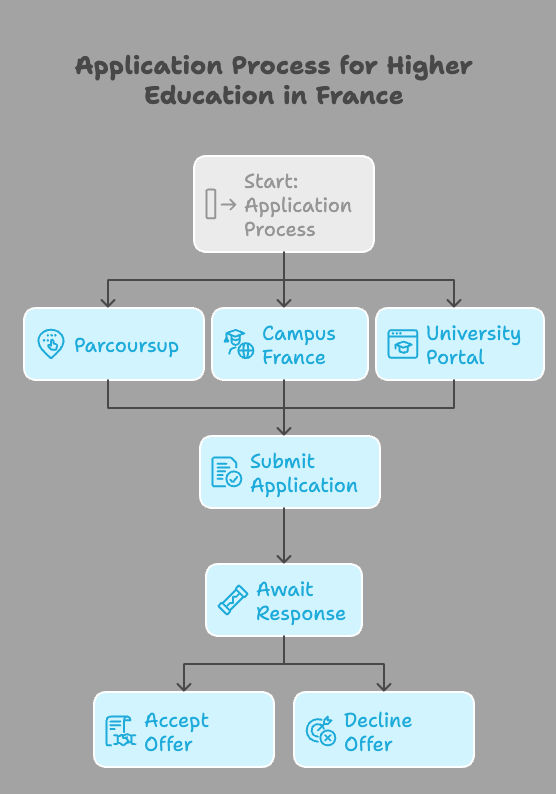
Your nationality decides which route you take, so this is the first thing to confirm. Most non EU students, including Indian applicants, apply through Campus France using the Études en France portal. This platform checks your documents, pre validates your profile, and links directly with your visa process later on. A few other routes also exist:
Parcoursup: mainly for undergraduate applications within France
Direct university applications: common for select master's and PhD programs, especially research based ones
Joint or Erasmus Mundus programs: have their own separate application system
Start this whole process 6 to 10 months before your intake. French universities are strict on deadlines, and late applications rarely get a second look.
Step-by-Step Application Process
Once you know your route, the process itself is fairly straightforward. Here is how it usually plays out from start to finish:
Shortlist your course and confirm the language it is taught in
Check entrance exams, portfolio needs, or interview rounds for that course
Collect and translate your documents where needed
Register on Études en France, Parcoursup, or the university portal
Submit your application and pay the application fee if there is one
Attend an interview or submit a research proposal, if asked
Receive your offer letter or Campus France attestation
Apply for your long stay student visa once you accept the offer
Start looking for housing while your visa is being processed
Keep confirmation receipts and emails from every stage. If anything goes missing later, these become your proof that you applied on time.
Even with low tuition already, scholarships can cut your costs even further, sometimes covering your entire monthly budget. Several options exist for international students, and a few are made specifically for Indians. Here is a full breakdown before you start applying.
Scholarships for International and Indian Students
France offers a solid mix of government and institution backed scholarships every year. Some cover just your stipend, while others add flights, insurance, and visa fee waivers on top. Here is a quick comparison:
€1,000 to €1,200 a month (₹1.1 lakhs to ₹1.3 lakhs a month)
Full tuition waiver, stipend, travel allowance
How to Apply for Scholarships
Each scholarship follows its own process, so read the fine print before you plan around one. For Eiffel, you cannot apply directly. Your French university has to nominate you after they offer you admission, so a strong application to the university itself comes first.
Charpak works differently, and Indian students can apply directly through the official Campus France India portal, without needing a university nomination.
A few things that help your chances across any scholarship:
Keep your academic grades consistently strong, most ask for a CGPA of 7.5 or higher
Write a clear and honest statement of purpose, avoid generic templates
Apply early, most government scholarships close by December to February for the September intake
Check if you can apply to more than one scholarship at once, many students do
Note: Scholarships in France get competitive fast, so starting your application 8 to 10 months ahead of your intake gives you a real shot.
Conclusion
Public universities in France pack in low cost, strong academics, and real career value, all at once. You get affordable tuition, degrees recognized worldwide, and a good shot at scholarships if your profile is strong. So here's how to think about it before you apply:
If you want a strong engineering or tech degree, look at Institut Polytechnique de Paris or Université Paris-Saclay first
If law, humanities, or medicine interests you more, Sorbonne University or Aix-Marseille University fit better
If your budget is tight, focus on universities outside Paris, cities like Grenoble and Strasbourg cost less to live in
If you are Indian and eyeing a master's degree, apply for the Charpak Scholarship early, it stays less competitive than global options
If English comfort is a concern, stick to master's level programs, that is where most English taught courses sit
Whatever path you pick, check the fees, requirements, and course language early on. Once that part is sorted, the rest of the process gets a lot smoother.
FAQs on Public Universities in France for International Students
Are public universities in France free?
Not fully free, but close to it. Public universities in France charge very low fees compared to other countries. EU students pay under €200 a year (₹22,000 a year), while non EU students pay around €2,902 to €3,941 a year (₹3.2 lakhs to ₹4.3 lakhs a year), depending on the course level.
Is France good for Indian students?
Yes, France works well for Indian students. Tuition stays affordable, degrees are recognized worldwide, and scholarships like Charpak are made just for Indian applicants. Add in strong research and growing English taught programs, and it becomes an easy choice for many.
Which French universities are best for Indian students?
Some of the top picks include Université PSL, Sorbonne University, Université Paris-Saclay, and Institut Polytechnique de Paris. These names rank high globally and offer a good mix of English and French taught courses.
Is France costly for Indian students?
Not really, especially when you compare it to US or UK. Tuition at public universities in France stays low, and living costs can be managed well if you pick a smaller city over Paris.
How to apply for admission in public universities in France?
Most international students apply through Campus France using the Études en France portal. You pick your course, submit your documents, and wait for your offer letter before moving on to the visa step.
How to apply for an MBA in a public university in France?
You apply the same way as any other master's program, through Campus France or directly on the university website. Check the language of instruction first, since some MBA programs are taught in English while others need French proficiency.
What is the list of public universities in France for international students?
Some well known names include Université PSL, Sorbonne University, Université Paris-Saclay, Université Paris Cité, Université Grenoble Alpes, and Aix-Marseille University. France has close to 70 public universities in total.
Do public universities in France offer English programs?
Yes, a good number of public universities in France with English programs exist today. You will find them mostly at the master's level, especially in engineering, business, and data science.
What documents are needed to apply to a public university in France?
You will need your passport, academic transcripts, a statement of purpose, a CV, and one or two recommendation letters. Art and design courses may also ask for a portfolio.
Are there free public universities in France for international students?
Education is heavily subsidized, but not completely free for international students. Some universities do offer fee waivers for a portion of their non EU students, so it is always worth checking with the university directly.
What scholarships are available for public universities in France?
The Eiffel Excellence Scholarship and the Charpak Scholarship are two popular options. Eiffel offers up to €2,100 a month (₹2.3 lakhs a month) for PhD students, while Charpak gives around €860 a month (₹95,000 a month) to Indian master's students.
Pragya Sharma is a content developer and marketer with 6.5+ years of experience in the education industry. She started her career as a social media copywriter for NIELIT, Ministry of Electronics & IT,...
Refer Your Friend & Earn upto ₹15000
Help your friend upgrade to a Global Career and earn rewards together.