What is Quantum AI?
By Rahul Singh
Updated on May 05, 2026 | 11 min read | 3.93K+ views
Share:

All courses
Certifications
More
By Rahul Singh
Updated on May 05, 2026 | 11 min read | 3.93K+ views
Share:
Table of Contents
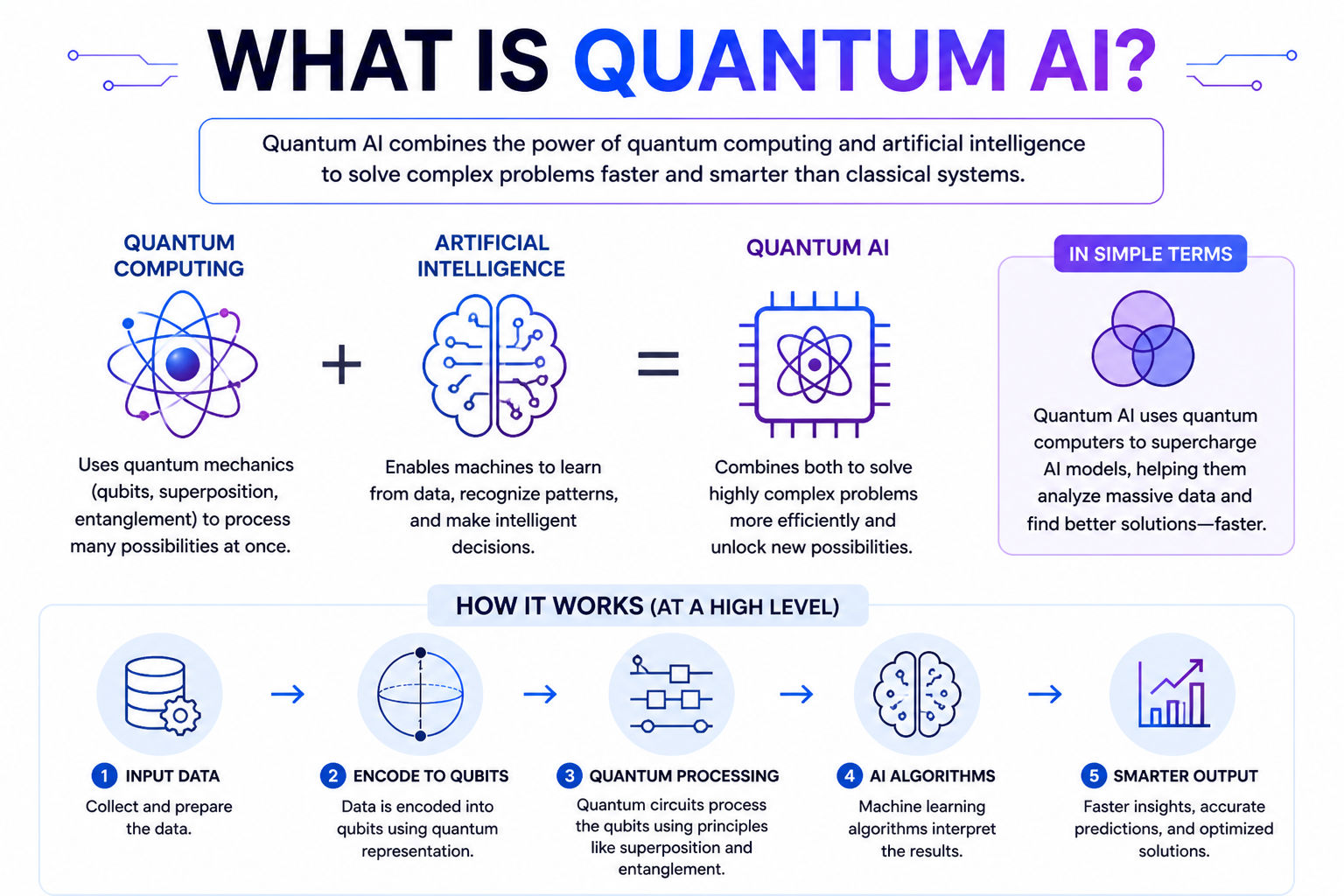
Quantum AI combines quantum computing with artificial intelligence to handle complex data in new ways. It uses principles like superposition and entanglement to process multiple possibilities at once, which can improve speed and efficiency compared to traditional systems.
This approach supports advanced machine learning and helps solve difficult problems in areas like optimization, material science, and large-scale data analysis that are hard for classical computers to handle.
In this blog, you will learn what Quantum AI means, how it works, where it is used, and what skills you need to get started.
Build practical AI skills and start solving real-world problems. Explore upGrad’s Artificial Intelligence courses to learn machine learning, Quantum AI, and core tools, and move toward roles in AI and data-driven applications.
Popular AI Programs
Understanding Quantum AI starts with knowing its two main parts. It directly combines traditional artificial intelligence with the incredible power of quantum computing. To grasp this concept, we first need to look at how normal computers process daily information.
Sundar Pichai (CEO of Google) explained why this shift from classical to quantum is so revolutionary when Google announced its major quantum breakthrough:
"For the first time, we have a quantum machine that speaks the language of nature... It doesn't just do things faster; it does things in a fundamentally different way.": Sundar Pichai
Also Read: What is an Operating System?
Traditional models often take weeks to process massive datasets. A system powered by Quantum AI can analyze the exact same data in seconds. This extreme speed comes from a strange physics rule called entanglement.
Entanglement means qubits connect directly to each other. If one qubit changes its state, the connected qubits change instantly, even if they are far apart. This instant connection lets the system process vast amounts of complex data together. It finds deep, hidden patterns that regular processors simply cannot see. Artificial intelligence relies entirely on finding patterns. Faster pattern recognition creates much smarter digital systems.
Here is a simple table comparing both technologies:
| Feature | Classical AI | Quantum AI |
| Data Unit | Bits (Strictly 0 or 1) | Qubits (0, 1, or both) |
| Processing Style | Sequential (One step at a time) | Simultaneous (All steps at once) |
| Speed | Fast | Incredibly fast |
| Best For | Simple, everyday digital tasks | Highly complex, massive problems |
The table shows a clear difference in raw computing power. Regular systems eventually get stuck on massive calculations. The newer technology simply glides right through them without slowing down.
Also Read: Artificial Intelligence Tools: Platforms, Frameworks, & Uses
Machine learning algorithms need massive amounts of data to get smarter. Analyzing this deep data takes immense computing power and a lot of time. Today, scientists often wait days or weeks for an algorithm to finish learning a new task.
Advanced physical processors supply the necessary power to fix this delay. They handle heavy mathematical lifting easily. This lets the software algorithms focus entirely on learning rather than waiting for server space.
Key facts to remember about this powerful combined process:
This perfect pairing creates a machine learning environment unlike anything we have seen before. It unlocks doors to solutions that regular computers could never reach.
Also Read: Feature Engineering for Machine Learning: Methods & Techniques
Free Courses
Quantum AI is still developing, but it already shows strong potential across industries. It helps solve complex problems that are difficult for traditional systems.
You can see its impact in areas where speed, accuracy, and large-scale data processing matter.
Quantum AI helps researchers simulate molecular structures with higher precision. This reduces trial and error in labs and speeds up drug development.
It is useful when studying how molecules interact at a deep level.
Example:
Also Read: Top 10 Uses of Artificial Intelligence
Financial systems deal with large and complex datasets. Quantum AI can analyze multiple scenarios at the same time and improve decision-making.
It helps reduce risk and optimize investments.
Example:
Quantum AI improves planning and operations in logistics. It helps companies manage routes, inventory, and demand more efficiently.
This is useful for large-scale delivery and supply systems.
Example:
Also Read: 23+ Top Applications of Generative AI Across Different Industries in 2026
Security systems need to stay ahead of threats. Quantum AI can strengthen encryption and detect unusual patterns quickly.
It helps protect sensitive data in digital systems.
Example:
Quantum AI can simulate complex environmental systems with better accuracy. It helps scientists understand climate patterns and predict future changes.
This supports better planning and decision-making.
Example:
Also Read: Applications of Artificial Intelligence and Its Impact
Industry |
Use Case |
Impact |
| Healthcare | Drug discovery | Faster research |
| Finance | Risk analysis | Better decisions |
| Logistics | Route optimization | Reduced cost |
| Security | Encryption | Strong protection |
| Environment | Climate modeling | Better predictions |
AI Courses to upskill
Explore Artificial Intelligence Courses for Career Progression
Quantum AI brings a new approach to solving complex problems. It focuses on speed, scale, and handling data in ways traditional systems cannot match.
Quantum AI can process multiple possibilities at the same time. This allows it to solve complex problems much faster than classical systems.
Example:
Also Read: How to Learn Artificial Intelligence and Machine Learning
Quantum AI is useful when you need to find the best solution among many options. It improves decision-making in systems with multiple variables.
Where it helps:
Quantum AI can enhance machine learning models by processing large and complex datasets more efficiently. This leads to better model performance.
Impact:
Also Read: How to Build Your Own AI System: Step-by-Step Guide
Quantum AI allows you to simulate real-world systems with higher accuracy. This is useful in research and scientific applications.
Examples:
Quantum AI improves how data is processed and analyzed. It reduces the load on systems while increasing speed.
Result:
Quantum AI can handle problems that are difficult for classical systems. It works well with complex and high-dimensional data.
Also Read: Features of Artificial Intelligence Explained Simply
Benefit |
What you gain |
| Speed | Faster computation |
| Optimization | Better decisions |
| Learning | Improved models |
| Simulation | Accurate predictions |
| Efficiency | Better data handling |
While the theoretical potential of Quantum AI is massive, we are not fully there yet. The technology still faces several massive hurdles before reaching everyday consumers and small businesses.
Here are the absolute biggest roadblocks holding the industry back right now:
Also Read: Beginner Guide to the Top 15 Types of AI Algorithms and Their Applications
You do not need a deep physics background to begin with Quantum AI. Focus on core concepts, build small projects, and learn step by step.
Start with the fundamentals. These skills help you understand both AI and quantum systems.
You can start building projects using existing tools. These frameworks simplify complex concepts.
Follow a clear path to avoid confusion.
Also Read: Top 40 AI Project Ideas
Subscribe to upGrad's Newsletter
Join thousands of learners who receive useful tips
Quantum AI is shaping the future of computing and artificial intelligence. It helps solve complex problems faster and opens new possibilities across industries. You now understand how it works, where it is used, and what skills you need to start. Begin with basics, practice with tools, and build real projects.
Want personalized guidance on AI and upskilling? Speak with an expert for a free 1:1 counselling session today.
Quantum AI exists today but mostly in research and early-stage experiments. Companies and labs are testing real use cases, but large-scale adoption is still limited. The technology is evolving as quantum hardware improves and becomes more stable.
You can see early use in finance, healthcare, and logistics. Systems analyze market data, simulate molecules, and optimize routes. These applications show how quantum AI can process complex datasets and improve decision-making across industries.
The main goal is to solve complex problems faster than classical systems. It helps improve machine learning, optimize processes, and simulate real-world systems that require high computational power.
No. Both will work together. Classical systems handle everyday tasks, while quantum ai focuses on complex problems like optimization and simulation. This hybrid approach is more practical for real-world use.
Quantum AI can process large datasets in parallel and reduce training complexity. It can improve prediction accuracy and speed by handling more variables at once, which is difficult for classical systems.
Industries dealing with complex data will benefit the most. This includes healthcare, finance, energy, and logistics. These fields require fast analysis and optimization, which quantum systems can support effectively.
Yes, but access is limited. You can use cloud-based tools and simulators to learn and build small projects. Full-scale quantum systems are still under development and not widely accessible.
Quantum AI introduces security and data risks. It may break current encryption methods and expose sensitive data if not managed properly. Experts warn that future systems could weaken existing cybersecurity protections.
It can both improve and challenge security. While it enables stronger encryption methods, it can also break current systems. This creates a need for new security standards and post-quantum cryptography.
Advances in quantum computing and AI research are driving interest. Organizations are exploring how these technologies can solve complex problems and create new opportunities in multiple industries.
Most queries focus on learning, problem-solving, and future trends. People ask how it works, where it is used, and how to start learning. This shows growing interest in practical applications and career opportunities.
98 articles published
Rahul Singh is an Associate Content Writer at upGrad, with a strong interest in Data Science, Machine Learning, and Artificial Intelligence. He combines technical development skills with data-driven s...
Speak with AI & ML expert
By submitting, I accept the T&C and
Privacy Policy
Top Resources
Master's Degree
18 Months
Executive Diploma
12 Months
IIIT Bangalore
Executive Programme in Generative AI & Agentic AI for LeadersIndia’s #1 Tech University
Dual Certification
5 Months