Why Learning Linear Algebra for Machine Learning Is Essential
By Kechit Goyal
Updated on Jul 07, 2026 | 12 min read | 13.92K+ views
Share:

All courses
Certifications
More
By Kechit Goyal
Updated on Jul 07, 2026 | 12 min read | 13.92K+ views
Share:
Linear algebra forms the mathematical backbone of modern machine learning. Every data point, feature, and model parameter can be expressed as vectors, matrices, or tensors, the foundational structures of linear algebra. The principles of linear algebra determine how data is represented, transformed, and optimized.
Understanding linear algebra for machine learning is not just about solving equations; it’s about comprehending how algorithms think, learn, and generalize. From computing gradients to transforming high-dimensional data into interpretable formats, linear algebra drives every layer of model development.
This article explores the key concepts, importance, and real-world applications of linear algebra in machine learning. It also explains how statistics and linear algebra for machine learning work together to support data-driven decision-making.
Enrol for the Machine Learning Course from the World’s top Universities. Earn Masters, Executive PGP, or Advanced Certificate Programs to fast-track your career.
Popular AI Programs
Linear algebra is a branch of mathematics that deals with vectors, matrices, and linear transformations. It focuses on understanding linear relationships among variables, making it an essential component of data analysis and algorithmic computation.
In machine learning, data is represented as numerical arrays (vectors and matrices). Models process these arrays through transformations and learn patterns by applying mathematical operations such as multiplication, addition, and decomposition.
For instance, an image dataset is stored as a matrix of pixel values, while neural networks use weight matrices to transform inputs into predictions. These matrix operations are made possible through linear algebra.
In simple terms, linear algebra is the language of data representation and manipulation in machine learning.
Free Courses
Linear algebra forms the backbone of all machine learning computations, from data representation to model training and prediction. It enables algorithms to process large datasets, perform transformations, and extract patterns efficiently.
Machine learning relies on linear transformations like scaling, rotation, and projection in multidimensional spaces, defined through vectors, matrices, and tensors. Without linear algebra, core algorithms such as regression, PCA, and neural networks would not function effectively.
Let’s explore how linear algebra powers different stages of the machine learning workflow:
1. Data Representation
At the core of every ML model lies data, and linear algebra defines how that data is represented numerically.
This structured representation allows algorithms to process thousands of records simultaneously through matrix operations, enabling scalable learning across large datasets.
2. Model Parameters
Every machine learning model, from a simple linear regression to a deep neural network, is governed by parameters that define its behavior. These parameters are organized as weight matrices and bias vectors.
These parameters are adjusted iteratively during training through algebraic transformations that optimize the model’s predictive accuracy. Essentially, linear algebra provides the computational engine for parameter tuning and forward propagation.
3. Optimization
Optimization is the process of finding model parameters that minimize the difference between predictions and actual outcomes, typically quantified by a loss function.
Linear algebra ensures that these vectorized updates are performed efficiently, especially when dealing with millions of parameters. Operations like matrix multiplication, dot products, and Jacobian computations are central to this optimization process.
Without linear algebra, optimization would be computationally infeasible for modern deep learning architectures involving billions of parameters.
4. Dimensionality Reduction
Real-world datasets often contain hundreds or thousands of features, many of which are redundant or correlated. Linear algebra enables algorithms to reduce dimensionality — simplifying datasets while preserving their most informative components.
Techniques such as Principal Component Analysis (PCA) rely on matrix decomposition methods like Eigenvalue Decomposition (EVD) or Singular Value Decomposition (SVD).
Dimensionality reduction powered by linear algebra improves computational efficiency, reduces overfitting, and enhances model interpretability, all key benefits in real-world ML applications.
5. Computational Efficiency and Scalability
Machine learning systems often operate on massive datasets that require billions of computations per second. Linear algebra offers vectorized operations, which allow simultaneous processing of multiple data points. This enables:
This computational advantage is why linear algebra remains integral to every ML framework, from TensorFlow and PyTorch to Scikit-learn.
| Master of Science in Machine Learning & AI from LJMU | Executive Post Graduate Programme in Machine Learning & AI from IIITB | |
| Advanced Certificate Programme in Machine Learning & NLP from IIITB | Advanced Certificate Programme in Machine Learning & Deep Learning from IIITB | Executive Post Graduate Program in Data Science & Machine Learning from University of Maryland |
AI Courses to upskill
Explore Artificial Intelligence Courses for Career Progression
Linear algebra provides the mathematical foundation that powers all stages of machine learning. From representing datasets to optimizing model parameters, these concepts help algorithms process large volumes of data efficiently, identify relationships, and perform transformations that lead to accurate predictions. Below are the key linear algebra concepts commonly applied in machine learning.
1. Scalars, Vectors, and Matrices
For example, in linear regression, data is represented as matrix X, coefficients as vector β, and predictions are computed using y = Xβ.
2. Matrix Operations
Matrix operations are central to most machine learning workflows. Common operations include:
Libraries such as NumPy, TensorFlow, and PyTorch handle these operations efficiently, enabling scalability for high-dimensional data.
3. Eigenvalues and Eigenvectors
Eigenvalues and eigenvectors represent the direction and magnitude of data variance. They are essential for dimensionality reduction techniques like Principal Component Analysis (PCA), which helps in identifying principal components and removing redundancy in features.
If A is a square matrix and v a non-zero vector, then Av = λv, where λ is the eigenvalue and v the corresponding eigenvector.
4. Linear Transformations
Linear transformations use matrices to map data from one vector space to another. In machine learning, they help project high-dimensional data into lower-dimensional subspaces, improving both computational efficiency and interpretability.
These transformations are foundational in models such as linear regression, PCA, and neural networks, where relationships between variables are modeled through linear mappings.
5. Dot Product and Inner Product
The dot product measures similarity or alignment between two vectors. It plays a critical role in:
By quantifying relationships between vectors, the dot product helps machine learning models understand similarity, direction, and interaction among data points.
Statistics and linear algebra are closely connected, forming the dual foundation of modern machine learning. While statistics focuses on data interpretation and inference, linear algebra provides the computational structure to perform these operations efficiently. Together, they enable algorithms to model relationships, analyze variance, and optimize predictions.
Statistical models often rely on algebraic representations to handle multidimensional data and complex relationships among variables. Some key intersections include:
By combining statistical inference with linear algebraic computation, machine learning algorithms can interpret data variability, estimate parameters precisely, and generate reliable predictive models.
Also Read: Importance of Statistics for Machine Learning Systems

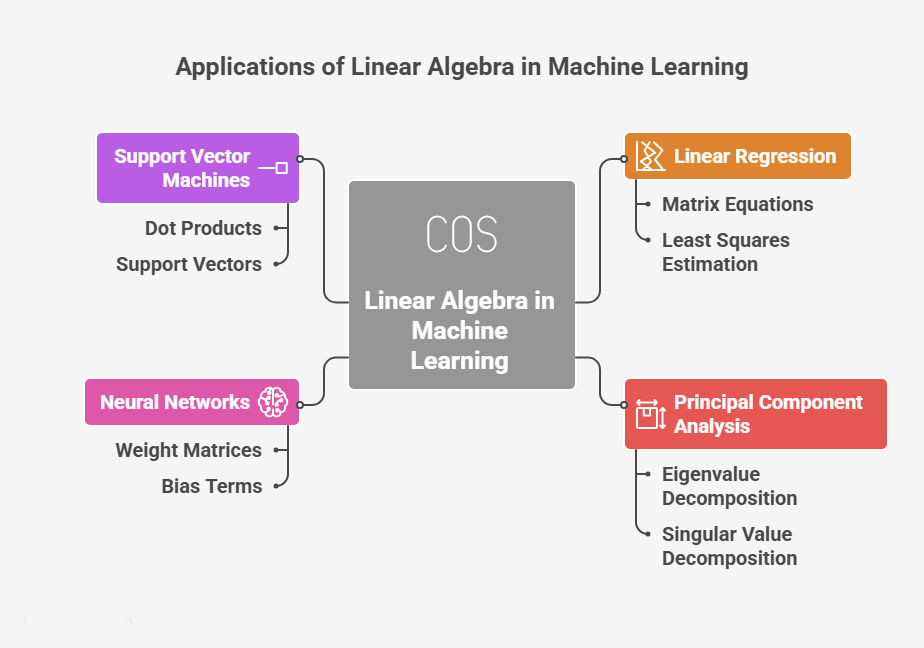
Linear algebra plays a vital role in powering core machine learning algorithms. It enables efficient data representation, feature extraction, and model optimization through algebraic computations. Below are some of the most common applications of linear algebra in machine learning.
1. Linear Regression
Linear regression uses matrix equations to determine the best-fitting line that minimizes prediction error. The equation y = Xβ + ε is solved using linear algebra to estimate β, where X represents input features, y the target variable, and ε the error term. Techniques such as least squares estimation leverage matrix inversion and multiplication to find optimal coefficients.
2. Principal Component Analysis (PCA)
PCA applies eigenvalue decomposition or singular value decomposition (SVD) to reduce data dimensionality. It identifies principal components, directions that capture maximum variance in data, thereby simplifying datasets while preserving essential information. This enhances computational efficiency and reduces overfitting in machine learning models.
3. Neural Networks
In neural networks, each layer performs matrix multiplications to propagate information. The computation z = Wx + b defines how inputs (x) are transformed by weight matrices (W) and bias terms (b) before applying activation functions. Linear algebra allows these operations to scale efficiently across thousands of neurons and parameters during both forward and backward propagation.
4. Support Vector Machines (SVM)
Support Vector Machines rely on dot products to measure similarity between data points and calculate decision boundaries. The optimal hyperplane separating classes is determined by maximizing the margin between support vectors, a process that depends on linear algebraic computations involving vector norms and inner products.
Subscribe to upGrad's Newsletter
Join thousands of learners who receive useful tips
Mastering linear algebra for machine learning requires a balance of theoretical understanding and hands-on coding experience. The following step-by-step approach provides a structured learning path.
Step 1: Learn the Fundamentals
Begin by understanding the basics, scalars, vectors, and matrices, along with their operations such as addition, multiplication, and inversion. These form the building blocks for all higher-level ML computations.
Step 2: Understand Geometric Interpretations
Visualize vectors and transformations in two- or three-dimensional spaces. Grasping geometric concepts like projection, rotation, and scaling helps in building intuition for how data moves through multidimensional spaces.
Step 3: Apply Linear Algebra in Coding
Use programming libraries such as NumPy, PyTorch, or TensorFlow to practice matrix multiplication, eigen decomposition, and SVD. Implementing these operations in code bridges theory with machine learning applications.
Step 4: Explore ML Algorithms
Analyze how linear algebra functions within algorithms like regression, PCA, and neural networks. Platforms such as upGrad offer structured programs that combine theory, visualization, and implementation.
Step 5: Practice Regularly
Consistent practice solidifies conceptual understanding. Build small machine learning models, visualize data transformations, and experiment with how changes in matrices and vectors influence predictions.
Must Read: Top Machine Learning Skills to Stand Out in 2025!
Linear algebra powers some of the most impactful applications in machine learning. It enables models to efficiently process, transform, and interpret complex data structures across different domains. Below are some real-world examples that demonstrate its practical use.
1. Image Recognition
Convolutional Neural Networks (CNNs) rely on matrix operations such as convolution to detect spatial features within images. Filters, represented as matrices, slide over pixel grids to identify patterns like edges, shapes, and textures. These transformations enable systems to perform tasks such as object detection and facial recognition.
2. Natural Language Processing (NLP)
In NLP, word embeddings such as Word2Vec and GloVe represent words as dense vectors in high-dimensional spaces. The relationships between words are quantified using dot products and cosine similarity, allowing algorithms to capture semantic meaning and contextual similarity between terms.
3. Recommendation Systems
Linear algebra techniques like matrix factorization decompose large user–item matrices into latent features. This approach helps predict user preferences based on hidden patterns in the data, forming the basis of modern recommendation systems used by platforms such as Netflix and Amazon.
4. Autonomous Systems
In robotics and self-driving vehicles, transformation matrices play a crucial role in navigation and perception. They help convert sensor data into coordinate systems, allowing machines to interpret their environment, estimate position, and adjust movements accurately.

While linear algebra is essential to mastering machine learning, it presents several conceptual and computational challenges for learners.
1. Abstract Nature
Many beginners struggle with the abstract representation of vectors, matrices, and transformations. These concepts often require visual or geometric interpretation to build intuition.
2. Dimensional Complexity
Visualizing high-dimensional data or transformations becomes challenging beyond three dimensions. This makes it harder to intuitively grasp how algorithms process large feature spaces.
3. Computational Overheads
Some matrix operations, such as inversion and eigen decomposition, are computationally intensive when dealing with large datasets. Efficient implementation and optimization techniques are required to handle such workloads.
Overcoming these challenges involves developing geometric intuition, leveraging visualization tools, and engaging in hands-on experimentation using programming libraries and real-world datasets.
As artificial intelligence continues to evolve, linear algebra for machine learning will remain the foundation for innovation, scalability, and computational efficiency. It will play a pivotal role in shaping how future models process vast amounts of data, optimize learning mechanisms, and deliver explainable outcomes.
1. Quantum Computing
In quantum machine learning, linear algebra defines the behavior of qubits and quantum gates. Concepts like vector spaces and tensor products are used to describe quantum states and transformations, enabling exponential computation speeds compared to classical systems. Quantum algorithms leverage these algebraic principles to enhance pattern recognition, cryptography, and optimization tasks.
2. Explainable AI (XAI)
The growing demand for transparency in AI models highlights the importance of algebraic decomposition methods such as matrix factorization and eigen analysis. These techniques help visualize decision boundaries, interpret feature contributions, and provide insight into how complex neural networks make predictions, making AI systems more trustworthy and interpretable.
Also Read: Explainable AI (XAI): Enhancing Transparency and Trust in Artificial Intelligence
3. Edge AI Optimization
As machine learning extends to edge devices and IoT systems, matrix compression and low-rank approximation methods are becoming essential. These techniques reduce model size and computational overhead while maintaining performance, allowing AI models to run efficiently on limited hardware such as smartphones, drones, and embedded systems.
Also Read: The Rise of Edge AI: How Decentralized AI is Reshaping Tech
Linear algebra is not merely a mathematical tool; it is the engine that drives every core function in machine learning. From representing data and training models to interpreting outcomes, it defines how algorithms operate under the hood.
By mastering linear algebra for machine learning, you build the foundation to understand and innovate across data science, AI, and advanced analytics. Combining it with statistical principles allows you to design robust, interpretable, and efficient models that power real-world AI systems.
Linear algebra simplifies data preprocessing by enabling normalization, scaling, and transformation using matrix operations. These methods convert raw datasets into structured numerical forms that algorithms can process efficiently. By applying concepts such as matrix multiplication and decomposition, linear algebra for machine learning ensures data consistency and improves model training performance.
Tensors generalize vectors and matrices into higher dimensions, and their manipulation follows the principles of linear algebra. In deep learning, tensors store multi-dimensional data such as images or sequences. Linear algebra operations like dot products and tensor contractions allow efficient computation, making tensors a fundamental component of modern machine learning architectures.
Data scientists should learn linear algebra because it provides the mathematical foundation for building, optimizing, and interpreting models. Understanding vector spaces, transformations, and decompositions allows them to fine-tune algorithms, improve model accuracy, and troubleshoot issues effectively. Mastering linear algebra for machine learning enhances analytical capabilities and fosters deeper algorithmic insight.
Linear algebra enhances computational efficiency through vectorization — replacing iterative loops with matrix-based operations. Frameworks like NumPy and TensorFlow use linear algebra to perform parallelized computations, reducing processing time and resource usage. This efficiency is vital for handling large datasets and complex models, ensuring faster training and prediction cycles.
In feature engineering, linear algebra helps create, transform, and select features through operations like scaling, projection, and dimensionality reduction. Techniques such as Principal Component Analysis (PCA) rely on matrix decomposition to identify informative features. Using linear algebra for machine learning streamlines feature selection, reducing redundancy and improving model interpretability.
Reinforcement learning uses linear algebra to represent states, actions, and rewards in vector or matrix form. These representations allow algorithms to compute value functions, policy gradients, and transition probabilities efficiently. Linear algebra provides the computational structure for optimizing decisions in dynamic environments, improving agent learning and adaptability.
Linear algebra powers data visualization by transforming multidimensional datasets into lower-dimensional spaces. Methods like PCA and SVD use eigen decomposition to project data points for visual analysis. This helps uncover relationships, clusters, and trends, allowing data scientists to interpret high-dimensional data intuitively and effectively.
Linear algebra techniques such as matrix decomposition and eigenvalue analysis help explain how machine learning models make predictions. They identify key components influencing outcomes and visualize relationships among features. This makes linear algebra for machine learning essential for explainable AI (XAI), ensuring transparency in data-driven decision-making.
Common mistakes include focusing solely on formulas without understanding geometric intuition, skipping hands-on coding, and neglecting vector and matrix visualization. Learners often underestimate the importance of practice. Combining theory with programming tools like NumPy or PyTorch helps build a strong conceptual and practical grasp of linear algebra for machine learning.
Matrix decomposition techniques such as LU, QR, and SVD break large computations into smaller, manageable steps. This reduces numerical instability and improves model training efficiency. In linear algebra for machine learning, decomposition methods are critical for optimizing algorithms like PCA, recommender systems, and dimensionality reduction models.
Yes. Linear algebra underpins unsupervised learning methods such as clustering, PCA, and factor analysis. It enables algorithms to identify hidden structures and relationships in unlabeled data. Techniques like eigenvalue decomposition help simplify complex datasets, allowing models to group or compress information effectively without explicit supervision.
Linear algebra facilitates efficient computation on large datasets through sparse matrix operations and optimized linear solvers. These techniques minimize memory consumption and accelerate training. Frameworks like TensorFlow and PyTorch leverage these principles, making linear algebra for machine learning indispensable for scalable big data processing.
Industries such as finance, healthcare, automotive, and e-commerce rely on linear algebra for machine learning to power forecasting, diagnosis, automation, and recommendation systems. It enables advanced analytics, risk modeling, and image recognition, supporting data-driven innovation across diverse business functions.
Yes. Coding strengthens practical understanding by linking mathematical concepts to algorithmic implementation. Using tools like Python, NumPy, and TensorFlow allows learners to visualize matrix transformations and test models. Integrating coding with theory is the most effective way to master linear algebra for machine learning.
Tools like GeoGebra, Desmos, and Python-based libraries such as Matplotlib and Plotly help visualize vectors, matrices, and transformations. They make abstract linear algebra concepts more intuitive by demonstrating how geometric operations affect data. Visualization fosters a deeper comprehension of mathematical relationships used in machine learning.
Optimization algorithms like gradient descent rely on linear algebra to compute gradients, update weights, and minimize error functions. Operations such as matrix differentiation and dot products streamline parameter adjustments during training, ensuring faster convergence and higher model accuracy.
Students should combine theory with application—studying vector spaces, practicing coding, and experimenting with datasets. Interactive courses on upGrad, Coursera, or Khan Academy help develop both intuition and technical competence. Regular practice with projects reinforces the application of linear algebra for machine learning.
In computer vision, linear algebra enables image transformations, filtering, and feature extraction. Convolution operations in CNNs are matrix multiplications that detect edges and textures. Linear algebra for machine learning thus forms the computational core of object detection, face recognition, and autonomous navigation systems.
Linear algebra supports transfer learning through matrix operations that reconfigure pre-trained model weights. These transformations adapt existing knowledge to new datasets, reducing training time and improving model performance. It ensures efficient reuse of learned representations across different domains.
Professionals skilled in linear algebra for machine learning gain a competitive edge in data science, AI, and analytics roles. The knowledge enables them to design efficient models, interpret complex data, and contribute to algorithmic innovation. It is a core competency for advancing in technical AI careers.
97 articles published
Kechit Goyal is a Technology Leader at Azent Overseas Education with a background in software development and leadership in fast-paced startups. He holds a B.Tech in Computer Science from the Indian I...
Speak with AI & ML expert
By submitting, I accept the T&C and
Privacy Policy
Top Resources
Master's Degree
18 Months
Executive Diploma
12 Months
IIIT Bangalore
Executive Programme in Generative AI & Agentic AI for LeadersIndia’s #1 Tech University
Dual Certification
5 Months