Agentic AI Trends 2026: What You Need to Know
By Rahul Singh
Updated on May 07, 2026 | 8 min read | 4.2K+ views
Share:

All courses
Certifications
More
By Rahul Singh
Updated on May 07, 2026 | 8 min read | 4.2K+ views
Share:
Table of Contents
In 2026, agentic AI is moving from simple assistants to autonomous systems that can plan and execute complete workflows. These systems often use multiple agents working together to handle complex tasks from start to finish.
Key trends include federated multi-agent systems, smaller domain-specific models, and agentic command centers for human oversight. There is also a strong focus on security, browser automation, and context engineering, where managing context becomes more important than basic prompting.
In this blog, you will learn the most important agentic AI trends 2026 that businesses, developers, and professionals should watch closely.
Agentic AI Courses to upskill
Explore Agentic AI Courses for Career Progression
IIIT Bangalore
EPGP in Applied AI and Agentic AIIIIT Bangalore
Executive Diploma in Machine Learning and AI360° Career Support
When tracking agentic AI trends 2026, the biggest and most obvious shift is the move from generation to execution. For the past few years, we used artificial intelligence primarily to generate text, write basic code, and create images. The systems waited patiently for a human to type a specific prompt.
In 2026, these systems are no longer passively waiting. They are actively perceiving their environment, planning multi-step actions, and executing tasks completely on their own.
To truly grasp the major agentic AI trends 2026, we must look at how the core capabilities have expanded. An agent without tools can only generate text. An agent with tools can complete real, meaningful work. Modern systems now easily connect to customer relationship managers, email clients, and payment gateways.
This creates a massive productivity boost for businesses. Workers spend less time clicking buttons and moving data between screens. Instead, they act as supervisors, reviewing the final output of the autonomous agent. The technology acts as a tireless digital worker rather than just a smart search engine.
Also Read: What Is Agentic AI? The Simple Guide to Self-Driving Software
The table below highlights the clear differences driving the current agentic ai trends 2026.
| Feature | Traditional Generative AI | Modern Agentic AI |
| Primary Function | Answers questions and creates content | Solves complex problems and takes action |
| Human Interaction | Requires constant, detailed prompting | Requires only a high-level goal |
| Workflow Style | Reactive and single-step | Proactive and multi-step |
| Memory Capacity | Forgets context quickly | Maintains long-term state and memory |
| Tool Usage | Rarely uses external tools | Actively uses APIs and software tools |
Another massive focus within agentic AI trends 2026 is the urgent need for strict governance. Because these systems now have the authority to act, they introduce new operational risks.
If a traditional chatbot makes a mistake, you simply get a bad paragraph of text. If an autonomous agent makes a mistake, it might send the wrong email to a client or delete an important file.
Also Read: 10+ Real Agentic AI Examples Across Industries (2026 Guide)
One of the most exciting agentic ai trends 2026 is the rapid evolution of retrieval-augmented generation. Traditional retrieval methods were great for building simple chatbots that answered basic questions from a company manual.
However, they struggled with complex tasks that required logical reasoning. Today, we are seeing the rise of Agentic RAG. This new approach transforms static data retrieval into a dynamic, thinking process.
Also Read: 10+ Real Agentic AI Examples Across Industries (2026 Guide)
This advanced reasoning capability enables true agentic workflows. In a traditional automated workflow, everything follows a strict, rigid path. Agentic workflows are completely different. They use reasoning loops to adapt dynamically when the data changes or unexpected errors occur.
When researching agentic ai trends 2026, you will see businesses applying these workflows everywhere. They are transforming every knowledge-driven industry.
Also Read: Difference Between Agentic RAG and Agentic AI
A key component of these modern workflows is the reflection cycle. Modern agents do not just act; they look back at what they just did.
Furthermore, these workflows now utilize hybrid memory systems. Short-term memory helps the agent keep track of the current task. Long-term memory allows the agent to retain organizational knowledge over months or years. This means the agent gets significantly smarter and more efficient the longer it works for your company.
Also Read: What is RAG in AI and How Retrieval-Augmented Generation Works
Enterprise adoption is one of the strongest agentic AI trends 2026. Companies are now using AI agents in real business operations instead of limiting them to internal experiments.
The focus is shifting from chatbots to autonomous workflow systems.
Many organizations tested generative AI in 2024 and 2025. In 2026, businesses are scaling those experiments into production systems.
Key adoption areas include:
Research shows enterprises are integrating AI directly into operational systems rather than running isolated AI projects.
Banks and financial institutions are becoming early adopters of agentic AI systems.
AI agents are now helping with:
Another important part of agentic AI trends 2026 is autonomous IT operations.
Modern AI agents can:
This reduces manual workload for operations teams.
Also Read: Top 20+ Generative AI Project Ideas in 2026
General-purpose AI models are slowly being replaced by domain-specific agents trained for specialized tasks.
Examples include:
Industry |
Agentic AI Use Case |
| Healthcare | Clinical documentation |
| Banking | Compliance automation |
| Manufacturing | Predictive maintenance |
| Retail | Inventory optimization |
| Education | Personalized learning |
| Insurance | Claims processing |
Industry-focused AI systems usually perform better because they understand domain-specific language and workflows.
Also Read: Best 30 Artificial Intelligence Projects
Companies are no longer impressed by simple AI demos. They want measurable outcomes.
Organizations now evaluate AI agents based on:
This practical mindset is shaping enterprise AI adoption in 2026.
Also Read: What is Generative AI? Understanding Key Applications and Its Role in the Future of Work
Agentic AI trends 2026 are already shaping how industries operate. These systems do more than assist. They take ownership of tasks, plan steps, and complete workflows with minimal input.
You can see this shift clearly across business operations, customer experience, software, healthcare, and finance.
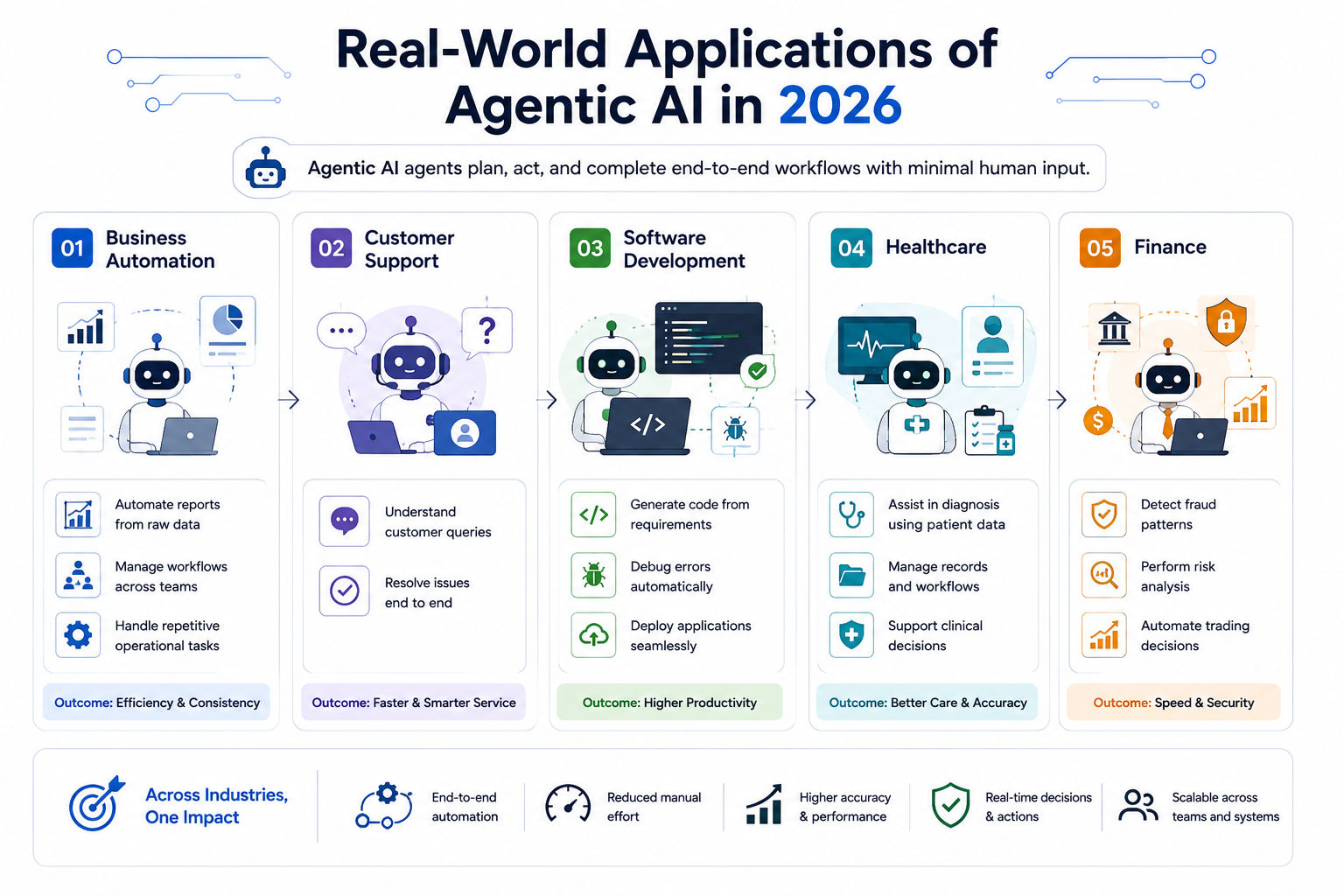
Agentic AI is changing how businesses handle daily operations. Instead of manual processes, AI agents now manage entire workflows.
You can use them to:
For example, an AI agent can collect data, generate insights, and send reports without human involvement. This reduces delays and improves consistency.
Also Read: Top 7 Generative AI Models in 2026
Support systems are becoming more autonomous. AI agents now handle complete customer journeys instead of just answering questions.
They can:
Agentic AI is speeding up development workflows. It does not just generate code. It handles multiple stages of the process.
You can use it to:
For example, an agent can write code, test it, fix issues, and push it to production. This reduces development time and improves productivity.
Also Read: Types of AI: From Narrow to Super Intelligence with Examples
Healthcare systems are using agentic AI to support decision-making and patient care. These systems work with sensitive data while maintaining accuracy.
They can:
In finance, speed and accuracy are critical. Agentic AI systems analyze data and act in real time.
They can:
For example, an agent can monitor transactions, flag suspicious activity, and take action instantly. This improves security and response time.
Also Read: Intelligent Agent in AI: Definition and Real-world Applications
Industry |
Use Case |
Benefit |
| Business | Workflow automation | Efficiency |
| Support | AI agents | Faster service |
| Tech | Code generation | Productivity |
| Healthcare | Decision support | Accuracy |
| Finance | Trading | Speed |
Agentic AI will move from task automation to full system-level decision-making. You will see AI agents managing workflows, collaborating across systems, and operating with minimal human input.
Area |
What will change |
Impact |
| Autonomous systems | Agents handle complete workflows independently | Reduced human intervention |
| Multi-agent ecosystems | Large networks of agents collaborate | Better coordination and accuracy |
| Context-aware AI | Systems understand long-term context | Smarter decisions |
| Industry-specific agents | Domain-focused AI models grow | Higher efficiency in sectors |
| Human-AI collaboration | Humans supervise AI systems | Better control and trust |
| Real-time intelligence | Faster decision-making systems | Improved responsiveness |
| Security and governance | Strong rules for AI behavior | Safer deployments |
| Tool integration | Deep integration with apps and APIs | Seamless automation |
| Self-improving systems | Agents learn continuously | Better performance over time |
| AI-driven platforms | End-to-end AI systems emerge | Full business automation |
Also Read: Future of Agentic AI
Agentic AI trends 2026 show a clear shift toward systems that can plan, act, and improve over time. These systems are changing how work gets done by handling complex tasks with speed and accuracy across industries.
To build these future-ready skills, explore upGrad’s agentic AI courses and start working on real-world projects that help you design and manage intelligent AI agents.
Want personalized guidance on Agentic AI and upskilling? Speak with an expert for a free 1:1 counselling session today.
Agentic AI trends 2026 focus on autonomous systems that can plan, reason, and execute tasks with minimal human input. Major trends include multi-agent collaboration, workflow automation, persistent memory, and AI systems that interact directly with tools, APIs, and digital environments.
The biggest AI trends include agentic systems, smaller domain-specific models, real-time automation, multimodal AI, and stronger AI governance. Businesses are also focusing on AI systems that can handle complete workflows instead of only generating responses.
Artificial intelligence will move from reactive tools to autonomous systems capable of decision-making and execution. AI agents will handle tasks independently, collaborate with other agents, and operate across software platforms with greater context awareness and memory.
The latest trends include federated multi-agent systems, browser automation, AI command centers, and context engineering. Organizations are shifting from simple prompt-based systems toward agents that can plan and manage long-term workflows.
Agentic AI trends 2026 are helping businesses automate operations, reduce repetitive work, and improve productivity. Companies are using AI agents for workflow management, customer support, analytics, and operational decision-making across departments.
Industries like finance, healthcare, logistics, customer service, and software development are adopting agentic AI rapidly. These sectors benefit from automation, real-time decisions, and intelligent workflow management.
Multi-agent systems improve efficiency by dividing tasks across specialized agents. One agent may research, another may verify, while another executes actions. This improves scalability, coordination, and response quality in complex AI applications.
You need programming skills, AI fundamentals, workflow automation knowledge, and understanding of multi-agent architectures. Skills in Python, API integration, and prompt engineering are also becoming increasingly important.
Risks include incorrect autonomous decisions, over-reliance on automation, security vulnerabilities, and misuse of sensitive data. Organizations are focusing on governance and human oversight to reduce these risks.
Agentic AI trends 2026 will automate repetitive workflows but also create demand for AI engineers, automation specialists, and system designers. Human roles will shift more toward supervision, strategy, and creative problem-solving.
Beyond 2026, agentic AI is expected to become more collaborative, context-aware, and autonomous. AI systems will manage larger workflows, coordinate across multiple environments, and operate as intelligent digital teams rather than isolated tools.
98 articles published
Rahul Singh is an Associate Content Writer at upGrad, with a strong interest in Data Science, Machine Learning, and Artificial Intelligence. He combines technical development skills with data-driven s...
Speak with AI & ML expert
By submitting, I accept the T&C and
Privacy Policy