
All courses
Agentic AI
Agentic AI

IIIT Bangalore
Executive Programme in Generative AI for LeadersArtificial Intelligence
Degree / Exec. PG

IIIT Bangalore
Executive Diploma in Machine Learning and AI
OPJ Global University
Master’s Degree in Artificial Intelligence and Data Science
Liverpool John Moores University
Master of Science in Machine Learning & AI
Golden Gate University
DBA in Emerging Technologies with Concentration in Generative AIExecutive Certificate

IIITB & IIM, Udaipur
Chief Technology Officer & AI Leadership Programme
IIIT-B & IIM, Udaipur
Chief Data and AI Officer ProgrammeOffline Bootcamps

upGrad
Data Science and AI-MLDoctorate
For All Domains
IIITB & IIM, Udaipur
Chief Technology Officer & AI Leadership Programme
Swiss School of Business and Management
Global Doctor of Business Administration from SSBM
Edgewood University
Doctorate in Business Administration by Edgewood UniversityGolden Gate University
Doctor of Business Administration From Golden Gate University
Rushford Business School
Doctor of Business Administration from Rushford Business School, SwitzerlandGolden Gate University
Doctor of Technology in Applied & Agentic AI-d9bdeff6165f4eb1ba2adcebde78e961.svg)
University of Waterloo
Chief Technology and AI Officer ProgramLeadership / AI
Golden Gate University
DBA in Emerging Technologies with a concentration in Generative and Agentic AIMachine Learning
Machine Learning
Data Science
Degree / Exec. PG
O.P Jindal Global University
Master’s Degree in Artificial Intelligence and Data ScienceIIIT Bangalore
Executive Diploma in Data Science & AILiverpool John Moores University
Master of Science in Data ScienceExecutive Certificate

upGrad | Microsoft
Gen AI Foundations Certificate Program from MicrosoftIIIT-B & IIM, Udaipur
Chief Data and AI Officer ProgrammeupGrad | Microsoft
Gen AI Mastery Certificate for Data AnalysisupGrad | Microsoft
Gen AI Mastery Certificate for Software DevelopmentupGrad | Microsoft
Gen AI Mastery Certificate for Managerial ExcellenceupGrad | Microsoft
Gen AI Mastery Certificate for Content CreationBootcamp
Offline Bootcamps
upGrad
Data Science and AI-MLMBA
Masters

Liverpool John Moores University
Master of Business Administration from Liverpool John Moores University (LJMU) with IIM Udaipur CertificationO.P.Jindal Global University
MBA (with Career Acceleration Program by upGrad)Edgewood University
MBA from Edgewood UniversityO.P.Jindal Global University
MBA from O.P.Jindal Global UniversityExecutive Certificate
Marketing
Executive Certificate
Offline Bootcamps
upGrad
Digital MarketingManagement
Degree
O.P Jindal Global University
MSc in International Accounting & Finance (ACCA integrated)
Golden Gate University
Master of Arts in Industrial-Organizational PsychologyExecutive Certificate
IIIT-B & IIM, Udaipur
Chief Technology Officer & AI Leadership ProgrammeIIIT-B & IIM, Udaipur
Chief Data and AI Officer Programme
IIM Kozhikode
Human Resource Analytics Course from IIM-KupGrad | Microsoft
Gen AI Foundations Certificate Program from MicrosoftBootcamp
HDFC Life
Insurance Fundamentals ProgramEducation
Education

Northeastern University
Master of Education (M.Ed.) from Northeastern UniversityEdgewood University
Doctor of Education (Ed.D.)Edgewood University
Master of Education (M.Ed.) from Edgewood UniversityCertifications
Project Management
Certification

Knowledgehut
Leadership And Communications In ProjectsKnowledgehut
Microsoft Project 2007/2010-ae8d039bbd2a41318308f8d26b52ac8f.svg)
Knowledgehut
Financial Management For Project ManagersKnowledgehut
Fundamentals of Earned Value Management (EVM)Knowledgehut
Fundamentals of Portfolio ManagementKnowledgehut
Fundamentals of Program Management-35c169da468a4cc481c6a8505a74826d.webp&w=128&q=75)
Knowledgehut
CAPM® CertificationsKnowledgehut
Microsoft® Project 2016Certifications & Trainings
-7f4b4f34e09d42bfa73b58f4a230cffa.webp&w=128&q=75)
Knowledgehut
PMP® CertificationKnowledgehut
PMI-RMP® CertificationKnowledgehut
PMP Renewal Learning PathKnowledgehut
Oracle Primavera P6 V18.8Knowledgehut
Microsoft® Project 2013Knowledgehut
PfMP® Certification CourseKnowledgehut
Project Planning and MonitoringPrince2 Certifications

Knowledgehut
PRINCE2® FoundationKnowledgehut
PRINCE2® PractitionerKnowledgehut
PRINCE2 Agile Foundation and PractitionerKnowledgehut
PRINCE2 Agile® Foundation CertificationKnowledgehut
PRINCE2 Agile® Practitioner CertificationManagement Certifications
Knowledgehut
Project Management Masters Certification ProgramKnowledgehut
Change ManagementKnowledgehut
Project Management TechniquesKnowledgehut
Product Management Certification ProgramKnowledgehut
Project Risk Management- Study abroad
- Offline centres
- uGSOT - B.Tech
More

%20(2)-db0b6f38da9c485faf76e366793c9b9e.webp&w=128&q=75)



Management Courses
Leadership skills training and professional development
Options from self-paced certificates to paid postgraduate programs
Covers strategic management, leadership, product management & AI
Study with over 12 global industry experts
Learner count
6K+
Avg. pay hike
53%
Top pay hike
567%
Talk to a Counsellor
By clicking, I accept the T&C and Privacy Policy
Management Course from Top Universities
Management Courses (11)
Golden Gate University
Master of Arts in Industrial-Organizational PsychologyCertification
15 Months
popular
IIM Kozhikode
PCP in AI for Business ProfessionalsCertification
6 Months
IIIT-B & IIM, Udaipur
Chief Technology Officer & AI Leadership ProgrammeCertification
6 Months
IIIT-B & IIM, Udaipur
Chief Data and AI Officer ProgramCertification
6 Months
%20(2)-db0b6f38da9c485faf76e366793c9b9e.webp&w=3840&q=75)
popular
IIT Kharagpur
EPGC in Building AI Products, Systems & ServicesExecutive Post Graduate Certificate
6 Months
new course
O.P. Jindal Global University
Masters in International Accounting and Finance (Accredited by ACCA, UK)Master's Degree
12 Months
bestseller
Certification
6 Months
Certification
3 Months

Microsoft
Generative AI Mastery Certificate for Managerial ExcellenceLearn to use Claude, M365 copilot,& more
Certification
2 Months
HDFC Life
Insurance Fundamentals Program4-month paid internship at HDFC Life upon succesful program completion
Certification
1.5 Months

popular
Certification
11 Months
Our Top University Partners
Learn by Doing in Management Projects
2+
Projects




What Our Learners Have To Say


Learn From The Best
12
Instructors










Services to Help You Achieve Your Goal through Management Training Courses
Interactive Live Sessions with leading industry experts covering curriculum + advanced topics










Management Course Overview
Management Courses Online helps you to build skills in leadership, strategy, communication, making decisions, managing people and business operations. These courses are specially designed for working professionals who want to pursue a management degree without leaving their current job, along with fresh graduates and career switchers.
For learning these skills, upGrad offers online management course in India from institutions such as IIM Kozhikode, IIIT Bangalore, IIM Bangalore, IIT Kharagpur, O.P. Jindal Global University and others.
The courses from upGrad consist of programs such as the 3-month Management Essentials program, 6-month professional certificates and executive programs, and postgraduate programs for learners who want a degree course with longer durations.
What Are Online Management Courses?
Online Management courses are the programs which are offered fully online and teaches you how business works and how to manage people. These courses usually consist of a combination of video tutorials, weekend classes, assignments, case studies, discussion groups, and projects.
Taking an online Business Management Course will enable individuals to learn skills that can be applied in different situations in the workplace.
Why Learn Management?
Management skills help you to take more responsibility, manage your team and be able to make better business decisions.
The World Economic Forum's Future of Jobs Report 2025 found that 61% of employers consider leadership and social influence a core workforce skill, while 69% identify analytical thinking as a core skill.
That’s why a management course can help you to:
- Prepare for a good leadership role
- Improve business decision making and problem solving
- Learn how you can manage projects and teams
- Understand business functions such as finance, marketing, HR and operations
- Build communication and negotiation skills
- Apply management concepts to workplace situations
For working professionals, a Management Course for Working Professionals can also provide a way to learn while continuing with a current job. upGrad's Management Courses Online include flexible learning options designed for professionals.
Who Can Pursue a Management Course Online?
Management courses online can help to shape a career for every kind of learner including fresher and working professionals. You can explore a management course if you are:
1. Working Professionals
If you are someone who is currently working somewhere and wants to grow into managerial roles. These leadership development programs will help you to:
- Build a decision-making ability
- Grow skills in people-management
- Preparing for greater responsibility in their current role
2. Team Leaders and Supervisors
If you are someone who is already managing people or projects, these strategic management courses can help you in:
- Strengthening the planning
- Improve your communication skills
- Improve the problem solving and critical thinking skills
3. Fresh Graduates
If you are someone who is recently graduated from any background, these management courses online help you to:
- Understand how a business functions
- Build the critical thinking and communication skills
- Build leadership knowledge before entering any workplace
4. Career Switchers
If you are someone who wants to switch your career toward management, these management courses online can help you:
- Move into product management by choosing specialised Product Management Courses
- Build knowledge in human resource management through an HR Management and Analytics Certification
- Develop business and strategic thinking through a Strategic Management Course
Types of Management Courses Online
Choosing the right management program that aligns with one’s career goals is important since there will be need for one to spend time in the best program possible. This choice is also influenced by the career stage that one is at.
Some common types of management courses online are:
Type of Course | Suitable For | Typical Objective |
Short-Term Skill Certification | Beginners and professionals | Build a focused business or management skill |
Executive Management Programme | Working professionals and experienced managers | Develop leadership and strategic management skills |
Postgraduate Programme | Graduates seeking deeper management education | Build broader business and managerial knowledge |
Specialised Management Course | Professionals targeting a specific function | Develop skills in areas such as HR, product management or analytics |
Leadership Development Program | Team leaders and currently working professionals preparing for senior roles | Build leadership skills, communication skills and decision-making skills |
Product Management Course | Professionals moving into product roles | Learn product planning, market research, growth and product decisions |
What Will You Learn in a Management Courses Online?
Management courses online can cover core business concepts along with practical leadership and decision-making skills.
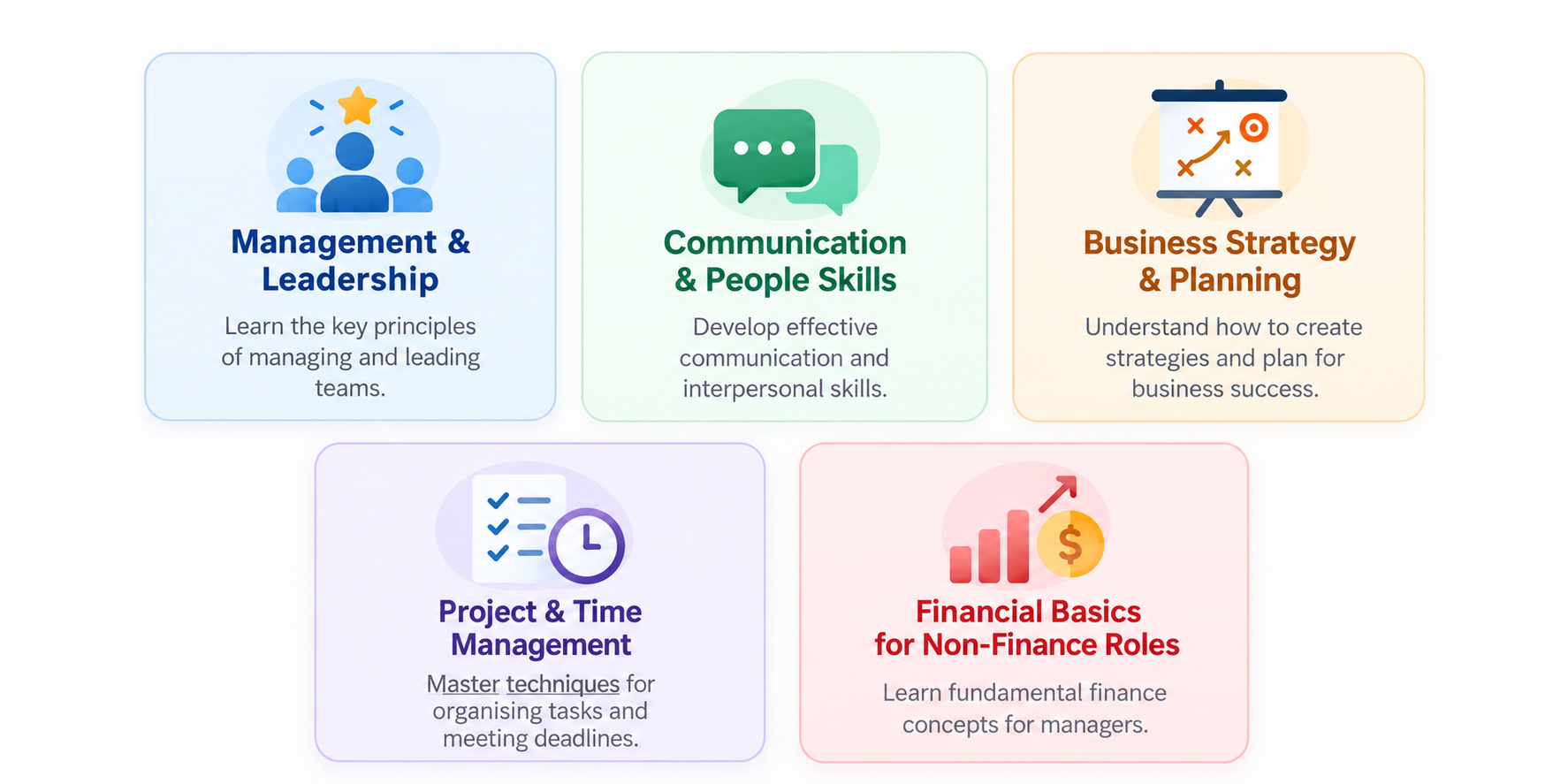
Below are the learning areas which are covered in upGrad’s Management programs:
Learning Area | What You Will Learn |
Leadership | Team management, motivation, conflict handling and performance management |
Strategic Management | Business growth, competitive analysis, market planning and strategic decisions |
Communication | Business presentations, negotiation, professional writing and stakeholder communication |
Finance | Budgeting, financial statements, cost control and financial decision-making |
Operations | Supply chain, resource planning and operational processes |
People Management | Recruitment, training, employee engagement and performance management |
Business Analytics | Data interpretation, performance metrics, forecasting and decision modelling |
Problem-Solving | Business analysis, planning and practical decision-making |
Skills and Tools You Can Learn In Management Courses Online
In upGrad management courses online these skills and tools are included for make your learning practical:
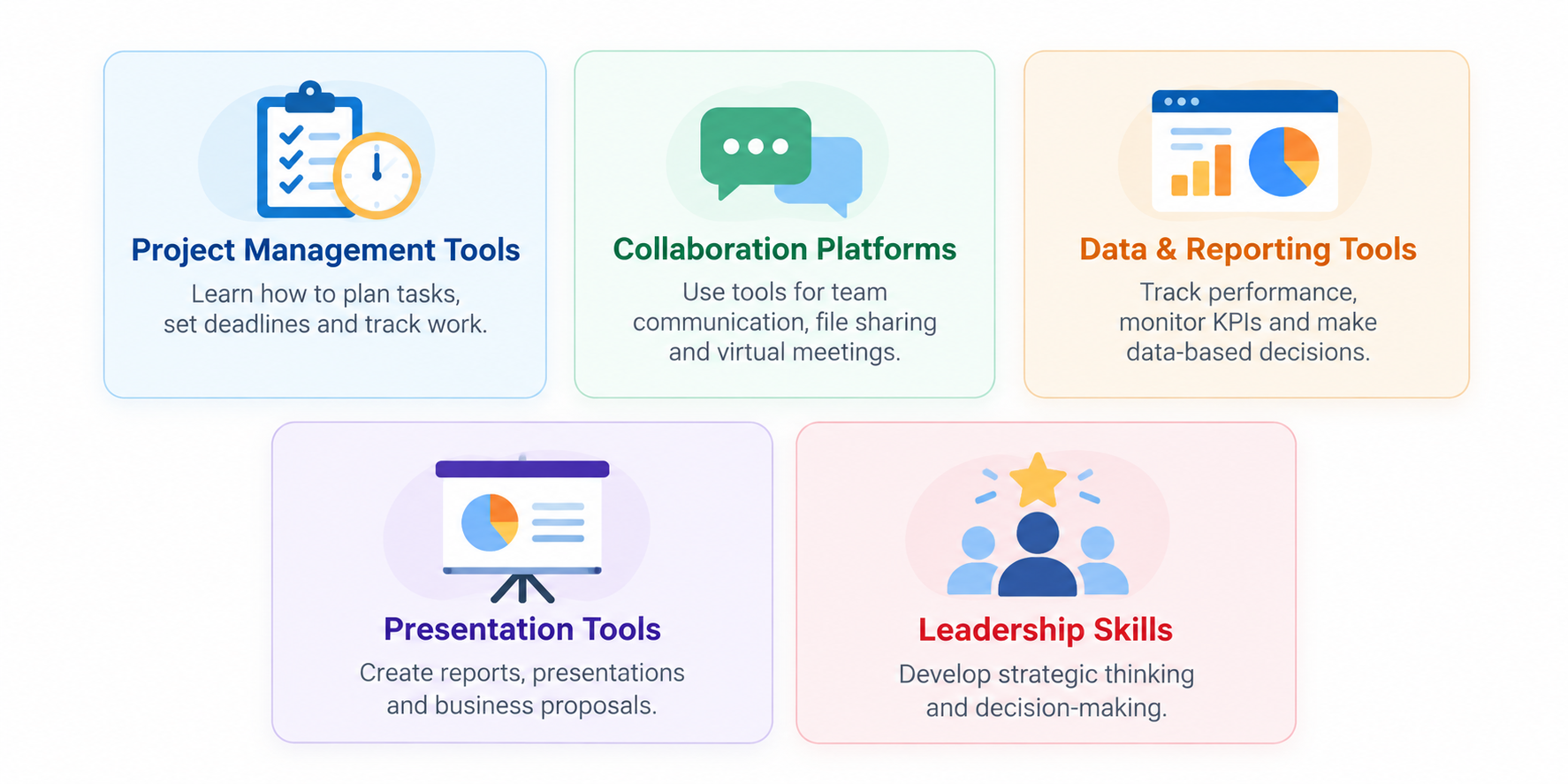
Skill / Tool Area | What You Will Learn |
Project Management Tools | Plan tasks, set deadlines and track work |
Collaboration Platforms | Use tools for team communication, file sharing and virtual meetings |
Data & Reporting Tools | Track performance, monitor KPIs and make data-based decisions |
Spreadsheets & Planning Tools | Budgeting, forecasting and basic business analysis |
Customer & Relationship Tools | Customer management, sales tracking and service planning |
Presentation Tools | Create reports, presentations and business proposals |
Documentation Tools | Write business documents and guides |
Leadership Skills | Develop strategic thinking and decision-making |
What Are Hands-on Projects You Will Work In upGrad Management Courses Online?
By using the skills and tools, you must explore some real capstone projects to gain real practical skills along with the theory. Below are the some of projects included in upGrad management programs:
Project | Problem Statement | Skills Learned |
HR Capstone Project | Identify HR challenges, conduct research and analyse workforce issues | HR strategy, research, data analysis, teamwork |
Workforce Planning and Deployment | Create a workforce plan using resource mapping and utilisation strategies | Workforce planning, resource optimisation, strategic thinking |
Healthcare Capstone Project | Analyse real healthcare scenarios from a systems perspective | Critical thinking, decision-making, problem-solving |
Career Outcomes After Management Courses Online
After completing a Leadership Development Program, Business Management Course Online or management program you can explore roles such as:
Job Role | What You Will Do |
Product Strategy | Work on product planning, market research and growth strategy |
Project Manager | Plan projects, manage timelines and coordinate teams |
Marketing Manager | Plan campaigns, manage branding and track performance |
Operations Manager | Oversee operations and improve business processes |
Business Analyst | Analyse data and suggest business improvements |
HR Manager | Manage hiring, training and employee performance |
Team Leader | Guide teams, assign tasks and track progress |
Where Can Management Skills Be Used?
Below are the industries where you can use the skills, you obtain from these courses:
- IT and Technology: Project management, team leadership and product delivery
- BFSI: Operations, customer management, risk and process management
- E-commerce and Retail: Sales operations, logistics, marketing and customer experience
- Healthcare: Hospital operations, administration, staffing and service management
- Consulting and Professional Services: Business problem-solving, client management and strategy
Management Courses Online Eligibility and Requirements
The eligibility criteria of the management courses online depends on the course you are looking for. Below is the eligibility criteria for some of the different types of upGrad’s Management Course in India:
Course Type | upGrad Programme | Eligibility Requirement |
Professional / Specialised Programme | Professional Certification in HR Management and Analytics from IIM Kozhikode | Bachelor's degree with 2 years of work experience, or a Master's degree. |
Professional Certificate Programme | Professional Certificate Programme in AI for Business Professionals from IIM Kozhikode | Bachelor's degree with a minimum of 3 years of work experience. |
Executive / Leadership Programme | Certificate Programme in General Management for Young Leaders from IIM Bangalore | Graduation in any discipline with 50% marks and 1–5 years of work experience. |
Postgraduate Programme | MSc in International Accounting & Finance from O.P. Jindal Global University | Bachelor's degree from a recognised university. Candidates with 50% or more are exempt from the entrance test, while those below 50% need to take the test. |
How to Choose the Right Management Course in India?
Before enrolling in a Management Course in India, compare the program based on your career goal and experience level.
Below are some of the checklist to look before enrolling:
What to Check | Why It Matters |
Career Goal | Helps you select a course linked to your target role |
Experience Level | Makes sure the programme matches your current knowledge |
Course Type | Choose between certification, executive and postgraduate learning |
Specialisation | Check for areas such as HR, product management, analytics or strategy |
Curriculum | Review the actual subjects and learning depth |
Projects | Look for practical business cases and projects |
Faculty and Mentors | Check who teaches and guides learners |
Learning Format | Compare live, recorded and self-paced learning |
University / Provider | Review the university, certification and programme credentials |
Management Courses Online Duration and Learning Format
The duration and learning format of the business management course online also depends on the course you are opting for.
Below are the duration and format of the programs offered by upGrad:
Programme | Duration | Learning Format |
Management Essentials | 3 months | Self-paced |
Professional Certificate Programme in AI for Business Professionals | 6 months | Online programme |
Professional Certification in HR Management and Analytics | 6 months | Online programme |
Chief Technology Officer & AI Leadership Programme | 6 months | Executive programme |
Certificate Programme in General Management for Young Leaders from IIM Bangalore | 11 months | Online programme |
O.P. Jindal Global University Master's in International Accounting and Finance | 12 months | Postgraduate programme |
Golden Gate University MA in Industrial-Organizational Psychology | 15 months | Postgraduate programme |
Essential Resources to Navigate Your Management Journey
Trending Management Resources
City-Wise Management Courses
Discover the Right Management Skills for You
From Learning to Leadership: Key Management Job Roles
Management Course FAQs
1. What is a management course?
A management course is a structured program that helps to build skills such as leadership skills, strategical skills, finance & operations skills, communication skills, team management and business decision making.
The depth of learning depends on whether you choose a short certification, professional programme or postgraduate option.
2. Can I take a management course online while working?
Yes. There are several management courses provided by various platforms including upGrad, which are specially designed to take care of the professional commitments of the candidates. The Management Course for Working Professionals allows you to work and learn management concepts at the same time.
3. What is the difference between a management course and an MBA?
The management course ranges from short management certification courses to Executive or Postgraduate Management Courses. MBA stands for the postgraduate management course that covers all the aspects of business in a more comprehensive manner. It depends on the candidate's preference and the extent of learning required.
4. Can I pursue a management course without having a managerial job?
Yes. One can join several management programmes without being a manager. Certain courses are specially designed for young professionals who are just entering into management roles and want to build their managerial expertise in the field
For example, upGrad's Certificate Programme in General Management for Young Leaders from IIM Bangalore is aimed at professionals with 1–5 years of work experience.
5. Can I take a Management Course in India after studying a different subject?
Yes. Many management programmes accept learners from different academic backgrounds. For example, upGrad's Professional Certificate Programme in General Management from IIM Kozhikode accepts graduates or eligible diploma holders from any discipline.
6. Are management courses useful for professionals moving from technical roles?
Yes, they can help the technical working professionals to build their business skills and move towards more specific managerial roles like product development. They can also explore areas such as strategy, leadership or business analytics based on roles they want to target.
7. Do online management courses include case studies?
Many programmes use case studies to connect management concepts with business situations. They can help learners examine a problem, compare possible approaches and understand how business decisions are made in practical settings. upGrad also has case-based and work-related learning across its management offerings.
8. Are there management courses focused on leadership?
Yes, the leadership development program focuses on areas such as team management, communication, making decisions, conflict resolutions and thinking strategies. The program is best for someone who wants to set and take bigger responsibilities within teams and organizations.
There are leadership-based courses offered by upGrad in their programs like the Chief Technology Officer & AI Leadership Programme.
9. Can I study strategic decision-making through an online programme?
Yes, one can learn strategic decision making from a Strategic Management Course, which can focus on subjects like growth, analysis, resource allocation, and planning. The IIM Kozhikode General Management program offered through upGrad has a module dedicated to Strategic Management and covers concepts related to strategic management and international business strategy.
10. Does a management course cover product management?
Some management courses have product management training in them, while some management courses include product strategy. However, product management courses basically focus on product strategy, needs of customers, researching the market, making decisions related to a product.
11. Can I specialise in HR through management courses?
Yes. People interested in people management can join human resources, workforce planning, and analytics programs. HR Management and Analytics Certification can include HR practices and decision making based on data that is related to the workforce. upGrad offers the Professional Certificate Programme in HR Management and Analytics from IIM Kozhikode.
12. Are management courses only about leadership and team management?
No, management courses cover several things apart from leadership and team management such as business functions, including marketing, finance, operations, economics, HR, analytics and strategy , which is based on the track you are opting for.
13. Can I get certification after completing an online management course?
Many management programmes provide a certificate or other credential after successful completion. The credential depends on the programme and awarding institution. upGrad's current courses include professional certificates as well as executive and postgraduate programmes.
14. Do online management courses include assessments?
Many programmes include projects, assignments or case-based learning. These activities let learners apply concepts to business situations. For example, upGrad's management courses include an HR Capstone Project and Workforce Planning and Deployment project, involving research, analysis, planning and presentation.
15. Can a Business Management Course Online help me move into a new function?
It can help you build knowledge for a different business function, depending on the programme you choose. A learner can explore areas such as product management, HR, strategy, analytics or general management. upGrad's current management portfolio includes specialised programmes across several of these areas.
upGrad Learner Support
Talk to our experts. We are available 7 days a week, 10 AM to 7 PM

Indian Nationals

Foreign Nationals
Disclaimer
1.upGrad does not grant credit; credits are granted, accepted, or transferred at the sole discretion of the relevant educational institution offering the diploma or degree. We advise you to enquire further regarding the suitability of this program for your academic, professional requirements and job prospects before .