
All courses
Agentic AI
Agentic AI
Artificial Intelligence
Degree / Exec. PG

IIIT Bangalore
Executive Diploma in Machine Learning and AI
OPJ Global University
Master’s Degree in Artificial Intelligence and Data Science
Liverpool John Moores University
Master of Science in Machine Learning & AI
Golden Gate University
DBA in Emerging Technologies with Concentration in Generative AIExecutive Certificate

IIITB & IIM, Udaipur
Chief Technology Officer & AI Leadership Programme
IIIT-B & IIM, Udaipur
Chief Data and AI Officer Programme
IIIT Bangalore
Executive Programme in Generative AI for Leaders
upGrad | Microsoft
Gen AI Mastery Certificate for Software DevelopmentOffline Bootcamps

upGrad
Data Science and AI-MLDoctorate
For All Domains
IIITB & IIM, Udaipur
Chief Technology Officer & AI Leadership Programme
Swiss School of Business and Management
Global Doctor of Business Administration from SSBM
Edgewood University
Doctorate in Business Administration by Edgewood UniversityGolden Gate University
Doctor of Business Administration From Golden Gate University
Rushford Business School
Doctor of Business Administration from Rushford Business School, Switzerland-d9bdeff6165f4eb1ba2adcebde78e961.svg)
University of Waterloo
Chief Technology and AI Officer ProgramLeadership / AI
Golden Gate University
DBA in Emerging Technologies with Concentration in Generative AIMachine Learning
Machine Learning
Data Science
Degree / Exec. PG
O.P Jindal Global University
Master’s Degree in Artificial Intelligence and Data ScienceIIIT Bangalore
Executive Diploma in Data Science & AILiverpool John Moores University
Master of Science in Data ScienceExecutive Certificate
upGrad | Microsoft
Gen AI Foundations Certificate Program from MicrosoftIIIT-B & IIM, Udaipur
Chief Data and AI Officer ProgrammeupGrad | Microsoft
Gen AI Mastery Certificate for Data AnalysisupGrad | Microsoft
Gen AI Mastery Certificate for Software DevelopmentupGrad | Microsoft
Gen AI Mastery Certificate for Managerial ExcellenceupGrad | Microsoft
Gen AI Mastery Certificate for Content CreationOffline Bootcamps
upGrad
Data Science and AI-MLMBA
Masters

Liverpool School of Business
Master of Business Administration from Liverpool Business School with IIM Udaipur CertificationO.P.Jindal Global University
MBA (with Career Acceleration Program by upGrad)Edgewood University
MBA from Edgewood UniversityO.P.Jindal Global University
MBA from O.P.Jindal Global UniversityExecutive Certificate
IMT, Ghaziabad
Advanced General Management ProgramMarketing
Executive Certificate
upGrad | Microsoft
Gen AI Foundations Certificate Program from MicrosoftupGrad | Microsoft
Gen AI Mastery Certificate for Content CreationOffline Bootcamps
upGrad
Digital MarketingManagement
Degree
O.P Jindal Global University
MSc in International Accounting & Finance (ACCA integrated)
Golden Gate University
Master of Arts in Industrial-Organizational PsychologyExecutive Certificate
IIIT-B & IIM, Udaipur
Chief Technology Officer & AI Leadership ProgrammeIIIT-B & IIM, Udaipur
Chief Data and AI Officer Programme
IIM Kozhikode
Human Resource Analytics Course from IIM-KupGrad | Microsoft
Gen AI Foundations Certificate Program from MicrosoftEducation
Education

Northeastern University
Master of Education (M.Ed.) from Northeastern UniversityEdgewood University
Doctor of Education (Ed.D.)Edgewood University
Master of Education (M.Ed.) from Edgewood UniversityCertifications
Project Management
Certification

Knowledgehut
Leadership And Communications In ProjectsKnowledgehut
Microsoft Project 2007/2010-ae8d039bbd2a41318308f8d26b52ac8f.svg)
Knowledgehut
Financial Management For Project ManagersKnowledgehut
Fundamentals of Earned Value Management (EVM)Knowledgehut
Fundamentals of Portfolio ManagementKnowledgehut
Fundamentals of Program Management-35c169da468a4cc481c6a8505a74826d.webp&w=128&q=75)
Knowledgehut
CAPM® CertificationsKnowledgehut
Microsoft® Project 2016Certifications & Trainings
-7f4b4f34e09d42bfa73b58f4a230cffa.webp&w=128&q=75)
Knowledgehut
PMP® CertificationKnowledgehut
PMI-RMP® CertificationKnowledgehut
PMP Renewal Learning PathKnowledgehut
Oracle Primavera P6 V18.8Knowledgehut
Microsoft® Project 2013Knowledgehut
PfMP® Certification CourseKnowledgehut
Project Planning and MonitoringPrince2 Certifications

Knowledgehut
PRINCE2® FoundationKnowledgehut
PRINCE2® PractitionerKnowledgehut
PRINCE2 Agile Foundation and PractitionerKnowledgehut
PRINCE2 Agile® Foundation CertificationKnowledgehut
PRINCE2 Agile® Practitioner CertificationManagement Certifications
Knowledgehut
Project Management Masters Certification ProgramKnowledgehut
Change ManagementKnowledgehut
Project Management TechniquesKnowledgehut
Product Management Certification ProgramKnowledgehut
Project Risk Management- Study abroad
- Offline centres
- uGSOT - B.Tech
More
%20(2)-db0b6f38da9c485faf76e366793c9b9e.webp&w=128&q=75)



Online MBA in Finance
An Online MBA in Finance is a 2 year, four semester postgraduate program designed for working professionals. It prepares learners for diverse management roles in the finance sector while building expertise in financial management, investment analysis, and corporate finance through flexible learning.
20(1)-70997669bd1a4ba2b565901e0eae2fa5%20(1)-de9c82be352d44bcb6a48fecf60b4465.jpeg&w=3840&q=75)
MBA in Finance Course Instructors
Learn from industry leaders in our MBA in Finance training programs and become career-ready with our world-class expert mentorship.
13
Instructors
4
Industry Experts








What our Learners Achieved
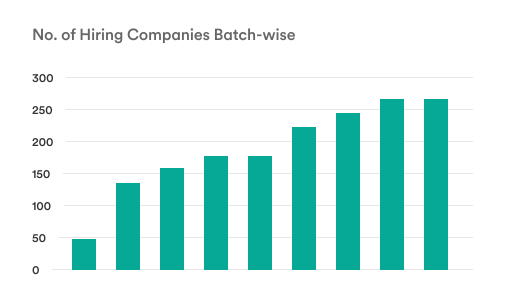
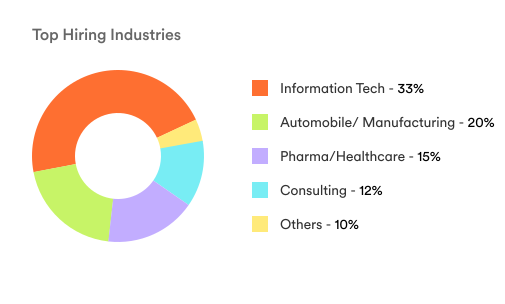
A Quick summary of the placement support
Top Recruiters










What Our Learners Have To Say


How Will upGrad Support You
5+ Harvard cases and simulations, and 50+ caselets overall
Learn from industry cases for practical application
Mix of Live Classes & Recorded lectures for your convenience
Industry Experts teach sessions in every course to keep it industry-relevant
Online MBA in Finance Guide for 2026
FAQs about MBA in Finance
1. What is the course curriculum for an MBA in Finance?
The MBA in Finance course curriculum typically covers core subjects like Financial Accounting, Corporate Finance, Investment Analysis, Risk Management, and Strategic Financial Management. Most programs also include electives like International Finance, FinTech, and Behavioral Finance, along with hands-on projects and case studies. The curriculum is designed to build a strong foundation in both theory and real-world financial decision-making.
2. Is an MBA in Finance degree right for you?
An MBA in Finance is ideal for individuals interested in financial planning, investment banking, or corporate finance roles. If you enjoy working with numbers, analyzing markets, and making strategic business decisions, then this specialization can lead to high-paying roles with growth potential. It's also a great fit for professionals looking to transition into leadership positions within the finance industry.
3. Why is an online MBA in Finance course better than an offline one?
An online MBA in Finance offers greater flexibility, allowing you to learn at your own pace while continuing your job. Unlike offline courses, it eliminates the need for relocation and reduces living expenses. Online programs also provide access to global faculty, recorded lectures, and interactive learning platforms making it a smarter choice for working professionals or those looking for a cost-effective, industry-relevant degree.
4. What is the difference between MS in finance and MBA in finance?
MBA in finance focuses on different financial aspects of a business. In comparison, a master's in finance focuses more on the different finance topics and closely related fields such as financial theory, quantitative finances, investments, valuation, etc. The number of institutions providing MS degrees is also very limited, but in terms of salary, an MS graduate can expect to earn less than an MBA graduate.
5. What is an MBA in Finance?
An MBA in Finance is a specialized program combining fundamental business management education with advanced financial management training. Topics include financial analysis, investment management, corporate finance, risk management, and financial markets, which are taught in the curriculum.
6. Why study an MBA in Finance?
Pursuing an MBA in Finance has several advantages, including financial knowledge, rich employment prospects in many fields, and a broad skill set combining strategic and analytical business knowledge. An MBA in Finance also offers a solid basis for financial ideas and practices that are required to negotiate challenging financial situations and propel corporate success.
7. What are the basic requirements for admission to MBA in Finance online courses?
To enroll in an MBA in Finance online course, candidates generally need:
- A bachelor’s degree from a recognized institution (any stream, though commerce or finance backgrounds are preferred)
- Entrance exam scores like CAT, GMAT, or GRE, depending on the program requirements
- A strong resume highlighting academic and/or professional achievements
- A Statement of Purpose (SOP) or essays explaining career goals
- Letters of recommendation from professors or employers
- Work experience, while preferred, is not always mandatory
- For global programs, TOEFL or IELTS scores may be needed as proof of English proficiency
8. Is a bachelor’s degree required to pursue an MBA in Finance?
Yes, a bachelor’s degree is a mandatory requirement for enrolling in any MBA in Finance course, whether it is full-time, executive, or online. While a background in commerce or business helps, students from engineering, science, and humanities can also apply.
9. Is work experience mandatory for pursuing an MBA in Finance?
No, work experience is not mandatory for all MBA in Finance programs, especially early-career or online options. However, top institutes may prefer candidates with 1–3 years of professional experience, particularly for executive or global MBA formats, as it adds value to peer learning and classroom discussions.
10. Who should pursue an online MBA in Finance course?
Professionals in finance, accounting, economics, or business looking to further their careers or get into finance leadership positions will find the online MBA in Finance perfect. Working professionals who want to study further while managing their studies with jobs will find this online program appropriate. Pursuing an online MBA in Finance can also help those seeking specific financial knowledge and improve their strategic decision-making ability.
11. Is there any need for an entrance test to pursue an online MBA in Finance?
Most universities do not require an online MBA in Finance aspirants to appear for any exam. Only some colleges may demand a CAT, GMAT, or particular university examination score for admission.
12. What is the cost of doing an MBA from Liverpool Business School through upGrad?
The MBA from Liverpool Business School offered via upGrad is an 18-month program starting at just INR 12,500/month, with the total course fee coming to approximately INR 4,85,000. This makes it one of the most affordable international online MBA options for Indian students aiming for a global edge.
13. What is the scope after the MBA in Finance course?
With great potential for advancement, graduates of an online MBA in Finance may pursue careers in banking, investing, consulting, corporate finance, and other industries, including financial analyst, investment banker, portfolio manager, risk manager, and chief financial officer. The necessity of knowledge in controlling financial risks, developing investment strategies, and guaranteeing a company's financial health drives the need for financial specialists.
14. What are the important subjects of an MBA in Finance?
Key courses include financial accounting, corporate finance, investment analysis, risk management, financial markets, and portfolio management, offering a sound basis for financial concepts and their application.
15. Which are the elective subjects in the MBA in Finance syllabus?
Derivatives, financial modeling, real estate finance, behavioral finance, and private equity are elective courses that let students fit their education to their job objectives. These electives provide students with specialized knowledge and abilities that improve their competency in certain finance areas, increasing their competitiveness in the employment market.
16. Which are important MBA in Finance books for students?
Essential books on MBA in Finance are:
- "Principles of Corporate Finance" by Richard A. Brealey and Stewart C. Myers
- "Investment Analysis and Portfolio Management" by Frank K. Reilly and Keith C. Brown
- "Financial Markets and Institutions" by Frederic S. Mishkin

upGrad Learner Support
Talk to our experts. We are available 7 days a week, 10 AM to 7 PM

Indian Nationals

Foreign Nationals