
All courses
Agentic AI
Agentic AI

IIIT Bangalore
Executive Programme in Generative AI for LeadersArtificial Intelligence
Degree / Exec. PG

IIIT Bangalore
Executive Diploma in Machine Learning and AI
OPJ Global University
Master’s Degree in Artificial Intelligence and Data Science
Liverpool John Moores University
Master of Science in Machine Learning & AI
Golden Gate University
DBA in Emerging Technologies with Concentration in Generative AIExecutive Certificate

IIITB & IIM, Udaipur
Chief Technology Officer & AI Leadership ProgrammeIIIT Bangalore
Executive Programme in Generative AI for Leaders
upGrad | Microsoft
Gen AI Foundations Certificate Program from MicrosoftupGrad | Microsoft
Gen AI Mastery Certificate for Data AnalysisupGrad | Microsoft
Gen AI Mastery Certificate for Software DevelopmentupGrad | Microsoft
Gen AI Mastery Certificate for Managerial ExcellenceOffline Bootcamps

upGrad
Data Science and AI-MLDoctorate
For All Domains
IIITB & IIM, Udaipur
Chief Technology Officer & AI Leadership Programme
Swiss School of Business and Management
Global Doctor of Business Administration from SSBM
Edgewood University
Doctorate in Business Administration by Edgewood UniversityGolden Gate University
Doctor of Business Administration From Golden Gate University
Rushford Business School
Doctor of Business Administration from Rushford Business School, SwitzerlandGolden Gate University
Master + Doctor of Business Administration (MBA+DBA)-d9bdeff6165f4eb1ba2adcebde78e961.svg)
University of Waterloo
Chief Technology and AI Officer ProgramLeadership / AI
Golden Gate University
DBA in Emerging Technologies with Concentration in Generative AIMachine Learning
Machine Learning
Data Science
Degree / Exec. PG
O.P Jindal Global University
Master’s Degree in Artificial Intelligence and Data ScienceIIIT Bangalore
Executive Diploma in Data Science & AILiverpool John Moores University
Master of Science in Data ScienceExecutive Certificate
upGrad | Microsoft
Gen AI Foundations Certificate Program from MicrosoftupGrad | Microsoft
Gen AI Mastery Certificate for Data AnalysisupGrad | Microsoft
Gen AI Mastery Certificate for Software DevelopmentupGrad | Microsoft
Gen AI Mastery Certificate for Managerial ExcellenceupGrad | Microsoft
Gen AI Mastery Certificate for Content CreationOffline Bootcamps
upGrad
Data Science and AI-MLupGrad
Data AnalyticsMBA
Masters

Paris School of Business
Master of Science in Business Management and TechnologyO.P.Jindal Global University
MBA (with Career Acceleration Program by upGrad)Edgewood University
MBA from Edgewood UniversityO.P.Jindal Global University
MBA from O.P.Jindal Global UniversityGolden Gate University
Master + Doctor of Business Administration (MBA+DBA)Executive Certificate

IMT, Ghaziabad
Advanced General Management ProgramMarketing
Executive Certificate
Offline Bootcamps
upGrad
Digital MarketingManagement
Degree
O.P Jindal Global University
MSc in International Accounting & Finance (ACCA integrated)Paris School of Business
Master of Science in Business Management and Technology
Golden Gate University
Master of Arts in Industrial-Organizational PsychologyExecutive Certificate

IIM Kozhikode
Human Resource Analytics Course from IIM-KupGrad | Microsoft
Gen AI Foundations Certificate Program from MicrosoftEducation
Education

Northeastern University
Master of Education (M.Ed.) from Northeastern UniversityEdgewood University
Doctor of Education (Ed.D.)Edgewood University
Master of Education (M.Ed.) from Edgewood UniversityCertifications
Project Management
Certification

Knowledgehut
Leadership And Communications In ProjectsKnowledgehut
Microsoft Project 2007/2010-ae8d039bbd2a41318308f8d26b52ac8f.svg)
Knowledgehut
Financial Management For Project ManagersKnowledgehut
Fundamentals of Earned Value Management (EVM)Knowledgehut
Fundamentals of Portfolio ManagementKnowledgehut
Fundamentals of Program Management-35c169da468a4cc481c6a8505a74826d.webp&w=128&q=75)
Knowledgehut
CAPM® CertificationsKnowledgehut
Microsoft® Project 2016Certifications & Trainings
-7f4b4f34e09d42bfa73b58f4a230cffa.webp&w=128&q=75)
Knowledgehut
PMP® CertificationKnowledgehut
PMI-RMP® CertificationKnowledgehut
PMP Renewal Learning PathKnowledgehut
Oracle Primavera P6 V18.8Knowledgehut
Microsoft® Project 2013Knowledgehut
PfMP® Certification CourseKnowledgehut
Project Planning and MonitoringPrince2 Certifications

Knowledgehut
PRINCE2® FoundationKnowledgehut
PRINCE2® PractitionerKnowledgehut
PRINCE2 Agile Foundation and PractitionerKnowledgehut
PRINCE2 Agile® Foundation CertificationKnowledgehut
PRINCE2 Agile® Practitioner CertificationManagement Certifications
Knowledgehut
Project Management Masters Certification ProgramKnowledgehut
Change ManagementKnowledgehut
Project Management TechniquesKnowledgehut
Product Management Certification ProgramKnowledgehut
Project Risk Management- Study abroad
- Offline centres
- uGSOT - B.Tech
More
%20(1)-d5498f0f972b4c99be680c2ee3b792d7.svg)


Video Production Online Course
Learn filming, lighting, and professional video production skills
Build skills in editing, sound design, and post-production
Work on real-world video production and shooting projects
Train on industry tools and cinematic storytelling techniques
Talk to a Counsellor
By clicking, I accept the T&C and Privacy Policy
Learn From The Best
5
Instructors
3
Industry Experts





Learn by Doing
Experience practical learning with real-world projects in our courses in digital marketing. Get hands-on experience & build your portfolio.
6+
Projects


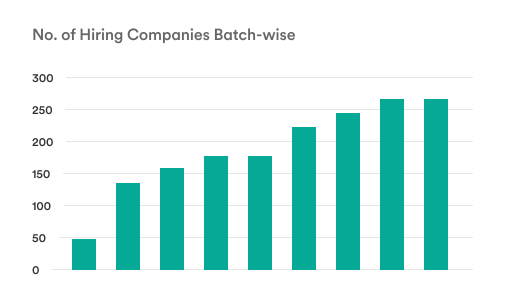
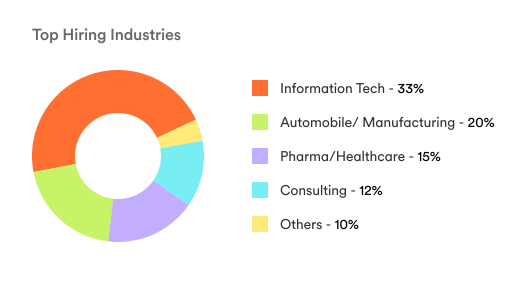
Our Placement Numbers
After completing the course, you can be placed in top companies with competitive salary packages. Get ahead in your career
Top Recruiters



What Our Learners Have To Say


How Will upGrad Supports You
Receive unparalleled guidance from industry mentors, teaching assistants, and graders
Receive one-on-one feedback from our seasoned faculty on submissions and personalized feedback to improvement
Our Syllabus is designed to provide you with ample of industry relevant knowledge with examples
Video Production Online Course Overview
Frequently Asked Questions
1. What skills do Video Production courses help beginners develop first?
Beginner-friendly Video Production courses focus on helping learners understand visual planning, foundational camera use, and basic editing logic. The goal is to build confidence with simple techniques before progressing toward more advanced production workflows, creative decisions, or technical tools.
2. Which type of videography course is considered best for aspiring content creators?
The best videography course is one that balances technical training with creative practice. Programs offering hands-on shooting sessions, real project assignments, and practical feedback from experienced mentors generally provide a strong learning foundation for upcoming creators and filmmakers.
3. What kind of equipment do beginners need before starting a Video Production course?
Beginners usually start with basic gear such as a smartphone or entry-level camera, simple audio accessories, and free editing tools. Courses guide learners on gradually upgrading equipment while focusing first on technique, storytelling, lighting, and composition fundamentals.
4. How long does it typically take to become comfortable with shooting and editing videos?
Most learners feel confident within a few months of consistent practice. While the course provides structured learning, real growth comes from applying techniques, experimenting with different scenes, and reviewing completed projects to identify strengths and areas for improvement.
5. How much should a creator charge for producing a two-minute video professionally?
Pricing for a two-minute video depends on location, equipment, editing complexity, and client needs, but creators generally charge anywhere between modest beginner rates and higher professional fees. Factors like scriptwriting, animation, and retakes also increase final project costs.
6. Are Video Production courses helpful for people who want to start freelancing full-time?
Yes, Video Production courses help learners understand professional workflow standards, client communication, project planning, and deliverable expectations. These skills, along with a growing portfolio, make it easier to enter the freelance market confidently and attract early clients.
7. What are the typical five phases involved in a complete video production process?
A full production cycle generally includes five stages: idea development, pre-production planning, filming, post-production editing, and delivery. Courses often explore each stage in detail, teaching learners how to maintain quality and efficiency throughout the entire workflow.
8. Do Video Production courses teach how to collaborate with teams and clients?
Many programs introduce learners to teamwork dynamics, handling feedback, planning shared tasks, communicating creative ideas, and aligning expectations with clients. These soft skills become essential when managing real-world projects involving directors, editors, designers, or production assistants.
9. Can learners specialize in certain types of videos during or after the course?
Yes, learners can choose to focus on areas such as commercial videos, documentaries, social media content, training modules, or cinematic storytelling. Specialization often evolves naturally as they discover their strengths during hands-on practice.
10. Do Video Production courses teach how to create visually appealing videos with limited resources?
Absolutely. Many courses emphasize resourceful filmmaking, using natural light, minimal equipment, and simple setups. Learners explore how creativity, framing, and storytelling can compensate for smaller budgets while still producing professional-looking results.
11. Are these courses beneficial for professionals outside creative fields?
Yes, professionals in business, education, consulting, and corporate roles benefit from video production training. It helps them create stronger presentations, instructional videos, internal communication content, and client pitches, allowing them to communicate more clearly and persuasively.
upGrad Learner Support
Talk to our experts. We are available 7 days a week, 10 AM to 7 PM

Indian Nationals

Foreign Nationals
Disclaimer
The above statistics depend on various factors and individual results may vary. Past performance is no guarantee of future results.
The student assumes full responsibility for all expenses associated with visas, travel, & related costs. upGrad does not .