
All courses
Agentic AI
Agentic AI

IIIT Bangalore
Executive Programme in Generative AI for LeadersArtificial Intelligence
Degree / Exec. PG

IIIT Bangalore
Executive Diploma in Machine Learning and AI
OPJ Global University
Master’s Degree in Artificial Intelligence and Data Science
Liverpool John Moores University
Master of Science in Machine Learning & AI
Golden Gate University
DBA in Emerging Technologies with Concentration in Generative AIExecutive Certificate

IIITB & IIM, Udaipur
Chief Technology Officer & AI Leadership ProgrammeIIIT Bangalore
Executive Programme in Generative AI for Leaders
upGrad | Microsoft
Gen AI Foundations Certificate Program from MicrosoftupGrad | Microsoft
Gen AI Mastery Certificate for Data AnalysisupGrad | Microsoft
Gen AI Mastery Certificate for Software DevelopmentupGrad | Microsoft
Gen AI Mastery Certificate for Managerial ExcellenceOffline Bootcamps

upGrad
Data Science and AI-MLDoctorate
For All Domains
IIITB & IIM, Udaipur
Chief Technology Officer & AI Leadership Programme
Swiss School of Business and Management
Global Doctor of Business Administration from SSBM
Edgewood University
Doctorate in Business Administration by Edgewood UniversityGolden Gate University
Doctor of Business Administration From Golden Gate University
Rushford Business School
Doctor of Business Administration from Rushford Business School, SwitzerlandGolden Gate University
Master + Doctor of Business Administration (MBA+DBA)-d9bdeff6165f4eb1ba2adcebde78e961.svg)
University of Waterloo
Chief Technology and AI Officer ProgramLeadership / AI
Golden Gate University
DBA in Emerging Technologies with Concentration in Generative AIMachine Learning
Machine Learning
Data Science
Degree / Exec. PG
O.P Jindal Global University
Master’s Degree in Artificial Intelligence and Data ScienceIIIT Bangalore
Executive Diploma in Data Science & AILiverpool John Moores University
Master of Science in Data ScienceExecutive Certificate
upGrad | Microsoft
Gen AI Foundations Certificate Program from MicrosoftupGrad | Microsoft
Gen AI Mastery Certificate for Data AnalysisupGrad | Microsoft
Gen AI Mastery Certificate for Software DevelopmentupGrad | Microsoft
Gen AI Mastery Certificate for Managerial ExcellenceupGrad | Microsoft
Gen AI Mastery Certificate for Content CreationOffline Bootcamps
upGrad
Data Science and AI-MLupGrad
Data AnalyticsMBA
Masters

Paris School of Business
Master of Science in Business Management and TechnologyO.P.Jindal Global University
MBA (with Career Acceleration Program by upGrad)Edgewood University
MBA from Edgewood UniversityO.P.Jindal Global University
MBA from O.P.Jindal Global UniversityGolden Gate University
Master + Doctor of Business Administration (MBA+DBA)Executive Certificate
IMT, Ghaziabad
Advanced General Management ProgramMarketing
Executive Certificate
Offline Bootcamps
upGrad
Digital MarketingManagement
Degree
O.P Jindal Global University
MSc in International Accounting & Finance (ACCA integrated)Paris School of Business
Master of Science in Business Management and Technology
Golden Gate University
Master of Arts in Industrial-Organizational PsychologyExecutive Certificate

IIM Kozhikode
Human Resource Analytics Course from IIM-KupGrad | Microsoft
Gen AI Foundations Certificate Program from MicrosoftEducation
Education

Northeastern University
Master of Education (M.Ed.) from Northeastern UniversityEdgewood University
Doctor of Education (Ed.D.)Edgewood University
Master of Education (M.Ed.) from Edgewood UniversityCertifications
Project Management
Certification

Knowledgehut
Leadership And Communications In ProjectsKnowledgehut
Microsoft Project 2007/2010-ae8d039bbd2a41318308f8d26b52ac8f.svg)
Knowledgehut
Financial Management For Project ManagersKnowledgehut
Fundamentals of Earned Value Management (EVM)Knowledgehut
Fundamentals of Portfolio ManagementKnowledgehut
Fundamentals of Program Management-35c169da468a4cc481c6a8505a74826d.webp&w=128&q=75)
Knowledgehut
CAPM® CertificationsKnowledgehut
Microsoft® Project 2016Certifications & Trainings
-7f4b4f34e09d42bfa73b58f4a230cffa.webp&w=128&q=75)
Knowledgehut
PMP® CertificationKnowledgehut
PMI-RMP® CertificationKnowledgehut
PMP Renewal Learning PathKnowledgehut
Oracle Primavera P6 V18.8Knowledgehut
Microsoft® Project 2013Knowledgehut
PfMP® Certification CourseKnowledgehut
Project Planning and MonitoringPrince2 Certifications

Knowledgehut
PRINCE2® FoundationKnowledgehut
PRINCE2® PractitionerKnowledgehut
PRINCE2 Agile Foundation and PractitionerKnowledgehut
PRINCE2 Agile® Foundation CertificationKnowledgehut
PRINCE2 Agile® Practitioner CertificationManagement Certifications
Knowledgehut
Project Management Masters Certification ProgramKnowledgehut
Change ManagementKnowledgehut
Project Management TechniquesKnowledgehut
Product Management Certification ProgramKnowledgehut
Project Risk Management- Study abroad
- Offline centres
- uGSOT - B.Tech
More
%20(1)-d5498f0f972b4c99be680c2ee3b792d7.svg)


Marketing Automation Online Course
Master workflows, email automation, and campaign setup
Learn lead scoring, segmentation, and CRM integration
Work on real-world automation and campaign projects
Gain hands-on experience with top marketing tools
Talk to a Counsellor
By clicking, I accept the T&C and Privacy Policy
Learn From The Best
5
Instructors
3
Industry Experts





Learn by Doing
Experience practical learning with real-world projects in our courses in digital marketing. Get hands-on experience & build your portfolio.
6+
Projects


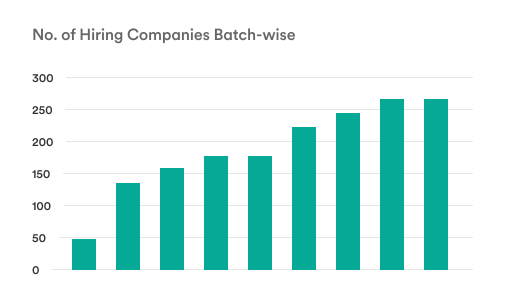
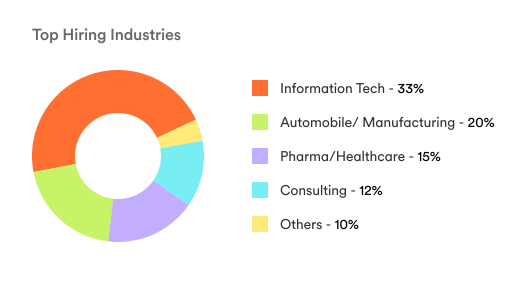
Our Placement Numbers
After completing the course, you can be placed in top companies with competitive salary packages. Get ahead in your career
Top Recruiters



What Our Learners Have To Say


How Will upGrad Supports You
Receive unparalleled guidance from industry mentors, teaching assistants, and graders
Receive one-on-one feedback from our seasoned faculty on submissions and personalized feedback to improvement
Our Syllabus is designed to provide you with ample of industry relevant knowledge with examples
Marketing Automation Online Course Overview
Frequently Asked Questions
1. How do marketing automation tools help improve customer engagement?
Marketing automation tools help brands maintain consistent engagement by sending timely, personalized communication. They analyze customer behavior, automate follow-ups, nurture leads, and ensure every interaction feels relevant, ultimately improving retention and long-term customer satisfaction without relying on constant manual effort.
2. What skills help professionals advance quickly in marketing automation roles?
Professionals who combine analytical thinking with creativity progress faster. Skills like audience segmentation, journey design, understanding data flows, and basic API familiarity help them build effective automated systems and adapt to evolving MarTech platforms efficiently.
3. How does AI enhance marketing automation platforms today?
AI improves marketing automation by predicting user actions, recommending personalized content, optimizing send times, and identifying patterns that manual analysis may miss. This allows marketing teams to scale their efforts and deliver more targeted communication with minimal manual intervention.
4. What are common challenges beginners face when learning marketing automation?
Beginners often struggle with workflow logic, segmentation complexity, and integration of different data sources. Understanding how triggers and conditions interact can take time, but hands-on practice and working with real scenarios significantly speed up the learning curve.
5. How important is data quality for successful marketing automation?
High-quality data is essential because inaccurate or outdated customer information leads to poorly targeted campaigns. Clean, structured, and regularly updated data ensures workflows perform correctly, resulting in more effective personalization and stronger campaign performance.
6. What responsibilities does a marketing automation architect typically handle?
A marketing automation architect oversees the design and implementation of large-scale automated workflows. They ensure data flows correctly across systems, maintain operational efficiency, and create scalable automation frameworks that support personalization, analytics, and multi-channel customer engagement.
7. What does a marketing technology architect contribute to an organization?
A marketing technology architect aligns marketing goals with technical infrastructure. They select tools, design integrations, manage automation governance, and optimize MarTech ecosystems so teams can launch campaigns smoothly and measure performance effectively across multiple platforms.
8. What is the typical salary range for automation architects in India?
Automation architects in India typically earn competitive salaries based on their expertise in workflow design, system integrations, and data architecture. Compensation varies widely but usually reflects their ability to handle complex automation environments and align them with business goals.
9. What does marketing automation primarily aim to achieve?
Marketing automation aims to streamline repetitive tasks, enhance personalization, and improve customer lifecycle management. It creates structured journeys that respond to user behavior, making communication timely, relevant, and scalable across multiple channels without constant manual intervention.
10. How does marketing automation support sales teams?
Marketing automation supports sales teams by delivering qualified leads, tracking behavioral signals, and automating nurturing sequences. It ensures prospects are warmed up before reaching sales, helping teams prioritize the right leads and speed up the conversion process.
11. Are marketing automation certifications useful for advancing a MarTech career?
Yes, certifications validate your ability to use automation tools, design workflows, and work with customer data. They demonstrate your technical maturity, strengthen your portfolio, and often help professionals secure better job roles or transition into specialized MarTech positions.
upGrad Learner Support
Talk to our experts. We are available 7 days a week, 10 AM to 7 PM

Indian Nationals

Foreign Nationals
Disclaimer
The above statistics depend on various factors and individual results may vary. Past performance is no guarantee of future results.
The student assumes full responsibility for all expenses associated with visas, travel, & related costs. upGrad does not .