
All courses
Agentic AI
Agentic AI

IIIT Bangalore
Executive Programme in Generative AI for LeadersArtificial Intelligence
Degree / Exec. PG

IIIT Bangalore
Executive Diploma in Machine Learning and AI
OPJ Global University
Master’s Degree in Artificial Intelligence and Data Science
Liverpool John Moores University
Master of Science in Machine Learning & AI
Golden Gate University
DBA in Emerging Technologies with Concentration in Generative AIExecutive Certificate

IIITB & IIM, Udaipur
Chief Technology Officer & AI Leadership ProgrammeIIIT Bangalore
Executive Programme in Generative AI for Leaders
upGrad | Microsoft
Gen AI Foundations Certificate Program from MicrosoftupGrad | Microsoft
Gen AI Mastery Certificate for Data AnalysisupGrad | Microsoft
Gen AI Mastery Certificate for Software DevelopmentupGrad | Microsoft
Gen AI Mastery Certificate for Managerial ExcellenceOffline Bootcamps

upGrad
Data Science and AI-MLDoctorate
For All Domains
IIITB & IIM, Udaipur
Chief Technology Officer & AI Leadership Programme
Swiss School of Business and Management
Global Doctor of Business Administration from SSBM
Edgewood University
Doctorate in Business Administration by Edgewood UniversityGolden Gate University
Doctor of Business Administration From Golden Gate University
Rushford Business School
Doctor of Business Administration from Rushford Business School, SwitzerlandGolden Gate University
Master + Doctor of Business Administration (MBA+DBA)-d9bdeff6165f4eb1ba2adcebde78e961.svg)
University of Waterloo
Chief Technology and AI Officer ProgramLeadership / AI
Golden Gate University
DBA in Emerging Technologies with Concentration in Generative AIMachine Learning
Machine Learning
Data Science
Degree / Exec. PG
O.P Jindal Global University
Master’s Degree in Artificial Intelligence and Data ScienceIIIT Bangalore
Executive Diploma in Data Science & AILiverpool John Moores University
Master of Science in Data ScienceExecutive Certificate
upGrad | Microsoft
Gen AI Foundations Certificate Program from MicrosoftupGrad | Microsoft
Gen AI Mastery Certificate for Data AnalysisupGrad | Microsoft
Gen AI Mastery Certificate for Software DevelopmentupGrad | Microsoft
Gen AI Mastery Certificate for Managerial ExcellenceupGrad | Microsoft
Gen AI Mastery Certificate for Content CreationOffline Bootcamps
upGrad
Data Science and AI-MLupGrad
Data AnalyticsMBA
Masters

Paris School of Business
Master of Science in Business Management and TechnologyO.P.Jindal Global University
MBA (with Career Acceleration Program by upGrad)Edgewood University
MBA from Edgewood UniversityO.P.Jindal Global University
MBA from O.P.Jindal Global UniversityGolden Gate University
Master + Doctor of Business Administration (MBA+DBA)Executive Certificate
IMT, Ghaziabad
Advanced General Management ProgramMarketing
Executive Certificate
Offline Bootcamps
upGrad
Digital MarketingManagement
Degree
O.P Jindal Global University
MSc in International Accounting & Finance (ACCA integrated)Paris School of Business
Master of Science in Business Management and Technology
Golden Gate University
Master of Arts in Industrial-Organizational PsychologyExecutive Certificate

IIM Kozhikode
Human Resource Analytics Course from IIM-KupGrad | Microsoft
Gen AI Foundations Certificate Program from MicrosoftEducation
Education

Northeastern University
Master of Education (M.Ed.) from Northeastern UniversityEdgewood University
Doctor of Education (Ed.D.)Edgewood University
Master of Education (M.Ed.) from Edgewood UniversityCertifications
Project Management
Certification

Knowledgehut
Leadership And Communications In ProjectsKnowledgehut
Microsoft Project 2007/2010-ae8d039bbd2a41318308f8d26b52ac8f.svg)
Knowledgehut
Financial Management For Project ManagersKnowledgehut
Fundamentals of Earned Value Management (EVM)Knowledgehut
Fundamentals of Portfolio ManagementKnowledgehut
Fundamentals of Program Management-35c169da468a4cc481c6a8505a74826d.webp&w=128&q=75)
Knowledgehut
CAPM® CertificationsKnowledgehut
Microsoft® Project 2016Certifications & Trainings
-7f4b4f34e09d42bfa73b58f4a230cffa.webp&w=128&q=75)
Knowledgehut
PMP® CertificationKnowledgehut
PMI-RMP® CertificationKnowledgehut
PMP Renewal Learning PathKnowledgehut
Oracle Primavera P6 V18.8Knowledgehut
Microsoft® Project 2013Knowledgehut
PfMP® Certification CourseKnowledgehut
Project Planning and MonitoringPrince2 Certifications

Knowledgehut
PRINCE2® FoundationKnowledgehut
PRINCE2® PractitionerKnowledgehut
PRINCE2 Agile Foundation and PractitionerKnowledgehut
PRINCE2 Agile® Foundation CertificationKnowledgehut
PRINCE2 Agile® Practitioner CertificationManagement Certifications
Knowledgehut
Project Management Masters Certification ProgramKnowledgehut
Change ManagementKnowledgehut
Project Management TechniquesKnowledgehut
Product Management Certification ProgramKnowledgehut
Project Risk Management- Study abroad
- Offline centres
- uGSOT - B.Tech
More
%20(1)-d5498f0f972b4c99be680c2ee3b792d7.svg)


Branding Courses
Master brand identity, positioning, and communication frameworks.
Build skills in messaging, visual identity, and brand storytelling.
Work on real brand audits, strategy decks, and live branding projects.
Train on tools for research, design, analytics, and brand management.
Talk to a Counsellor
By clicking, I accept the T&C and Privacy Policy
Learn From The Best
5
Instructors
3
Industry Experts





Learn by Doing
Experience practical learning with real-world projects in our courses in digital marketing. Get hands-on experience & build your portfolio.
6+
Projects


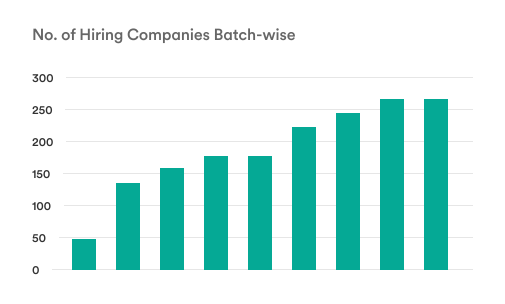
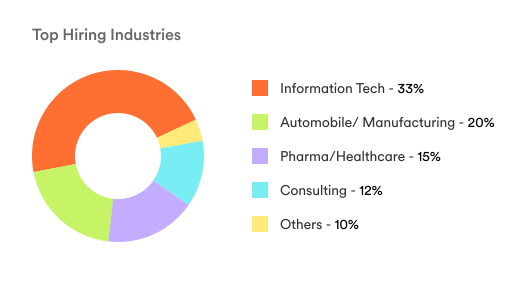
Our Placement Numbers
After completing the course, you can be placed in top companies with competitive salary packages. Get ahead in your career
Top Recruiters



What Our Learners Have To Say


How Will upGrad Supports You
Receive unparalleled guidance from industry mentors, teaching assistants, and graders
Receive one-on-one feedback from our seasoned faculty on submissions and personalized feedback to improvement
Our Syllabus is designed to provide you with ample of industry relevant knowledge with examples
Branding Course Overview
Frequently Asked Questions
1. What is a Branding course?
A Branding course teaches the fundamentals of building, positioning, and managing a brand. It covers brand identity, messaging, visual elements, customer perception, and strategic communication to help learners understand how strong, memorable, and consistent brands are created and sustained across markets.
2. Who should consider taking a Branding course?
Branding courses are ideal for students, marketers, designers, entrepreneurs, and professionals in creative or business roles. Anyone interested in shaping brand identity, improving communication, understanding consumer behaviour, or developing strategic thinking can benefit from these structured, practical programs.
3. Do I need prior marketing or design knowledge?
No prior marketing or design experience is required. Most programs start with foundational concepts and gradually introduce strategy, identity development, and communication principles. A creative mindset helps, but the curriculum is designed to support complete beginners as well.
4. What topics are usually included in a Branding course?
Branding courses typically cover brand identity systems, positioning strategies, market differentiation, storytelling frameworks, audience research, brand personality, tone of voice, competitive analysis, and brand equity. Some programs also include visual basics like logo structure, colour psychology, and typography.
5. How long does a Branding course usually take to complete?
Depending on depth and format, Branding courses range from one-month introductions to year-long advanced programs. Short courses focus on fundamentals, while longer programs include real projects, case studies, brand audits, and complete strategy development for stronger practical understanding.
6. What skills will I gain after completing the course?
You’ll gain skills in brand strategy, identity creation, storytelling, customer insight analysis, competitive mapping, communication planning, and brand guideline development. These skills help you understand how brands influence consumer behaviour and how strategic branding strengthens business growth and perception.
7. Will I get to work on real or practical branding projects?
Most reputable courses include practical tasks such as brand audits, identity redesigns, competitor studies, storytelling exercises, and full brand strategy presentations. These hands-on projects help you apply theoretical concepts and develop portfolio-ready work for future job opportunities.
8. Do I need a portfolio for branding-related careers?
A portfolio is highly valuable because it demonstrates your strategic thinking, creativity, and problem-solving abilities. Branding projects like identity systems, positioning maps, message frameworks, and brand guidelines make your work more credible and help you stand out in job interviews.
9. What career opportunities can I pursue after completing a Branding course?
Completing a Branding course opens doors to roles such as Brand Strategist, Brand Manager, Creative Strategist, Visual Identity Designer, Marketing Executive, or Communications Specialist. These roles exist across agencies, corporates, startups, retail, technology, advertising, and digital marketing sectors.
10. How useful is branding knowledge for entrepreneurs and business owners?
Branding skills help entrepreneurs shape their business positioning, communicate purpose, build trust, and differentiate from competitors. Understanding branding ensures consistent storytelling, stronger customer engagement, and a professional identity that supports long-term business growth and competitive advantage.
11. Do Branding courses provide certification, and does it matter?
Many courses offer certifications, which help showcase structured learning and commitment. While certification adds credibility, employers usually prioritize practical branding ability, strategic clarity, and portfolio quality. Strong real-world projects often have a greater impact than certificates alone.
upGrad Learner Support
Talk to our experts. We are available 7 days a week, 10 AM to 7 PM

Indian Nationals

Foreign Nationals
Disclaimer
The above statistics depend on various factors and individual results may vary. Past performance is no guarantee of future results.
The student assumes full responsibility for all expenses associated with visas, travel, & related costs. upGrad does not .