Best Machine Learning Books for Beginners to Experts
By Rohan Vats
Updated on Jan 20, 2026 | 6 min read | 8.21K+ views
Share:

All courses
Certifications
More
By Rohan Vats
Updated on Jan 20, 2026 | 6 min read | 8.21K+ views
Share:
Table of Contents
Machine learning is one of the most in-demand skills today, used in fields like data science, artificial intelligence, finance, healthcare, and software development. While online tutorials are helpful, machine learning books remain one of the best ways to build a strong and clear understanding of core concepts.
The right book can explain complex ideas step by step, helping you learn both theory and practical thinking. For beginners, books like Hands-On Machine Learning with Scikit-Learn, Keras, and TensorFlow by Aurélien Géron are highly recommended, while learners with some background often turn to Pattern Recognition and Machine Learning by Christopher M. Bishop for deeper insights.
In this blog, we explore the best machine learning books for every level.
Want faster, guided learning? Explore our top Machine Learning Courses Online and enroll today to build real-world skills with expert support.
Popular AI Programs
If you are new to machine learning, choosing the right books is important. Beginner-friendly Machine Learning books focus on clear concepts, real-world examples, and simple explanations instead of heavy math, helping you build understanding and confidence.
Recommended Machine Learning Books for Beginners:
Boost your ML skills with expert guidance! Enroll in the Executive Diploma in Machine Learning and AI from IIITB for hands-on projects, mentorship, and career-focused training. Start learning today!
Must Read: Top Advanced Computer Skills to Learn for Career Growth
Free Courses
After learning ML basics, the next step is to explore deeper mathematics, algorithms, and theory. These books focus on how and why models work, including evaluation, optimization, and advanced methods, making them ideal for technical and practical problem-solving.
Here are some of the best Machine Learning Books for Intermediate & Advanced Learners:
Related Article: Scope of Machine Learning
AI Courses to upskill
Explore Artificial Intelligence Courses for Career Progression
Algorithms and optimization form the core of machine learning, guiding how models learn and improve. These books focus on mathematical foundations and optimization techniques and are best for learners comfortable with math and coding.
Best Machine Learning Books based ML Algorithms & Optimization:
This section is for students preparing for GATE, academic exams, interviews, and placements. These books focus on practice-based learning with MCQs, solved examples, and problems to strengthen concepts and exam readiness.
Top Machine Learning Books for Exams & Practice:
Choosing the right machine learning book saves time and helps you learn better. The best book depends on your background, goals, and learning style.
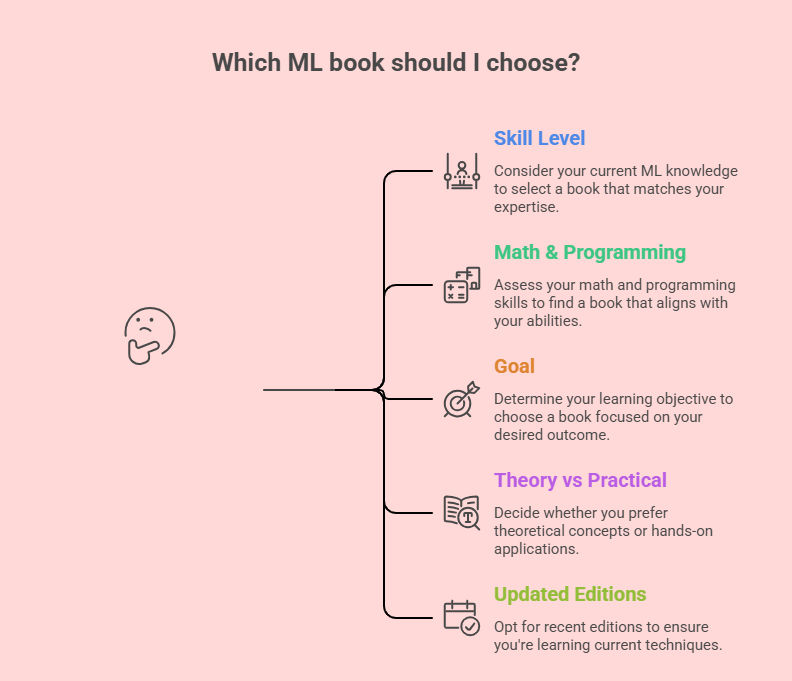
Key factors to consider:
Subscribe to upGrad's Newsletter
Join thousands of learners who receive useful tips
Choosing the right machine learning books plays a key role in building strong skills, whether you are a beginner or an advanced learner. The best approach is to start with simple, concept-based books and slowly move toward more technical and exam-focused resources.
Combine reading with regular practice to gain real understanding and confidence.
If you want faster, guided learning with real-world projects, explore our top Machine Learning Courses Online and enroll today to grow your skills and advance your career.
The best beginner machine learning books explain concepts in simple language with real-world examples. Popular choices include Hands-On Machine Learning by Aurélien Géron and Machine Learning for Dummies. These books avoid heavy math and focus on building clear understanding. They are ideal for students and first-time learners.
If you are starting from zero, choose a book that focuses on concepts and intuition. Machine Learning for Absolute Beginners by Oliver Theobald is a good option. It explains ML ideas without complex terms. This helps new learners gain confidence early.
Machine learning books provide structured and detailed learning that many tutorials lack. Books explain concepts step by step and help build strong foundations. Online tutorials are good for quick learning, but books give deeper clarity. Using both together works best.
For advanced learners, books like Pattern Recognition and Machine Learning by Christopher M. Bishop are highly recommended. These books focus on theory, math, and algorithms. They are best for researchers and experienced data scientists. A strong math background is helpful.
Books like Convex Optimization by Boyd and Numerical Optimization by Nocedal focus on algorithms and optimization. They explain how models learn and improve. These books are math-heavy and technical. They are best for engineers and advanced learners.
Yes, many machine learning books are useful for GATE and academic exams. Books by Ethem Alpaydin and Bishop are often recommended. They cover theory, definitions, and exam-relevant topics. Practice workbooks also help with MCQs and revision.
Machine learning books are very helpful for interview preparation. They strengthen core concepts and explain algorithms clearly. Books that balance theory and practice are best. Pair book learning with coding practice for better results.
The math level depends on the book. Beginner books use very little math and focus on intuition. Advanced books require knowledge of statistics, linear algebra, and calculus. Always check the book level before buying.
Yes, some ML books are written for non-programmers. Machine Learning for Dummies and Machine Learning for Absolute Beginners are good examples. These books explain ideas without deep coding. They are ideal for business and management learners.
It depends on your goal. Theory-based books help with deep understanding and exams. Practical books focus on coding, tools, and real projects. Beginners should start practical, then move to theory slowly.
Yes, relying on only one book is not recommended. Each book explains topics differently. Reading 2–3 books helps fill learning gaps. It also improves clarity and confidence.
Check the publication year and edition of the book. Machine learning changes fast, so older books may miss modern tools. Updated editions usually include new algorithms and libraries. Always prefer the latest version.
There is no one perfect book for everyone. Hands-On Machine Learning is often called the best overall book. It balances theory and practice well. Your background and goal still matter most.
Yes, machine learning is considered a high-paying field. ML engineers and data scientists are in strong demand. Salaries depend on skills, experience, and location. Strong foundations increase career growth.
ChatGPT is an artificial intelligence system that uses machine learning. It is trained using deep learning and large language models. ML helps it learn patterns from data. AI is the broader field it belongs to.
Learning machine learning in one week is not realistic. You can only understand basic ideas in that time. ML requires time, practice, and patience. Books and courses help build skills step by step.
There are four main types of machine learning. These are supervised learning, unsupervised learning, semi-supervised learning, and reinforcement learning. Each type solves different problems. Beginner books usually cover the first two.
Books alone are not enough to become job-ready. They build strong knowledge but practice is also needed. Projects, coding, and real data work are important. Combining books with courses works best.
Most international ML books are suitable for Indian students. Some books are especially popular for GATE and placements. Indian exam-focused notes and workbooks add extra value. A mix of both is helpful.
Yes, combining books with online courses gives faster results. Books build concepts, while courses offer guidance and projects. Courses also help with doubts and practical skills. Explore Machine Learning Courses Online to learn faster and smarter.
418 articles published
Rohan Vats is a Senior Engineering Manager with over a decade of experience in building scalable frontend architectures and leading high-performing engineering teams. Holding a B.Tech in Computer Scie...
Speak with AI & ML expert
By submitting, I accept the T&C and
Privacy Policy
Top Resources
Master's Degree
18 Months
Executive Diploma
12 Months
IIIT Bangalore
Executive Programme in Generative AI & Agentic AI for LeadersIndia’s #1 Tech University
Dual Certification
5 Months