Understanding Clustering in Machine Learning Algorithms
Updated on Nov 06, 2025 | 11 min read | 9.25K+ views
Share:

All courses
Certifications
More
Updated on Nov 06, 2025 | 11 min read | 9.25K+ views
Share:
Table of Contents
Clustering in machine learning is a powerful unsupervised learning technique that groups similar data points together based on their characteristics. It helps uncover hidden patterns and structures within datasets without using predefined labels. This process is essential for identifying natural groupings that improve understanding and decision-making across applications.
This blog explains what clustering in machine learning is, how it works, and its main types such as K-means clustering and hierarchical clustering. You will also learn about its algorithms, real-world applications, and advantages in data-driven environments. By the end, you will understand how clustering supports tasks like customer segmentation, image analysis, and anomaly detection.
Explore upGrad’s AI and Machine Learning Courses to gain industry-relevant skills and stay ahead in your career! Build your AI and ML skills for the current industry demands.

Popular AI Programs
Clustering in machine learning refers to grouping similar data points based on specific characteristics or patterns. The algorithm identifies underlying relationships in data and organizes it into clusters that represent these similarities.
Unlike supervised learning, where models learn from labeled data, clustering techniques work on unlabeled datasets, meaning there’s no predefined output or category. Instead, the algorithm discovers structure automatically, making it particularly useful for exploratory data analysis.
For example, a retailer can use clustering to identify different customer groups based on purchasing behavior. Similarly, healthcare organizations can cluster patient data to predict disease risk categories.
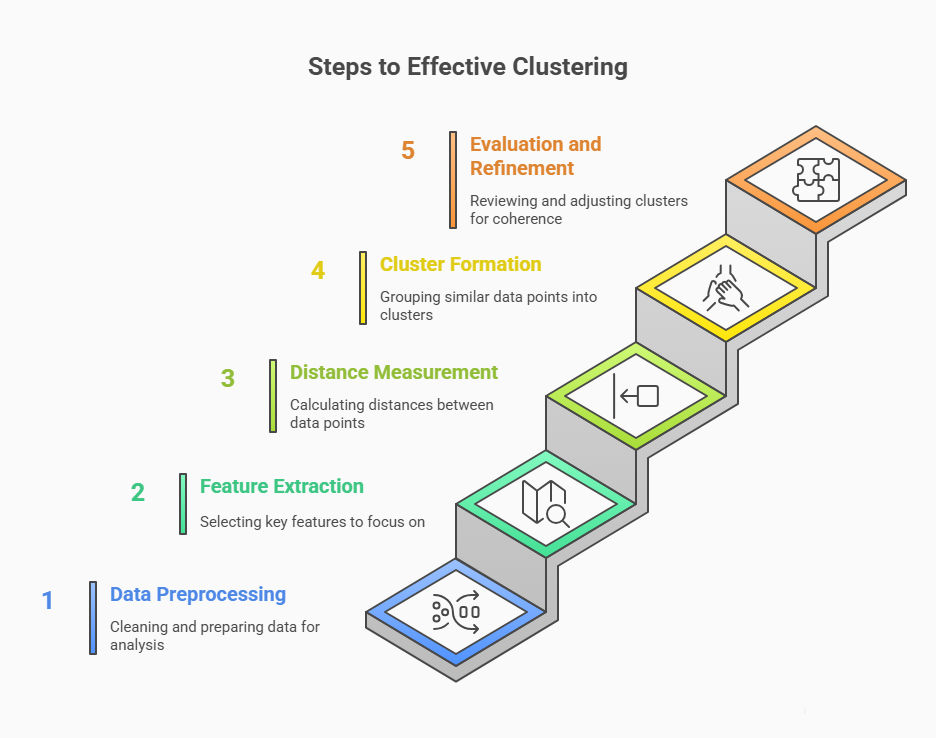
Clustering in machine learning follows a structured process that helps group similar data points together logically and efficiently. It transforms raw, unorganized data into meaningful patterns that can be analyzed and interpreted. Here’s how it works:
1. Data Preprocessing:
The first step is to clean and prepare the data. Missing values, duplicate entries, and irrelevant features are removed. The data is then normalized and scaled so that features with larger numerical values do not overshadow smaller ones.
2. Feature Extraction:
Next, key features that best describe the dataset are selected or transformed. This step ensures that the algorithm focuses on the most important characteristics of the data.
3. Distance Measurement:
Clustering algorithms rely on distance or similarity metrics to measure how close or far data points are from one another. Common measures include:
4. Cluster Formation:
After computing the distances, the algorithm groups data points into clusters. Each cluster contains points that are more similar to each other than to those in other clusters.
5. Evaluation and Refinement:
Finally, the clusters are reviewed and refined. The algorithm iteratively adjusts boundaries to make each cluster more coherent and meaningful.
Must Read: Data Preprocessing in Machine Learning: 11 Key Steps You Must Know!
Clustering in machine learning can be categorized based on how data points are grouped and how cluster relationships are structured. The two main distinctions are Hard vs. Soft Clustering and Flat vs. Hierarchical Clustering.
1. Hard vs. Soft Clustering
Type |
Description |
Example Algorithm |
Use Case |
| Hard Clustering | Each data point belongs to exactly one cluster with no overlap. | K-Means Clustering | Works best when clusters are clearly separated. |
| Soft Clustering | Data points can belong to multiple clusters with different probabilities. | Gaussian Mixture Models (GMM) | Suitable for data with overlapping boundaries. |
2. Flat vs. Hierarchical Clustering
Type |
Description |
Example Algorithm |
Visualization Benefit |
| Flat Clustering | Divides data into fixed clusters without showing hierarchy. | K-Means | Simple structure; useful when the number of clusters is predefined. |
| Hierarchical Clustering | Builds a tree-like structure (dendrogram) showing cluster relationships. | Agglomerative or Divisive Hierarchical Clustering | Helps visualize nested relationships and select optimal clusters. |
AI Courses to upskill
Explore Artificial Intelligence Courses for Career Progression
Clustering in machine learning requires choosing the right algorithm for your data and objective. The sections below explain the leading algorithms in depth so a beginner can understand when and how to use each one.
K-Means is a centroid-based algorithm that partitions data into a fixed number of clusters. Each cluster is represented by its centroid, which is the average of the points assigned to that cluster. The goal is to minimize within-cluster variance so that points in the same cluster are as similar as possible.
Type
Hard clustering, flat (non-hierarchical).
How it works
Advantages
Disadvantages
Applications
Customer segmentation, image color quantization, market segmentation, and initial preprocessing step for other algorithms.
Hierarchical clustering builds a multi-level tree of clusters. The tree shows how clusters merge or split at different levels of granularity. That makes it useful when you want to explore cluster structure at multiple resolutions.
Type
Hard clustering, hierarchical (agglomerative or divisive).
How it works
Advantages
Disadvantages
Applications
Phylogenetics, document clustering for topic exploration, grouping similar products, and exploratory data analysis where hierarchy matters.
DBSCAN is a density-based algorithm that finds clusters as dense regions of points separated by regions of low density. It also identifies outliers explicitly. It is effective when clusters have irregular shapes.
Type
Density-based, can be considered hard clustering with explicit noise labeling.
How it works
Advantages
Disadvantages
Applications
Spatial data analysis, anomaly detection in time series or logs, clustering GPS coordinates, and fraud detection.
OPTICS is an extension of DBSCAN designed to handle clusters of varying density. Instead of producing a single clustering for fixed parameters, OPTICS produces an ordering of points that captures clustering structure across a range of density thresholds.
Type
Density-based, produces a reachability plot rather than a single flat clustering.
How it works
Advantages
Disadvantages
Applications
Exploratory analysis where cluster density varies, geospatial clustering, and datasets with nested or hierarchical density patterns.
GMM is a model-based probabilistic clustering technique. It assumes the data is generated from a mixture of Gaussian distributions. Each Gaussian represents a cluster and points have probabilities of belonging to each cluster.
Type
Soft clustering, probabilistic.
How it works
Advantages
Disadvantages
Applications
Speaker identification, anomaly detection with probability scores, soft segmentation in image analysis, and any task where cluster membership is uncertain.
Mean Shift is a mode-seeking algorithm that identifies clusters by finding the densest regions (modes) in the feature space. It does not require the number of clusters ahead of time.
Type
Density-based, non-parametric.
How it works
Advantages
Disadvantages
Applications
Image segmentation, object tracking, and mode detection in density estimation tasks.
Spectral clustering uses graph theory and linear algebra. It constructs a graph that represents data point similarities, computes a low-dimensional embedding from the graph’s Laplacian, and then applies a standard clustering algorithm like K-Means in the embedded space.
Type
Graph-based, can be considered a form of flat clustering after embedding.
How it works
Advantages
Disadvantages
Applications
Image segmentation, social network community detection, clustering on manifold data, and situations where clusters are not linearly separable.
Clustering in machine learning continues to advance as researchers integrate new technologies and methodologies to enhance accuracy, scalability, and interpretability. The following key trends highlight where clustering is heading in the coming years.

Clustering in machine learning plays a vital role in uncovering hidden structures and relationships within complex data. It helps businesses and researchers make data-driven decisions without relying on labeled datasets. From identifying customer groups to detecting anomalies, clustering simplifies large-scale data analysis and enhances predictive modeling.
As data continues to grow in volume and complexity, clustering in machine learning will remain an essential analytical technique. With advancements in deep learning, explainability, and scalable algorithms, future clustering models will deliver more accurate, interpretable, and actionable insights across industries. Its adaptability and efficiency ensure continued relevance in solving various data challenges.
Discover in-demand Machine Learning skills to expand your expertise. Explore the programs below to find the perfect fit for your goals.
Clustering in machine learning is used to identify natural groupings in data without predefined labels. Its primary purpose is to discover hidden patterns, relationships, or structures within datasets. This helps organizations segment customers, detect anomalies, or simplify complex data, making clustering a critical tool for data analysis and decision-making across industries.
Feature selection directly impacts clustering in machine learning by determining which attributes represent the dataset effectively. Irrelevant or redundant features can distort cluster boundaries, reduce accuracy, and increase computation. Selecting meaningful features or applying dimensionality reduction techniques like PCA ensures clearer, well-separated clusters and improves the performance of algorithms such as K-Means clustering in machine learning or hierarchical clustering in machine learning.
Distance metrics measure similarity between data points in clustering algorithms. Common metrics include Euclidean distance, Manhattan distance, and cosine similarity. The choice of metric affects how clusters form and their separation. For example, K-Means clustering in machine learning relies heavily on Euclidean distance, while density-based methods like DBSCAN use neighborhood density to define clusters accurately.
K-Means clustering in machine learning can efficiently handle large datasets through iterative centroid updates. However, its performance depends on proper initialization and selecting the right number of clusters. Using mini-batch K-Means or parallel computing frameworks improves scalability. Preprocessing data through normalization and dimensionality reduction further ensures faster convergence and more accurate cluster formation in large-scale scenarios.
Hierarchical clustering in machine learning is used to create nested clusters that reveal relationships at multiple levels. It is particularly useful for visualizing data structure through dendrograms, identifying subgroups within clusters, and analyzing datasets where the number of clusters is unknown. This method is often applied in bioinformatics, social network analysis, and customer segmentation.
Clustering in machine learning is unsupervised, grouping similar data points without labels. Classification is supervised, assigning data points to predefined categories based on labeled training data. Clustering discovers natural patterns, while classification predicts outcomes. The choice depends on whether labeled data is available and whether the goal is exploratory analysis or predictive modeling.
Clustering in machine learning can be affected by noise and outliers, which may distort cluster boundaries. Algorithms like DBSCAN are more robust to noise because they consider density and can mark outliers separately. Preprocessing steps such as outlier removal, normalization, and careful feature selection further improve the accuracy and reliability of clustering results.
Large datasets pose challenges for clustering in machine learning, including high computation time, memory constraints, and difficulty visualizing clusters. Algorithms like hierarchical clustering become computationally expensive, while K-Means may converge slowly without proper initialization. Using scalable algorithms, distributed frameworks, and dimensionality reduction techniques addresses these challenges effectively.
Clustering in machine learning segments customers based on demographics, behavior, and purchase history. Businesses can identify high-value customers, design personalized campaigns, predict churn, and optimize pricing strategies. Algorithms like K-Means clustering in machine learning or hierarchical clustering in machine learning help create actionable marketing insights by grouping similar customer profiles effectively.
Yes, clustering in machine learning can detect anomalies by identifying points that do not belong to any dense cluster. Density-based algorithms like DBSCAN are particularly effective, as they separate normal patterns from outliers. This is widely applied in fraud detection, network security, and system monitoring to flag unusual or suspicious behavior automatically.
Determining the right number of clusters is essential for effective clustering in machine learning. Methods like the Elbow Method, Silhouette Analysis, and Gap Statistics help identify the point where adding more clusters provides diminishing returns. These techniques are commonly used with K-Means clustering in machine learning to balance accuracy and interpretability.
Soft clustering allows data points to belong to multiple clusters with probabilities instead of being assigned to a single cluster. Gaussian Mixture Models (GMM) are commonly used for soft clustering. This approach captures overlapping patterns and uncertainty, providing a richer understanding of data relationships compared to traditional hard clustering methods.
DBSCAN groups points based on density rather than distance, unlike K-Means or hierarchical clustering. It automatically identifies clusters of arbitrary shapes and marks sparse points as outliers. This makes DBSCAN highly effective for datasets with noise and irregular cluster distributions, such as geospatial data or fraud detection scenarios.
Clustering in machine learning helps feature engineering by creating new attributes based on groupings. For instance, cluster labels can be added as features in predictive models, capturing hidden patterns. This approach improves model accuracy, reduces dimensionality, and uncovers relationships that might not be apparent in raw data.
Popular tools for clustering include Python libraries like scikit-learn, pandas, NumPy, and SciPy; R libraries such as cluster and factoextra; MATLAB built-in clustering toolkits; and big data frameworks like Apache Spark MLlib and Weka. These libraries provide efficient implementations of K-Means, DBSCAN, hierarchical clustering, and Gaussian Mixture Models.
Clustering in machine learning helps healthcare professionals group patients based on symptoms, genetic profiles, or treatment responses. It supports early disease diagnosis, personalized treatment plans, and outbreak prediction. Applications include analyzing medical imaging, electronic health records, and patient segmentation for preventive care programs.
Explainable clustering improves interpretability by showing why data points are grouped together. Techniques include visualizations, rule-based explanations, and feature importance analysis. This is important for industries like finance and healthcare, where decision transparency is critical, ensuring clustering results are actionable and trustworthy.
Yes, clustering in machine learning can be used alongside supervised models in hybrid approaches. For example, cluster labels can serve as input features for classification or regression tasks, enhancing predictive performance by capturing hidden structures in data. This combination is often applied in customer targeting and fraud prediction.
High-dimensional data can complicate clustering by creating sparse, less separable clusters. Techniques such as Principal Component Analysis (PCA) or t-SNE reduce dimensionality, preserve essential structures, and improve the performance of K-Means clustering in machine learning or hierarchical clustering in machine learning. Proper feature selection is also crucial in these cases.
Clustering in machine learning is widely applied across industries including marketing, finance, healthcare, retail, and cybersecurity. It enables customer segmentation, fraud detection, disease pattern analysis, inventory optimization, and network anomaly detection. Its ability to uncover hidden patterns makes it a versatile tool for both strategic and operational decision-making.
911 articles published
Pavan Vadapalli is the Director of Engineering , bringing over 18 years of experience in software engineering, technology leadership, and startup innovation. Holding a B.Tech and an MBA from the India...
Speak with AI & ML expert
By submitting, I accept the T&C and
Privacy Policy
Top Resources
Master's Degree
18 Months
Executive Diploma
12 Months
IIIT Bangalore
Executive Programme in Generative AI & Agentic AI for LeadersIndia’s #1 Tech University
Dual Certification
5 Months