Anomaly Detection With Machine Learning: Techniques and Uses
Updated on Oct 31, 2025 | 8 min read | 8.18K+ views
Share:

All courses
Certifications
More
Updated on Oct 31, 2025 | 8 min read | 8.18K+ views
Share:
Table of Contents
Anomaly detection with machine learning is the process of identifying irregular or unusual patterns in data that deviate from normal behavior. It helps organizations detect fraud, prevent system failures, and ensure data accuracy by using algorithms that learn from historical trends. This approach enables faster and more reliable detection of outliers across large datasets.
This blog explains how anomaly detection with machine learning works, its key techniques, and common algorithms used in different industries. It also discusses applications, major challenges, and the future of this technology in fields such as finance, healthcare, and cybersecurity. By the end, you will understand how machine learning helps automate anomaly detection and supports data-driven decision-making across modern enterprises.
Explore how AI and machine learning are transforming cybersecurity and beyond. Enroll in our AI & Machine Learning Courses to stay ahead in this evolving tech landscape.
Popular AI Programs
Anomaly detection refers to the process of identifying patterns or data points that deviate from expected behavior. These deviations, known as anomalies or outliers, often represent critical and actionable insights, such as fraud, system faults, or network intrusions.
When integrated with machine learning, anomaly detection becomes intelligent and automated. Instead of manually defining rules, ML models learn from data patterns, enabling scalable detection across diverse domains such as finance, healthcare, and cybersecurity.
Key Characteristics
Free Courses
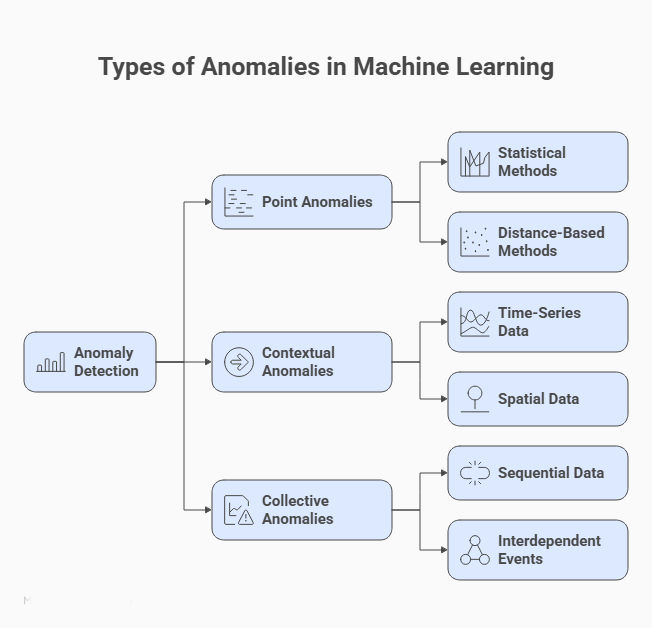
Anomaly detection with machine learning focuses on identifying deviations from normal patterns. These deviations can appear in different forms depending on the nature and context of the data. Understanding the types of anomalies is crucial for selecting the right detection approach and algorithm.
1. Point Anomalies
A point anomaly occurs when a single data instance differs significantly from the rest of the dataset. These are the most common anomalies and are often easy to detect using statistical or distance-based methods. Point anomalies usually indicate errors, fraud, or system malfunctions.
Example: A single transaction amount that is drastically higher than a customer’s usual spending pattern may signal potential credit card fraud.
Also Read: Fraud Detection in Transactions with Python: A Machine Learning Project
2. Contextual Anomalies
Contextual anomalies depend on the specific circumstances or context of the data. What appears normal in one situation may be abnormal in another. This type is common in time-series or spatial data, where seasonality, location, or environment influence normal behavior.
Example: A temperature of 30°C might be typical during summer but unusual in winter, indicating a sensor error or unexpected environmental change.
3. Collective Anomalies
Collective anomalies occur when a group of related data points collectively shows an abnormal pattern, even though individual points may appear normal. These anomalies are particularly important in sequential data or systems where events are interdependent.
Example: A sudden spike in website traffic over a short period could indicate a coordinated cyberattack or bot activity, even if individual requests seem legitimate.
AI Courses to upskill
Explore Artificial Intelligence Courses for Career Progression
Anomaly detection leverages various machine learning techniques depending on whether labeled data is available. Each learning paradigm offers a distinct approach to identifying outliers, patterns, or deviations that indicate abnormal behavior. Below are the three main types of learning methods used in anomaly detection.
1. Supervised Learning
Supervised learning techniques are used when the dataset contains clearly labeled examples of both normal and anomalous instances. The model learns from this labeled data to predict whether new observations fall into the “normal” or “anomalous” class. These models tend to perform well when sufficient high-quality labeled data is available.
Common Algorithms: Logistic Regression, Decision Trees, Random Forests.
Example: Credit card fraud detection systems where past transactions are tagged as either “legitimate” or “fraudulent” to train the model.
2. Unsupervised Learning
Unsupervised learning is applied when labeled data is unavailable. These algorithms explore the data structure to identify unusual patterns or clusters that deviate from the majority. Unsupervised methods are ideal for scenarios where anomalies are rare, dynamic, or difficult to label manually.
Common Algorithms: k-Means Clustering, DBSCAN, Isolation Forest, Autoencoders.
Example: Detecting network intrusions in cybersecurity by identifying abnormal traffic patterns without predefined labels.
3. Semi-Supervised Learning
Semi-supervised learning operates on datasets where only normal instances are available for training. The model learns the behavior of normal data and flags any deviation from this learned pattern as an anomaly. This technique is particularly valuable in industrial or predictive maintenance systems where faults occur infrequently.
Common Algorithms: One-Class SVM, Deep Autoencoders.
Example: Predictive maintenance for industrial machinery, where the system is trained on normal operating data and detects early signs of failure through anomalies.
Anomaly detection employs a variety of algorithms, ranging from classical statistical approaches to advanced deep learning techniques. Each algorithm offers unique advantages based on data type, size, and complexity.
Algorithm |
Type |
Description |
Example Application |
| Isolation Forest | Unsupervised | Randomly partitions data and isolates anomalies faster than normal points, making it efficient for large datasets. | Fraud detection |
| One-Class SVM | Semi-supervised | Learns the boundary that separates normal data from outliers in a high-dimensional space. | Network monitoring |
| k-Means Clustering | Unsupervised | Groups data into clusters and flags points that don’t fit any cluster as anomalies. | Customer segmentation |
| Autoencoders | Deep Learning | Neural networks trained to reconstruct input data; high reconstruction error indicates anomalies. | Healthcare analytics |
| LOF (Local Outlier Factor) | Unsupervised | Measures the local density deviation of data points, detecting those that are isolated or sparse. | Credit scoring |
Building an anomaly detection system with machine learning involves a structured workflow that ensures accuracy, scalability, and adaptability. Below is a step-by-step process to implement anomaly detection in real-world applications.
1. Define the Objective
Clearly determine what qualifies as an anomaly in your specific use case. An anomaly in financial data could indicate fraud, while in industrial IoT data, it may signal equipment failure. Establishing this definition guides all subsequent steps.
2. Data Collection
Gather data from diverse and relevant sources such as transaction logs, sensor readings, or network traffic. The quality and diversity of your data directly influence model performance and accuracy.
3. Preprocessing
Clean and preprocess the collected data by removing duplicates, handling missing values, and normalizing numerical features. Noise reduction and standardization are essential to prevent misleading patterns during training.
Must Read: Data Preprocessing in Machine Learning: 11 Key Steps You Must Know!
4. Feature Engineering
Extract, select, or create features that best represent the underlying data behavior. For instance, statistical measures, time-series patterns, or domain-specific attributes can enhance model interpretability and detection precision.
5. Model Selection
Choose a suitable anomaly detection algorithm based on data availability and labeling. Supervised methods (like Random Forest) work with labeled data, while unsupervised techniques (like Isolation Forest or Autoencoders) perform better with unlabeled datasets.
6. Model Training
Train the chosen model on normal or labeled data to help it learn expected behavior. Ensure the dataset is balanced or use synthetic techniques to avoid bias toward normal instances.
7. Evaluation
Assess model performance using metrics tailored for anomaly detection, including Precision, Recall, F1-score, and ROC-AUC. These metrics help measure how well the model distinguishes normal data from anomalies.
8. Deployment
Integrate the trained model into your production environment or decision-making pipeline. This enables real-time anomaly detection and automated alerts for rapid response.
9. Monitoring
Continuously track model performance post-deployment. Since data patterns evolve over time, periodic retraining and recalibration ensure sustained accuracy and minimize false positives or negatives.

Subscribe to upGrad's Newsletter
Join thousands of learners who receive useful tips
Anomaly detection plays a pivotal role in maintaining the security, reliability, and performance of data-driven systems.
Key Benefits
Anomaly detection with machine learning is widely used across industries to identify rare or irregular patterns that indicate errors, fraud, or system inefficiencies. Below are some of the most impactful real-world applications.
1. Fraud Detection
Financial institutions leverage machine learning models to recognize unusual transaction patterns that deviate from normal customer behavior. These systems analyze parameters like transaction amount, frequency, and location to detect potential fraud in real time.
Example: Credit card companies flag a sudden high-value purchase from an unusual location as a possible fraudulent transaction.
2. Cybersecurity
In cybersecurity, anomaly detection identifies irregular network activities, unauthorized access, or data breaches. ML models analyze network traffic, login attempts, and data flow to uncover hidden threats.
Example: Detection of distributed denial-of-service (DDoS) attacks or abnormal login patterns in enterprise systems.
3. Predictive Maintenance
Manufacturers use anomaly detection to predict equipment failures before they occur. By analyzing sensor data from machinery, ML models identify subtle deviations that indicate wear, malfunction, or energy inefficiency.
Example: Predicting bearing failure in industrial machines using vibration and temperature sensor data.
4. Healthcare Analytics
Anomaly detection models in healthcare analyze patient vitals, medical imaging, or laboratory results to detect early signs of disease or abnormal conditions.
Example: Identifying unusual heart rate fluctuations in ECG data that may signal arrhythmia or cardiac issues.
5. Retail and E-Commerce
Retailers and online platforms apply anomaly detection to monitor sales, customer behavior, and reviews. These systems identify unexpected trends or potential fraud.
Example: Detecting sudden spikes in product reviews or unusual purchase activity that may indicate fake reviews or fraudulent orders.
6. Energy Management
In the energy sector, ML-based anomaly detection helps utility providers identify irregular consumption patterns, grid imbalances, or system inefficiencies.
Example: Detecting abnormal energy usage patterns that may suggest faulty meters or equipment failures.
Implementing anomaly detection with machine learning comes with several challenges that can impact accuracy and scalability.
Organizations can enhance the performance and reliability of their anomaly detection systems by following key best practices.
Anomaly detection with machine learning is transforming industries by enabling organizations to act proactively rather than reactively. The following examples illustrate how various sectors leverage ML-driven anomaly detection to improve efficiency, security, and reliability.
Industry |
Use Case |
Impact |
| Banking | Fraud detection | Reduced financial losses through early identification of suspicious transactions. |
| Healthcare | Patient anomaly monitoring | Early detection of health risks, improving patient outcomes and treatment precision. |
| Manufacturing | Equipment anomaly prediction | Minimized equipment downtime and optimized maintenance schedules. |
| Retail | Unusual purchase pattern detection | Improved demand forecasting and prevention of fraudulent activities. |
| IT Infrastructure | Network anomaly detection | Enhanced system uptime and reduced cybersecurity threats. |
These examples showcase how anomaly detection models enable data-driven decisions that enhance operational resilience and drive measurable business impact.
The future of anomaly detection with machine learning is rapidly evolving, driven by innovations in deep learning, generative AI, and real-time analytics. As data grows in complexity and volume, next-generation anomaly detection systems will become more adaptive, interpretable, and autonomous.
Edge computing enables anomaly detection closer to data sources, such as IoT devices or sensors. This reduces latency and supports real-time monitoring in critical applications like autonomous vehicles and industrial automation.
Must Read: Cloud Computing Vs Edge Computing: Difference Between Cloud Computing & Edge Computing
Explainable AI enhances the interpretability of anomaly detection models by allowing stakeholders to understand why a data point is classified as an anomaly. This transparency builds trust, particularly in high-stakes industries such as finance and healthcare.
Federated learning allows multiple systems to collaboratively train anomaly detection models without sharing sensitive data. This approach maintains privacy and compliance while improving detection accuracy across distributed environments.
Anomaly detection with machine learning plays a crucial role in modern data-driven systems. It enables organizations to identify irregular patterns, prevent fraud, and ensure operational stability. By continuously learning from data, these models help detect hidden issues early, improving decision-making and business efficiency.
With rapid advancements in AI, anomaly detection with machine learning is becoming more accurate and scalable. The future will see more adaptive, explainable, and automated solutions that detect anomalies in real time. This evolution will strengthen risk management, enhance performance, and drive smarter strategies across industries.
Anomaly detection with machine learning works by training models to learn normal data patterns and automatically identify deviations that could indicate errors, fraud, or unusual behavior. It uses statistical, clustering, or deep learning algorithms to detect anomalies in real time, ensuring faster responses and improved decision-making across industries like finance, healthcare, and cybersecurity.
It enables organizations to maintain data integrity, detect cyber threats, and prevent operational failures. By using anomaly detection with machine learning, companies can uncover hidden patterns in massive datasets, reduce downtime, and enhance predictive analytics for smarter, data-driven strategies in dynamic business environments.
Anomalies in machine learning are classified into three main types: point anomalies (individual deviations), contextual anomalies (dependent on context), and collective anomalies (patterns of abnormal data points). Understanding these types helps in selecting appropriate algorithms and improving detection accuracy.
Machine learning enhances anomaly detection by eliminating manual rule-setting and enabling adaptive learning. Unlike traditional statistical methods, ML algorithms dynamically learn from evolving data, improving detection accuracy, scalability, and automation while reducing false positives.
Popular algorithms for anomaly detection with machine learning include Isolation Forest, One-Class SVM, Autoencoders, Local Outlier Factor (LOF), and k-Means Clustering. These algorithms vary in their approach; some focus on distance measures, others on reconstruction errors, to efficiently detect rare or abnormal instances.
Supervised anomaly detection uses labeled datasets where both normal and anomalous data are known. In contrast, unsupervised methods work with unlabeled data, identifying anomalies by detecting deviations in data distribution or clustering behavior.
In cybersecurity, anomaly detection with machine learning identifies unusual login attempts, network traffic surges, or unauthorized access. These systems enhance threat detection by continuously monitoring data patterns and alerting teams to potential intrusions or malicious activity in real time.
AI enables anomaly detection systems to adapt, learn, and scale automatically. Through deep learning and neural networks, AI-powered models identify subtle anomalies in large, complex datasets, improving speed, precision, and real-time responsiveness across applications.
The Isolation Forest algorithm isolates anomalies by randomly selecting features and splitting data points. Since anomalies are rare and different, they require fewer splits to isolate, making this method highly efficient for large datasets and real-time fraud detection.
Autoencoders, a type of deep learning model, learn to reconstruct input data. When the reconstruction error exceeds a certain threshold, it indicates an anomaly. This makes them highly effective in detecting complex irregularities in images, sensor data, and time-series information.
Common challenges include imbalanced datasets, high-dimensional data, interpretability issues, and computational inefficiencies. Overcoming these requires careful preprocessing, model tuning, and continuous retraining to ensure the model adapts to evolving data trends.
Anomaly detection with machine learning identifies suspicious transaction patterns, sudden spikes, or irregular behaviors that indicate potential fraud. This proactive approach allows financial institutions to act before significant losses occur, ensuring greater security and compliance.
Key metrics include Precision, Recall, F1-Score, ROC-AUC, and confusion matrices. These metrics measure the model’s ability to accurately classify anomalies while minimizing false positives and negatives.
In IoT, anomaly detection monitors sensor data for irregularities like device malfunctions, abnormal readings, or connectivity issues. Machine learning models process this data in real time, improving equipment reliability and system safety.
Popular datasets include the KDD Cup 99 (for network intrusion), NAB (Numenta Anomaly Benchmark), UNSW-NB15, and Credit Card Fraud Detection datasets. These benchmarks help test the efficiency of ML models across various anomaly scenarios.
Contextual anomalies occur when a data point is only abnormal within a specific context. For example, high electricity usage during peak hours may be normal, but the same usage at night could indicate a malfunction or anomaly.
Yes. Deep learning models like Autoencoders, CNNs, and LSTMs can capture nonlinear relationships and temporal dependencies, allowing for more accurate detection of subtle and complex anomalies in multidimensional data.
Best practices include data normalization, model retraining, ensemble learning, domain expert input, and using visualization tools for interpretability. These steps ensure reliable, scalable, and explainable anomaly detection performance.
The field is advancing toward explainable, adaptive, and real-time systems powered by AI and edge computing. These innovations enable faster insights, better transparency, and privacy-preserving detection across industries.
Tools like TensorFlow, PyTorch, Scikit-learn, and Amazon SageMaker provide robust frameworks for building and deploying anomaly detection models. They support both traditional ML algorithms and advanced deep learning architectures.
911 articles published
Pavan Vadapalli is the Director of Engineering , bringing over 18 years of experience in software engineering, technology leadership, and startup innovation. Holding a B.Tech and an MBA from the India...
Speak with AI & ML expert
By submitting, I accept the T&C and
Privacy Policy
Top Resources
Master's Degree
18 Months
Executive Diploma
12 Months
IIIT Bangalore
Executive Programme in Generative AI & Agentic AI for LeadersIndia’s #1 Tech University
Dual Certification
5 Months