360 Degree Feedback: The Ultimate Guide to Multi-Rater Appraisals
By upGrad
Updated on May 07, 2026 | 384 views
Share:

All courses
Certifications
More
By upGrad
Updated on May 07, 2026 | 384 views
Share:
Table of Contents
360 degree feedback is a holistic performance review method where an employee receives anonymous feedback from the people who work around them. This usually includes their manager, peers, direct reports, and sometimes even customers or clients. Unlike traditional top-down reviews, this system provides a full circle of insights into a person's professional behavior and impact.
By gathering diverse viewpoints, organizations can move away from biased evaluations and toward a more balanced understanding of individual performance.
In this blog, you’ll learn the 360 degree feedback meaning, how the 360 degree feedback system works, examples of its application, and practical tips to implement it effectively. By the end, you’ll have a clear roadmap to use this tool for professional development and organizational success.
Apply 360 degree feedback insights to your own growth journey with upGrad’s management programs, it is designed to help you lead better and work smarter.
Popular Management Programs
Understanding what is 360 degree feedback starts with looking at the limitations of standard reviews. In a typical setup, only a supervisor gives feedback. But, a supervisor might not see how an employee interacts with teammates or helps juniors.
The feedback system solves this by collecting data from multiple "touchpoints." This creates a comprehensive profile of an employee’s strengths and areas for improvement.
The primary goal of this process is professional development. It is not usually meant for deciding raises or promotions, although some companies do use it that way. When people receive consistent feedback from multiple sources, they are more likely to accept the results as valid rather than feeling singled out by a single manager.
A successful 360 degree feedback system relies on four main pillars of participation:
The core difference is depth. A standard review tells you what results you delivered. 360 degree feedback tells you how you delivered them and how others experience working with you.
Here are some other differentiating pointers:
Feature |
Standard Review |
360 Degree Feedback |
| Sources of feedback | Manager only | Peers, reports, manager, self |
| Perspective | One-dimensional | Multi-directional |
| Focus | Past performance | Behavior and skills |
| Blind spots addressed | Rarely | Often |
| Self-awareness built | Limited | Strong |
Also read: The 5 Best Ways for Employee Engagement!
Free Courses
Understanding the 360 degree feedback system helps you use it effectively rather than just going through the motions.
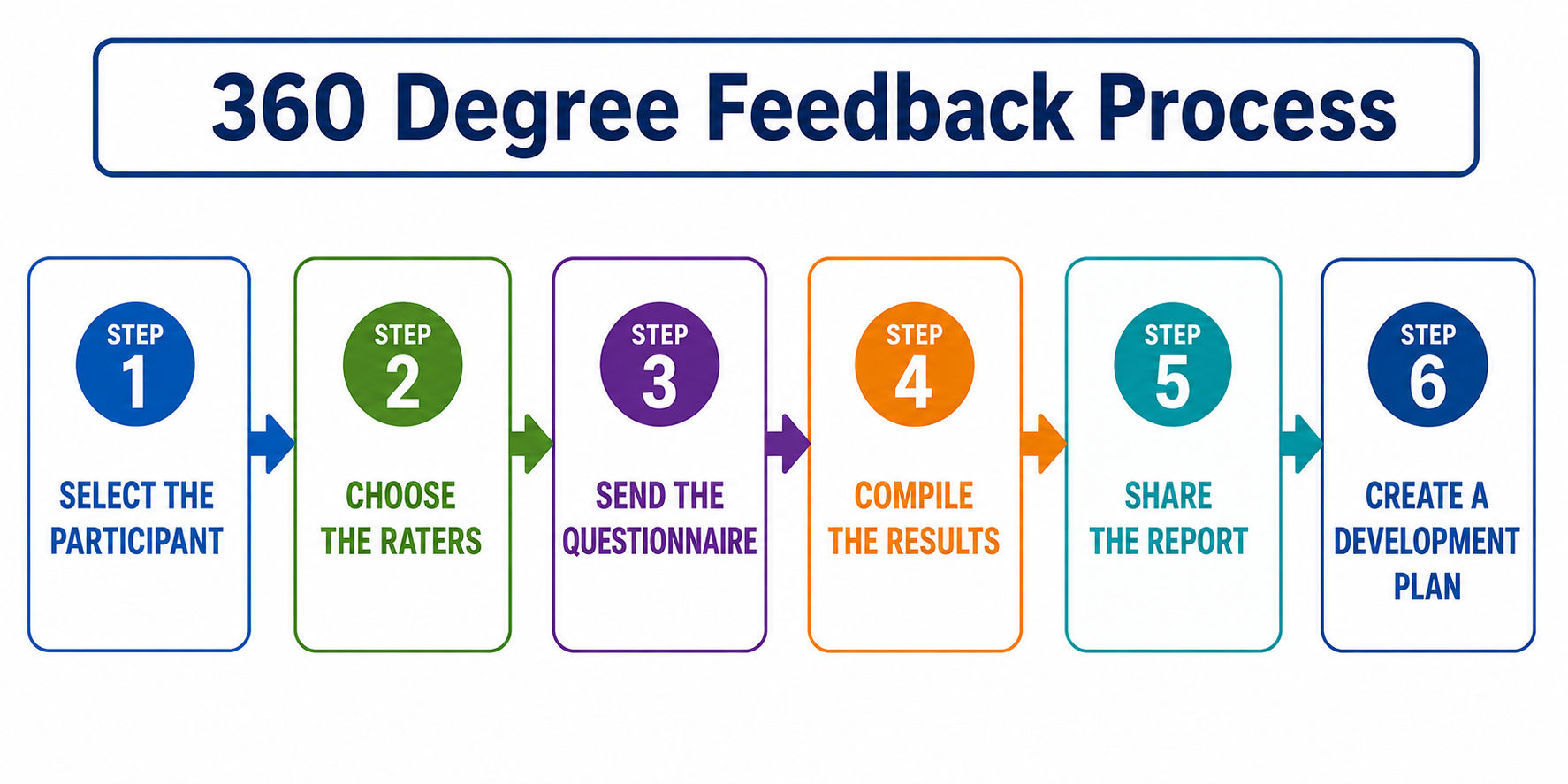
The system typically follows these steps:
Step 1: Select the participant. Find the employee who will receive feedback. This person is called the subject or ratee.
Step 2: Choose the raters. The subject, their manager, peers, and direct reports are invited to participate. In some cases, external clients are included.
Step 3: Send the questionnaire. Each rater completes a structured 360 degree feedback questionnaire. Responses are usually anonymous to encourage honesty.
Step 4: Compile the results. A 360 degree feedback software tool aggregates the responses and generates a report. The data is grouped by rater category so the subject can see patterns.
Step 5: Share the report. The subject reviews their results, often with support from an HR professional or coach.
Step 6: Create a skill development plan. Based on the feedback, the individual sets goals and works on specific skills.
It is not a replacement for performance appraisals. It is a development tool. Used correctly, it supports growth. Used incorrectly (such as tying it to promotions or pay decisions), it can damage trust and produce biased results.
A good 360 degree feedback system is confidential, consistent, and tied to clear development goals and not just bureaucratic box-ticking.
Also read: Self-Evaluation: Meaning, Best Examples & Pro Tips (2025)
Management Courses to upskill
Explore Management Courses for Career Progression
IIIT-B & IIM, Udaipur
Chief Technology Officer & AI Leadership ProgrammeSeeing real feedback examples makes it easier to understand how this works in actual workplaces.
A senior manager at a tech company is enrolled in a leadership program. Their team, peers, and two skip-level managers are asked to rate them on communication, decision-making, and team support.
The results show that peers rate their collaboration highly, but direct reports feel they do not receive enough recognition. Armed with this insight, the manager sets a goal to give more specific, timely praise to their team.
Without 360 degree feedback, this blind spot might never have surfaced.
An HR team uses a 360 degree feedback system twice a year for all team leads. Instead of just reviewing sales targets, the questionnaire also captures data on collaboration, problem-solving, and communication.
One team lead scores well on results but low on "keeps the team informed during changes." This specific feedback helps them focus on communication practices during the second half of the year.
A company promotes an individual contributor to a management role. After six months, they run a 360 degree feedback cycle to assess how the transition is going. Peers notice strong subject-matter expertise but point out difficulty in delegating. The manager now knows what to work on, rather than guessing.
| Weak Feedback | Strong Feedback |
| "Good communicator" | "Explains complex ideas clearly in team meetings" |
| "Not a team player" | "Tends to work independently without updating the team on progress" |
| "Hard worker" | "Consistently meets deadlines even under tight timelines" |
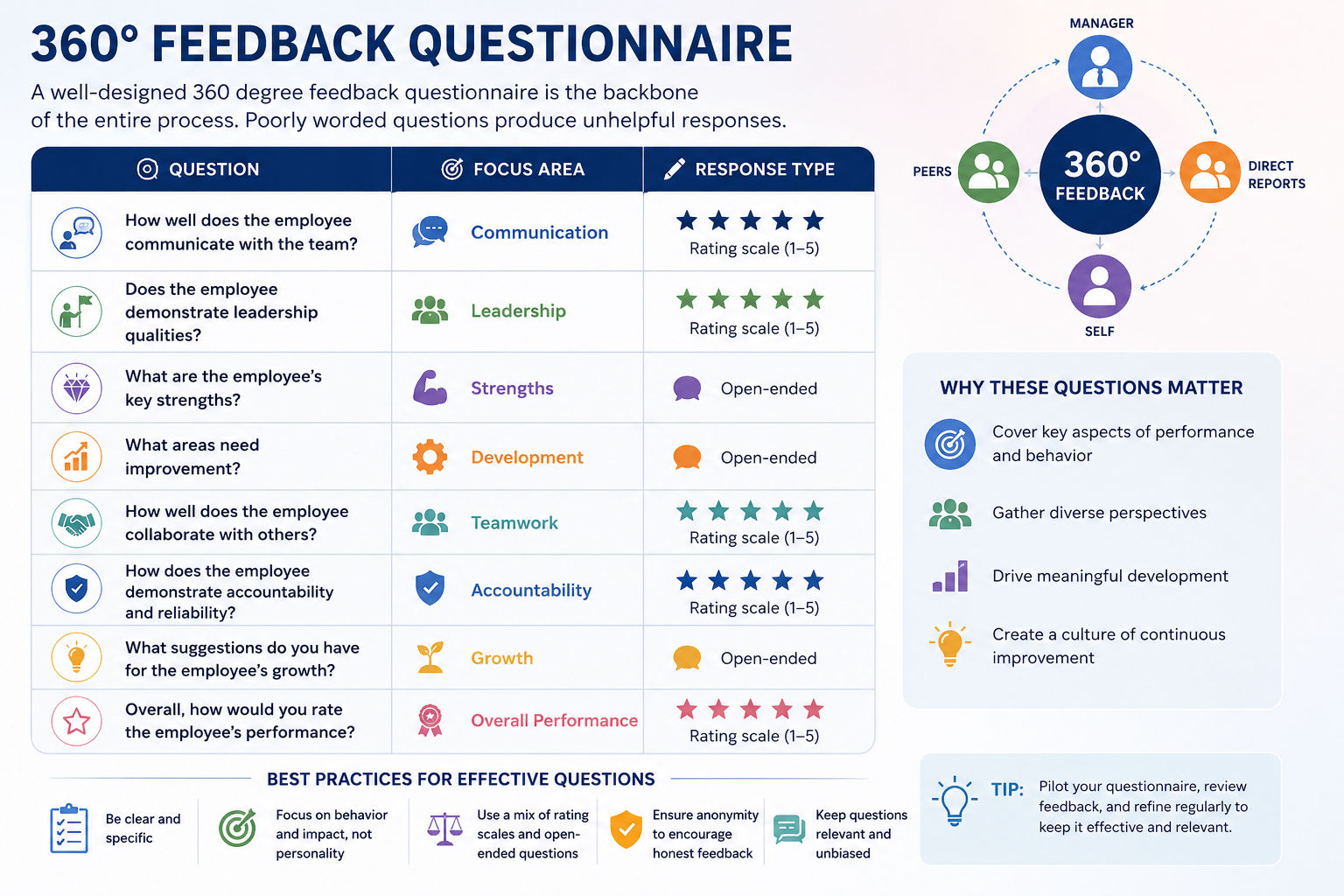
A well-designed 360 degree feedback questionnaire is the backbone of the entire process. Poorly worded questions produce unhelpful responses.
| Question | Focus Area | Response Type |
| How well does the employee communicate with the team? | Communication | Rating scale (1–5) |
| Does the employee demonstrate leadership qualities? | Leadership | Rating scale (1–5) |
| What are the employee’s key strengths? | Strengths | Open-ended |
| What areas need improvement? | Development | Open-ended |
Also read: How To Set Short Term Career Goals To Improve Your Career
Running a 360 degree feedback system manually with spreadsheets and emails is messy, slow, and hard to keep anonymous. A dedicated 360 degree feedback software tool makes the whole process smoother.
Before picking a tool, check for these features:
Most tools offer free trials. It is worth testing two or three before committing. Here are some popular tools you can use:
| Tool | Best For | Key Feature |
| Culture Amp | Mid to large enterprises | Strong analytics and benchmarking |
| Leapsome | Continuous performance management | Integrates goals and feedback |
| Lattice | Growing teams | Easy UI and manager coaching tools |
| SurveyMonkey | Custom surveys on a budget | Flexible question builder |
| Qualtrics | Enterprise-level organisations | Advanced data analytics |
| 15Five | Weekly check-ins and development | Combines pulse surveys with 360 |
Also read: Understanding Motivation Theory in Management: Key Insights
Having a 360 degree feedback system in place is a good start. But how you design and run it determines whether people find it useful or just another HR exercise. These best practices help organizations get real value from the process.
The quality of your 360 degree feedback questionnaire directly impacts the quality of the feedback you receive. A well-designed questionnaire gives raters clear, focused prompts they can respond to honestly.
Confidentiality is what separates honest feedback from polite, surface-level responses. If raters fear their input will be traced back to them, the entire process loses its value.
Collecting feedback is only half the job. What happens after the results are shared is what drives growth.
Also read: Top 10 Simple Ways to Improve Your Time Management Skills
360 degree feedback gives employees and organizations something most traditional reviews cannot. A complete, multi-perspective view of how someone works, leads, and communicates. When set up correctly with a clear process, a well-designed questionnaire, and the right software, it becomes one of the most powerful tools in any HR or learning and development strategy.
If you are thinking about implementing a 360 degree feedback system in your organization, start small. Run a pilot with one team, gather learnings, and refine your process before scaling.
Book a free consultation with upGrad today and discover the right path to strengthen your leadership and career.
Yes, most organizations keep 360 degree feedback anonymous to encourage honest responses. Anonymous feedback reduces fear of conflict and helps employees receive more genuine opinions from peers, managers, and team members participating in the evaluation process.
A performance appraisal is typically a top-down assessment conducted by a manager. 360 degree feedback, on the other hand, collects input from multiple sources including peers, direct reports, and sometimes customers. While appraisals often focus on results, 360 feedback focuses more on behaviors, skills, and interpersonal effectiveness.
Most experts recommend between 5 and 10 raters per person. More than ten can become difficult to manage and may reduce the quality of responses. The goal is enough perspectives to paint a complete picture without overwhelming participants.
Yes, anonymity is strongly recommended. When raters know their responses are confidential, they are far more likely to give honest, useful feedback. Without anonymity, many people default to safe, vague responses to avoid conflict or damaging relationships.
It is not advisable to use 360 degree feedback data for high-stakes decisions like promotions or pay raises. Doing so can distort responses, as raters may adjust their answers based on whether they want to help or hinder someone's career. This tool works best when used purely for development and coaching purposes.
Most organizations run feedback once or twice a year. Running it too frequently leads to survey fatigue and lower-quality responses. Once a year is a good baseline for most teams. Some companies run a lighter mid-year pulse check and a more comprehensive cycle at the end of the year.
Common skills assessed in a questionnaire include communication, collaboration, leadership, problem-solving, accountability, and adaptability. The specific competencies measured should align with your organization's values and the role requirements of the person being assessed.
The best response to critical feedback is curiosity, not defensiveness. Start by looking for patterns and if multiple raters mention the same issue, it is worth taking seriously. Discuss the feedback with a manager or coach to understand it better.
Using software is essential for managing the high volume of data generated during reviews. It automates the distribution of surveys and ensures that all responses remain strictly anonymous. The software also creates visual reports that make it easy for employees to understand their results.
Yes, 360 degree feedback can improve employee performance when used correctly. Employees gain clearer insights into their strengths and weaknesses, allowing them to work on communication, leadership, collaboration, and professional development in a more focused way.
It improves culture by promoting a sense of transparency and continuous learning. When this feedback system is implemented fairly, it shows that the company values everyone's voice. It encourages employees to support one another and helps leaders stay grounded and aware of their team's needs and morale.
1011 articles published
We are an online education platform providing industry-relevant programs for professionals, designed and delivered in collaboration with world-class faculty and businesses. Merging the latest technolo...
Get Free Consultation
By submitting, I accept the T&C and
Privacy Policy
Top Resources
Certification
3 Months
Certification
6 Months
O.P. Jindal Global University
Masters in International Accounting and Finance (Accredited by ACCA, UK)Master's Degree
12 Months