Management Courses

    Flexible, specialized training for aspiring leaders and professionals

    Options from self-paced certificates to paid postgraduate programs

    Covers strategic management, leadership, product management & AI

    Learn from 12+ world-class industry experts

Learner count

6K+

Avg. pay hike

53%

Top pay hike

567%

Talk to a Counsellor

By clicking, I accept the T&C and Privacy Policy

Our Top University Partners

Learn by Doing in Management Projects

2+

Projects

image
Our Programs are Accredited
Best-in-class content by leading faculty and industry leaders in the form of videos, cases and projects, assignments and live sessions
accredition image
accredition image
accredition image
right-top-arrowleft-top-arrow

What Our Learners Have To Say

Learn From The Best

12

Instructors

Services to Help You Achieve Your Goal through Management Training Courses

Industry Expert Guidance
Receive unparalleled guidance and feedback from industry mentors

    Interactive Live Sessions with leading industry experts covering curriculum + advanced topics

video thumbnail image
play

Management Blogs You Might Like To Read

Management Course Overview

In a world of rapid change - whether it’s digital disruption, remote/hybrid teams, global supply-chains, or evolving business models - organizations need leaders who can adapt, strategise and steer growth. That’s why management education has become one of the most important career investments in 2026.

Whether you’re a student gearing up for your first leadership role, a working professional moving up to middle/senior management, or an entrepreneur looking to scale your business - a management course can deliver the strategic insight, business acumen, and leadership mindset you need.

Management Course Eligibility Criteria

While specific eligibility depends on the institute and level, typical criteria look like:

Educational Qualification:

  • A bachelor’s degree (in any stream) from a recognised university.
  • For postgraduate/advanced programs: some work experience may be preferred or required.

Technical & Professional Skills:

  • Basic business understanding (commerce, management, economics) is helpful
  • Communication, teamwork and analytical thinking are valued
  • For senior/exec programs: prior work experience (3-5+ years or more) may be expected

Professional Eligibility:

  • Working professionals from functions such as operations, marketing, finance, HR, supply-chain wanting to upskill or move into strategy/leadership roles
  • Fresh graduates seeking management training and business foundation

Signs that Management Course is the Right Choice for You

If you’re someone who enjoys problem-solving, working with teams, leading initiatives and making strategic decisions - a management course could be a strong fit.

You should pursue a Management course if you:

Because it helps you to:

Like managing people, projects or processes

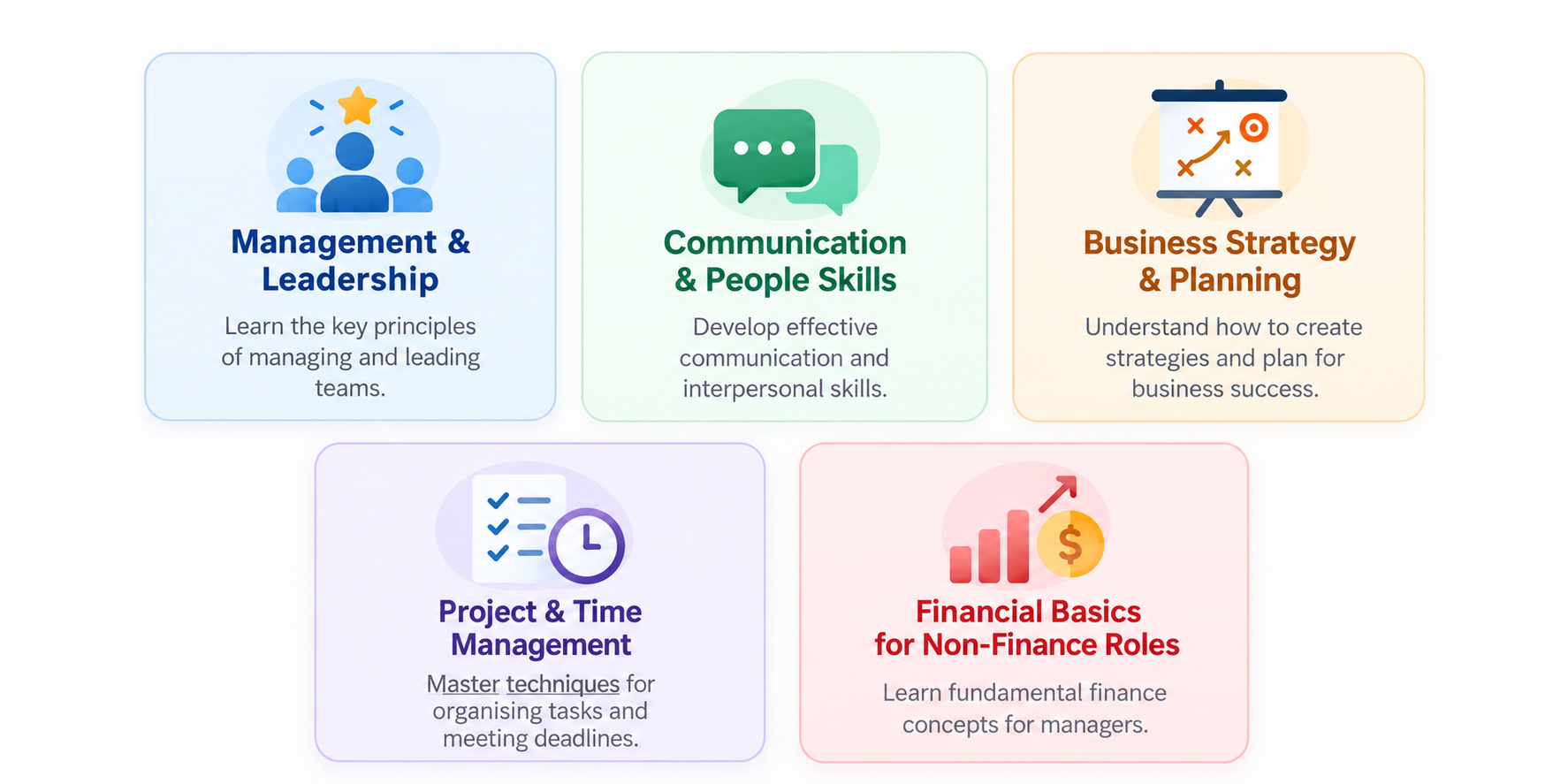
Acquire leadership, decision-making and team management skills

Enjoy looking at the “big picture” rather than only technical details

Develop strategic thinking, business modelling and operations insight

Want a flexible, high-impact career

Transition into roles across industries and business functions

Are from a non-management background

Bridge into business-leadership with structured frameworks and credentials

Top Reasons to Learn Management in 2026

Upskilling with an online management course today can give you a powerful advantage, helping you build leadership capabilities, understand business fundamentals, and transition into high-impact roles across industries.

Here’s why strengthening your management skills matters more than ever:

1. Leadership & Strategic Demand

Organizations are increasingly looking for professionals who can do more than execute -they need leaders who can manage change, digital transformation, cross-functional teams, and global operations. Online management courses give you access to those leadership skills and frameworks.

2. Strong Career & Salary Growth

Management credentials often correlate with significant salary growth and career elevation. For example, online-management programs emphasise salary hike potential and leadership roles.

3. Applicability Across Industries

Management skills are universal - whether it’s finance, marketing, HR, operations, supply chain or product. This makes a management qualification highly versatile.

4. Real-World Problem Solving

Management courses often include projects, case studies and capstones where you apply strategic frameworks to real organizational challenges - not just textbook theory.

5. Competitive Edge in a Shifting Job Market

India’s management field is expanding quickly, growing at a 12-15% CAGR between 2020 and 2026, mainly because businesses are adopting digital tools, entering global markets, and building new ventures. As companies evolve, they need managers who can handle change, lead teams, and make smart business decisions.

Management Course Fees and Duration

When selecting a management course in India, cost and timeline are key considerations:

Type of Course

Average Fees (INR)

Duration

Online Certificate / Short-Term

1,50,000 – 4,00,000

3–6 months

PG / Advanced Diploma

4,00,000 – 8,00,000

6–12 months

Executive/Full-Master Level

8,00,000 – 12,50,000

12-18 months or more

Duration breakdown:

  • Short-term programs (weeks to 6 months): Ideal for working professionals seeking quick upskilling.
  • Mid-term (6-12 months): More comprehensive, good for career transition.
  • Long-term/master-level (12+ months): Structured for in-depth business mastery and leadership readiness.

Key Factors to Choose the Best Management Course in India

Choosing an online management course can be tricky because there are countless options, formats, and certifications out there. Instead of looking for “the best,” focus on finding a program that fits your goals, learning pace, and time commitments.

Here’s an easy breakdown to help you make the right choice

1. Check the Curriculum

A robust program should cover:

  • Business fundamentals: strategy, marketing, finance, HR, operations
  • Leadership and organizational behaviour
  • Data-driven decision making and business analytics
  • Real-world case studies and capstone projects

2. Evaluate Mode and Flexibility

  • Can you balance your work and study?
  • Are there live sessions + self-paced modules?
  • Is there mentor support and peer collaboration?

3. Certification & Recognition

  • Look for courses with recognised university partners, industry mentors.
  • Alumni success and placement support matter.

4. Career Support & Network

  • Does the program offer career services, interview prep, mentorship, networking?

5. Reviews & Outcomes

  • Check student testimonials, transitions into leadership roles.
  • Consider which specialization fits your goals (marketing, HR, finance, analytics).

Management Course Syllabus Breakdown

A well-structured online management course is designed to help you grow from a beginner to a confident, industry-ready management professional.

Here’s a clear breakdown of the topics and skills you’ll develop along the way:

1. Foundations of Business & Management

  • Business strategy & models
  • Organizational behavior, leadership, team dynamics
  • Marketing fundamentals and brand building

2. Finance & Accounting for Managers

  • Budgeting, financial statement analysis, investment decisions
  • Risk management, corporate finance basics

3. Operations, Supply Chain & Analytics

  • Operations strategy, supply-chain optimisation, logistics
  • Analytics for business decisions, dashboards, BI tools

4. Human Resources & Change Management

  • Talent acquisition, learning & development, performance management
  • Managing change, leadership, culture in organizations

5. Data-Driven Decision Making & Business Intelligence

  • Data analysis for executives, Excel/BI tools, interpreting metrics
  • Decision-making frameworks, scenario planning

6. Industry Case Study

  • Apply learning to practical business challenge
  • Strategy formulation, business recommendation, leadership presentation

7. Soft Skills & Leadership

  • Communication, negotiation, stakeholder management
  • Problem-solving, critical thinking, global business mindset

Management Career Opportunities and Job Roles

Completing an online management course can open doors to a wide range of career opportunities across sectors. As companies look for professionals who can lead teams, streamline operations, and drive business growth, strong management skills have become more valuable than ever.

Whether you're just starting your career or aiming to move into a leadership role, an online management certification can help you grow faster and take on bigger responsibilities.

1. Popular Job Roles After a Management Course

Here’s a snapshot of the in-demand management roles in India and globally:

Job Role

Average Base Pay in India* (INR)

Business Analyst

6 LPA

Business Manager

10 LPA

Operations Manager

9 LPA

Marketing Manager

12 LPA

HR Manager

8 LPA

Consulting Associate

7 LPA

General Manager / Senior Leadership

34.8 LPA

*Figures are indicative and vary by experience, function and industry.

Source: Glassdoor

2. Industries Hiring Management Professionals

Management skills are in demand across sectors, offering diverse career options:

  • E-Commerce & Retail: Managing growth, operations & logistics
  • Finance & Banking: Strategy, risk, business units
  • IT & Technology: Product operations, management, change leadership
  • Healthcare & Pharma: Operations, strategic growth, management
  • Manufacturing & Supply Chain: Process optimisation, plant leadership

3. Career Growth and Progression

Management offers a clear growth path, from entry-level roles to senior leadership:

Career Stage

Typical Roles

Entry Level

Business Analyst, Management Trainee

Mid Level

Manager – Operations/Marketing/HR, Consultant

Senior Level

Head of Function, Senior Manager – Strategy

Leadership

VP – Operations, Strategy Director, General Manager

Essential Resources to Navigate Your Management Journey 

If you’re aspiring to step into leadership, business strategy, or entrepreneurship, these resources will help you make informed choices about your management career. From understanding the syllabus and eligibility to exploring fees, placements, salaries, and job roles - each link gives you practical insights into what to expect in 2026. Whether you’re a fresher or a working professional aiming for a managerial transition, these guides will help you plan your next move.

  • A management course typically covers subjects like marketing, finance, operations, HR, business analytics, and leadership - providing a holistic foundation in business administration. Understanding the syllabus helps you choose a specialization that aligns with your career goals.
    Explore the detailed syllabus here: Management Course Syllabus
  • Most management programs are open to graduates from any discipline, but candidates with strong analytical, communication, or leadership skills tend to thrive. Knowing the eligibility criteria ensures you select the right course level — from diploma to MBA or executive programs.
    See detailed eligibility criteria here: Management Course Eligibility
  • Management course fees in India generally range from INR 1 lakh to INR 10 lakh depending on the institute, duration, and program format (online, hybrid, or full-time). Understanding costs and timelines helps you invest wisely in a course that fits your career aspirations.
    Check detailed fees and duration here: Management Course Fees & Duration
  • Courses offering placement assistance, mentorship, and networking opportunities with industry professionals can greatly enhance your career growth in management.
    Learn more about placement-driven programs here: Management Courses with Placement
  • The average base pay of a Business Manager in India is around 10 LPA, depending on experience, specialization, and industry (according to Glassdoor). Reviewing salary trends can help you assess your potential career growth and ROI.
    Explore detailed salary insights here: Management Salary in India
  • Roles like Product Manager, Operations Head, and Business Development Manager are among the highest-paying management jobs in India in 2026, reflecting the growing demand for strategic thinkers and decision-makers.
    Discover top-paying roles here: Top Management Jobs in India 2026

City-Wise Management Courses

Discover Management courses curated for freshers, working professionals, and career switchers, and explore curriculum highlights, required skills, and learning outcomes offered.

Here are the Management courses we offer in Bangalore:

Discover the Right Management Skills for You

If you’re looking to start or grow your career in management, this guide helps you quickly understand what each specialization teaches, the skills you’ll gain, and the types of roles you can pursue. Whether you’re new to management or upskilling, it makes exploring your options simple and practical.

Key management skills:

  • Learn how customers make decisions and how businesses can influence buying patterns. Gain insights into behavioral trends and decision-making frameworks to improve marketing and management strategies. 
    See full details here: Consumer Behaviour 
  • Understand logistics, procurement, and inventory planning to optimize end-to-end supply operations. Learn techniques to improve efficiency, reduce costs, and ensure timely delivery of products and services. 
    Explore this specialization in detail: Supply Chain Management 
  • Gain skills in financial modeling, budgeting, and evaluating business performance for informed decisions. Learn to interpret financial statements, assess investments, and support strategic planning. 
    Check detailed insights here: Financial Analysis 
  • Explore how technology is transforming banking, payments, and financial services. Understand innovations in digital finance, blockchain, and emerging financial solutions. 
    Learn more about this skill here: Introduction to FinTech 
  • Use data to enhance talent management, recruitment, and employee engagement strategies. Learn to analyze workforce trends and improve organizational effectiveness. 
    Discover the full syllabus here: HR Analytics 
  • Build core communication skills for professional and managerial effectiveness. Learn to convey ideas clearly, write professionally, and present with confidence. 
    Find detailed insights here: Fundamentals of Communication 
  • Learn advanced strategies to communicate persuasively in business settings. Develop skills in negotiation, storytelling, and executive-level presentations. 
    Check out here: Art of Effective Communication 
  • Understand research design, data collection, and analysis for informed business decision-making. Learn to interpret results and present actionable insights. 
    Explore this skill in detail: Introduction to Research Methodology 
  • Gain practical sales skills to improve client acquisition and revenue growth. Learn effective pitching, negotiation, and customer relationship strategies. 
    Read more about this specialization here: Mastering Sales Technique 
  • Learn writing, reporting, and storytelling techniques applicable to business communications. Build skills in creating clear, compelling, and professional content. 
    Get detailed insights here: Fundamentals of Journalism 
  • Understand key economic concepts and their impact on business strategy and markets. Learn macro and microeconomic principles to make informed management decisions. 
    Explore details here: Economics Masterclass 
  • Learn the fundamentals of microeconomic theory and its application in managerial decisions. Understand supply, demand, pricing, and market behavior for better strategic planning. 
    See insights in detail here: Introduction to Microeconomics 

From Learning to Leadership: Key Management Job Roles

Management courses prepare learners for a wide range of business, finance, sales, and leadership roles across industries. Understanding these job roles helps you align your learning with real-world responsibilities, required skills, and long-term career growth. Below is a quick overview of some of the most in-demand management roles today.

  • Manages organizational operations, business strategy, team coordination, and performance tracking to achieve short- and long-term business goals. Learn more about responsibilities, skills, and career progression in this role: business management job description.
  • Builds and manages online and offline communities by driving engagement, content strategy, brand advocacy, and stakeholder communication to strengthen customer relationships. Explore role expectations and required skills: community manager job description.
  • Focuses on client acquisition, relationship management, negotiations, and revenue generation while tracking sales performance against business targets. Understand key responsibilities and growth opportunities: sales executive job description.
  • Handles invoicing, collections, credit control, and reconciliation processes to ensure healthy cash flow and financial accuracy within an organization. Get detailed role insights here: AR job description.
  • Oversees financial reporting, compliance, budgeting, internal controls, and financial governance to support strategic decision-making at the leadership level. Learn about this role in detail: financial controller job description.
  • Identifies, assesses, and mitigates financial and operational risks using data analysis, risk models, and regulatory frameworks to protect business interests. Explore responsibilities and career scope: risk analyst job description.
  • Supports business decisions through financial modeling, forecasting, reporting, and data-driven insights across investments, operations, and strategy. Understand the role and required skills: financial analyst job description.
  • Leads financial planning, budgeting, performance monitoring, and team management while aligning financial strategy with overall business objectives. Learn more about the role and career path: finance manager job description.
  • Advises organizations on strategy, operations, transformation, and performance improvement using structured problem-solving approaches. Learn about consulting responsibilities and career scope: management consultant job description.

FAQs on Management Course

1What are management courses online?

Online management courses are structured programs that teach business leadership, strategy, operations, finance, and people management through digital learning platforms. Instead of attending a physical campus, learners participate through virtual classes.

These courses usually include:

  • Recorded lectures and live online sessions
  • Assignments and practical exercises
  • Real-world business case studies
  • Interactive discussions and projects

Professionals and graduates choose online management courses because they provide flexibility and allow learning from any location. upGrad management programs also focus on practical and industry-relevant knowledge to help learners develop leadership and decision-making skills.

2What do you learn in an online management course?

A learner studies how businesses operate, grow, and compete in dynamic markets. The curriculum typically covers both foundational business knowledge and applied managerial decision-making. Programs focus on helping learners understand how leaders guide teams, allocate resources, and solve organizational challenges.

Most courses include learning areas such as:

  • Strategic planning and business development
  • Financial analysis and budgeting
  • Marketing and customer behavior
  • Operations and supply chain management
  • Leadership and organizational behavior

Advanced programs also introduce analytics, innovation strategy, and digital transformation. The learning approach connects theory with practical workplace scenarios so professionals can apply concepts immediately.

3What skills are developed through online management courses?

Online management programs build a wide range of professional and leadership competencies. A learner develops both technical business knowledge and interpersonal management abilities required for supervisory and strategic roles.

Common skill outcomes include:

  • Leadership and team coordination
  • Analytical decision-making
  • Business problem-solving
  • Strategic thinking and planning
  • Communication and negotiation
  • Time and resource management

Many programs also strengthen emotional intelligence and conflict resolution capability. These skills prepare professionals to manage teams, improve productivity, and handle complex organizational responsibilities with confidence.

4What are the different types of management courses available online?

Online management education exists in multiple formats designed for different career stages. Learners can choose programs based on depth, duration, and specialization. Short certification courses focus on specific skills, while postgraduate and executive programs provide broader managerial training.

Common program categories include:

  • Short-term skill certifications
  • Executive leadership programs
  • Postgraduate diplomas
  • Master’s degrees in management or business
  • Specialized domain certifications

Some programs focus on general management, while others target functions such as HR, finance, operations, or analytics. This variety allows learners to select training aligned with career goals.

5Can beginners take management courses online?

Yes. Many online management courses are designed for beginners with no prior business background.

Beginner programs usually start with:

  • Basic management and organizational concepts
  • Decision-making fundamentals
  • Workplace communication and leadership basics

Lessons are structured step by step so learners can gradually build knowledge through examples and practical exercises. upGrad management programs also offer beginner-friendly learning paths that help new learners build strong business foundations and move toward professional management roles.

6Do you need a degree to enroll in a management course online?

It depends on the level of the course.

  • Short certification courses often accept learners without a formal degree because they focus on skill development.
  • Postgraduate diplomas and master’s programs usually require a bachelor’s degree.
  • Executive management programs may also expect professional work experience.

Eligibility requirements vary by institution. Learners should review the admission criteria before enrolling in programs such as upGrad online management courses.

7How long does an online management course take?

The duration of an online management course depends on the program level and learning format.

Typical timelines include:

  • Short certification programs: a few weeks to a few months
  • Professional diploma programs: about 3–12 months
  • Master’s programs: around 1–2 years

Self-paced courses allow faster completion, while instructor-led programs follow fixed schedules. upGrad management programs offer flexible learning formats so professionals can study alongside their jobs.

8Are management courses online self paced or instructor led?

Online management courses are available in both self-paced and instructor-led formats.

  • Self-paced courses allow learners to study according to their own schedule, which works well for busy professionals.
  • Instructor-led programs follow structured timelines with live classes, deadlines, and interaction with faculty.

Many upGrad management programs use a blended format that combines recorded lectures for flexibility with live sessions for discussion and mentorship.

9How do online management courses differ from traditional classroom programs?

Online and classroom programs differ mainly in delivery format and flexibility. Online courses allow learners to study remotely and manage schedules independently. Classroom programs require physical attendance and fixed timetables.

Online learning often emphasizes:

  • Digital collaboration tools
  • Flexible learning schedules
  • Remote networking opportunities
  • Immediate workplace application

Traditional programs provide campus experience and face-to-face interaction but may limit scheduling flexibility. Both formats can deliver strong academic outcomes when curriculum quality and faculty expertise remain high.

10Is online learning effective for management education?

Online learning effectively supports management education when programs include structured curriculum, interactive sessions, and practical application. Many professionals benefit from applying concepts directly to their workplace while studying. This real-time application often improves understanding and retention.

Modern digital platforms offer collaborative learning, live discussions, simulations, and project-based assessments. These features create an engaging environment similar to classroom interaction. Effectiveness ultimately depends on program quality, learner discipline, and active participation in assignments and discussions.

11Are management courses online recognized by employers?

Employers widely recognize online management courses when reputable institutions deliver them and the curriculum reflects industry needs. Organizations focus on demonstrated skills rather than learning format. A candidate who shows strong leadership ability and practical knowledge gains professional credibility.

Recognition increases when programs include:

  • Industry-relevant curriculum
  • Applied projects or case studies
  • Faculty with business experience
  • Accredited institutional partnerships

Employers value continuous learning and professional development. Many companies actively encourage employees to pursue online management education.

12How do employers view online management qualifications?

Employers evaluate online management qualifications based on relevance, credibility, and skill outcomes. They assess whether the program teaches applicable knowledge that improves job performance. Recruiters often review project experience, leadership exposure, and specialization rather than focusing only on certification format.

When a professional demonstrates improved decision-making, strategic thinking, and managerial competence, employers consider the qualification valuable. Many organizations now view online education as a standard part of professional development.

13Are online courses less valuable than on campus programs?

No. Online courses are not less valuable than on-campus programs. The value depends on the curriculum quality, institutional reputation, and practical learning outcomes.

Well-designed online programs can provide:

  • Strong academic content
  • Real-world projects and case studies
  • Mentorship and industry interaction

Many professionals choose online programs such as those offered by upGrad because they can apply new skills directly in their workplace while continuing their careers. Employers usually focus on demonstrated skills rather than the learning format.

14Do top universities offer online management courses?

Yes, many leading universities actively offer online management programs to expand access for working professionals. They design flexible yet academically rigorous courses that learners can complete remotely while gaining globally recognized credentials.

Through partnerships with upGrad.com, learners can enroll in industry-relevant university programs such as:

  • Master of Science in Business Management and Technology by Paris School of Business
  • MSc in International Accounting & Finance from O.P. Jindal Global University, accredited by ACCA

These programs combine expert faculty teaching, practical projects, and globally aligned curriculum, ensuring strong academic credibility and career relevance.

15Which online management course offers certification?

Many online management courses provide certification after learners complete coursework and assessments.

Examples from upGrad include:

These programs award recognized certificates that help demonstrate management skills and professional training to employers.

16Are there free management courses online with certificates?

Yes. Some platforms offer free management courses with certificates that help learners explore basic business and leadership concepts.

Examples include:

These short courses help learners understand foundational management and marketing concepts before moving to advanced programs. Many professionals later enroll in structured upGrad management programs for deeper training and career development.

17Is an online management course worth it?

An online management course becomes worthwhile when it improves career progression, leadership capability, or earning potential. Many professionals use these programs to transition into managerial roles or expand strategic responsibility. Value increases when programs include real-world projects and recognized certification.

Return on investment depends on factors such as:

  • Career growth after completion
  • Skill relevance to industry demand
  • Salary progression
  • Networking opportunities

When a learner actively applies acquired knowledge in professional settings, the long-term benefits often justify the investment.

18What common myths exist about online management learning?

Several misconceptions surround online management education. Some people believe online learning lacks academic rigor or employer recognition. Others assume it does not provide networking or practical exposure. Modern programs contradict these assumptions.

Well-designed online management courses include live faculty interaction, collaborative projects, and real business case analysis. Many institutions maintain the same curriculum standards as campus programs. Learners often interact with peers from diverse industries, creating strong professional networks. Quality depends on program design rather than delivery mode.

19What are the best platforms for online management courses?

The best platforms for online management courses usually partner with reputable universities and provide structured learning with career-focused support.

Strong platforms typically offer:

  • Industry-relevant curriculum
  • Mentorship and expert faculty guidance
  • Practical projects and case studies
  • Career services such as resume guidance and networking

upGrad offers management programs in collaboration with global universities and focuses on practical business learning designed for working professionals.

20How does a learner choose the right online management course?

A learner should evaluate personal career goals before selecting a program. Course content must align with desired specialization and industry demand. Program structure, flexibility, and institutional credibility also influence decision-making.

Important selection factors include:

  • Career objectives and role aspirations
  • Program duration and time commitment
  • Faculty expertise and institutional reputation
  • Curriculum depth and specialization
  • Financial investment and ROI

A structured evaluation ensures that the chosen program supports long-term professional growth.

21Which courses are best for leadership development?

Leadership-focused management programs help professionals build decision-making authority, team management capability, and strategic vision. These courses teach how leaders motivate employees, manage organizational change, and guide business growth.

Leadership development programs often include:

  • Organizational behavior analysis
  • Strategic thinking frameworks
  • Conflict resolution techniques
  • Executive communication skills

Professionals preparing for supervisory or senior roles benefit most from structured leadership training.

22What are the best online management courses for tech professionals?

Technology professionals benefit from management programs that connect technical expertise with business strategy. Courses focusing on product management, digital transformation, and business analytics help engineers and IT specialists move into leadership roles.

Relevant learning areas include:

  • Technology-driven business strategy
  • Data-based decision-making
  • Product lifecycle management
  • Innovation leadership

These programs help technical professionals understand market needs and manage cross-functional teams effectively.

23Can a learner combine multiple short online management courses into a career path?

Yes. Many professionals build expertise by completing multiple short online management courses over time. This approach helps learners gradually develop specialized skills in different areas.

Learners may combine courses in:

  • Leadership and team management
  • Business analytics and data-driven decision making
  • Strategy and business growth

Stacking certifications creates a structured learning path and shows continuous professional development. upGrad management courses allow learners to build skills step by step and strengthen their career prospects.

24How are online management courses structured?

Most programs organize content into modules that progress logically from foundational concepts to advanced applications. Each module includes lectures, assignments, and assessments designed to evaluate understanding.

Typical course structure includes:

  • Video lectures and reading material
  • Practical assignments and projects
  • Case study analysis
  • Quizzes and evaluations

Structured progression ensures systematic skill development and measurable learning outcomes.

25Are there live sessions or only recorded lectures?

Many online management courses include both recorded lectures and live interactive sessions.

Learners usually receive:

  • Recorded lectures for flexible learning and revision
  • Live classes or workshops for discussions and concept clarification
  • Q&A sessions and case study analysis with faculty

This blended format allows flexibility while still providing structured interaction. upGrad management programs also follow this approach to support both convenience and active learning.

26How are assignments and assessments conducted?

Online management courses evaluate learners through practical and theoretical assessments. Assignments often require analysis of business scenarios, strategic planning exercises, and data interpretation tasks. Some programs also include presentations and peer-reviewed projects.

Assessment methods may include:

  • Case study reports
  • Individual projects
  • Online quizzes
  • Group assignments

Evaluation focuses on practical understanding rather than memorization.

27Are online exams proctored?

Many institutions conduct proctored examinations to ensure academic integrity. Digital proctoring systems monitor exam environments through secure software. These tools verify identity and prevent unfair practices.

Proctored exams maintain academic credibility and ensure fair evaluation standards comparable to traditional institutions.

28Do online courses include group projects and peer interaction?

Yes. Many structured online programs include collaborative learning activities.

Key elements include:

  • Group projects that simulate real workplace teamwork
  • Discussions to solve business or strategy problems
  • Collaborative presentations and project reviews
  • Peer interaction that encourages knowledge sharing
  • Opportunities to connect with professionals from different industries

upGrad online programs also include group activities and peer discussions to support collaborative learning.

29Can a learner get mentorship while doing an online management course?

Yes. Many online management courses provide academic and industry mentorship to support learners during the program.

Mentorship usually includes:

  • Guidance on complex concepts and course topics
  • Feedback on assignments and projects
  • Career planning and goal setting
  • Insights from experienced professionals

upGrad management programs also include mentorship and academic support to help learners improve their skills and career readiness.

30Are there opportunities to interact with industry professionals?

Structured management programs often invite industry experts to conduct guest lectures, workshops, and masterclasses. These sessions expose learners to real business challenges and emerging industry trends.

Interaction with professionals helps learners understand practical applications of management theory. Networking opportunities may also support career advancement and professional visibility.

31Do platforms provide practical case studies in management courses?

Most structured online management programs include practical case studies as a core learning method. Case studies present real business situations that require analysis, decision-making, and strategic thinking. A learner examines company challenges, evaluates possible solutions, and recommends actions based on management principles.

Case-based learning helps learners:

  • Understand real organizational problems
  • Apply theoretical frameworks to business decisions
  • Develop analytical and strategic thinking
  • Improve problem-solving ability

This approach prepares professionals to handle workplace complexities confidently by practicing decision-making in realistic scenarios before applying it on the job.

32Do management courses include real business simulations?

Many advanced management programs include business simulations that replicate real organizational environments. Simulations allow learners to make strategic decisions in a controlled setting and observe outcomes based on those decisions. These activities help learners understand how market forces, operational constraints, and leadership choices influence business performance.

Simulation exercises often involve:

  • Managing virtual companies or departments
  • Allocating resources and budgets
  • Responding to market changes
  • Competing with simulated competitors

This experiential learning method strengthens decision-making skills and builds confidence in handling complex business situations.

33Do online management programs have deadlines or flexible schedules?

Online management programs may follow either structured timelines or flexible schedules depending on their format. Self-paced programs allow learners to complete modules according to personal availability. Instructor-led programs usually include fixed deadlines to maintain learning progress and discipline.

Structured programs often include:

  • Assignment submission deadlines
  • Scheduled live sessions
  • Exam timelines
  • Module completion targets

Flexible scheduling benefits working professionals, while deadline-driven programs support consistent academic engagement. A learner should choose the format that matches personal time management ability and learning preferences.

34How much weekly time commitment do management courses require?

Weekly time commitment depends on course level, learning format, and academic intensity. Most structured online management programs require approximately 6 to 12 hours of study per week. Intensive executive or degree programs may demand additional time for projects and assessments.

Typical weekly effort includes:

  • Watching lectures and reviewing materials
  • Completing assignments or case studies
  • Participating in discussions or live sessions
  • Preparing for assessments

Learners should plan study schedules carefully to balance academic requirements with professional and personal responsibilities.

35Can a learner access course materials after completion?

Many online management programs allow learners to retain access to course materials after completion. Continued access enables revision, reference, and skill reinforcement. Learners often revisit lectures, case studies, and reading resources when applying concepts in professional settings.

Extended access supports:

  • Long-term knowledge retention
  • Continuous professional development
  • Practical workplace application
  • Preparation for advanced learning

Access policies vary by platform, so learners should confirm availability before enrolling.

36Will a learner study project management in online management courses?

Many management programs include project management fundamentals because organizations rely heavily on structured project execution. Learners study how to plan, implement, monitor, and complete projects efficiently within time and budget constraints.

Key learning areas typically include:

  • Project planning and scheduling
  • Risk identification and mitigation
  • Resource allocation
  • Performance monitoring

Project management training helps professionals coordinate teams, manage deadlines, and deliver results effectively across industries.

37Are strategic management courses available online?

Yes, many online programs specialize in strategic management. These courses focus on long-term business planning and competitive positioning. A learner studies how organizations analyze markets, allocate resources, and design growth strategies.

Strategic management education typically covers:

  • Competitive analysis frameworks
  • Market expansion planning
  • Corporate strategy formulation
  • Organizational decision-making

These courses prepare professionals to take leadership roles that require high-level planning and business direction.

38Do online management courses teach business analytics?

Many modern management programs integrate business analytics because data-driven decision-making has become essential in organizations. Learners study how to interpret business data, identify trends, and make informed strategic choices.

Analytics modules often include:

  • Data interpretation techniques
  • Performance metrics evaluation
  • Forecasting and trend analysis
  • Decision modeling

Learners can also build these skills through specialized options such as Best Free Business Analytics Courses Online with Certificates offered by upGrad.com, which focus on practical data interpretation and business decision-making.

39Are leadership and team building topics included?

Leadership and team development form central components of most management programs. Courses teach how leaders motivate teams, resolve conflicts, and create productive work environments. Learners explore leadership styles and communication strategies that improve organizational performance.

Training commonly includes:

  • Team motivation techniques
  • Conflict resolution methods
  • Performance management practices
  • Collaborative leadership approaches

These skills help professionals guide teams effectively and achieve organizational objectives.

40Will a learner study financial decision making in management courses?

Financial decision-making forms an essential part of management education because leaders must evaluate profitability and allocate resources wisely. Learners study budgeting, cost analysis, and investment evaluation.

Financial training typically includes:

  • Reading financial statements
  • Budget planning and cost control
  • Profitability assessment
  • Investment evaluation techniques

These skills enable managers to make informed financial choices that support business growth and sustainability.

41Are communication skills taught in online management training?

Communication training forms a critical component of management education. Managers must clearly convey ideas, negotiate with stakeholders, and lead teams effectively. Online programs teach structured communication strategies for professional environments.

Training usually covers:

  • Business presentation skills
  • Negotiation techniques
  • Professional writing and reporting
  • Interpersonal communication

Learners can also strengthen professional communication through specialized programs such as the Free Strategic Business Communication Course Online with Certificate offered by upGrad.com, which focuses on real business scenarios and practical communication frameworks.

42Will a learner develop skills for team leadership and people management?

Yes, management programs strongly emphasize people management capability. Learners study how to supervise employees, manage performance, and build productive work cultures.

People management training includes:

  • Employee motivation strategies
  • Performance evaluation methods
  • Conflict resolution approaches
  • Workforce planning

These competencies help professionals manage teams efficiently and support organizational success.

43How do online management courses prepare students for managerial roles?

Online management courses prepare learners by combining theoretical knowledge with practical application. Programs develop leadership thinking, strategic decision-making, and operational management ability.

Preparation includes:

  • Real-world business problem solving
  • Leadership skill development
  • Strategic planning exercises
  • Project-based learning

This structured training equips professionals with the competencies required to supervise teams, manage resources, and guide organizational growth.

44What are the popular online management specializations?

Many learners choose specialization areas aligned with industry demand and career goals. Specializations provide focused expertise within specific business functions.

Popular options include:

  • Human resource management
  • Operations and supply chain
  • Finance and accounting
  • Marketing and strategy
  • Business analytics

Specialization helps professionals develop targeted expertise that supports career advancement.

45What advanced management topics should a learner study after basics?

After mastering fundamentals, learners can pursue advanced topics that address complex organizational challenges. Advanced learning deepens strategic understanding and leadership capability.

Common advanced topics include:

  • Corporate governance
  • Innovation management
  • Global business strategy
  • Digital transformation leadership
  • Organizational change management

Advanced topics prepare professionals for senior leadership roles.

46Are there online management courses for executives?

Yes. Online management courses for executives are designed for experienced professionals who handle strategic leadership and organizational decisions.

These programs usually cover:

  • Strategic leadership frameworks
  • Business expansion and growth planning
  • Corporate governance principles
  • Organizational innovation and transformation

upGrad executive management programs allow senior professionals to learn from industry experts while interacting with peers from leadership roles.

47What courses teach risk management online?

Risk management courses train professionals to identify potential threats and develop mitigation strategies. Organizations rely on risk management to maintain operational stability and regulatory compliance.

Learning areas often include:

  • Financial and operational risk assessment
  • Compliance management
  • Crisis response planning
  • Risk monitoring systems

These programs prepare professionals to anticipate challenges and safeguard organizational performance.

48Are online courses available for supply chain management?

Yes, many programs specialize in supply chain and logistics management. These courses teach how organizations manage procurement, inventory, distribution, and transportation efficiently.

Supply chain training includes:

  • Demand forecasting
  • Inventory control strategies
  • Logistics planning
  • Supplier relationship management

This specialization supports careers in manufacturing, retail, and global trade.

49Do management courses cover performance management systems?

Many management programs include performance management systems, especially those focused on HR and leadership. Learners study how organizations measure employee productivity and implement improvement strategies.

Training typically covers:

  • Performance evaluation frameworks
  • Goal-setting methodologies
  • Feedback systems
  • Productivity monitoring

These skills help managers maintain high performance standards across teams.

50What are popular online certifications for product management?

Product management certifications train professionals to develop and manage products from concept to market launch. These programs combine business strategy, customer research, and product lifecycle management.

Learners typically study:

  • Market analysis techniques
  • Product development processes
  • Pricing strategies
  • Customer experience management

These certifications support careers in technology, consumer goods, and service industries.

51Are there management courses focused on sustainability and CSR?

Yes, some programs focus on sustainability and corporate social responsibility. These courses teach how organizations balance profitability with environmental and social responsibility.

Learning topics often include:

  • Sustainable business practices
  • Ethical governance
  • Environmental impact assessment
  • Social responsibility strategies

These programs prepare professionals to lead responsible and sustainable business initiatives.

52Can a learner take online courses in strategic decision making?

Strategic decision-making courses help professionals evaluate complex business scenarios and select optimal actions. Learners study analytical frameworks that guide long-term planning and organizational growth.

Training typically involves:

  • Scenario analysis
  • Competitive positioning strategies
  • Resource allocation decisions
  • Strategic evaluation models

These skills support leadership roles that require critical thinking and planning.

53What jobs can a learner get after completing an online management course?

Management education opens opportunities across industries. Learners qualify for roles that require leadership, planning, and operational oversight.

Common career paths include:

  • Team leader or supervisor
  • Operations manager
  • Project manager
  • HR manager
  • Business analyst

Job opportunities depend on experience level and specialization. Management training enhances employability and career progression.

54What is the average salary after online management courses?

Salary outcomes vary based on experience, specialization, and industry. In India, professionals who complete structured management training typically earn around ₹5 lakh to ₹20 lakh per year, depending on their role and career stage. Many professionals experience salary growth after gaining management skills because organizations value leadership capability and strategic thinking.

55Do online management certifications help with promotions?

Management certifications demonstrate readiness for increased responsibility. Employers often consider certified professionals for leadership roles because certification confirms structured skill development.

Promotional advantages include:

  • Evidence of professional growth
  • Demonstrated leadership capability
  • Improved decision-making competence
  • Increased managerial credibility

Certification strengthens internal career advancement opportunities.

56Does an online management course help mid career professionals?

Mid-career professionals often use management education to transition into leadership positions. Structured learning helps them upgrade strategic thinking and supervisory skills.

Benefits for mid-career learners include:

  • Career progression into senior roles
  • Skill diversification
  • Leadership development
  • Industry knowledge expansion

Management education supports long-term professional growth and role transition.

57Are online management courses suitable for entrepreneurs?

Entrepreneurs benefit from management training because business success requires structured planning and resource management. Courses teach financial planning, market strategy, and operational efficiency.

Entrepreneurial benefits include:

  • Business growth strategy development
  • Financial management capability
  • Market analysis skills
  • Organizational leadership knowledge

Management education helps entrepreneurs build sustainable and scalable businesses.

58How much do online management courses cost?

Course fees vary depending on academic level, institutional reputation, and program duration. Short certifications generally cost less, while postgraduate or executive programs require higher investment due to extensive curriculum and faculty involvement.

Cost factors include:

  • Program length
  • Institutional accreditation
  • Specialization depth
  • Career support services

Learners should evaluate cost relative to expected career benefits.

59Are online management courses cheaper than traditional degrees?

Online programs often cost less because they eliminate campus infrastructure and relocation expenses. Learners save on travel, accommodation, and daily commuting.

Cost advantages include:

  • Reduced living expenses
  • Flexible payment options
  • Shorter program duration
  • Lower administrative costs

These factors make online management education financially accessible for many professionals.

60Are scholarships or financial aid available for online management programs?

Many institutions provide scholarships, discounts, and financial assistance to support learners. Some programs offer merit-based or need-based funding. Others provide installment payment plans that reduce financial burden.

Financial support options may include:

  • Tuition scholarships
  • EMI payment structures
  • Corporate sponsorship
  • Early enrollment discounts

Financial aid helps learners manage education costs effectively.

61Do employers sponsor online management education?

Some organizations sponsor employee education to develop leadership talent. Companies invest in management training to improve organizational performance and retain skilled professionals.

Employer sponsorship may include:

  • Full or partial tuition reimbursement
  • Study leave support
  • Internal training programs

Professionals should check company learning policies to explore sponsorship opportunities.

62Is a paid online management certification worth the investment?

A paid certification delivers value when it strengthens career prospects and skill relevance. Structured programs provide mentorship, advanced curriculum, and recognized credentials that support professional growth.

Investment becomes worthwhile when it leads to:

  • Promotion opportunities
  • Salary growth
  • Expanded leadership responsibility
  • Improved job security

Outcome-driven evaluation determines true value.

63Are there affordable management courses with certificates?

Yes. Many institutions offer affordable management courses with certificates designed for skill development without a large financial commitment.

Common options include:

  • Short-term certification programs
  • Entry-level management courses
  • Flexible payment or EMI plans
  • Online learning formats

upGrad management courses also provide structured online programs with certification, helping learners upgrade management skills within manageable budgets.

64Do platforms offer flexible payment plans?

Many education providers offer installment-based payment structures to reduce upfront financial burden. Flexible plans allow learners to pay fees over time instead of in a single payment.

Common payment options include:

  • Monthly installments
  • Deferred payment schedules
  • No-cost EMI plans

Flexible payment improves accessibility for working professionals.

65What additional costs should a learner expect beyond tuition?

Some programs may involve additional expenses beyond tuition. These costs vary depending on course structure and institutional policies.

Possible additional expenses include:

  • Examination or certification fees
  • Study materials or software access
  • Optional workshops or events

Learners should review complete fee structure before enrollment.

66Do free courses provide enough value for career growth?

Free courses help you understand basic management concepts and explore your interest in the subject. They usually provide introductory knowledge but may not include advanced training, mentorship, or career support.

Free learning can support:

  • Conceptual understanding
  • Skill exploration
  • Initial career planning

Professionals who want deeper expertise and career progression often choose structured programs such as upGrad management courses.

67What is the return on investment for management courses online?

The return on investment depends on how the course supports your career growth and skill development.

Key factors that influence ROI include:

  • Promotion opportunities in current roles
  • Higher earning potential
  • Expanded professional network
  • Improved leadership and management skills

Programs from upGrad focus on practical business knowledge and leadership development, which can support long-term career growth.

68Can a learner complete online management courses while working full time?

Yes. Most online management courses are designed for working professionals.

Key features include:

  • Flexible schedules that allow study during evenings or weekends
  • Self-paced modules for learning without interrupting work
  • Practical lessons that can be applied directly in the workplace

upGrad management programs follow this flexible format so professionals can continue working while upgrading their management and leadership skills.

69Online management course vs MBA - which is better?

An online management course can be a better option for many professionals because it offers flexible learning and faster skill development. You can learn while continuing your job and focus on specific management skills that are directly useful in your current role.

Online management courses usually provide:

  • Flexible schedules for working professionals
  • Practical business skills and real case studies
  • Faster completion compared to traditional MBA programs
  • Opportunities to specialize in specific management areas

Programs such as upGrad online management courses help professionals build leadership and business skills without taking a career break.

70Do online management courses count toward a degree?

Yes. Some online management courses provide academic credits that may count toward a degree program.

Credit recognition usually depends on:

  • Institutional policies of the university
  • Accreditation status of the program
  • Structure and academic level of the course

Learners should verify credit transfer eligibility before enrolling. upGrad management programs developed with university partners may also offer pathways toward postgraduate diplomas or degree programs.

71Are management courses online good before an MBA?

Online management courses help learners build foundational business knowledge before pursuing an MBA. They introduce essential concepts such as strategy, finance, and leadership.

Preparatory benefits include:

  • Improved academic readiness
  • Better understanding of business fundamentals
  • Stronger confidence in advanced study

Many learners use online courses to confirm interest in management before committing to full-time postgraduate education.

72Can online management courses replace an MBA?

Yes. In many cases, online management courses can serve as an alternative to an MBA, especially for professionals who want practical business skills without committing to a long academic program.

Online management courses usually offer:

  • Focused learning on specific business and leadership skills
  • Faster completion compared to traditional MBA programs
  • Flexibility for working professionals
  • Practical case studies and industry-focused training

Programs such as upGrad online management courses help professionals build leadership, strategy, and business skills that support career growth.

73Do employers prefer certifications or experience over online courses?

Employers generally value a combination of experience and relevant certification. Practical experience demonstrates real-world capability, while certification confirms structured learning and skill validation.

Strong professional profiles typically include:

  • Hands-on work experience
  • Recognized certification
  • Demonstrated leadership ability

Balanced credentials strengthen employability and career progression.

upGrad Learner Support

Talk to our experts. We are available 7 days a week, 10 AM to 7 PM

text

Indian Nationals

text

Foreign Nationals

Disclaimer

1.upGrad does not grant credit; credits are granted, accepted, or transferred at the sole discretion of the relevant educational institution offering the diploma or degree. We advise you to enquire further regarding the suitability of this program for your academic, professional requirements and job prospects before .