What Is Vertex AI?
By Rahul Singh
Updated on May 05, 2026 | 10 min read | 3.29K+ views
Share:

All courses
Certifications
More
By Rahul Singh
Updated on May 05, 2026 | 10 min read | 3.29K+ views
Share:
Table of Contents
Vertex AI is a fully managed platform from Google Cloud that helps you build, deploy, and scale machine learning models and generative AI applications. It brings all key tools into one place, so you can manage the full workflow without switching between services.
It combines features like AutoML, custom model training, and Gemini models in a single interface and API. This helps you move from data to production faster and build real-world AI systems more efficiently.
In this blog, you will learn what vertex AI is, how it works, its key features, use cases, and how to get started.
Build practical AI and ML skills and start creating real applications. Explore upGrad’s Artificial Intelligence courses to learn vertex AI, machine learning, and generative AI tools, and move toward roles in AI development and cloud-based ML systems.
Popular AI Programs
Understanding vertex AI starts with knowing its primary goal. Before this specific technology existed, developers had to use dozens of separate, disconnected software tools. They needed one tool to organize raw data and another entirely different tool to train their models. This made building artificial intelligence incredibly slow, messy, and deeply frustrating.
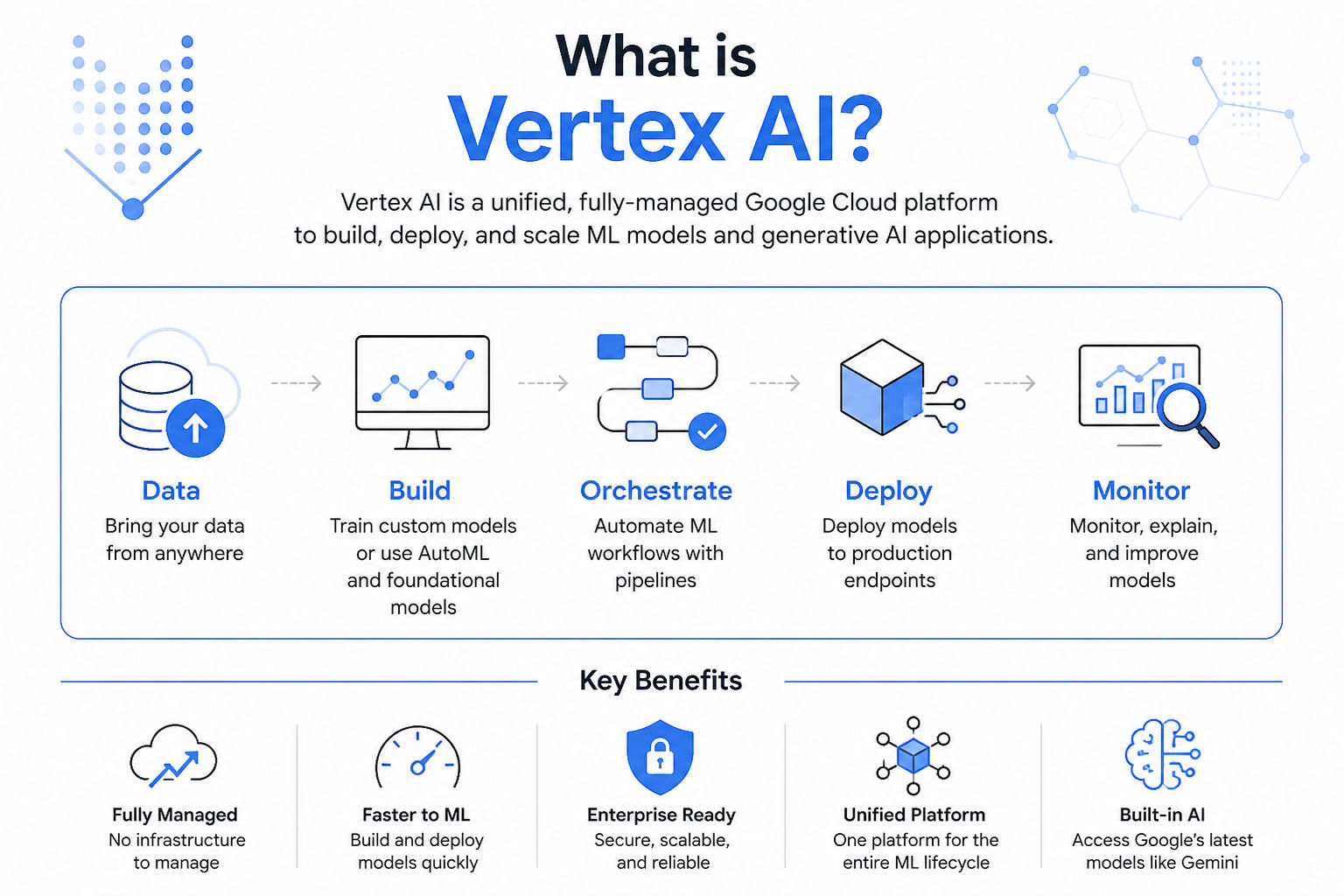
This platform completely solves that messy problem.
Also Read: Top 5 Machine Learning Models Explained For Beginners
To see how google vertex AI actually works, you have to look at the standard project lifecycle. This platform seamlessly guides users through every single mandatory step of the process.
Once your specific model is fully trained, it is completely ready for the real world. Deployment means putting the model into a live mobile app or public website. The platform handles all the massive server requirements silently behind the scenes.
After deployment, the system actively watches the model daily. It tracks live performance daily to ensure accuracy never drops. If the model starts making weird mistakes, the system instantly alerts you.
Here is a simple table showing the clear difference between old methods and this modern platform:
| Feature | Traditional Methods | The Modern Platform |
| Tool Integration | Highly disconnected | Fully unified |
| Coding Skill Needed | Expert level required | Beginner-friendly |
| Model Tracking | Done manually | Fully automated |
Also Read: Machine Learning Tutorial: Basics, Algorithms, and Examples Explained
Free Courses
These components help you manage the full ML lifecycle inside vertex AI. You move from data to production without switching tools.
Model training lets you build custom models using your own data. You control how the model learns and improves.
What this means:
Pre-trained models help you start quickly without building from scratch. They are already trained on large datasets.
What this means:
Also Read: Learning Models in Machine Learning: 16 Key Types and How They Are Used
Pipelines help you automate your ML workflow. You can define steps and run them in sequence.
What this means:
Model deployment lets you make your model available for real use. You can serve predictions through APIs.
What this means:
Also Read: How to Learn Artificial Intelligence and Machine Learning
Component |
Purpose |
Outcome |
| Model Training | Build custom models | Problem-specific solutions |
| Pre-trained Models | Use ready models | Faster setup |
| Pipelines | Automate workflow | Efficient process |
| Model Deployment | Serve models via API | Real-world usage |
These components make vertex AI practical for building and deploying machine learning systems.
AI Courses to upskill
Explore Artificial Intelligence Courses for Career Progression
What exactly makes google vertex AI so incredibly powerful? The real secret is its massive collection of built-in features. These digital tools are specifically designed to make complex coding tasks much easier.
One of the absolute best features is the Model Garden. Think of this as a massive digital library for artificial intelligence. It securely contains over two hundred pre-built, ready-to-use foundation models.
Another deeply powerful feature within vertex AI is AutoML. This is highly perfect for absolute beginners who do not know how to write complex code. You simply upload your raw data, and AutoML automatically builds the absolute best model for you.
For highly experienced engineers, the platform offers deep custom training features.
Also Read: Automated Machine Learning Workflow: Best Practices and Optimization Tips
Building modern software is a highly repetitive daily process. The Pipelines feature automatically handles these boring, repetitive tasks. It securely links different software steps together into one smooth, automated chain.
This specifically means a developer does not have to manually trigger each new step. The system naturally flows from data cleaning directly to active model training. This deep automation reduces expensive human errors significantly.
Here are the main features you should definitely remember:
Finally, we absolutely must talk about MLOps, which perfectly stands for Machine Learning Operations. The google vertex AI platform excels greatly in this specific technical area. It provides deep tools to manage, scale, and secure models globally.
It tracks every single minute change made to a specific project. If a new update unexpectedly breaks the system, developers can instantly roll back to an older, safer version. This massive safety net is absolutely crucial for huge global businesses.
Also Read: What Is the Difference Between ML and MLOps?
Vertex AI Gemini is a major step forward in AI development. It brings advanced capabilities into one system, so you can build smarter applications without combining multiple tools.
It is not just a text model. It works across different types of data and supports real-world use cases.
Vertex AI Gemini can understand and process multiple input types at once. You can work with text, images, audio, and video in a single workflow.
Also Read: What is MLOps vs DevOps in Modern Software Engineering?
The broader platform now focuses heavily on building autonomous digital agents. These are smart, independent bots that actively complete complex daily tasks. They naturally go far beyond just answering simple user questions.
Using vertex AI gemini, developers can easily build an agent that books flights, updates databases, and sends emails automatically. The new visual Agent Builder tool lets users design these complex agents safely. You strictly do not even need to write a single line of actual code.
Here is a quick look at the popular model variants available:
| Model Variant | Best Daily Use Case | Key Strength |
| Pro Version | Highly complex, deep reasoning tasks | Massive memory context |
| Flash Version | Fast, high-volume daily tasks | Incredible processing speed |
| Flash-Lite | Simple, highly repetitive digital actions | Extremely budget-friendly |
Also Read: Types of Agents in AI: A Complete Guide to How Intelligent Agents Work
Vertex AI Gemini supports a very large context window. This allows the model to remember and process large amounts of information at once.
Example:
Also Read: 10+ Real Agentic AI Examples Across Industries (2026 Guide)
Vertex AI is used across industries to build practical AI systems. You can use it to analyze data, make predictions, and automate decisions at scale.
You can understand user behavior and improve how you interact with customers. This helps you deliver more relevant experiences.
Example:
Also Read: Top 10 Uses of Artificial Intelligence
You can analyze medical data to support better decisions. It helps doctors and systems process large datasets quickly.
You can detect risks and unusual patterns in financial data. This improves security and decision-making.
Example:
You can build applications that create and understand content. This helps automate tasks and improve productivity.
Example:
Also Read: 23+ Top Applications of Generative AI Across Different Industries in 2026
Industry |
Use Case |
Impact |
| Customer analytics | Personalization | Better engagement |
| Healthcare | Risk prediction | Improved care |
| Finance | Fraud detection | Higher security |
| Retail | Demand forecasting | Better planning |
| Generative AI | Content and chat | Faster workflows |
These use cases show how vertex AI helps you build real-world AI solutions across different domains.
Subscribe to upGrad's Newsletter
Join thousands of learners who receive useful tips
You can start with vertex AI using a clear, step-by-step path. Focus on basics first, then move to building and deploying real models.
You need a strong foundation before using the platform. This helps you understand how models work and how to build them.
Once you know the basics, start using google vertex AI on the cloud. This is where you build and manage your models.
Begin with small projects to understand how the system works. Use built-in tools to reduce complexity.
Also Read: What Is the BERT Model?
Now move to generative AI features using vertex AI gemini. This helps you build interactive and intelligent applications.
After building a model, you need to make it usable. Deployment helps you connect your model to real applications.
Also Read: Applications of Artificial Intelligence and Its Impact
Vertex AI helps you build, train, and deploy machine learning models in one place. It simplifies complex workflows and supports both traditional and generative AI use cases. You can start with basics, build small projects, and scale gradually. Learning vertex AI gives you practical skills to work on real AI applications and data-driven solutions.
Want personalized guidance on AI and upskilling? Speak with an expert for a free 1:1 counselling session today.
Vertex AI helps you build, train, and deploy machine learning models in one platform. It simplifies the full workflow from data to production. You can manage models, automate pipelines, and scale applications without handling infrastructure manually.
Google AI refers to the broader research and AI technologies developed by Google. Vertex AI is a platform that lets you use those technologies to build real applications. Think of Google AI as the innovation layer and Vertex AI as the deployment layer.
You can start with limited free credits through Google Cloud trials. After that, it follows a pay-as-you-go model. You only pay for compute, storage, and API usage based on how much you use.
No, they are different. Gemini is the AI model, while vertex AI is the platform that lets you use and deploy that model. Vertex AI provides tools to scale and manage Gemini in production systems.
Vertex AI supports generative AI by giving access to models like Gemini. You can build apps that handle text, images, and video in one system. It also allows customization, tuning, and deployment at scale.
Major competitors include Amazon SageMaker, Azure Machine Learning, Databricks, and IBM watsonx.ai. These platforms also provide tools to build and deploy machine learning models across cloud environments.
Yes, you can start with AutoML and pre-trained models. These tools reduce the need for deep coding. As you gain experience, you can move to custom models and advanced workflows.
Vertex AI gemini is used to access Gemini models within Vertex AI. You can build chatbots, generate content, and create AI-powered applications that handle multiple data types like text and images.
Vertex AI focuses on a unified experience and deep integration with Google Cloud. Other platforms may offer more control or flexibility, but vertex AI is strong for end-to-end workflows and scalability.
Developers use vertex AI because it reduces complexity. It combines tools for training, deployment, and monitoring in one place. This helps you build and launch AI applications faster with fewer dependencies.
Most users ask how to build models, deploy APIs, and use Gemini for real-world apps. Queries focus on practical use cases, cost, and integration with existing systems, showing a shift toward hands-on AI development.
98 articles published
Rahul Singh is an Associate Content Writer at upGrad, with a strong interest in Data Science, Machine Learning, and Artificial Intelligence. He combines technical development skills with data-driven s...
Speak with AI & ML expert
By submitting, I accept the T&C and
Privacy Policy
Top Resources
Master's Degree
18 Months
Executive Diploma
12 Months
IIIT Bangalore
Executive Programme in Generative AI & Agentic AI for LeadersIndia’s #1 Tech University
Dual Certification
5 Months