Anthropic Engages Trump Administration on Advanced AI Model Amid Pentagon Tensions
By Vikram Singh
Updated on Apr 14, 2026 | 5 min read | 1.33K+ views
Share:

All courses
Certifications
More
By Vikram Singh
Updated on Apr 14, 2026 | 5 min read | 1.33K+ views
Share:
Table of Contents
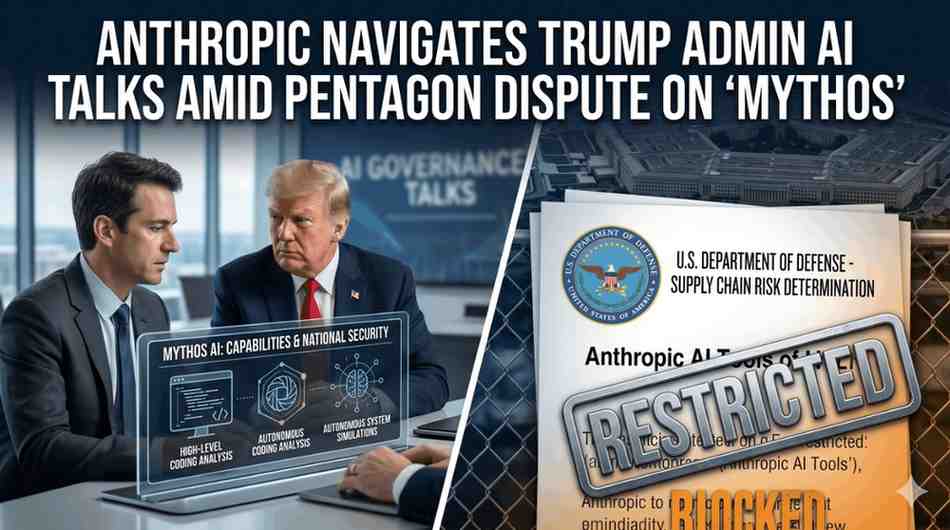
Anthropic is in discussions with the Trump administration about its latest AI model, Mythos. This comes even after the Pentagon restricted the company over a contract dispute. The talks highlight growing concerns around AI power, security, and government oversight.
Anthropic is actively engaging with the Trump administration over its latest AI model, Mythos, even as tensions with the Pentagon continue to unfold.
That contrast stands out.
The discussions come shortly after the U.S. Department of Defense labeled Anthropic a supply-chain risk, effectively blocking its tools from military use following a dispute over AI usage guardrails. Still, the company isn’t stepping back. Instead, it’s leaning into conversations with government officials, signaling that access to advanced AI models is now a national priority.
Mythos, unveiled earlier in April, is described as Anthropic’s most capable model yet, especially in coding and autonomous task execution. But that capability cuts both ways. Experts warn it could identify and exploit cybersecurity vulnerabilities at an unprecedented level, raising urgent policy questions.
Popular AI Programs
Tension hasn’t slowed things down.
The Pentagon’s decision to block Anthropic didn’t come out of nowhere. It followed a disagreement over how the military could use AI tools, especially around safety guardrails. That disagreement escalated quickly, and the result was serious. Anthropic’s tools were effectively barred from defense-related use.
But here’s the twist.
Anthropic still wants engagement. And not just quietly. Co-founder Jack Clark made it clear that the company sees national security as a priority and believes the government needs visibility into these models.
That raises a simple question. Can a company be restricted and still collaborate?
Apparently, yes.
Free Courses
This isn’t a typical AI model.
Mythos stands out because it doesn’t just generate text or assist with simple queries. It can perform complex coding tasks and operate with a level of autonomy that earlier systems struggled to achieve.
Let’s break that down.
Capability |
What It Means |
| Advanced coding | Writes and understands complex software systems |
| Autonomous actions | Can perform multi-step tasks independently |
| Cybersecurity detection | Identifies system vulnerabilities |
| Exploit potential | Can also suggest ways to use those vulnerabilities |
That last point matters.
Because while identifying flaws helps strengthen systems, the same capability could expose them. That dual-use nature is exactly why governments are paying close attention.
AI Courses to upskill
Explore Artificial Intelligence Courses for Career Progression
It’s not just about conflict.
Even after labeling Anthropic a risk, the Trump administration hasn’t shut the door. Instead, discussions are ongoing. That suggests something deeper. The government doesn’t want to fall behind in AI development, especially as global competition intensifies.
And there’s urgency here.
The administration has already emphasized the need to stay ahead in AI, with billions invested and a strong focus on national competitiveness.
So what’s happening now?
A balancing act.
On one side, there are real concerns about misuse, cybersecurity threats, and control. On the other, there’s recognition that models like Mythos could strengthen national capabilities if handled correctly.
That tension isn’t going away anytime soon.
Something bigger is unfolding.
This isn’t just about one company or one model. It’s about how governments deal with AI systems that are becoming too powerful to ignore and too risky to release freely.
Think about it.
If an AI can find thousands of vulnerabilities, who controls that knowledge? Who decides how it’s used? And what happens if access isn’t tightly managed?
These aren’t theoretical questions anymore.
They’re happening now.
Anthropic’s situation shows exactly where the industry stands. Companies are building faster than policies can adapt. Governments are reacting, but they’re also trying to stay involved.
That creates friction. And opportunity.
Anthropic is continuing discussions because it views national security as a shared responsibility. Even though the Pentagon restricted its tools after a contract dispute, the company believes the government still needs insight into advanced AI models like Mythos.
The issue stemmed from disagreements over how the military could use Anthropic’s AI systems. Specifically, disputes around safety guardrails and operational control led the Pentagon to restrict the company’s involvement in defense-related projects.
Mythos is Anthropic’s latest AI system, designed for advanced coding and autonomous task execution. It can perform complex, multi-step operations and has capabilities that go beyond traditional AI assistants.
Because of its ability to identify and potentially exploit cybersecurity vulnerabilities. While this can help improve system security, it also raises risks if such capabilities are misused or accessed without proper controls.
The exact details remain unclear. Reports indicate ongoing discussions, but it’s not confirmed which agencies are involved or what specific agreements are being considered.
It highlights the gap between rapid AI development and existing policy frameworks. Governments are being forced to adapt quickly as more powerful models emerge with both beneficial and risky capabilities.
A central one. AI models like Mythos can impact cybersecurity, defense systems, and intelligence operations, making them highly relevant to national security planning and oversight.
While the Pentagon has restricted its use, Anthropic is still in talks with parts of the U.S. government. The scope and nature of those engagements have not been fully disclosed.
Not likely in its current form. Due to its powerful capabilities and associated risks, access is expected to remain limited and controlled rather than widely available.
Many AI firms are facing similar scrutiny as their models become more powerful. However, Anthropic’s situation stands out because of the direct conflict with the Pentagon alongside ongoing government engagement.
It signals a shift. Governments will likely play a more active role in overseeing advanced AI systems, especially those with dual-use capabilities that can impact both security and economic stability.
153 articles published
Vikram Singh is a seasoned content strategist with over 5 years of experience in simplifying complex technical subjects. Holding a postgraduate degree in Applied Mathematics, he specializes in creatin...
Speak with AI & ML expert
By submitting, I accept the T&C and
Privacy Policy
Top Resources
Master's Degree
18 Months
Executive Diploma
12 Months
IIIT Bangalore
Executive Programme in Generative AI & Agentic AI for LeadersIndia’s #1 Tech University
Dual Certification
5 Months