
All courses
Agentic AI
Agentic AI
Artificial Intelligence
Degree / Exec. PG

IIIT Bangalore
Executive Diploma in Machine Learning and AI
OPJ Global University
Master’s Degree in Artificial Intelligence and Data Science
Liverpool John Moores University
Master of Science in Machine Learning & AI
Golden Gate University
DBA in Emerging Technologies with Concentration in Generative AIExecutive Certificate

IIITB & IIM, Udaipur
Chief Technology Officer & AI Leadership Programme
IIIT-B & IIM, Udaipur
Chief Data and AI Officer Programme
IIIT Bangalore
Executive Programme in Generative AI for Leaders
upGrad | Microsoft
Gen AI Mastery Certificate for Software DevelopmentOffline Bootcamps

upGrad
Data Science and AI-MLDoctorate
For All Domains
IIITB & IIM, Udaipur
Chief Technology Officer & AI Leadership Programme
Swiss School of Business and Management
Global Doctor of Business Administration from SSBM
Edgewood University
Doctorate in Business Administration by Edgewood UniversityGolden Gate University
Doctor of Business Administration From Golden Gate University
Rushford Business School
Doctor of Business Administration from Rushford Business School, Switzerland-d9bdeff6165f4eb1ba2adcebde78e961.svg)
University of Waterloo
Chief Technology and AI Officer ProgramLeadership / AI
Golden Gate University
DBA in Emerging Technologies with a concentration in Generative and Agentic AIMachine Learning
Machine Learning
Data Science
Degree / Exec. PG
O.P Jindal Global University
Master’s Degree in Artificial Intelligence and Data ScienceIIIT Bangalore
Executive Diploma in Data Science & AILiverpool John Moores University
Master of Science in Data ScienceExecutive Certificate
upGrad | Microsoft
Gen AI Foundations Certificate Program from MicrosoftIIIT-B & IIM, Udaipur
Chief Data and AI Officer ProgrammeupGrad | Microsoft
Gen AI Mastery Certificate for Data AnalysisupGrad | Microsoft
Gen AI Mastery Certificate for Software DevelopmentupGrad | Microsoft
Gen AI Mastery Certificate for Managerial ExcellenceupGrad | Microsoft
Gen AI Mastery Certificate for Content CreationOffline Bootcamps
upGrad
Data Science and AI-MLMBA
Masters
Liverpool School of Business
Master of Business Administration from Liverpool Business School with IIM Udaipur CertificationO.P.Jindal Global University
MBA (with Career Acceleration Program by upGrad)Edgewood University
MBA from Edgewood UniversityO.P.Jindal Global University
MBA from O.P.Jindal Global UniversityExecutive Certificate
IMT, Ghaziabad
Advanced General Management ProgramMarketing
Executive Certificate
upGrad | Microsoft
Gen AI Foundations Certificate Program from MicrosoftupGrad | Microsoft
Gen AI Mastery Certificate for Content CreationOffline Bootcamps
upGrad
Digital MarketingManagement
Degree
O.P Jindal Global University
MSc in International Accounting & Finance (ACCA integrated)
Golden Gate University
Master of Arts in Industrial-Organizational PsychologyExecutive Certificate
IIIT-B & IIM, Udaipur
Chief Technology Officer & AI Leadership ProgrammeIIIT-B & IIM, Udaipur
Chief Data and AI Officer Programme
IIM Kozhikode
Human Resource Analytics Course from IIM-KupGrad | Microsoft
Gen AI Foundations Certificate Program from MicrosoftEducation
Education

Northeastern University
Master of Education (M.Ed.) from Northeastern UniversityEdgewood University
Doctor of Education (Ed.D.)Edgewood University
Master of Education (M.Ed.) from Edgewood UniversityCertifications
Project Management
Certification

Knowledgehut
Leadership And Communications In ProjectsKnowledgehut
Microsoft Project 2007/2010-ae8d039bbd2a41318308f8d26b52ac8f.svg)
Knowledgehut
Financial Management For Project ManagersKnowledgehut
Fundamentals of Earned Value Management (EVM)Knowledgehut
Fundamentals of Portfolio ManagementKnowledgehut
Fundamentals of Program Management-35c169da468a4cc481c6a8505a74826d.webp&w=128&q=75)
Knowledgehut
CAPM® CertificationsKnowledgehut
Microsoft® Project 2016Certifications & Trainings
-7f4b4f34e09d42bfa73b58f4a230cffa.webp&w=128&q=75)
Knowledgehut
PMP® CertificationKnowledgehut
PMI-RMP® CertificationKnowledgehut
PMP Renewal Learning PathKnowledgehut
Oracle Primavera P6 V18.8Knowledgehut
Microsoft® Project 2013Knowledgehut
PfMP® Certification CourseKnowledgehut
Project Planning and MonitoringPrince2 Certifications

Knowledgehut
PRINCE2® FoundationKnowledgehut
PRINCE2® PractitionerKnowledgehut
PRINCE2 Agile Foundation and PractitionerKnowledgehut
PRINCE2 Agile® Foundation CertificationKnowledgehut
PRINCE2 Agile® Practitioner CertificationManagement Certifications
Knowledgehut
Project Management Masters Certification ProgramKnowledgehut
Change ManagementKnowledgehut
Project Management TechniquesKnowledgehut
Product Management Certification ProgramKnowledgehut
Project Risk Management- Study abroad
- Offline centres
- uGSOT - B.Tech
More
%20(2)-db0b6f38da9c485faf76e366793c9b9e.webp&w=128&q=75)

NSOU: Courses, Admissions & Placements 2025
Set up in 1997 to mark Netaji Subhas Chandra Bose's birth centenary, NSOU is West Bengal’s first state open university, offering BA and BCom programs since 1998 to marginalised communities.
-1e9b1f51016142608eddc0d4bbf4cfc4.png&w=3840&q=75)
NSOU Key Highlights
NSOU Courses and Fees
NSOU Placements and Admissions
Netaji Subhas Open University (NSOU) has a Placement Facilitation Service under its School of Vocational Studies. Though it does not provide job placement guarantees, the cells do support students by allowing them to post CVs on a job portal operated by TeamLease, a manpower solutions company. The service is a liaison between employers and students, and although resume assistance, mock interviews, or workshop support isn't listed on the website, the website does give users access to possible recruiters.
NSOU Ranking 2024-2025
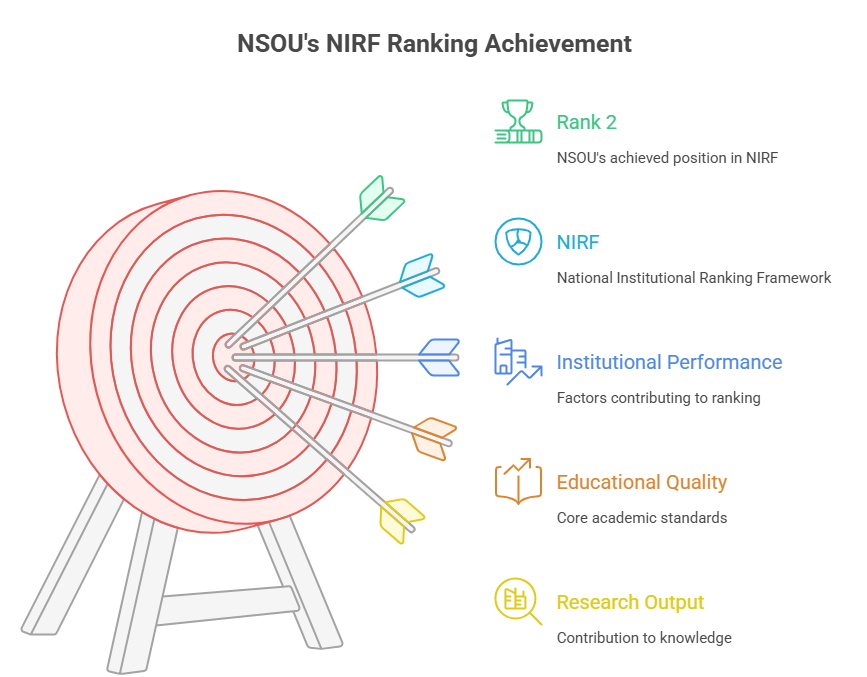
NSOU has secured the 2nd position in the 2024 National Institutional Ranking Framework (NIRF).Below is the NIRF ranking of NSOU from the previous three years:
Year | Rank |
2024 | 2 |
Additionally, NIRF does not provide course-wise ranking for Open Universities.
NSOU VS BRAOU VS IGNOU
NSOU Notable Alumni
FAQs for NSOU
1. What is the national ranking of Netaji Subhas Open University (NSOU) as per NIRF 2024?
As per the National Institutional Ranking Framework (NIRF) 2024, Netaji Subhas Open University (NSOU) has secured the 2nd position among open universities in India. This impressive ranking highlights NSOU’s growing academic presence, quality of distance education, accessibility to marginalized communities, and its commitment to lifelong learning. The ranking takes into account parameters such as teaching, learning resources, research, graduation outcomes, outreach, and inclusivity. NSOU’s consistent performance in these areas, especially in the domain of open and distance learning, has positioned it among the top three open universities in the country alongside IGNOU and BRAOU.
2. When was NSOU established and what is its historical significance?
Netaji Subhas Open University (NSOU) was established in 1997 under the W.B. Act XIX to commemorate the birth centenary of Netaji Subhas Chandra Bose. It officially began academic operations in July 1998 from the ancestral residence of Sarat Chandra Bose, symbolizing a deep-rooted connection to India’s freedom movement and educational reform. The institution was set up with a vision to provide inclusive and quality education to learners from marginalized sections of society, especially in West Bengal. Over the years, NSOU has expanded its reach by offering a wide range of programs in arts, science, commerce, social work, and vocational studies through open and distance learning.
3. What are the most popular programs offered by NSOU at the undergraduate and postgraduate levels?
NSOU offers a diverse range of programs catering to undergraduate (UG), postgraduate (PG), and diploma students. Some of the most sought-after programs at the UG level include Bachelor of Arts (BA), Bachelor of Commerce (B.Com), Bachelor of Science (B.Sc), and Bachelor of Education (B.Ed). At the PG level, popular courses include Master of Arts (MA) in various disciplines such as History and Journalism, Master of Commerce (M.Com), Master of Science (M.Sc) in Mathematics, and Master of Social Work (MSW). Specialized professional and vocational programs such as B.Lib.I.Sc, M.Ed, PG Diplomas, and MOOCs further enhance NSOU’s academic portfolio, making it a holistic center for distance education.
4. What is the duration and fee structure for NSOU’s major courses?
NSOU’s course durations vary based on the level and type of program. Undergraduate programs like BA, B.Com, and B.Sc generally have a duration of 3 years, while PG programs such as MA, M.Sc, and M.Com span 2 years. Diploma and certification programs typically last between 6 to 12 months, and professional degrees like B.Ed and M.Ed are structured over 2 years. Fee structures are remarkably affordable:
- B.Sc: ₹13,800 – ₹15,600
- B.Ed: ₹6,774
- MA: ₹7,600 (General) to ₹26,000 (Mass Communication)
- M.Sc: ₹27,467
- M.Com: ₹7,600
- MSW: ₹10,400
- B.Lib.I.Sc: ₹5,000
These affordable fees make NSOU an ideal option for learners seeking quality education on a budget.
5. Does NSOU provide placement assistance or career support to students?
While NSOU does not guarantee campus placements in the traditional sense, it has introduced a Placement Facilitation Service through its School of Vocational Studies. This service functions as a bridge between students and employers. Through a partnership with TeamLease, a reputed manpower solutions company, students are allowed to upload their CVs on a dedicated job portal. This increases their visibility to prospective employers. Though services like mock interviews or resume workshops are not explicitly mentioned, the portal creates a support system where students can connect with job opportunities relevant to their domain of study.
6. What entrance exams are required for admission to various NSOU programs?
NSOU’s admission process is primarily merit-based for most undergraduate and postgraduate programs. However, certain specialized or advanced-level courses have specific entrance requirements. For instance, candidates applying for Ph.D. programs need to qualify the Research Eligibility Test (RET) conducted by the university. For the MBA program, students must clear the NSOU-MET (Management Entrance Test) followed by a Personal Interview (PI). Other programs, such as the PG Diplomas, BA, and MA, are based solely on academic merit and do not require separate entrance tests. Additionally, students must meet minimum educational qualifications as outlined for each course.
7. How many schools and departments are there under NSOU?
NSOU functions through six distinct schools, each dedicated to specific academic disciplines. These include:
- School of Humanities
- School of Social Sciences
- School of Sciences
- School of Education
- School of Vocational Studies
- School of Professional Studies
Each school is responsible for curriculum development, faculty engagement, and course delivery in their respective fields. This organized structure allows NSOU to cater to a diverse range of learners and ensure academic excellence across all levels of study.
8. How many courses are offered at NSOU, and what are the major streams?
As of 2025, NSOU offers 109 courses across undergraduate, postgraduate, diploma, certificate, and doctoral levels. These courses span multiple streams including Arts, Commerce, Science, Social Work, Journalism & Mass Communication, Education, and Vocational Studies. This extensive portfolio makes NSOU one of the most comprehensive open universities in eastern India. Additionally, the university has introduced several MOOCs and online learning initiatives to increase accessibility and cater to remote learners in both urban and rural areas.
9. What is the NSOU admission process for 2025, and how can one apply?
To apply for NSOU courses in 2025, candidates must first visit the official NSOU website and fill out the online application form. The process involves:
- Registering with a valid email and mobile number
- Selecting the desired course and school
- Uploading scanned copies of required documents
Paying the application fee online Following successful submission, candidates are shortlisted based on merit (or entrance test score, if applicable). Shortlisted applicants must then undergo document verification, after which they are required to pay the course fee to confirm their seat. The entire process is conducted online, making it seamless and accessible to distance learners.
10. What is the fee range for NSOU’s MBA and PG Diploma programs?
NSOU’s MBA program is among its most popular professional offerings and is available at a competitive fee ranging from ₹8,300 to ₹1 lakh, depending on the specialization and delivery mode. Similarly, PG Diploma programs in fields like journalism, social work, management, and vocational studies are priced between ₹8,300 and ₹30,000. These programs are structured to provide practical knowledge and industry relevance while remaining affordable to students from diverse socio-economic backgrounds.
11. Has NSOU received UGC 12B recognition, and what does it mean?
Yes, NSOU received UGC 12B status in October 2024. This is a major milestone for the university, as it allows NSOU to receive financial grants from the University Grants Commission (UGC) for research and development purposes. The 12B status also enables the university to participate in centrally sponsored academic schemes, establish collaborative research projects, and gain wider national and international academic recognition. This recognition is a testament to NSOU’s institutional quality and its efforts to expand open and distance education across the state and country.
upGrad Learner Support
Talk to our experts. We are available 7 days a week, 10 AM to 7 PM

Indian Nationals

Foreign Nationals