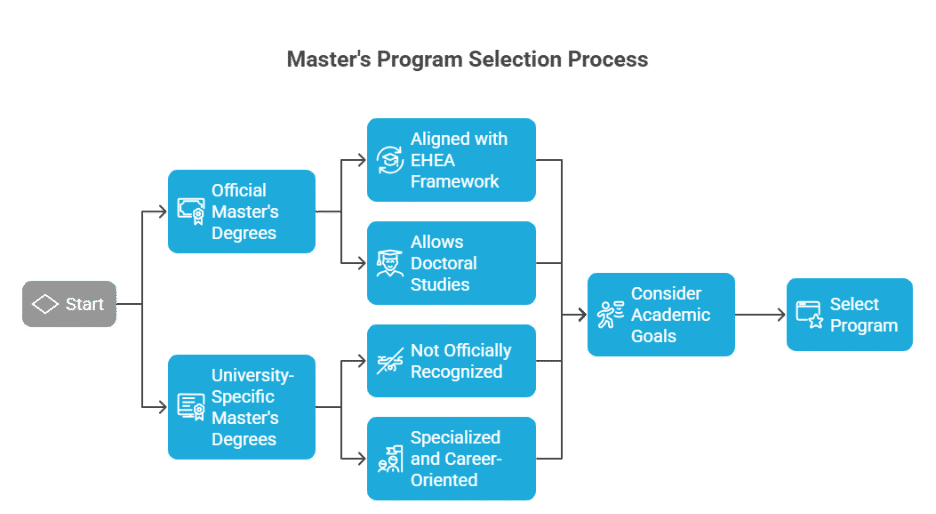
Master's degree in Spain takes around 1–2 years, depending on the programme credits 60, 90 or 120 ECTS . Students can choose from a wide range of English-taught courses in engineering, data science, business, healthcare, technology, and sustainability from internationally recognized universities with moderate public-university tuition and a lifestyle that is often less expensive than some northern European destinations.
This article covers everything about MS in Spain for international students, including leading public and private universities, popular specializations, tuition and living expenses, admission requirements, scholarships, intakes, application process, student visa requirements, career opportunities and the best cities to consider.
Key Highlights
Particular
Key Details
Degree Duration
1–2 Years
Credits
60–120 ECTS
Public Tuition
€1,000–€6,000 (₹1.1–6.6 lakh)
Private Tuition
€5,000–€20,000+ (₹5.5–22 lakh+)
Popular Fields
Data, Business, Engineering
Top Universities
UB, UPC, UCM, UC3M
Language
English / Spanish
English Score
IELTS 6.0+
Main Intake
September
Work During Study
Up to 30 hrs/week
Post-Study Option
Job-search residence
Popular Cities
Madrid, Barcelona, Valencia
Key Advantage
European career exposure
Planning to study in Spain? Find top universities, popular courses, admission requirements, tuition fees and scholarships to plan your study abroad journey.
Why Choose MS in Spain
Spain offers European education with large public institutions, technology-focused schools and private business institutions, while cities such as Madrid and Barcelona have sizeable international communities.
Reasons to study MS in spain :
Multiple English-taught options are available, particularly in technology, business and engineering.
Public universities offer comparatively moderate tuition, although fees vary by programme and student category.
Madrid is particularly strong in business and finance, while Barcelona has a strong technology, startup and engineering ecosystem.
Many programmes use projects, research and practical learning alongside classroom teaching.
Spain's major university cities have established international student communities.
Studying in Spain also places students within the wider European academic and business environment.
Spain can be particularly interesting when your priority is a combination of manageable tuition, lifestyle and access to European career opportunities, rather than simply the lowest possible cost.
Top Universities for MS in Spain
Spain has a mix of large public universities and prestigious private institutions. When selecting a university, look at the specific Master's programme, its language, curriculum, industry links and fee structure instead of relying only on the university's overall reputation.
Leading Public Universities:
University
Strong Areas
QS World University Ranking'27
University of Barcelona (UB)
Life Sciences, Data, Economics, Social Sciences
165
Complutense University of Madrid (UCM)
Sciences, Humanities, Business, Health
199
Autonomous University of Barcelona (UAB)
Sciences, Biotechnology, Engineering, Social Sciences
Private universities offer more specialized programmes, international curricula and strong business-school networks, but they can be considerably more expensive.
University
Strong Areas
Typical Positioning
IE University
Business, Data, Technology, Finance
Premium private
ESADE
Business, Finance, Management, Marketing
Premium business education
EADA Business School
Business, Finance, Marketing
Private business school
Universidad Europea
Technology, Business, Health, Engineering
Career-focused
Ramon Llull University
Business, Engineering, Design, Social Sciences
Private university ecosystem
Popular MS Courses in Spain
Spain offers Master's programmes across technology, engineering, business, life sciences and social sciences. Programmes connected to technology, analytics, engineering and business are be particularly relevant if your goal is employment after graduation.
Specialization
Potential Career Areas
Data Science & Analytics
Data Science, Business Intelligence, Analytics
Artificial Intelligence
AI Engineering, Machine Learning, Research
Computer Science
Software Development, Cloud, Cybersecurity
Engineering
Mechanical, Electrical, Industrial, Automotive
Biomedical Engineering
Medical Technology, Healthcare, R&D
Business Analytics
Consulting, Analytics, Strategy
Finance
Banking, Financial Analysis, Risk
International Business
Business Development, Consulting, Management
Supply Chain Management
Logistics, Operations, Procurement
Renewable Energy & Sustainability
Energy, ESG, Sustainability
Here are the most in demand masters specializations in Spain:
Data Science and Big Data: Increasingly relevant to students targeting technology and analytics roles. Spain has a growing technology ecosystem, particularly around Madrid and Barcelona.
Computer Science and Artificial Intelligence: Suitable for students from computer science, engineering, mathematics or related academic backgrounds. Programme prerequisites include programming, mathematics, algorithms and statistics.
Engineering: Engineering remains a major area across Spanish universities, with Master's programmes covering mechanical, electrical, industrial, civil, telecommunications, aerospace and other fields.
Business and Analytics: Students from commerce, economics, business or engineering backgrounds can consider Master's programmes in business analytics, finance, management, international business and related areas.
Eligibility Criteria for MS in Spain
Eligibility varies considerably by programme. A recognized Bachelor's degree is the basic requirement, but universities can also specify prerequisite subjects, academic credits, entrance assessments or professional experience.
Eligibility Criteria
Specific Requirement
Bachelor's Degree
Recognised Bachelor's degree with min of 60% or a GPA of 3.0/4.0
Programme-specific; required mainly for selected quantitative/business programmes
SOP / Motivation Letter
Required by many universities to explain academic background, career goals and programme fit
Motivation Letter
Required by many universities/programmes
Recommendation Letters
2 academic or professional reference letters.
Degree Verification
Non-EHEA qualifications may require equivalence or academic-level verification by the university
Intake Period for MS in Spain
The September/Fall intake is the main intake for most Master's programmes in Spain. Some universities also offer programmes beginning in January or February, but Spring availability is more limited.
Fall Intake: The Fall intake usually begins in September or October and offers the widest choice of programmes.
For international applicants, applications can open many months before classes begin.
Spring Intake: The Spring intake generally starts in January or February, but the number of Master's programmes available is considerably smaller.
Starting the application process 8–12 months before the intended intake gives time for academic-document checks, English-language testing, scholarship applications and visa formalities.
Application Process for MS in Spain
The admission process for MS in Spain is straightforward but time-sensitive. Most universities accept online applications, and admission decisions depend on academic performance, English proficiency, and supporting documents.
Step 1: Research and Shortlist Universities
Start by identifying universities and programs that align with your career goals. Review Master programs in Spain in English, eligibility criteria, tuition fees, and application deadlines.
Shortlist at least 3–5 universities, balancing academic strength, location, and cost. Use official university websites for verified information.
Step 2: Prepare Documents
Gather and authenticate all required documents before applying. Essential Documents:
Academic transcripts and degree certificate
Proof of English proficiency (IELTS/TOEFL)
Valid passport copy
Updated CV or résumé
Statement of Purpose (SOP) and two Letters of Recommendation (LORs)
Step 3: Submit Online Applications
Applications are submitted directly through the university’s admission portal or centralized systems like Spain’s SIIU platform for public institutions.
Pay a non-refundable application fee of €30–€100 (INR 3.07K–10.24K) depending on the university.
Upload your documents, double-check all details, and track submission status via your application dashboard.
Step 4: Attend Interviews or Entrance Tests
Some private and business schools (like IE or ESADE) may conduct online interviews or require additional entrance assessments (e.g., GMAT or internal aptitude tests).
Prepare to discuss your academic background, goals, and how your chosen MS in Spain aligns with your career objectives.
Step 5: Receive Offer and Confirm Admission
If selected, you’ll receive a conditional or unconditional offer letter via email. Confirm your seat by paying the initial tuition deposit (around €500–€2,000 / INR 51K–2.05L) within the stated deadline.
After confirmation, you can begin your student visa application and prepare for relocation.
Cost of MS in Spain
The cost of MS in Spain depends on whether you choose a public or private university, the number of ECTS credits and non-EU student have additional expenses as well like living expenses, health insurance, etc.
Tuition Fees at Public Universities
Public universities are significantly more affordable than private institutions, but international fees vary by university and programme.
Public University
Approx: Tuition
UPC
€3,200–€6,100 (₹3.5–6.7 lakh) for many 60–120 ECTS Master's programmes
UPF
From €5,749.80 (₹6.3 lakh) for several 60-ECTS non-EU Master's programmes
UCM
Programme-dependent; fees vary by ECTS and student status
UC3M
Programme-dependent; fees vary by ECTS and student status
Tuition Fees at Private Universities
Private Master's programmes are more expensive and range from approximately €5,000–€20,000+ (₹5.5–22 lakh+), with premium business and specialized programmes potentially exceeding this range.
Living Expense in Spain
Cost of living in Spain vary by city. Madrid and Barcelona are more expensive than cities like Granada, Seville or Valencia. They are based on the latest available Numbeo Spain data:
Scholarships for MS in Spain are available through Erasmus Mundus, Spanish government-linked schemes, university scholarships and private funding, but the number of awards is limited and eligibility can vary sharply by nationality and programme.
Scholarship
Eligibility for Indian Students
Funding / Benefit
Erasmus Mundus Joint Master
Open to students worldwide; programme-specific academic criteria apply
Up to €1,400/month (Approx. ₹1.54 lakh/month)
University-Specific Scholarships
Depends on the Spanish university and MS programme
Tuition waiver, tuition reduction or financial grant
IE University Scholarships
International Master's applicants, subject to programme and scholarship criteria
Selected awards can provide substantial tuition reductions; exact percentage varies by award
Job Opportunities After MS in Spain
Spain offers career opportunities across technology, consulting, finance, engineering, renewable energy, pharmaceuticals, tourism and international business.
However, Indian students should have realistic salary expectations. Spain generally has lower graduate salaries than Germany or some northern European destinations, although the cost of living can also be lower in many cities.
The best cities for Masters degree in Spain depend on your field and budget, with Madrid and Barcelona leading for top-tier business and tech networking, Valencia and Malaga offering booming tech and engineering hubs with lower costs, and historic cities like Salamanca or Granada providing budget-friendly student lifestyles
City
Strong Areas
Best Suited For
Madrid
Finance, Consulting, Technology, Business
Business, Data, Finance, IT
Barcelona
Technology, Startups, Engineering, Biotech
AI, CS, Engineering, Life Sciences
Valencia
Engineering, Business, Technology, Sustainability
Engineering, Business, Data
Bilbao
Engineering, Industry, Energy
Engineering, Manufacturing
Seville
Aerospace, Renewable Energy, Engineering
Aerospace, Energy, Engineering
Madrid: Madrid is Spain's largest business centre and is particularly suitable for students targeting consulting, finance, technology, business analytics and international companies.
Barcelona: Barcelona has a strong ecosystem around technology, startups, engineering, biotechnology and digital businesses. It is particularly relevant for students targeting computer science and technology-related Master's programmes.
Valencia: Valencia can be appealing if you want a major Spanish university city with a different cost and lifestyle profile than Madrid or Barcelona.
Bilbao: Bilbao is particularly relevant for engineering, manufacturing and energy-related careers.
Seville: Seville is worth considering for aerospace, renewable energy and engineering-related fields, particularly for students looking beyond Madrid and Barcelona.
Conclusion
MS in Spain offers a reasonably priced European Master's with international exposure and a good student lifestyle, Spain can make a lot of sense. Public universities can be significantly more affordable than private institutions, and cities such as Madrid and Barcelona offer strong international environments.
Students who benefit most are those who have clear academic and career goals before applying. Choosing a specialization with strong market demand, gaining internship experience, and developing language skills can significantly improve employment prospects after graduation.
What are the benefits of studying in Spain for international students?
Spain offers globally recognized degrees, affordable tuition, and English-taught master’s programs across leading universities. International students benefit from cultural diversity, research opportunities, and EU-wide job access, making Spain one of Europe’s most cost-effective destinations for pursuing postgraduate education with excellent academic and professional exposure.
How is Spain’s higher education system structured for master’s degrees?
Spain’s higher education follows the European Bologna Process, ensuring international compatibility. Master’s programs typically last one to two years (60–120 ECTS credits) and include coursework, research projects, and a final thesis. Degrees awarded are recognized across the EU and other countries participating in the European Higher Education Area.
Is it mandatory to learn Spanish for studying MS programs in Spain?
No, Spanish is not mandatory since many universities offer master’s programs in English. However, learning basic Spanish can enhance daily communication, networking, and employability during internships. Some programs may include optional Spanish language courses for international students seeking to adapt better to the local environment.
What is the duration of MS programs in Spain for international students?
Most MS programs in Spain span one to two academic years, depending on the specialization and university. Courses typically carry 60–120 ECTS credits, including classroom learning, research, and internships. A few programs, particularly in engineering or research, may extend to 24 months for completion.
Are master’s degrees from Spain recognized globally?
Yes, Spanish master’s degrees are internationally recognized under the European Higher Education Area (EHEA). Graduates can pursue employment or further studies across Europe and beyond. Spain’s universities, such as the University of Barcelona and IE University, consistently appear in global rankings, ensuring high academic credibility worldwide.
What are the entry requirements for Indian students applying for an MS in Spain?
Indian students need a recognized bachelor’s degree, proof of English proficiency (IELTS 6.0–6.5 or TOEFL 80–90), academic transcripts, and a statement of purpose. Some universities may request GRE/GMAT scores or prior work experience for competitive programs like management and data science.
What is the average GPA or academic score needed for admission to Spanish universities?
Most Spanish universities require a minimum GPA of 2.5–3.0 on a 4.0 scale, or around 60–70% in Indian grading terms. Competitive programs, particularly in STEM or business schools, may expect higher academic performance along with relevant coursework or research background.
Do Spanish universities require work experience for postgraduate programs?
Work experience is not mandatory for most MS programs. However, management and MBA programs at universities like IE and ESADE often prefer applicants with 1–3 years of professional experience. For technical or research-oriented master’s programs, academic merit usually holds more weight than prior work exposure.
How can I find universities offering English-taught master’s programs in Spain?
Students can explore English-taught programs through the official Study in Spain portal or university websites such as IE University, UC3M, and UAM. Most major universities list “Master programs in English” under their international admissions sections, with detailed course outlines and admission deadlines available online.
Can Indian students work part-time while studying in Spain?
Yes, Indian students can work part-time for up to 20 hours per week during their academic term. They must obtain a student work authorization tied to their residence permit. Typical part-time earnings range between €8–€12 per hour, depending on location and job type.
Are there post-study work visa options after completing an MS in Spain?
After graduation, international students can apply for a one-year post-study residence permit to search for employment. Once they secure a job, they can transition to a work visa or EU Blue Card, which allows longer residence and employment within Spain or other EU countries.
Are there any scholarships specifically for Indian students in Spain?
Yes, several scholarships support Indian students, including the Erasmus+ program, MAEC-AECID, and university-specific awards from IE and UIC Barcelona. These can partially or fully cover tuition and living expenses, offering financial assistance to deserving students based on merit and academic performance.
How can international students manage accommodation in Spain?
Students can choose between university housing, private apartments, or shared flats. Monthly costs range from €300–€700 depending on the city. Madrid and Barcelona are comparatively expensive, while Valencia and Seville offer affordable options with easy access to public transport and student facilities.
How does Spain compare with other European countries for master’s education?
Spain offers lower tuition costs and wider access to English-taught programs than many European countries. Its strong education standards, cultural openness, and balanced living costs provide a competitive edge, making it an excellent choice for students seeking global exposure without high expenses.
What are the best cities in Spain for international students pursuing MS programs?
Top cities include Madrid, Barcelona, Valencia, and Seville. Madrid and Barcelona host most globally ranked universities, while Valencia and Seville are known for affordability and student-friendly living. All these cities offer vibrant cultural experiences and easy connectivity for international students.
Bulbul is a self-driven professional and an expert writer & editor. She has been a part of the ed-tech industry for the past 2 years now and is motivated to provide study abroad aspirants with factual...
Refer Your Friend & Earn upto ₹15000
Help your friend upgrade to a Global Career and earn rewards together.