Gini Index Formula: A Complete Guide for Decision Trees and Machine Learning
Updated on Dec 06, 2025 | 16 min read | 81.41K+ views
Share:

All courses
Certifications
More
Updated on Dec 06, 2025 | 16 min read | 81.41K+ views
Share:
Table of Contents
What is gini index in machine learning? The Gini Index is a measure of impurity used to evaluate how well a split separates classes in a dataset, lower values mean a purer node (more of the same class), while higher values indicate mixed classes. It directly answers the question by quantifying the probability of incorrectly classifying a randomly chosen element if it were labeled according to the distribution of classes in that node.
The Gini Index formula (1 − Σ pᵢ², where pᵢ is the proportion of class i) is calculated for each candidate split and the algorithm selects the split that produces the largest reduction in impurity. That reduction guides the tree toward simpler, more discriminative nodes and helps the model generalize better.
Understanding the Gini Index formula lets you make informed choices about feature selection, split criteria, and stopping conditions, all of which improve your model’s structure and predictive performance. If you tune how and when splits occur (for example, by limiting depth or minimum samples per leaf), you can reduce overfitting while keeping high accuracy.
When applied to build classifiers, this measure is foundational in gini index decision tree models.
Understanding artificial intelligence lays the groundwork for mastering concepts like the Gini Index in machine learning — explore what is artificial intelligence.
Read: Decision Tree in Data Mining? Types, Real World Examples & Applications

Popular AI Programs
The Gini Index (or Gini Impurity) measures the likelihood of a random element being incorrectly classified in a dataset. It plays a key role in decision trees, helping to determine the best attribute to split data on at each node.
The Gini Index ranges from 0 to 1:
The Gini Index formula is:
Where:
Now that the stage has been set let's examine the details of the Gini Index and how it functions within decision trees.
Want to advance your career in AI and ML? Take a look at our most popular programs:
The Gini Index measures inequality by quantifying the distribution of resources like wealth, income, or class labels. Originally from economics to assess income inequality, it is now used in machine learning to evaluate data impurity and guide decision tree splits, maintaining the core idea of measuring "inequality.”
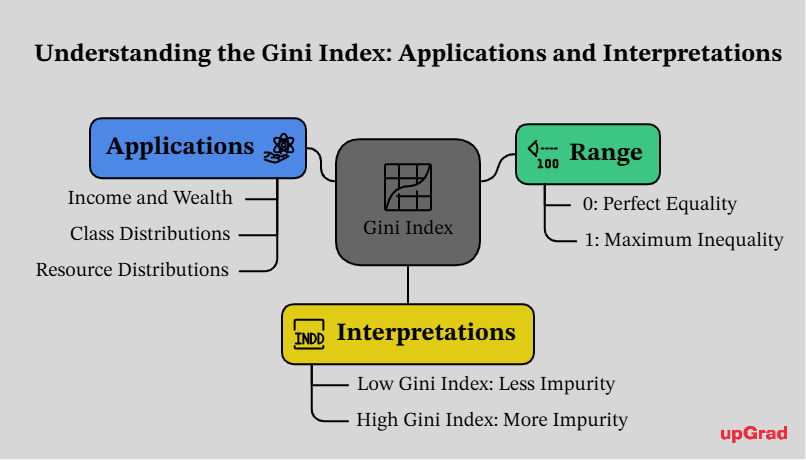
The Gini Index is a value that ranges from 0 to 1:
The Gini Index evaluates how well a split separates data. A split with one dominant class has a low Gini Index (less impurity), while an even distribution across classes results in a higher Gini Index (more impurity).
Ready to see the Gini Index formula in action? Let's explore how it helps decision trees make real-world predictions.
Take some time to read about Decision trees in AI, their types, examples, and how to create one.
The Gini Index plays a central role in how a gini index decision tree determines its optimal splits. It measures impurity at each node, helping the algorithm decide which feature creates the most homogeneous subsets and ultimately boosts classification accuracy.
At each decision point, the Gini index algorithm evaluates various features and their splits, using the Gini Index to determine the lowest impurity. The feature with the lowest Gini Index is chosen to ensure the most "pure" nodes, where most instances belong to a single class.
When applied consistently, minimizing the Gini Index results in clean, well-separated groups, enhancing prediction accuracy. In practice, a decision tree using gini index prioritizes splits only as long as impurity continues to decrease, once it stops, the tree finalizes its leaf nodes.
A decision tree works by recursively splitting the data into subsets based on feature values in a hierarchical structure. Here's how the flow of a decision tree typically works:
The Gini Index is integral to decision trees for a few key reasons. It helps the tree to make the best splits, which in turn ensures high classification accuracy. The Gini Index formula is computationally inexpensive and provides clear insights into which features contribute most to the classification decision.
Now that we're clear on the Gini Index decision tree's role, let's examine the actual math behind the scenes and learn how the Gini Index is calculated.
Also Read: Random Forest Vs Decision Tree
AI Courses to upskill
Explore Artificial Intelligence Courses for Career Progression
The Gini Index measures impurity or inequality in a dataset using class proportions. It calculates the likelihood that two randomly chosen elements belong to different classes. Lower values indicate greater purity, while higher values suggest more impurity.
The formula to calculate the Gini Index varies depending on the type of data you're working with: discrete or continuous.
For datasets with discrete classes, the Gini Index formula is:
Where:
For continuous data, like income or resource distribution, the Gini Index formula becomes:
Where:
To calculate the Gini Index from data, follow these steps. Here’s an example using discrete data:
1. Organize Data:
Arrange your data by class. For instance, if you're classifying customer purchases, your classes might be "Yes" (bought the product) and "No" (didn't buy).
2. Compute Proportions:
For each class, calculate the proportion of the total population in that class. For example, if 70 out of 100 customers buy the product, the proportion for "Yes" is:
pYes=70/100=0.7
And for "No," it’s:
pNo=30/100=0.3
3. Apply the Gini Index Formula:
Using the Gini Index formula for discrete data, the Gini Index is calculated as:
Substituting the values:
This gives you a Gini Index value of 0.42, indicating the dataset's impurity. The closer the value is to 0, the purer the split; the closer it is to 1, the more impure the split.
The Gini Index plays a crucial role in machine learning and is widely used by researchers globally. Its effectiveness in measuring impurity and guiding decision tree splits makes it a cornerstone of the field. Let’s explore why it has become such an essential tool in this domain.
Read More: Decision Tree Example: A Comprehensive Guide to Understanding and Implementing Decision Trees
The Gini Index is widely used across ML workflows, especially when answering the core question of what is gini index in machine learning. It acts as a measure of impurity within nodes, helping models form meaningful splits that boost accuracy and improve predictive performance.
In classification tasks, the Gini Index formula plays a crucial role in determining which feature should be used for splitting at each decision point. During model training, a decision tree using gini index continually evaluates features to minimize impurity, ensuring the most accurate and efficient classification path.
Key Benefits:
By consistently selecting the most discriminative features, the Gini Index helps construct a decision tree that can quickly and accurately classify new data points.
Also Read: Data Preprocessing in Machine Learning: 7 Easy Steps To Follow
While the Gini Index is mainly used in classification tasks, it can be adapted for regression trees; however, in regression, it's replaced by a different measure focused on minimizing variance rather than class purity.
Key Benefits:
In regression tasks, the Gini Index isn't directly used, but minimizing impurity is still key. Variance reduction in regression trees works similarly to the Gini Index, optimizing decision points for the best predictions.
Let's take a step back and see how the concept of inequality is visualized with the Lorenz Curve and find out how closely it's tied to the Gini Index.
Also Read: 6 Types of Regression Models in Machine Learning You Should Know About
Choosing the right impurity measure is key when building decision trees. The Gini Index, Entropy, and Information Gain all evaluate splits differently, each suited for different scenarios. Here's a comparison to help determine the best option for your use case.
Both the Gini Index and Entropy are used as splitting criteria to measure data impurity, but they differ in their mathematical approach and how they penalize impurity.
Here's a table comparing their key differences:
| Parameter | Gini Index | Entropy |
| Definition | Measures the likelihood of incorrect classification. | Measures the disorder or uncertainty in a dataset. |
| Computation Speed | It is faster, as it involves simpler calculations. | It is slower due to the logarithmic computation. |
| Range of Values | Ranges from 0 (perfect split) to 1 (maximum impurity). | Ranges from 0 (perfect split) to log2C\log_2 Clog2C (maximum impurity), where CCC is the number of classes. |
| Preferred Scenarios | Suitable for classification tasks with binary or multi-class outputs. | It is ideal for cases where a more nuanced measurement of impurity is needed, such as when class distribution is skewed. |
| Use Case | It is often used when computational efficiency is a priority. | Preferred when precise measurements of uncertainty are required, especially with complex datasets. |
The Gini Index is faster and preferred for speed, while entropy is better for datasets with class imbalance or when using a more precise impurity measure. is needed.
Both the Gini Index and Information Gain are popular choices for evaluating feature splits in decision trees. However, they cater to different needs depending on factors like dataset size, the computational complexity of the problem, and the desired interpretability of the tree.
Below is a comparison to help determine which metric is more suitable for specific situations.
| Parameter | Gini Index | Information Gain |
| Purpose | Measures impurity based on probability distribution. | Measures the effectiveness of a feature in reducing uncertainty. |
| Efficiency | It is faster to compute due to simpler calculation. | Slower due to the need for logarithmic calculations. |
| Interpretability | Provides a clear, easy-to-understand impurity measure. | More abstract; requires an understanding of entropy. |
| Best Use Case | Best for large datasets where computational speed is essential. | Works well when focusing on how well a feature reduces uncertainty. |
| Usage in Decision Trees | Often used in classification problems where speed and simplicity are key. | Used in decision trees where a more nuanced understanding of data splits is required, especially in complex or highly imbalanced datasets. |
The Gini Index is preferred for efficiency and speed, especially with large datasets or in real-time systems. At the same time, Information Gain is better for understanding split depth and handling complex distributions.
These are some of the factors that make the Gini Index such a popular metric in real-world applications. How? Read on to find more!
Subscribe to upGrad's Newsletter
Join thousands of learners who receive useful tips
The Gini Index is widely used in machine learning and economic analysis for its simplicity and efficiency, and it also helps a gini index decision tree work faster by quickly identifying the splits that reduce impurity the most. However, it may not always capture the full complexity of certain datasets or issues.

The table below further examines the key advantages and limitations of the Gini Index for easy reference.
| Parameter | Advantages of the Gini Index | Limitations of the Gini Index |
| Simplicity | Easy to understand and apply, with straightforward calculations. | Only capture some nuances in complex datasets. |
| Applicability | Works well for classification problems, especially in decision trees. | It may be less effective for regression tasks or continuous data. |
| Computational Efficiency | Requires less computational power and is faster to calculate compared to other measures like entropy. | It may need to be more informative in certain scenarios where deeper analysis is required. |
| Interpretability | Provides a clear measure of impurity, making the decision process easy to follow. | Less intuitive in capturing complex relationships within data. |
| Use Cases | It is ideal for decision trees and other classification tasks. | Only sometimes ideal for datasets with skewed class distributions or highly imbalanced classes. |
| Accuracy | Provides reliable results in many machine learning models. | It can be less accurate in some cases, especially when compared to other metrics like entropy or information gain in certain datasets. |
The Gini Index is fast and efficient for classification tasks but may struggle with highly skewed class distributions. It's important to consider these limitations before using it for a specific use case.
The Gini Index is a widely used measure of inequality, but it is not the only tool for quantifying disparities in income or wealth distribution. Other inequality measures, such as the Theil Index and Atkinson Index, offer different ways of capturing inequality, each with its own strengths and weaknesses.
Here's how the Gini Index compares with these alternative measures:
The Theil Index is another popular measure of inequality. Still, it differs from the Gini Index in that it is based on entropy (a concept from information theory), making it sensitive to the concentration of wealth at the top or bottom of the distribution.
| Parameter | Gini Index | Theil Index |
| Range | 0 to 1 (0 = perfect equality, 1 = maximum inequality) | 0 to ∞\infty∞ (0 = perfect equality; higher values indicate more inequality) |
| Sensitivity | Equal weight to all parts of the distribution | More sensitive to changes at the top or bottom of the income distribution |
| Interpretability | Easier to interpret due to its simple formula | More complex to interpret as it is based on entropy measures |
| Decomposition | It cannot easily be broken down by subgroups | Easily decomposed into within-group and between-group inequality |
| Best Use Case | Suitable for general comparisons of inequality | Useful when focusing on specific groups or the impact of inequality within and between subgroups |
| Strengths | Simple, fast, and widely understood | Provides a deeper understanding of inequality, especially in heterogeneous populations |
| Weaknesses | Does not capture specific segments of the population well | More complex to calculate and understand, can be less intuitive |
The Gini Index is simpler and more intuitive but needs to provide the depth of analysis that the Theil Index offers, especially in terms of dissecting inequality within specific subgroups.
The Atkinson Index is another inequality measure that, unlike the Gini Index, incorporates a parameter of inequality aversion. This means that the Atkinson Index can be adjusted to reflect society’s tolerance for inequality, making it more flexible for policy analysis.
| Parameter | Gini Index | Atkinson Index |
| Range | 0 to 1 (0 = perfect equality, 1 = maximum inequality) | 0 to 1 (0 = perfect equality, 1 = maximum inequality) |
| Sensitivity | Equal sensitivity across the distribution | More sensitive to inequality at the lower end of the distribution if the aversion parameter is high |
| Interpretability | Simple and widely understood | It is more complex due to the inclusion of the inequality aversion parameter |
| Policy Use | Effective for general inequality measurement | It is ideal for assessing the social desirability of reducing inequality, as it allows policymakers to adjust the level of inequality aversion |
| Best Use Case | General comparisons and simple inequality analysis | When policymakers want to reflect societal preferences regarding inequality aversion |
| Strengths | Widely accepted and easy to compute | Flexible in capturing different levels of social aversion to inequality |
| Weaknesses | Does not reflect different societal attitudes toward inequality | More complex to compute, and its meaning can vary depending on the aversion parameter chosen |
The Atkinson Index offers more flexibility, especially for policy applications where inequality aversion plays a role. However, it can be more challenging to interpret and calculate compared to the Gini Index.
Calculating the Gini Index can be done through several tools and software options. Let’s walk through a gini index decision tree solved example to understand how these tools simplify real-world computation. Whether you use Python, R, Excel, or online calculators, each platform makes it easy to compute impurity values and apply them in data analysis or model building.
Several tools are widely used for Gini Index calculations, each catering to different levels of expertise and calculation needs. Here’s an overview of some of the most common ones:
These tools make calculating the Gini Index much more accessible and allow users to choose the method that best suits their dataset and level of expertise.
Also Read: 15 Key Skills Every Business Analyst Needs In Order to Excel

Mastering the Gini Index is crucial for anyone working with decision trees in machine learning. By understanding how the Gini Index helps to split data and improve model accuracy, you’ll be better equipped to build more efficient, interpretable models. Even a decision tree using gini index benefits from clearer, faster splits driven by impurity reduction. Whether you’re just getting started with machine learning or looking to refine your models, the Gini Index will undoubtedly be an essential tool in your toolkit.
Keeping yourself updated with the latest technology and updates in different fields can help you boost your career and take it to the next level. Want to know more? Check out upGrad’s free courses from various domains today.
If you have questions about which of our courses best suits your skills, you can also schedule a free career counseling call!
Discover top-rated Machine Learning and AI courses online and gain the skills to excel in the world of technology!
Stay ahead in tech with in-demand Machine Learning skills that open doors to exciting opportunities!
Explore popular AI and ML blogs along with free courses to enhance your knowledge and grow in the field of artificial intelligence!
The Gini Index is a statistical measure used to quantify impurity or inequality in a dataset. It evaluates how mixed the classes are within a node. A value closer to 0 indicates perfect purity, while higher values show greater randomness or diversity.
The Gini Index is defined as the probability that two randomly selected data points belong to different classes. It gives a numerical score to represent class distribution. This makes it useful for classification-based algorithms.
It helps analysts understand how well data can be separated into meaningful groups. The measure supports model-building by revealing impurity levels. Its simplicity makes it widely used in classification and inequality studies.
It measures how unevenly data points are distributed across multiple categories. Higher scores indicate mixed or impure datasets. This information helps models choose better feature splits.
The gini index formula calculates impurity using class probabilities. It is computed as 1 minus the sum of squared class proportions. This makes it both fast and easy to apply in large datasets.
The gini index formula decision tree calculation analyzes multiple split options and scores their impurity. The formula helps identify splits with maximum purity gain. This ensures more accurate and efficient tree structures.
The Gini Index assesses how well a model separates different classes during training. It is widely used in tree-based algorithms for evaluating node quality. It improves model accuracy by guiding cleaner splits.
It selects features that best divide data into pure groups. Lower impurity improves classification consistency and prediction reliability. This makes it a vital metric in supervised learning workflows.
In data mining, the Gini Index helps uncover structure in large, unlabelled datasets. It evaluates how well attributes separate groups. This supports effective pattern discovery and model-building.
A gini index decision tree evaluates impurity at every node to select the most effective split. By choosing the lowest Gini value, the tree forms purer branches. This results in clearer classification paths.
It guides the decision process by identifying features that minimize impurity. Lower Gini values represent clearer distinctions among classes. This leads to more accurate and well-structured trees.
The tree evaluates all possible splits and assigns impurity scores using Gini. The split with the smallest impurity score is selected. This ensures each branch becomes progressively more homogeneous.
A decision tree using gini index builds faster, cleaner splits due to simple calculations. It avoids unnecessary complexity and maintains interpretability. This makes it ideal for scalable machine-learning workflows.
A gini index decision tree solved example computes impurity for each class split, compares values, and selects the most pure division. This step-by-step process demonstrates how classification improves. Such examples make the concept easy to visualize.
Gini is simpler and computationally lighter, while entropy relies on logarithmic calculations. Both measure impurity but penalize class distribution differently. Their use depends on model needs and dataset characteristics.
Gini is preferred when faster computation is required, especially in large datasets. It often yields similar results to entropy but with less processing time. This makes it practical for resource-intensive applications.
Both metrics evaluate how well a feature separates classes. Information gain reduces entropy, while Gini reduces impurity. Their effectiveness varies based on dataset complexity and model requirements.
It offers speed, simplicity, and reliability in assessing data purity. The metric helps models form strong decision boundaries. These characteristics make it widely used in real-world machine-learning applications.
It may favor features with many distinct values, potentially skewing splits. On imbalanced datasets, the measure may not fully capture class dynamics. Proper preprocessing helps overcome these issues.
Lower values indicate cleaner separation and better model decisions. Higher values show mixed data that requires further splitting. This interpretation helps guide feature selection and model refinement.
2 articles published
Gurucharan M K is an undergraduate student of Biomedical Engineering and an aspiring AI engineer with a strong passion for Deep Learning and Machine Learning.He is dedicated to exploring the intersect...
Speak with AI & ML expert
By submitting, I accept the T&C and
Privacy Policy
Top Resources
Master's Degree
18 Months
Executive Diploma
12 Months
IIIT Bangalore
Executive Programme in Generative AI & Agentic AI for LeadersIndia’s #1 Tech University
Dual Certification
5 Months