What is the LL.M. Course Duration?
By upGrad
Updated on Jul 07, 2026 | 8 min read | 12.45K+ views
Share:

All courses
Certifications
More
By upGrad
Updated on Jul 07, 2026 | 8 min read | 12.45K+ views
Share:
An LLM (Master of Laws) program usually takes 1–2 years to complete, depending on the country, university, and mode of study (full-time, part-time, or online). Many global and some Indian universities offer 1-year intensive courses, while others, particularly in India under recent BCI guidelines, follow a 2-year structure with a stronger research focus.
This blog covers LLM course duration in India and abroad, including 1-year vs 2-year programs, BCI rules, online validity, and country-wise timelines. It also helps you choose the right LLM duration based on career goals, specialization, and practice requirements.
Looking to build legal expertise without the cost?
Explore our Free Online Law Courses with Certificates in 2026 and gain practical knowledge in key legal areas while strengthening your credentials, at no cost, and on your own schedule.

If you're planning to pursue a LLM degree in India, it's important to know how long the course takes. In India, the duration of an LLM course is usually 1 or 2 years, depending on the program you choose. Some colleges offer a 1-year LLM that's fast-tracked and intense, while others stick to the more traditional 2-year LLM course with more in-depth study and research.
But before giving you an idea on LLM duration, just have a quick look at our advanced LLM Courses from the top Jindal Global Law School:
Below is a quick comparison of the LLM duration in India. Let's have a look at
Program Type |
How Long is an LLM? |
Ideal For |
| 1-Year LLM | 12 months | Professionals wanting quick upskilling |
| 2-Year LLM | 24 months | Students interested in deep legal research |
| Part-Time/Executive | 2–3 years | Working professionals |
Also Read: Steps to Success - Your Roadmap to Becoming a Corporate Lawyer
Did You Know? Earlier, most LLM degrees in India were just 1 year long. In 2021, the Bar Council of India (BCI) decided to make the LLM course duration 2 years to match international standards from the 2022-23 academic year. However, since many colleges raised concerns, both 1-year and 2-year LLM programs are still offered in India today. |
However, if you want more information on LLM, check out this blog LLM Degree Course Structure, Admission, Duration & Careers.
Free Courses
Wondering how long an LLM program is if you're planning to study abroad? Here's a quick look at the typical LLM degree duration across some of the top study destinations. These durations may vary slightly depending on whether you choose a full-time, part-time, or hybrid LLM course.
Country |
Typical LLM Duration |
| United States | Most LLM courses in the US are 1 year long (full-time). However, part-time or online LLM programs may stretch up to 2–3 years in some cases. |
| United Kingdom | The standard LLM degree duration is 1 year full-time. Part-time LLM programs or research-based options can take up to 2.5 years. |
| Canada | In Canada, the LLM course duration typically ranges between 1–2 years, depending on the university and course format. |
| Australia | Most LLM programs in Australia last for 1 year full-time, though some extended or dual-specialization options may take longer. |
| Germany | LLM degrees in Germany can be 1 or 2 years, based on the university and whether you pursue a research-oriented or coursework-based program. |
| France | A regular LLM degree in France takes 1 year, while part-time options may go up to 2 years. |
Also Read: Top 10 Career Opportunities in Law in India: Salary, Skills
The table below helps clarify the difference between LLM 1-year and 2-year courses, aiding you in choosing the right format based on your goals.
Aspect |
1-Year LLM |
2-Year LLM |
| Duration | 1 academic year | 2 academic years |
| Recognition | Accepted in the UK, Australia, and some Indian private institutes | Approved by the Bar Council of India (BCI) in 2021, it has come into force since the academic year 2022-23. |
| Course Load | Intensive, compact learning | More balanced pace with deeper exploration |
| Research/Thesis Time | Limited time for an in-depth thesis | More time for dissertation and academic research |
| Specializations Available | International Law, Corporate Law, Human Rights, Intellectual Property Law | Criminal Law, Constitutional Law, Business Law, Taxation Law, Environmental Law |
| Eligibility | Bachelor’s degree in Law (LLB or equivalent) | Bachelor’s degree in Law (LLB or equivalent) |
| Internship/Practical Exposure | Limited internship opportunities | More room for internships, moot courts, and fieldwork |
| Global Acceptance | Recognized globally (especially in the UK, EU, and Australia) | Increasing international recognition, especially in academic/legal fields |
| Fee Structure | Generally lower due to shorter duration | Higher due to extended curriculum and time |
| Best Suited For | Working professionals, students looking for quick upskilling | Fresh graduates, judiciary aspirants, research-focused students |
| Common Countries Offering | UK, Australia, Singapore, select Indian private universities | India (as per BCI mandate), Germany, France, Canada |
| Note: If you are aiming to work in India’s legal system, a 2-year LLM is the safer bet post-BCI’s guidelines. However, if you plan to work abroad or in multinational legal teams, a 1-year LLM may still serve your goals well. |
Further Read: LLM Subjects List and Syllabus 2025: A Complete Guide
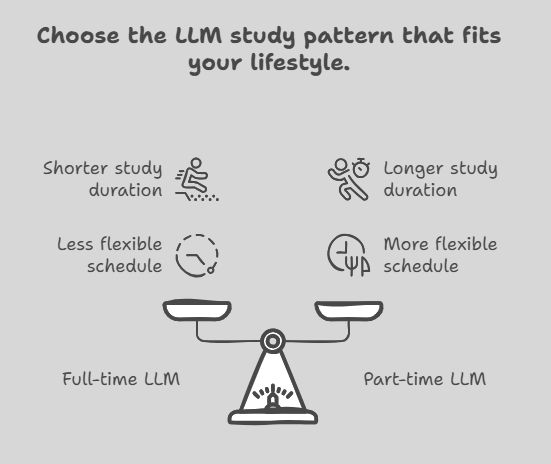
There are a few different ways the LLM program duration can be affected based on where, what, and how you decide to study. Here's what determines the length of an LLM program:
Subscribe to upGrad's Newsletter
Join thousands of learners who receive useful tips
Since candidates cannot legally practice with a part-time course (more than two years) in India, it is better to rule out that option first.
Most countries prefer to keep the LLM postgraduate degree within a year. They believe that since the LLM course aims to provide an opportunity to focus on a particular area of law, extending its time will defeat the purpose.
However, BCI thinks otherwise and believes a year might be too little for candidates to completely grasp or master the concentration they are picking. Therefore, the two-year course is being prioritized in India.
This discussion has been going on since 2013. In 2022, LLM candidates received the freedom to choose their course duration. However, the confusion did not end there. As mentioned above in the blog, BCI announced the abolition of the one-year LLM program from the academic year 2022-23, leaving an uncertain future for the program.
Hence, if you plan to pursue an LLM to practice legally in India, opting for a two-year course will ensure your degree stays relevant. But ultimately, the decision boils down to your personal preference. Additionally, if you want to pursue online, hybrid, or distance LLM programs, keep in mind that the program you opt for must have approval from BCI.

With more than 10 million learners, upGrad is one of the preferred online learning platforms for individuals looking for specialized education to jumpstart their careers. Its blended LLM courses are practice-oriented and designed to teach you the skills you need to take on real-life legal challenges.
Practical learning is the shining feature of upGrad LLM courses. upGrad law courses include case studies, industry projects, and learning directly from the legal experts, adding value to both knowledge and practical application.
Here are a few of them,
| Program | Institution |
| LL.M. in AI and Emerging Technologies (Blended Learning Program) | Offered by Jindal Global Law School |
LL.M. in Dispute Resolution (Blended Learning Program)
|
Offered by Jindal Global Law School |
LL.M. in Intellectual Property & Technology Law (Blended Learning Program)
|
Offered by Jindal Global Law School |
LL.M. in Dispute Resolution (Blended Learning Program)
|
Offered by Jindal Global Law School |
| Contract Law Certificate Course - Bootcamp | Offered by upGrad |
Free Certificate Course in Introduction to Intellectual Property Rights
|
Offered by upGrad |
Free Certificate Course in Law and Justice in a Globalizing World
|
Offered by upGrad |
Free Certificate Course in Merger and Control Rights
|
Offered by upGrad |
| Free Certificate Course in Soft Skills for Lawyers | Offered by upGrad |
Are you looking to choose the right LLM degree duration for your career growth? You can take some time and book a free career counseling session with our counselors. For more information, you can visit your nearest upGrad center!
Transform your passion for law into expertise! Discover our popular Law courses and start your journey to legal success!
Dive into our must-read Law articles—packed with tips and trends that every legal enthusiast should know!
References:
https://www.thehindu.com/education/online-or-hybrid-llm-degrees-without-bci-approval-deemed-invalid/article69755396.ece
https://timesofindia.indiatimes.com/education/news/rules-abolishing-one-year-llm-to-come-into-effect-from-2022-23-bci-to-sc/articleshow/80858436.cms
https://www.deccanherald.com/india/bci-rules-against-one-year-llm-course-to-operate-from-2022-23-sc-told-950007.html
https://www.glassdoor.co.in/Salaries/llm-salary-SRCH_KO0,3.htm
Yes, LLM duration can influence judiciary preparation. A 2-year LLM is often preferred as it aligns with BCI norms and offers deeper conceptual clarity, which can help candidates build a strong foundation for judicial service exams and long-term legal careers.
No. Government universities usually follow BCI-aligned 2-year LLM formats, while private universities may offer both 1-year and 2-year options depending on institutional approvals, curriculum design, and whether the program targets working professionals or research-oriented students.
Generally, no. Most universities require at least one academic year to complete an LLM. Accelerated programs may compress coursework but still meet mandatory credit requirements, ensuring the degree remains academically valid and professionally recognized.
The official duration usually remains the same, but certain specializations may involve heavier coursework or research components. Subjects like taxation, constitutional law, or international law can feel more intensive, even if the total program length does not change.
Yes. One-year LLMs focus more on coursework and exams, while two-year programs often include dissertations, seminars, and extended research projects, offering a more balanced pace and deeper academic engagement over time.
A longer LLM does not guarantee higher salaries, but it provides more time for internships, research, and skill-building. This can improve employability, especially in academia, policy research, legal consulting, and specialized advisory roles.
For corporate law roles, employers prioritize specialization and practical skills over duration. A well-structured 1-year LLM can be sufficient, while a 2-year LLM may benefit those aiming for compliance, policy, or senior advisory positions.
Yes. Many universities prefer candidates with research-focused LLM degrees. A 2-year LLM with a dissertation often strengthens PhD applications by demonstrating academic rigor, research capability, and subject-matter depth.
Yes. Academic institutions often favor candidates with longer, research-oriented LLM programs. A 2-year LLM with a strong dissertation is generally considered more suitable for university teaching and academic research roles.
Yes. Executive or weekend LLM programs usually extend over a longer period, often 2–3 years, as coursework is spread out to accommodate working professionals while maintaining academic credit and learning outcomes.
Yes. Longer LLM programs typically involve higher overall tuition and living costs. However, they may also offer greater academic depth, networking opportunities, and research exposure, which some students consider a worthwhile investment.
Yes. Student visa duration is usually linked to course length. A 1-year LLM requires a shorter visa, while longer programs may involve renewals, additional documentation, and higher compliance responsibilities.
In some countries, post-study work rights are linked to program duration. Longer courses may offer extended stay options, while shorter LLM programs can limit post-study employment time, depending on local immigration policies.
Not always. Common law countries like the UK usually offer 1-year LLMs, while civil law countries may structure programs over 1–2 years, especially when research components or language training are included.
Yes. Longer LLM programs provide more time to build professional networks through seminars, internships, conferences, and academic collaborations. Shorter programs require students to network more proactively within limited timeframes.
Yes. A longer LLM allows gradual development of legal research, writing, and analytical skills. Shorter programs demand faster learning and are best suited for students with clear goals and strong foundational legal knowledge.
Usually, no. Universities rarely allow switching formats mid-program due to differences in curriculum, credit structure, and assessment methods. Choosing the right duration before enrollment is crucial to avoid academic complications.
No. Work experience does not shorten the official LLM duration. However, experienced professionals may choose executive or intensive formats that better align with their schedules while maintaining the same academic requirements.
No. While the BCI provides overarching guidelines, universities retain flexibility in structuring programs. As a result, minor variations in duration, pace, and academic intensity may exist across institutions and states.
Select your LLM duration based on career plans, practice location, research interests, and regulatory requirements. A longer program suits Indian practice or academia, while a shorter LLM works well for quick specialization or international exposure.
1011 articles published
We are an online education platform providing industry-relevant programs for professionals, designed and delivered in collaboration with world-class faculty and businesses. Merging the latest technolo...
Get Free Consultation
By submitting, I accept the T&C and
Privacy Policy