Best Generative AI Platforms from Beginners to Advanced Users
By Rahul Singh
Updated on May 13, 2026 | 9 min read | 3.73K+ views
Share:

All courses
Certifications
More
By Rahul Singh
Updated on May 13, 2026 | 9 min read | 3.73K+ views
Share:
Generative AI platforms are software environments that let you create, deploy, and manage AI models for generating text, images, code, and audio. They bring together models, APIs, and tools so you can build and scale AI applications from one place.
Popular platforms include ChatGPT, Google Gemini, Microsoft Azure AI, and Claude. You can use them for content creation, automation, customer support, and building real-world AI products.
In this complete guide, you will learn exactly how these Generative AI platforms operate. You will also explore their core benefits, analyze different types, and provide practical everyday examples.
Generative AI Courses to upskill
Explore Generative AI Courses for Career Progression
IIIT Bangalore
EPGP in Applied AI and Agentic AIIIIT Bangalore
Executive Diploma in Machine Learning and AI360° Career Support
Generative AI platforms are transforming how we create content, write code, design visuals, and solve complex problems. Each platform specializes in different types of tasks, so choosing the right one depends on your goals, skill level, and workflow.
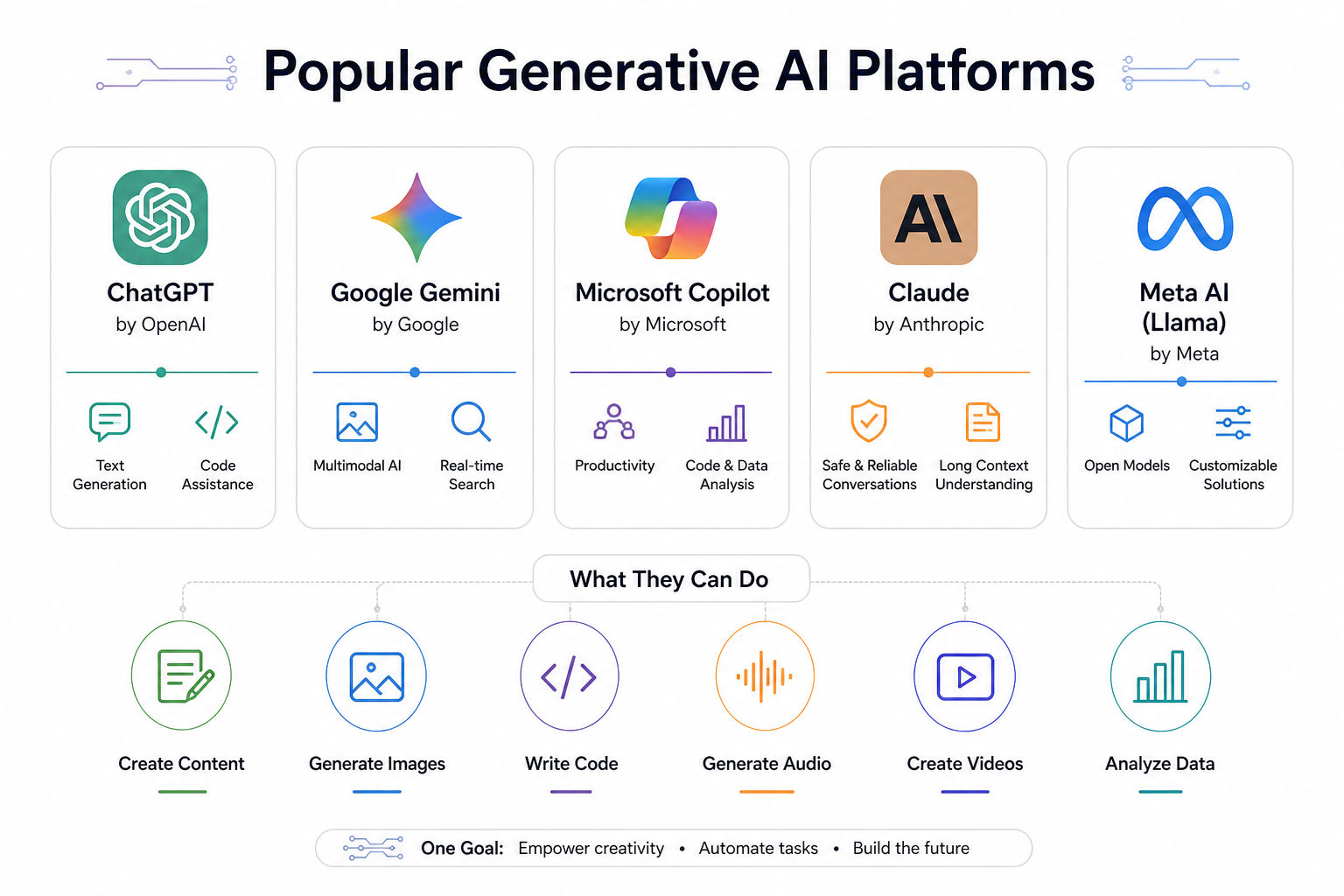
These are the most widely used and accessible AI tools. Platforms like ChatGPT, Google Gemini, and Claude fall into this category.
They are designed to understand and generate human-like text, making them extremely versatile.
Key Capabilities
Common Use Cases
Also Read: GPT-4 vs ChatGPT: What’s the Difference?
These tools convert text prompts into visuals. Popular examples include DALL·E, Midjourney, and Stable Diffusion.
Key Capabilities
Common Use Cases
These platforms assist developers in writing, debugging, and optimizing code. Examples include GitHub Copilot and Amazon CodeWhisperer.
Key Capabilities
Common Use Cases
These are advanced platforms that combine multiple capabilities, text, images, audio, and sometimes video. Examples include GPT-4 and Gemini.
Key Capabilities
Common Use Cases
Also Read: Highest Paying Programming Languages in India: 2026 Guide
Generative ai platforms are highly advanced digital workspaces. They allow everyday users to create completely new content using simple text prompts. You simply type exactly what you want, and the system builds it instantly.
Traditional software strictly requires you to do all the hard manual work. These modern systems do the heavy lifting for you automatically. They rely on massive artificial intelligence models running silently behind the scenes.
Also Read: What is Generative AI? Understanding Key Applications and Its Role in the Future of Work
These tools learn by reading massive amounts of existing global data. They constantly study billions of web pages, digital books, and high-resolution images. This massive learning phase deeply teaches them human language and creative patterns.
Here is a simple table comparing traditional digital tools and modern automated systems:
| Feature | Traditional Software Tools | Generative AI Platforms |
| Content Creation | Highly manual and very slow | Fully automated and instant |
| User Input | Requires exact mouse clicks | Uses natural human language |
| Learning Ability | Never learns from past actions | Constantly improves over time |
| Skill Required | Requires deep technical training | Extremely beginner-friendly |
The user interface for these systems is usually incredibly simple and clean. You absolutely do not need to know complex computer coding to use them. Anyone who can type a basic sentence can generate amazing digital results today.
Also Read: Top 7 Generative AI Models in 2026
Generative AI platforms are becoming essential because they:
For beginners, they open the door to creativity and efficiency without requiring deep technical knowledge.
The massive global adoption of generative ai platforms is definitely not just a passing trend. They actively offer massive, undeniable benefits to everyday individuals and huge global corporations.
Let us look closely at the primary business benefits actively driving this massive global shift.
The absolute biggest daily advantage is incredible raw processing speed. Digital tasks that previously took several hours now take only a few minutes. A professional writer can easily draft ten distinct blog articles in a single afternoon.
Also Read: Easiest Way to Learn Generative AI in 6 months
Generative ai platforms actively help small businesses lower their daily operational costs. Companies can seamlessly produce much more digital content without hiring massive new teams. This makes small startup businesses highly competitive against giant, wealthy corporations.
Marketing agencies heavily use these systems to scale their daily client work smoothly. They confidently deliver high-quality campaign materials significantly faster than ever before. This naturally creates much higher profit margins and incredibly happy clients.
Every single creative professional faces terrible creative block eventually. Staring hopelessly at a blank digital page is deeply frustrating and highly stressful. These digital systems provide instant creative inspiration strictly on demand.
Here are the main platform benefits summarized clearly:
Also Read: The Ultimate Guide to Gen AI Tools for Businesses and Creators
Generative ai platforms are powerful, but they are not perfect. You need to understand their limits before using them in real life.
These systems can generate incorrect or misleading outputs. You cannot assume every response is reliable.
They do not truly understand the real world. They rely on patterns, not actual reasoning.
Also Read: Generative AI Roadmap
There are risks related to content and data usage. You need to use these tools responsibly.
Overuse can affect how you think and work. You should not rely on them for everything.
Limitation |
What it means |
| Accuracy | Needs verification |
| Context | Limited understanding |
| Ethics | Risk of misuse |
| Dependency | Over-reliance issues |
Use generative ai platforms as a support tool, not a complete replacement for human judgment.
Also Read: Generative AI vs Traditional AI: Which One Is Right for You?
With so many distinct options available, picking the absolute best tool is difficult. Not all generative ai platforms are built with the exact same business goals. You must deeply evaluate your specific daily needs before spending any corporate money.
Here is a highly simple guide to confidently picking the absolute best digital tools.
First, clearly identify the highly specific daily problem you want to solve. Do you strictly need help writing long articles, or creating marketing images? Some modern platforms are highly specialized, while others actively offer broad general tools.
Make a clear physical list of your absolute necessary platform features. If your remote team needs to collaborate globally, heavily look for multiplayer workspace features. If you need strict brand voice control, find a tool offering deep custom training.
Also Read: Generative AI Examples: Real-World Applications Explained
Digital security is a massive concern when using public generative ai platforms. You must ensure the software vendor strongly protects your private company data.
Here is a simple checklist for evaluating new artificial intelligence software:
| Evaluation Criteria | What to Actively Look For | Why It Strictly Matters |
| Data Security | Enterprise encryption and privacy options | Keeps private data safe |
| Output Quality | Accurate, highly readable, clear results | Reduces manual editing time |
| Ease of Use | Clean, highly simple user interface | Ensures fast team adoption |
| Customer Support | Active live chat and deep tutorials | Helps solve bugs instantly |
Pricing structures naturally vary wildly across different modern software tools. Some platforms actively charge a flat monthly fee, while others charge strictly per generated word. Always accurately calculate your estimated daily usage before ever signing a long enterprise contract.
Many top generative ai platforms actively offer a basic free trial tier. You should always thoroughly test the core software before fully committing your annual budget.
Also Read: The Evolution of Generative AI From GANs to Transformer Models
Choosing the right platform is important for building practical Generative AI and Agentic AI skills. The best online platforms offer hands-on projects, structured learning paths, mentorship, and real-world AI applications for beginners as well as advanced professionals.
Here are some of the top platforms and ecosystems helping learners build Generative AI and Agentic AI expertise in 2026:
Generative AI platforms are changing how we create, learn, and work. They make advanced technology accessible to everyone, from beginners to professionals. Whether you want to write content, design visuals, or build software, these platforms can help you do it faster and more efficiently.
However, they are not perfect. Understanding their strengths and limitations is key to using them effectively. By combining AI capabilities with human thinking, you can unlock their full potential.
Want personalized guidance on Gen AI and upskilling? Speak with an expert for a free 1:1 counselling session today.
A generative AI platform is a system that lets you create content like text, images, or code using AI models. It provides tools, APIs, and infrastructure to build and deploy applications. These platforms simplify development and allow you to scale AI solutions quickly.
Some of the most widely used platforms include ChatGPT, Google Gemini, Claude, Microsoft Azure AI, and Meta Llama-based tools. These platforms support content creation, automation, and app development across industries.
Yes. ChatGPT is a generative AI system that creates human-like text, answers questions, and generates content. It uses large language models trained on vast datasets to predict and generate responses based on your input.
They use deep learning models trained on large datasets. These models learn patterns in language, images, and code. When you provide input, they predict the most relevant output based on context, enabling automatic content generation across formats.
Generative ai platforms help automate tasks like content creation, customer support, and data analysis. They improve productivity and reduce manual effort. Businesses use them to build scalable applications and enhance user experience with AI-driven solutions.
Yes. Many platforms offer no-code or low-code interfaces. You can use prompts and simple tools to generate outputs. However, coding skills help when you want to integrate APIs or build advanced applications.
Industries like marketing, healthcare, finance, and software development use these platforms widely. They help generate content, analyze data, and automate workflows, making them useful across multiple domains.
Generative ai platforms support multiple formats like text, images, audio, and video. Modern systems are multimodal, meaning they can process and generate different types of data in a single workflow for better flexibility.
They can be safe if used correctly, but you should avoid sharing sensitive information. Many platforms offer security features, but data privacy depends on how the system is configured and managed.
Generative ai platforms focus on creating outputs using AI, while traditional tools follow fixed rules. They are more flexible and adaptive, making them useful for dynamic tasks like writing, coding, and design.
Recent trends focus on multimodal capabilities, where systems handle text, images, audio, and video together. There is also a shift toward real-time applications, better personalization, and enterprise adoption. Many platforms now support faster deployment and improved integration into everyday tools and workflows.
98 articles published
Rahul Singh is an Associate Content Writer at upGrad, with a strong interest in Data Science, Machine Learning, and Artificial Intelligence. He combines technical development skills with data-driven s...
Speak with AI & ML expert
By submitting, I accept the T&C and
Privacy Policy