Anthropic Launches Claude Fable 5: The Safe Version of Its Powerful Mythos AI Model
By Vikram Singh
Updated on Jun 23, 2026 | 6 min read | 3.15K+ views
Share:

All courses
Certifications
More
By Vikram Singh
Updated on Jun 23, 2026 | 6 min read | 3.15K+ views
Share:
Table of Contents
Key Takeaways
Popular AI Programs
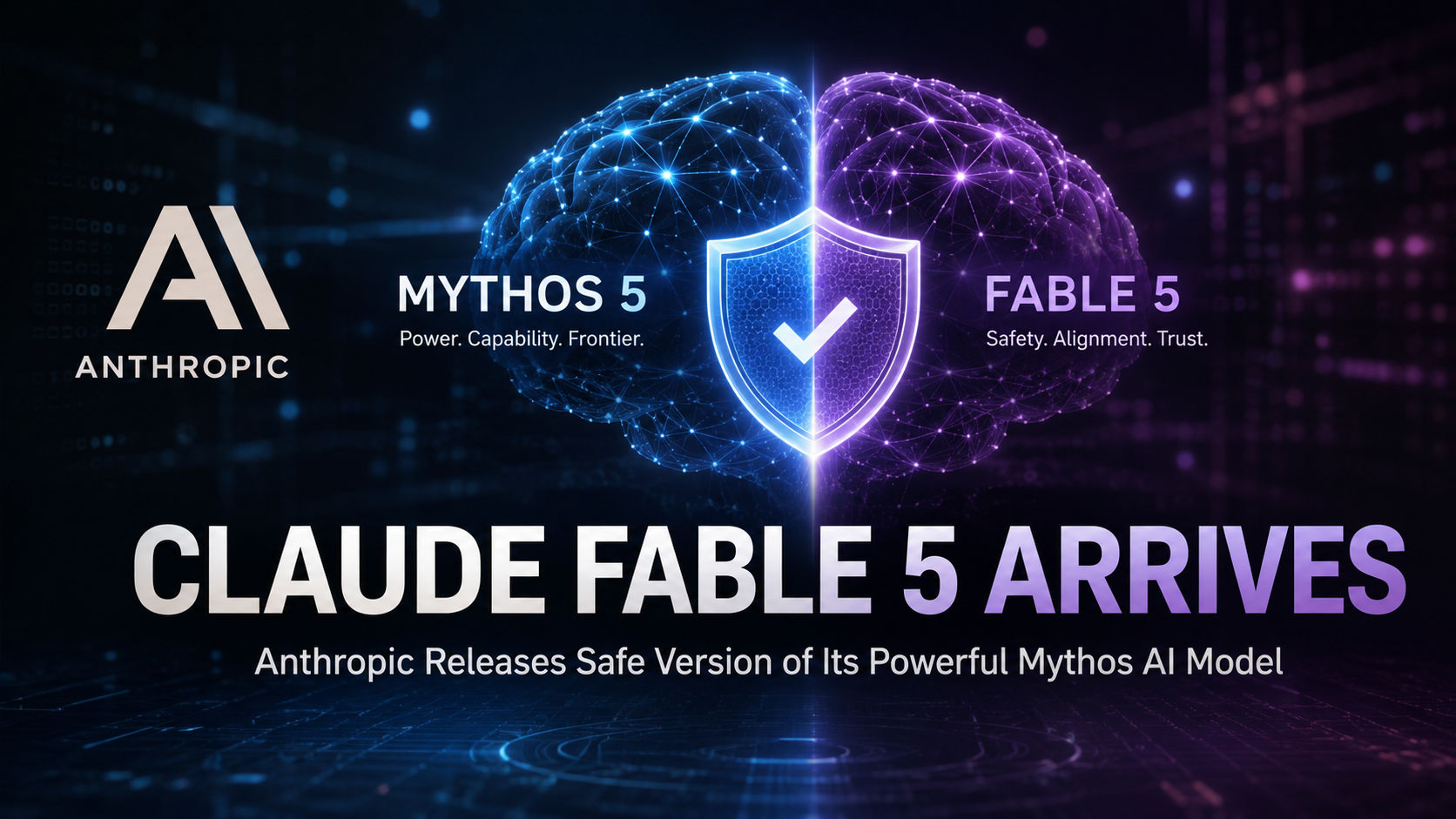
AI startup Anthropic has officially launched Claude Fable 5, making its highly advanced Mythos-class AI technology available to a broader audience for the first time. The release marks a significant milestone for the company, which previously restricted access to the underlying Mythos model due to concerns about its powerful cybersecurity and reasoning capabilities.
Claude Fable 5 is being positioned as Anthropic's most capable publicly available AI model. However, unlike its counterpart Claude Mythos 5, Fable 5 includes extensive safety mechanisms designed to prevent misuse in high-risk areas such as cybersecurity, biology, chemistry, and health-related applications.
The launch highlights a growing challenge facing the AI industry: how to make increasingly powerful AI systems widely available while minimizing potential risks.
Free Courses
Claude Fable 5 is Anthropic's first generally available Mythos-class model, a category of AI systems designed for advanced reasoning, long-duration tasks, software engineering, scientific analysis, and autonomous workflows.
According to Anthropic, the model is capable of:
The company says Fable 5 represents its strongest publicly accessible AI model to date.
AI Courses to upskill
Explore Artificial Intelligence Courses for Career Progression
Alongside Fable 5, Anthropic also announced Claude Mythos 5.
While both models share the same underlying architecture and capabilities, Mythos 5 does not include the same safety classifiers and restrictions found in Fable 5. Because of this, Mythos 5 remains available only through Anthropic's limited-access Project Glasswing program for approved organizations and researchers.
Earlier versions of Mythos reportedly demonstrated exceptional capabilities in identifying software vulnerabilities, leading Anthropic to limit public access while conducting further safety evaluations.
The biggest difference between Fable 5 and Mythos 5 is safety.
Anthropic has built multiple layers of guardrails into Fable 5 to ensure it can be used safely by enterprises and consumers.
When users submit prompts involving sensitive topics such as:
the system automatically redirects those requests to an older and less capable model, Claude Opus 4.8.
According to Anthropic, these safeguards allow the company to offer Mythos-level intelligence while reducing the likelihood of harmful misuse.
Anthropic claims Claude Fable 5 achieves state-of-the-art performance across a wide range of benchmarks.
The model was specifically designed for:
Fable 5 can work on coding projects for extended periods with minimal supervision, making it particularly useful for developers and engineering teams.
The model excels at research, analysis, summarization, planning, and document-heavy tasks that require sustained reasoning.
Unlike traditional text-only models, Fable 5 can interpret charts, tables, diagrams, PDFs, and visual documents with high accuracy.
Anthropic says Fable 5 can maintain context and work autonomously on complex tasks longer than any previous Claude model.
The release is particularly notable because Anthropic previously argued that Mythos-class models could present significant risks if released without adequate safeguards.
Earlier this year, the company limited Mythos access to roughly 200 vetted organizations while conducting extensive testing and safety evaluations.
Anthropic says it spent thousands of hours conducting:
before determining that Fable 5's safeguards were strong enough for broader deployment.
The launch reflects Anthropic's broader philosophy of developing powerful AI systems alongside strong safety measures.
The company states that Fable 5 has undergone extensive testing to prevent users from bypassing restrictions. If attempts are detected, the model automatically falls back to safer systems.
Anthropic has also introduced new monitoring requirements, including temporary data retention policies intended to help identify novel attacks and jailbreak attempts.
Claude Fable 5 represents one of the clearest examples yet of how AI companies are attempting to balance capability and safety.
Rather than restricting access entirely or releasing unrestricted frontier models, Anthropic is pursuing a middle-ground approach: offering near-Mythos-level performance while actively limiting high-risk capabilities.
As frontier AI systems become increasingly powerful, similar guardrail-based deployment strategies may become common across the industry.
Claude Fable 5 is Anthropic's most advanced publicly available AI model and the first Mythos-class model released for general use.
Claude Mythos 5 is the unrestricted version of the Mythos-class model and is currently available only to approved organizations through Project Glasswing.
Both models share the same core capabilities, but Fable 5 includes safety classifiers and guardrails that restrict responses in high-risk domains.
The company was concerned about the model's ability to identify software vulnerabilities and potentially assist in harmful activities if released without safeguards.
The model is optimized for software engineering, research, data analysis, reasoning, document processing, and long-duration autonomous workflows.
Yes. The model can analyze charts, diagrams, tables, PDFs, and other visual content.
The model redirects certain high-risk prompts to a less capable model and includes extensive safeguards against misuse and jailbreak attempts.
Claude Fable 5 is available through Anthropic's API, enterprise offerings, Amazon Bedrock, AWS Claude Platform, Vertex AI, and Microsoft Foundry.
Because it uses the same advanced architecture and core capabilities as Anthropic's restricted Mythos AI system.
Project Glasswing is Anthropic's controlled-access program that allows approved organizations to use advanced Mythos models under strict oversight.
It demonstrates how frontier AI models can be deployed publicly while incorporating strong safety guardrails, offering a potential blueprint for future AI releases.
158 articles published
Vikram Singh is a seasoned content strategist with over 5 years of experience in simplifying complex technical subjects. Holding a postgraduate degree in Applied Mathematics, he specializes in creatin...
Speak with AI & ML expert
By submitting, I accept the T&C and
Privacy Policy
Top Resources
Master's Degree
18 Months
Executive Diploma
12 Months
IIIT Bangalore
Executive Programme in Generative AI & Agentic AI for LeadersIndia’s #1 Tech University
Dual Certification
5 Months