
All courses
Agentic AI
Agentic AI

IIIT Bangalore
Executive Programme in Generative AI for LeadersArtificial Intelligence
Degree / Exec. PG

IIIT Bangalore
Executive Diploma in Machine Learning and AI
OPJ Global University
Master’s Degree in Artificial Intelligence and Data Science
Liverpool John Moores University
Master of Science in Machine Learning & AI
Golden Gate University
DBA in Emerging Technologies with Concentration in Generative AIExecutive Certificate

IIITB & IIM, Udaipur
Chief Technology Officer & AI Leadership Programme
IIIT-B & IIM, Udaipur
Chief Data and AI Officer ProgrammeOffline Bootcamps

upGrad
Data Science and AI-MLDoctorate
For All Domains
IIITB & IIM, Udaipur
Chief Technology Officer & AI Leadership Programme
Swiss School of Business and Management
Global Doctor of Business Administration from SSBM
Edgewood University
Doctorate in Business Administration by Edgewood UniversityGolden Gate University
Doctor of Business Administration From Golden Gate University
Rushford Business School
Doctor of Business Administration from Rushford Business School, SwitzerlandGolden Gate University
Doctor of Technology in Applied & Agentic AI-d9bdeff6165f4eb1ba2adcebde78e961.svg)
University of Waterloo
Chief Technology and AI Officer ProgramLeadership / AI
Golden Gate University
DBA in Emerging Technologies with a concentration in Generative and Agentic AIMachine Learning
Machine Learning
Data Science
Degree / Exec. PG
O.P Jindal Global University
Master’s Degree in Artificial Intelligence and Data ScienceIIIT Bangalore
Executive Diploma in Data Science & AILiverpool John Moores University
Master of Science in Data ScienceExecutive Certificate

upGrad | Microsoft
Gen AI Foundations Certificate Program from MicrosoftIIIT-B & IIM, Udaipur
Chief Data and AI Officer ProgrammeupGrad | Microsoft
Gen AI Mastery Certificate for Data AnalysisupGrad | Microsoft
Gen AI Mastery Certificate for Software DevelopmentupGrad | Microsoft
Gen AI Mastery Certificate for Managerial ExcellenceupGrad | Microsoft
Gen AI Mastery Certificate for Content CreationBootcamp
Offline Bootcamps
upGrad
Data Science and AI-MLMBA
Masters

Liverpool John Moores University
Master of Business Administration from Liverpool John Moores University (LJMU) with IIM Udaipur CertificationO.P.Jindal Global University
MBA (with Career Acceleration Program by upGrad)Edgewood University
MBA from Edgewood UniversityO.P.Jindal Global University
MBA from O.P.Jindal Global UniversityExecutive Certificate
Marketing
Executive Certificate
Offline Bootcamps
upGrad
Digital MarketingManagement
Degree
O.P Jindal Global University
MSc in International Accounting & Finance (ACCA integrated)
Golden Gate University
Master of Arts in Industrial-Organizational PsychologyExecutive Certificate
IIIT-B & IIM, Udaipur
Chief Technology Officer & AI Leadership ProgrammeIIIT-B & IIM, Udaipur
Chief Data and AI Officer Programme
IIM Kozhikode
Human Resource Analytics Course from IIM-KupGrad | Microsoft
Gen AI Foundations Certificate Program from MicrosoftBootcamp
HDFC Life
Insurance Fundamentals ProgramEducation
Education

Northeastern University
Master of Education (M.Ed.) from Northeastern UniversityEdgewood University
Doctor of Education (Ed.D.)Edgewood University
Master of Education (M.Ed.) from Edgewood UniversityCertifications
Project Management
Certification

Knowledgehut
Leadership And Communications In ProjectsKnowledgehut
Microsoft Project 2007/2010-ae8d039bbd2a41318308f8d26b52ac8f.svg)
Knowledgehut
Financial Management For Project ManagersKnowledgehut
Fundamentals of Earned Value Management (EVM)Knowledgehut
Fundamentals of Portfolio ManagementKnowledgehut
Fundamentals of Program Management-35c169da468a4cc481c6a8505a74826d.webp&w=128&q=75)
Knowledgehut
CAPM® CertificationsKnowledgehut
Microsoft® Project 2016Certifications & Trainings
-7f4b4f34e09d42bfa73b58f4a230cffa.webp&w=128&q=75)
Knowledgehut
PMP® CertificationKnowledgehut
PMI-RMP® CertificationKnowledgehut
PMP Renewal Learning PathKnowledgehut
Oracle Primavera P6 V18.8Knowledgehut
Microsoft® Project 2013Knowledgehut
PfMP® Certification CourseKnowledgehut
Project Planning and MonitoringPrince2 Certifications

Knowledgehut
PRINCE2® FoundationKnowledgehut
PRINCE2® PractitionerKnowledgehut
PRINCE2 Agile Foundation and PractitionerKnowledgehut
PRINCE2 Agile® Foundation CertificationKnowledgehut
PRINCE2 Agile® Practitioner CertificationManagement Certifications
Knowledgehut
Project Management Masters Certification ProgramKnowledgehut
Change ManagementKnowledgehut
Project Management TechniquesKnowledgehut
Product Management Certification ProgramKnowledgehut
Project Risk Management- Study abroad
- Offline centres
- uGSOT - B.Tech
More
%20(2)-db0b6f38da9c485faf76e366793c9b9e.webp&w=128&q=75)




Data Science Courses
Learn Data Science from basics to advance with hands-on projects, real datasets, and tools like Python, SQL, and Machine Learning. Build skills that help you analyze data, find insights, and grow into roles like Data Analyst, Data Scientist, or ML Engineer.
Certificate in Data Science courses with GenAI integrated curriculum
Get to study with top-tier faculty at IIIT Bangalore and LJMU
Learn Python, Machine Learning, AI, Tableau, and SQL designed for industry needs
-80f5aca04e9b49ca9902fe2806c12f6e.webp&w=3840&q=75)
Career Support
57% Avg Salary Hike
Career Coaching
Data Science Course From Top Universities
Data Science Courses (8)
Executive Diploma
12 Months
Certification
6 Months

bestseller
Master's Degree
18 Months
Certification
DS for Beginers

O.P.Jindal Global University
Master of Science in Artificial Intelligence and Data ScienceMaster's Degree
12 Months
popular
Bootcamp
6 Months
Classroom
6 Months
-4c349343809f452a8b692e3368cd8097.webp&w=3840&q=75)
MIT Open Learning
Universal AI by MIT Open LearningCertification
200+ Hours




Our Top University Partners for Data Science Programs
How AI-Ready Is Your Career?
The work you do today may already be easy for AI to replace. Find out where you truly stand.
Automation risk in your profile
Skill relevancy for AI roles
Ability to adapt
🧠 Discover how future-ready your career really is
-d7bcc89c78df4cff8b2140ff79f1ffb1.webp&w=1200&q=75)
Learn by Doing
16+
Industry projects to choose from


Learn Data Science From The Best Instructors
8
Instructors
10
Industry Experts
















-39a9e7a7278a441ea08a60a1f45b4913.png&w=128&q=75)











What Our Learners Have To Say About Data Science Course


Explore Other Related Courses
How can upGrad support you?
Access the various career developement support services offered by upGrad to help you achieve your dream career and professional goals
You can write to us via studentsupport@upgrad.com or for urgent queries use the " Talk to Us" option on the learning platform
We are always there to support our online data science course learners on demand.


Data Science Course Overview
Data is the most valuable asset nowadays for businesses because it helps them to understand customers, improve their products and make better decisions.
Data Science helps to collect this valuable data, analyze it, and find out the useful pattern and information. It combines statistics, programming, visualisation, and Machine Learning to solve real-world business problems.
A data science course online helps you to learn this broad and demanding field.
upGrad provides a range of data science courses. These courses are designed for students, working professionals, technical experts and even those with -technical backgrounds. The programs offered by upGrad help individuals build skills like Python, SQL, statistics, machine learning and data visualization. These skills can open doors to roles such as Data Analyst, Data Scientist and Data Engineer.
What Is Data Science?
Data Science is a field that uses science and math techniques, statistics and computer programs to turn data into useful information that can help people make decisions.
The Data Science field does not only focus on looking at data that already exists. Data Science professionals also build future‑looking models, create reports and use machine learning to solve specific problems.
How Does Data Science Work?
Data science uses these key steps for solving the real world problems:
- Data Collection: Start by gathering data from databases, websites, applications, surveys, sensors and other places.
- Data Cleaning: Next fix the data by removing mistakes, duplicates, missing parts and any inconsistent entries.
- Data Analysis: Then look closely at the data to find patterns, trends and connections.
- Data Visualization: After that share what you found using charts, graphs and dashboards.
- Machine Learning: Then use machine learning techniques to create models that can predict results or make decisions automatically.
- Decisions: Finally apply what you learn to solve a business problem or a practical issue.
What Are the Main Applications of Data Science?
Data Science is used across every industry nowadays because every industry operates on some kind of data.
Some common applications among the industries are:
Industry | How Data Science Is Used |
IT and Software | Build data-driven products, improve systems and finally work with datasets |
Banking and Finance | Analyze risk, detect fraud, and support financial decisions |
E-commerce and Retail | Recommend products, understand customer behaviour, and manage inventory |
Healthcare | Analyze patient data, support diagnosis, and assist research |
Marketing and Advertising | Understand customers, analyze campaigns, and identify target audiences |
Media and Content | Track user behaviour, analyze content performance, and personalize user experiences |
Consulting | Analyze business data and support better decisions |
These applications show why pursuing a Data Science Course in India is a good decision as it helps in every sector.
Who Should Take a Data Science Course Online?
A Data Science Certification Course is best for anyone who is interested in working with data, understanding business trends or want to build technical skills for data roles.
A Data Science Course Online fits best for:
1. Software and Data Professionals
If you already work with software, data, or analytics, a PG Diploma in Data Science or certification can help you build more advanced skills.
You can learn to:
- Build data-driven solutions
- Work with real datasets
- Apply Machine Learning techniques
- Move towards advanced data roles
2. System Architects and Team Managers
If you manage systems or technical teams, a Data Science course online can help you understand how data is collected, processed, and used.
You will explore how to:
- Design better data processes
- Use data insights for decisions
- Guide data-related projects
3. Product Owners and Business Leaders
If you work with products or business oriented goals, a Data Science certification course can help you use data in your daily decision-making.
You will learn how to:
- Track product and business performance
- Understand customer behaviour
- Use data to support business decisions
4. Students and Early-Career Professionals
If you are starting your career and exploring new technologies, a Data Science course online can help you build skills step by step.
You will learn to:
- Understand how data works
- Practice with real datasets
- Build practical projects
- Develop a foundation for data roles
5. Professionals From Non-Tech Backgrounds
Professionals from marketing, finance, operations, and other fields can use a PG Diploma in Data Science or executive courses to bring data into their existing work.
You will explore how to:
- Analyse data from your field
- Find useful business insights
- Use data to support decisions
What Will You Learn in a Data Science Course Online?
A PG Diploma in Data Science or Data Science Certification Course will help you to learn programming, statistics, data analysis, Machine Learning, and advanced AI topics.
The exact Data Science Course Syllabus depends on the course you choose, but the learning path generally includes:
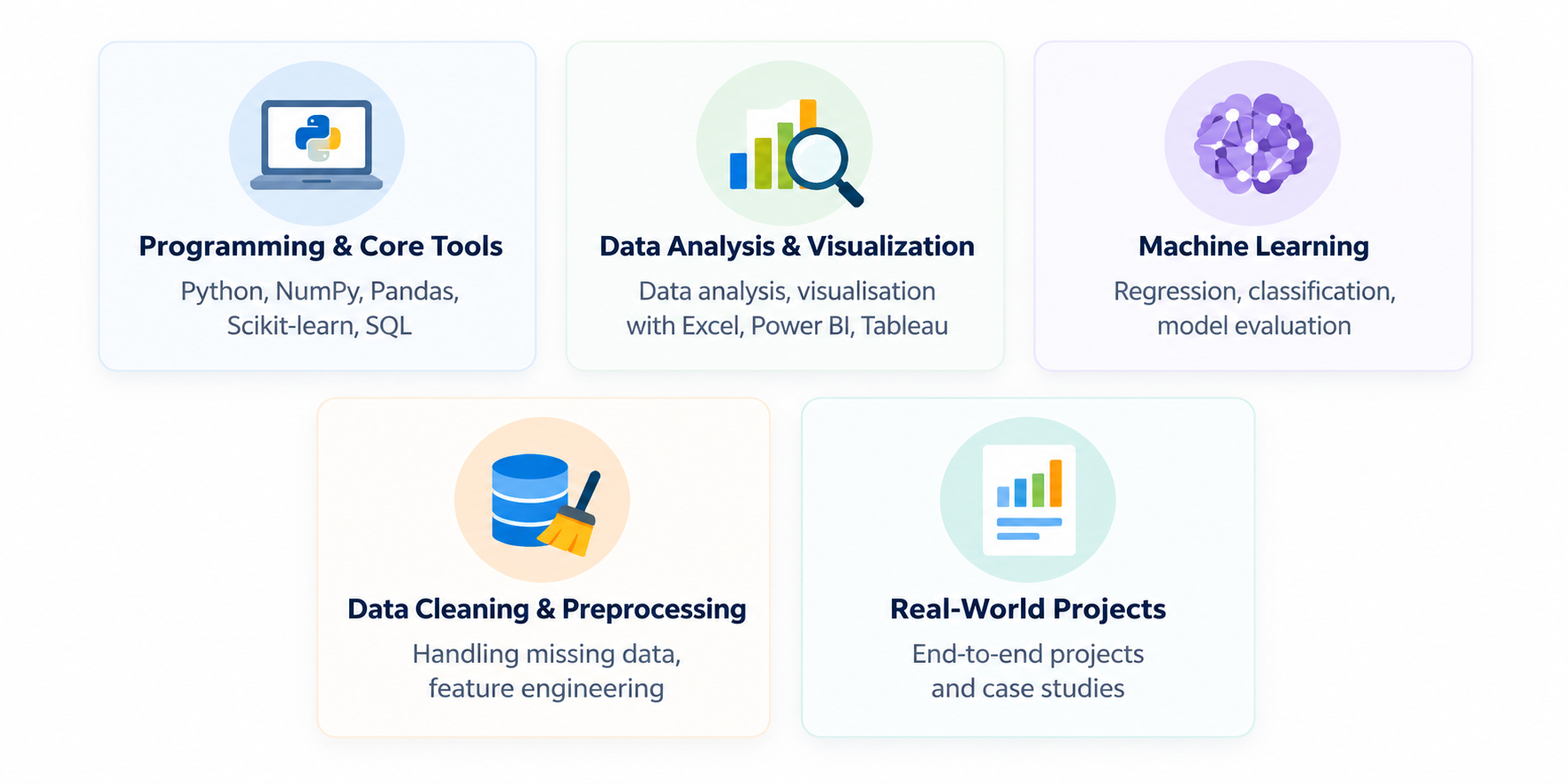
Learning Area | What You Can Learn |
Programming & Core Tools | Python, NumPy, Pandas, Scikit-learn, SQL |
Mathematics & Statistics | Probability, Statistics, and Linear Algebra basics |
Data Analysis & Visualisation | Pandas, Excel, Matplotlib, Power BI, Tableau |
Machine Learning | Regression, Classification, and Model Evaluation |
Data Cleaning & Preprocessing | Fixing data, handling errors, and Feature Engineering |
Exploratory Data Analysis | EDA, identifying patterns, and trend analysis |
Model Building & Evaluation | Training models and testing their accuracy |
Business Problem Solving | Data-driven decisions and solving real use cases |
Dashboarding & Reporting | Building interactive dashboards and presenting clear insights |
Capstone Projects | Credit EDA, RSVP Case Study, and IPL Visualisation |
Tools and Technologies You Will Learn in Data Science Course in India
From data handling tools to visualization platforms, here are the tools you will learn in upGrad’s Data Science Online Courses:
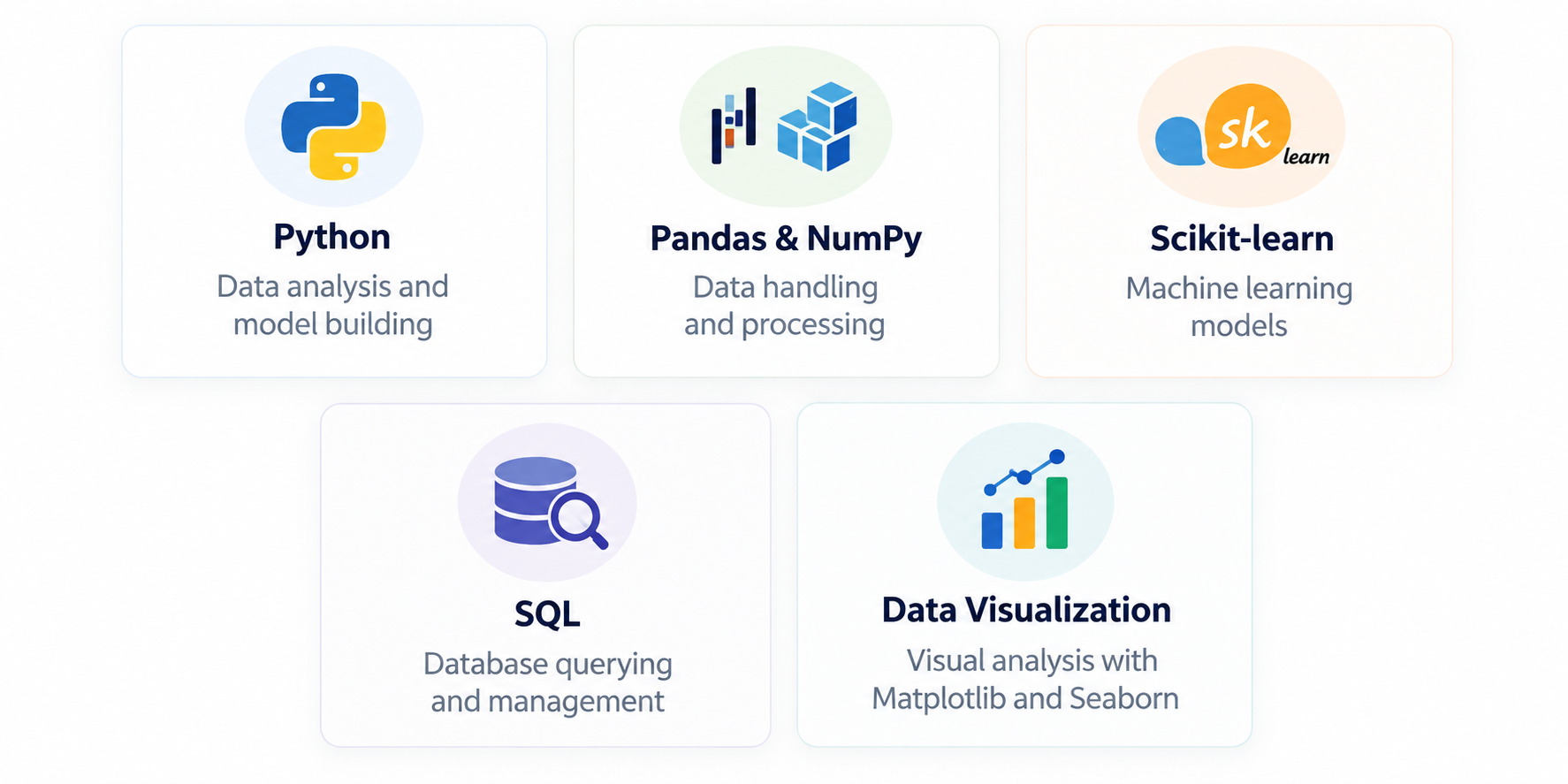
Tool / Technology | Purpose |
Python | Data analysis and model building |
Pandas & NumPy | Data handling and processing |
Scikit-learn | Machine Learning models |
SQL | Database querying and management |
Excel | Basic analysis and reporting |
Matplotlib & Seaborn | Data visualisation |
BI Tools | Dashboards and insights |
Notebook Environments | Interactive coding and experiments |
Hands-On Projects in upGrad Data Science Courses
Learning Data Science only by reading concepts is not possible. You have to work with real datasets, understand the working of the data science lifecycle.
That’s why upGrad included real life hands-on projects and real case study in its Data Science Course Syllabus. Some of the projects included in the upGrad’s Data Science online courses are:
Project | Problem Statement | Skills You Learn |
Credit EDA Assignment | Analyze credit data to find patterns, clean the dataset, and study trends. | Data Analysis, Pandas, NumPy, Data Cleaning, Visualisation |
RSVP Case Study | Analyze movie data to find insights about audience trends, ratings, and performance. | Data Analysis, SQL, Trend Analysis, Business Insights |
Bike Sharing Assignment | Analyze bike rental data and identify factors that affect demand. | Regression, EDA, Feature Analysis, Data Visualisation |
IPL Visualisation Assignment | Create visual insights from IPL data about teams, players, and match results. | Data Visualisation, Storytelling, Python Libraries |
Airbnb Case Study | Analyze Airbnb listing data to understand pricing, demand, and customer behaviour. | EDA, Data Cleaning, Business Analysis, Visualisation |
Online Data Science Courses: Duration and Eligibility
Our Data Science online programs in India are designed to be completed between 6-18 months and contain self-paced learning and flexibility to complete, in addition to scheduled learning. These are offered as certificates, executive diplomas and master’s degrees from institutions like IIIT Bangalore, Liverpool John Moores University and O.P. Jindal.
Course | University/Institute | Credential | Duration | Eligibility |
Executive Diploma in Data Science & Artificial Intelligence from IIITB | IIIT - Bangalore | Diploma | 12 Months | Bachelors or Master’s Degree or its equivalent in any discipline with minimum 50% aggregate mark or equivalent CGPA |
Executive Post Graduate Certificate Programme in Data Science & AI from IIITB | IIIT - Bangalore | Certificate | 6 Months | Bachelors or Master’s Degree or its equivalent in any discipline with minimum 50% aggregate mark or equivalent CGPA |
Master of Science in Data Science from Liverpool John Moores University | Liverpool John Moores University | Masters | 18 Months | Bachelor’s degree with 50% mandatory |
Professional Certificate Programme in Data Science & Agentic AI | IIIT - Bangalore | Certificate | 6 Months | Bachelor’s degree or currently pursuing an undergraduate degree present in Final Year are eligible for this program. |
M.Sc. in Artificial Intelligence and Data Science | O.P. Jindal Global University | Masters | 12 Months | Bachelor’s degree with 50% mandatory |
Professional Certificate Program in Data Science and AI with PwC Academy | PwC Academy | Certificate | 110+ Live Hour and 200+ Self-Paced Hours | Completed or currently pursuing graduation in any field |
Gen AI-powered Data Science with Machine Learning | IIIT - Bangalore | Certificate | 6 Months | Graduation in any science / tech stream (B.E., B.Tech, B.Sc, B.C.A., etc.) |
Universal AI Program by MIT Open Learning | MIT Open Learning | Certificate | Self Paced (200 Hours) | Open for All |
What Are The Career Outcomes After a Data Science Certification Course?
After completing a Data Science Course in India, you can explore these job roles:
Role | What You Will Do |
Data Scientist | Analyze data, build models, and solve business problems |
Data Engineer | Build and manage data pipelines and systems |
Data Analyst | Work with data, create reports, find trends, and support decisions |
Machine Learning Engineer | Build and deploy models for predictions and automation |
Analytics Consultant | Help companies use data to improve performance and strategy |
Business Analyst | Use data to improve processes and support business decisions |
Industries Hiring Data Science Professionals
Companies across different industries hire professionals who can work with data and solve business problems. Some of them are:
- IT and Software: Companies are using Data science for building data-driven products, improving systems and working with large-scale applications.
- Banking, Financial Services, and Insurance: Data Science is also used to analyse risk, detect fraud and Support financial decisions.
- E-commerce & Retail: In ecommerce it is used to recommend products, understand customer behaviour, and manage inventory.
- Healthcare and Life Sciences: In healthcare data science is used to work with patient data, support diagnosis, and assist research.
- Consulting and Professional Services: It is used to analyze business data and support better decisions.
- Media and Content Platforms: Track user behaviour, manage content, and personalise user experiences.
Essential Resources to Navigate Your Data Science Journey
Frequently Asked Questions
1. What is a Data Science course online?
A Data Science course online teaches you how to collect data, clean data, analyse data and interpret data to find patterns and insights. It can cover Python, SQL, statistics, Machine Learning, data visualisation and practical projects to help you solve real-world business problems.
2. Can I learn Data Science online as a beginner?
Yes, you can learn Data Science online as a beginner. Beginner-friendly programs such as upGrad’s Professional Certificate Programme in Data Science & Agentic AI can help you start with Python, mathematics, statistics, data analysis, and visualization before moving towards Machine Learning and advanced topics.
3. Do I need coding experience to learn Data Science?
You do not always need prior coding experience. Some beginner friendly Data Science certification courses such as Professional Certificate Programme in Data Science & Agentic AI introduce Python and other programming concepts from the basics. You will need to develop coding skills during the course because programming is used for data analysis and model building.
4. How much maths is required for Data Science?
You need an understanding of mathematics and statistics for Data Science. Topics such as probability, statistics and basic linear algebra are useful for understanding data analysis and Machine Learning concepts.
5. Which programming language should I learn for Data Science?
Python is one of the programming languages used in Data Science. It is used for data analysis, visualization and model building. SQL is also useful for querying databases while some programmes may introduce R for analysis.
6. What is the difference between Data Science and Data Analytics?
In Data science you are involved in the process of collecting data, analyzing the interpretation of that data, while in Data Analytics you mainly focus on evaluating the existing data for identifying trends and generating the insights.
7. What is the difference between Data Science and Machine Learning?
In Data Science you basically collect data, clean it, analyze it, visualize it and then interpret that data, while in Machine learning you use algorithms and data to make models which can predict outcomes based on the data it was trained on.
8. What is the Data Science Course Duration?
The Data Science course duration depends on the program you are selecting. For example the Executive Post Graduate Certificate in Data Science & AI is a 6-month programme while the Executive Diploma in Data Science & AI is 12 months. The Master of Science in Data Science from Liverpool John Moores University has an 18-month duration.
9. How do I choose a Data Science course online?
For selecting the right data science course online you should start checking your skill level, your career goals, learning time and your academic background. You must compare the Data Science Course Syllabus, projects, course duration, tools and technologies covered, and learning format.
10. Is a Data Science certification course enough to start a career?
A certification can help you build Data Science skills but your practical knowledge also matters which is included in upGrad Data Science online courses. Projects, assignments, knowledge of tools such as Python and SQL and the ability to work with datasets can help you demonstrate your skills.
11. Can I pursue a Data Science course while working?
Yes, Data Science online courses are suitable for working professionals who want to learn technology without leaving their current job. The flexible learning format gives you the advantages of learning anytime and anywhere, but it differs from program to program. You must check all the details before opting a course.
12. What projects should I look for in a Data Science course?
Look for programmes that provide hands-on work with real datasets. Projects such as credit data analysis, movie data analysis, bike-sharing analysis, IPL visualisation, and Airbnb analysis can help you practise data cleaning, EDA, visualisation, SQL, and business analysis.
13. Can a Data Science course help me switch careers?
Yes. A Data Science course can help people who want to change jobs by learning skills like Python, SQL, statistics, data analysis, Machine Learning and visualisation. Working on projects can also help you show these skills when you apply for jobs in data fields.
14. What is the difference between a Data Science course and a PG Diploma in Data Science?
A Data Science course is a programme with different durations and levels, including certificate courses. A PG Diploma in Data Science is usually a course that gives more in-depth and structured learning. The content and who can join depend on the programme.
15. What career options are available after a Data Science course?
After completing a Data Science course you can explore job roles such as Data Scientist, Data Analyst, Data Engineer, Machine Learning Engineer and Analytics Consultant. The job you want to prepare for requires skills, experience in some cases and your career choice you want to pursue.
16. Why is learning Data Science important in 2026?
Learning Data Science helps professionals analyse data, identify patterns, and make informed business decisions using tools such as Python, SQL, and Machine Learning.
These skills can help learners explore opportunities in data analysis, data science, and Machine Learning across industries.
17. Can a non-technical graduate or a fresher become a data scientist?
Yes, with the right training, freshers and non-technical graduates can become data scientists. They can learn basic statistics, Python and SQL, then move to machine learning and real-world projects to develop the skills needed for entry-level opportunities.
upGrad Learner Support
Talk to our experts. We are available 7 days a week, 10 AM to 7 PM

Indian Nationals

Foreign Nationals
Disclaimer
This program does not constitute a dual, joint, or twinning degree program
upGrad does not grant credit; credits are granted, accepted or transferred at the sole discretion of an educational institution. upGrad is not a college or university i.