
All courses
Agentic AI
Agentic AI

IIIT Bangalore
Executive Programme in Generative AI for LeadersArtificial Intelligence
Degree / Exec. PG

IIIT Bangalore
Executive Diploma in Machine Learning and AI
OPJ Global University
Master’s Degree in Artificial Intelligence and Data Science
Liverpool John Moores University
Master of Science in Machine Learning & AI
Golden Gate University
DBA in Emerging Technologies with Concentration in Generative AIExecutive Certificate

IIITB & IIM, Udaipur
Chief Technology Officer & AI Leadership ProgrammeIIIT Bangalore
Executive Programme in Generative AI for Leaders
upGrad | Microsoft
Gen AI Foundations Certificate Program from MicrosoftupGrad | Microsoft
Gen AI Mastery Certificate for Data AnalysisupGrad | Microsoft
Gen AI Mastery Certificate for Software DevelopmentupGrad | Microsoft
Gen AI Mastery Certificate for Managerial ExcellenceOffline Bootcamps

upGrad
Data Science and AI-MLDoctorate
For All Domains
IIITB & IIM, Udaipur
Chief Technology Officer & AI Leadership Programme
Swiss School of Business and Management
Global Doctor of Business Administration from SSBM
Edgewood University
Doctorate in Business Administration by Edgewood UniversityGolden Gate University
Doctor of Business Administration From Golden Gate University
Rushford Business School
Doctor of Business Administration from Rushford Business School, SwitzerlandGolden Gate University
Master + Doctor of Business Administration (MBA+DBA)-d9bdeff6165f4eb1ba2adcebde78e961.svg)
University of Waterloo
Chief Technology and AI Officer ProgramLeadership / AI
Golden Gate University
DBA in Emerging Technologies with Concentration in Generative AIMachine Learning
Machine Learning
Data Science
Degree / Exec. PG
O.P Jindal Global University
Master’s Degree in Artificial Intelligence and Data ScienceIIIT Bangalore
Executive Diploma in Data Science & AILiverpool John Moores University
Master of Science in Data ScienceExecutive Certificate
upGrad | Microsoft
Gen AI Foundations Certificate Program from MicrosoftupGrad | Microsoft
Gen AI Mastery Certificate for Data AnalysisupGrad | Microsoft
Gen AI Mastery Certificate for Software DevelopmentupGrad | Microsoft
Gen AI Mastery Certificate for Managerial ExcellenceupGrad | Microsoft
Gen AI Mastery Certificate for Content CreationOffline Bootcamps
upGrad
Data Science and AI-MLupGrad
Data AnalyticsMBA
Masters

Paris School of Business
Master of Science in Business Management and TechnologyO.P.Jindal Global University
MBA (with Career Acceleration Program by upGrad)Edgewood University
MBA from Edgewood UniversityO.P.Jindal Global University
MBA from O.P.Jindal Global UniversityGolden Gate University
Master + Doctor of Business Administration (MBA+DBA)Executive Certificate

IMT, Ghaziabad
Advanced General Management ProgramMarketing
Executive Certificate
Offline Bootcamps
upGrad
Digital MarketingManagement
Degree
O.P Jindal Global University
MSc in International Accounting & Finance (ACCA integrated)Paris School of Business
Master of Science in Business Management and Technology
Golden Gate University
Master of Arts in Industrial-Organizational PsychologyExecutive Certificate

IIIT-B & IIM, Udaipur
Chief Technology Officer & AI Leadership Programme
IIM Kozhikode
Human Resource Analytics Course from IIM-KupGrad | Microsoft
Gen AI Foundations Certificate Program from MicrosoftEducation
Education

Northeastern University
Master of Education (M.Ed.) from Northeastern UniversityEdgewood University
Doctor of Education (Ed.D.)Edgewood University
Master of Education (M.Ed.) from Edgewood UniversityCertifications
Project Management
Certification

Knowledgehut
Leadership And Communications In ProjectsKnowledgehut
Microsoft Project 2007/2010-ae8d039bbd2a41318308f8d26b52ac8f.svg)
Knowledgehut
Financial Management For Project ManagersKnowledgehut
Fundamentals of Earned Value Management (EVM)Knowledgehut
Fundamentals of Portfolio ManagementKnowledgehut
Fundamentals of Program Management-35c169da468a4cc481c6a8505a74826d.webp&w=128&q=75)
Knowledgehut
CAPM® CertificationsKnowledgehut
Microsoft® Project 2016Certifications & Trainings
-7f4b4f34e09d42bfa73b58f4a230cffa.webp&w=128&q=75)
Knowledgehut
PMP® CertificationKnowledgehut
PMI-RMP® CertificationKnowledgehut
PMP Renewal Learning PathKnowledgehut
Oracle Primavera P6 V18.8Knowledgehut
Microsoft® Project 2013Knowledgehut
PfMP® Certification CourseKnowledgehut
Project Planning and MonitoringPrince2 Certifications

Knowledgehut
PRINCE2® FoundationKnowledgehut
PRINCE2® PractitionerKnowledgehut
PRINCE2 Agile Foundation and PractitionerKnowledgehut
PRINCE2 Agile® Foundation CertificationKnowledgehut
PRINCE2 Agile® Practitioner CertificationManagement Certifications
Knowledgehut
Project Management Masters Certification ProgramKnowledgehut
Change ManagementKnowledgehut
Project Management TechniquesKnowledgehut
Product Management Certification ProgramKnowledgehut
Project Risk Management- Study abroad
- Offline centres
- uGSOT - B.Tech
More


Online Communication Courses
Online Communication Courses help you improve verbal, written, and professional communication skills. Learn public speaking, business writing, presentation skills, and workplace communication techniques to express ideas clearly, build confidence, and succeed in academic and corporate environments.
20(1)-70997669bd1a4ba2b565901e0eae2fa5%20(1)-de9c82be352d44bcb6a48fecf60b4465.jpeg&w=3840&q=75)
Communication Course Overview
Introduction
Communication is the practice of exchanging information between two or more individuals/parties. The fundamentals of communication denote that it is a process of generating and propagating information, ideas, facts, points of view, and feelings among people.
Today, businesses hugely depend on exchanging information to meet their organisational requirements. Good business communication skills play a vital role in meeting the requirements and significantly contribute to organisational success. Notwithstanding its significance, business communication has not developed to the level it should. So, academic and industry sectors have started training employees on effective business communication and its significance.
The intention of business communication training for employees is to make sure employees work more productively and flawlessly. Therefore, successful business communication is crucial for the effective functioning of all the business units. Also, effective business communication is fundamental for the success of organisations and employees. Good communication skills allow individuals to interact with others within an organisation efficiently. These fundamentals of communication skills are vital for career development because they uplift confidence and ensure clarity of information.
To ensure flawless functioning, an organisation should understand the 7cs of effective business communication. When the matter comes to communication in business management, an organisation benefits from the internal and external information collected and conveyed by employees.
Let us now understand the Communication Models.
Communication Models
7 c's of effective business communication
Any model aims to present a visual representation of a concept to simplify its understanding.
Communication models are the key components of the fundamentals of communication. These models illustrate the social process of communication. Every model elucidates the development of communication while accentuating various components of th
Communication models are valuable because they visually illustrate the complex interactions that happen during communication. They convert the basic structure of communication into a simpler form. Moreover, they discern different elements engaged in and how various components of the process of business communication interact.
Three standard Communication Models are:
i. Linear
ii. Interactive
iii. Transactional
Each of these models provides a unique perspective on the communication process. Let’s get details of each of these models.
i. Linear:
This communication model illustrates communication as a one-way process. It involves a sender, information/message, and receiver. This model was developed when one-way communication was the only method to transmit messages. For example, individuals can hear a message transmitted from the radio announcer, but they can’t transmit a message to the radio announcer. In this communication model, the role of the receiver owns little credibility.
The functioning of the Linear model resembles its name, i.e., a sender encodes a message through a channel, and the receiver then decodes the message. Essentially, it is straight-line communication typically found in mass communication. So its examples include radio, television, newspaper, etc. There is no instant feedback in this model.
ii. Interactive:
This communication model defines communication as a process that involves two or more individuals who can be both the sender and receiver. It denotes the interactive, two-way process where each involved individual aims to maintain the conversation. Moreover, this model considers how feedback is provided on transmitted messages in both psychological and physical contexts.
In simple words, this model takes the Linear model and multiplies it by ‘two’ with a rapid flip of the return message. Unlike the Linear model, the Interactive model involves a feedback element because a message is encoded and transmitted to the decoding receiver. Subsequently, the roles reverse, and the receiver encodes and transmits a response to the original sender, who now becomes the receiver.
For example, the exchange of text messages where a sender sends you a message, and you respond. Other examples of the Interactive model are telephone calls and email exchanges
iii. Transactional:
The transactional model studies the communication process in terms of cultural, relational, and social contexts. Individuals are called communicators rather than senders and receivers. These communicators not just communicate to send messages but also help them to establish relationships, agreements, and social communities through conversation
This communication model describes face-to-face interaction or transaction as a dynamic process not restricted to a simple definition. Both the sender and receiver can play identical roles simultaneously. The messages can be sent forward and backwards simultaneously.
Communication Process
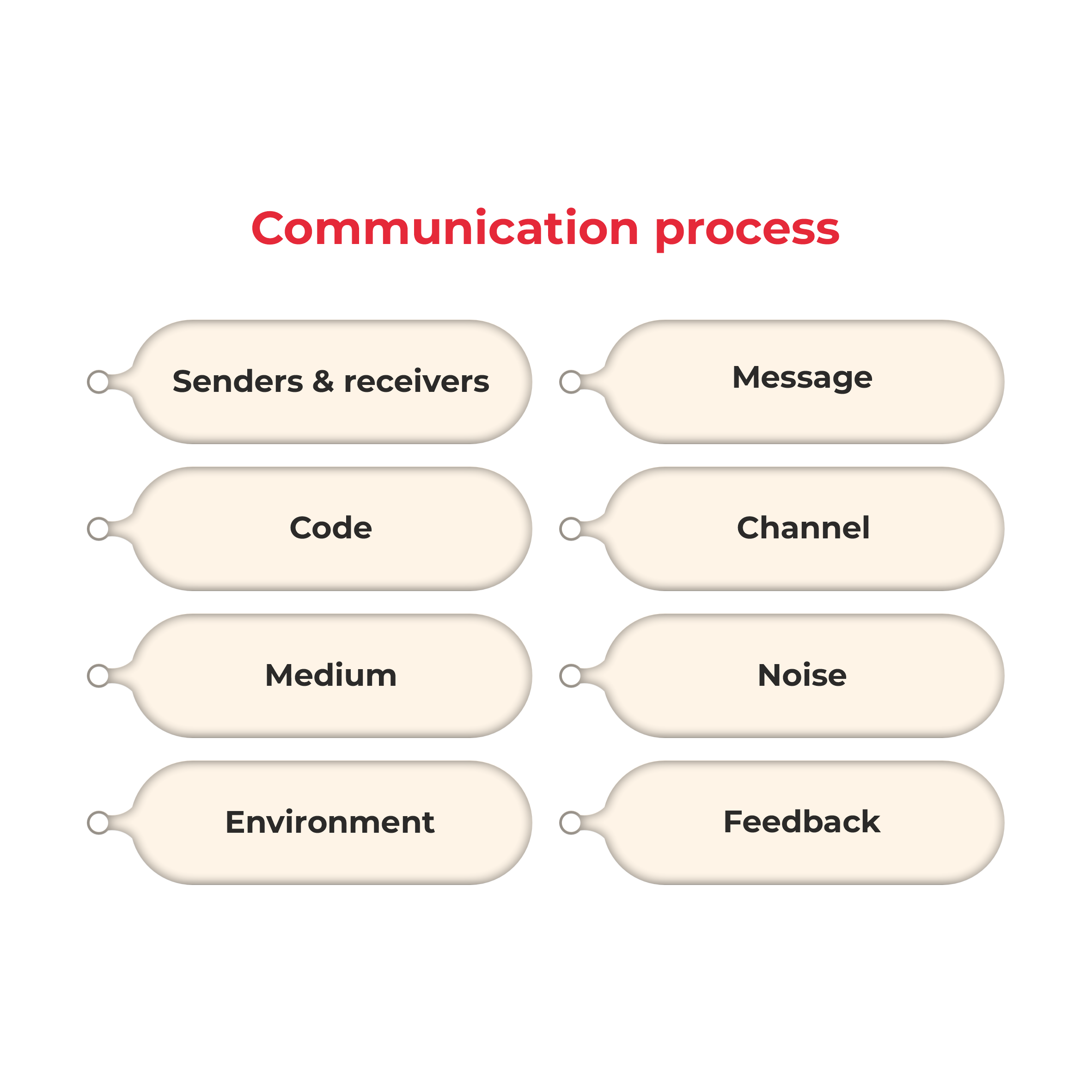
One of the most important fundamentals of communication is the communication process. The phases involved in this process are:
a) Senders & Receivers
b) Message
c) Code
d) Channel
e) Medium
f) Noise
g) Environment
h) Feedback
a) Senders & Receivers:
Communication is impossible without somebody to send and receive a message. Communication is about establishing a connection, whether it’s a business meeting, delivery of a lecture to students, an announcement of a product launch, or an individual making eye contact with an unknown in a crowd. The roles of sender and receiver are fixed
b) Message:
The message is something that is being told, read, signed, or gestured. In verbal and non-verbal communication, the message is something the sender attempts to communicate to the receiver. For example, an officer giving orders to employees is the message.
c) Code:
In the fundamentals of communication theory, the code is the system used to express the message. The code can be written word or oral language. For a code to be effective inthe fundamentals of communication theory, it should be mutually understandable to the speaker and receiver.
d) Channel:
A message is configured in code, but the question is what to call the means of transmitting that code. Well, it is called the Channel. The most fundamental channel is the human voice, i.e., the vibration of vocal code allows the encoded message to be captured by the receiver. Many businesses refer to channels as tools that extend the capacity of their bodies to communicate. Examples of channels are radio signals, fibre-optic cables, print materials, and semaphore flags.
e) Medium:
The channel is the means of transmission, whereas the medium denotes the means of communication. For example, a TV show is a medium while the TV itself is a channel.
Each medium employs a commanding influence on the message that it communicates. Moreover, every medium has powerful tropes, limitations, and strengths which strongly shape how a message is generated and received.
f) Noise:
In communication, noise is both literal and metaphorical. It can be physical interference in a signal when a storm interrupts a satellite uplink. It can be mental; for example, bias or prejudice against the sender may weaken the receiver’s potential to accept their message.
The semantic noise denotes an issue in the code. For example, if a lecturer uses lots of jargon to explain a concept to their first-year students, the message will be lost since the receivers can’t understand it.
Noise can arise due to internal or external factors. Internal factors include interest, intelligence, ego clashes, attention, motivation, and the relation between sender and receiver. External factors are associated with the physical environment, like the sound of the surroundings or the weather where the communication process occurs.
g) Environment:
It denotes the place where the communication occurs. It directly affects how messages are delivered and received. For example, the cultural context affects things that can and can’t be pronounced publicly. Team meeting in an organisation features an extremely formal environment, whereas conversation with friends and relatives is informal.
h) Feedback
One of the important facets of communication is to explain your message effectively. But it is not worthy of getting so involved in explaining your point that the feedback from the receiver is neglected. Feedback helps the parties involved in the communication to calibrate how the message is being conveyed and to make required adjustments depending on whether the feedback is positive or negative. With socialisation, you can strengthen your ability to give accurate feedback.
Verbal and Non-Verbal Communication
The speakers impress their receivers by using verbal and non-verbal symbols. They should evaluate their audience and determine how to reach them verbally and non-verbally effectively.
Non-verbal communication:
It is a basic form of communication that doesn’t include the use of words. Instead, it uses cues, gestures, spatial relationships, vocal qualities, etc., to express a message. Commonly, it is used to denote emotions like love, anger, happiness, dislike, respect, etc. Non-verbal communication is usually spontaneous and less structured relative to verbal communication. Since it is unplanned, it is occasionally considered more trustworthy than verbal communication. The reason is it imitates the real feelings of the communicator.
Non-verbal communication improves the efficacy of the message because audiences interpret body language and gesture quicker and easier than verbal communication. When combined with verbal communication, it makes a presentation more effective and lays a greater influence on the audience. So, non-verbal communication is one of the significant communication skills for effective business presentations.
The precise use of non-verbal communication can minimise the noise in the communication process. The speaker can understand the audience’s non-verbal indications like attention level, discomfort, disinterest, etc. Hence, the speaker would focus on using motivating and attention-grabbing non-verbal cues to upkeep the interest of the audience. Hence, non-verbal communication can indirectly improve the intensity of verbal communication.
Non-verbal communication comes with some limitations. For example, several complex ideas, thoughts, or messages must be communicated sequentially to be eloquent.
Verbal communication:
Verbal communication implicates the arrangement of words in a meaningful and structured manner, following the rules of grammar. Subsequently, the message is conveyed to the audience in either written or spoken format.
Two important aspects of Verbal communication:
- Listening
- Speaking and Writing
Listening is one of the fundamentals of communication skills, without which communication is ineffective. Many businesses pay less attention to listening skills. Both speaking and listening should hold equal importance.
Oral communication can’t be effective unless the audience is well-versed at listening, and the majority of its content is forgotten after a presentation session completes. Developing decent listening skills helps to effectively grasp the content of an oral representation and also helps to remember the concept being explained.The fundamentals of oral communication class teach students how to develop listening skills and enhance communication.
- Speaking and Writing:
Effective verbal communication focuses on the use of both writing and speech to transmit a message. Oral communication is more effective in engaging a focused target audience because it encompasses interaction and non-verbal cues to supplement the speech. On the other hand, written communication is vital for engaging many distributed recipients. Based on the requirements and the situation, businesses use both written and spoken channels for communication.
Barriers of Communication
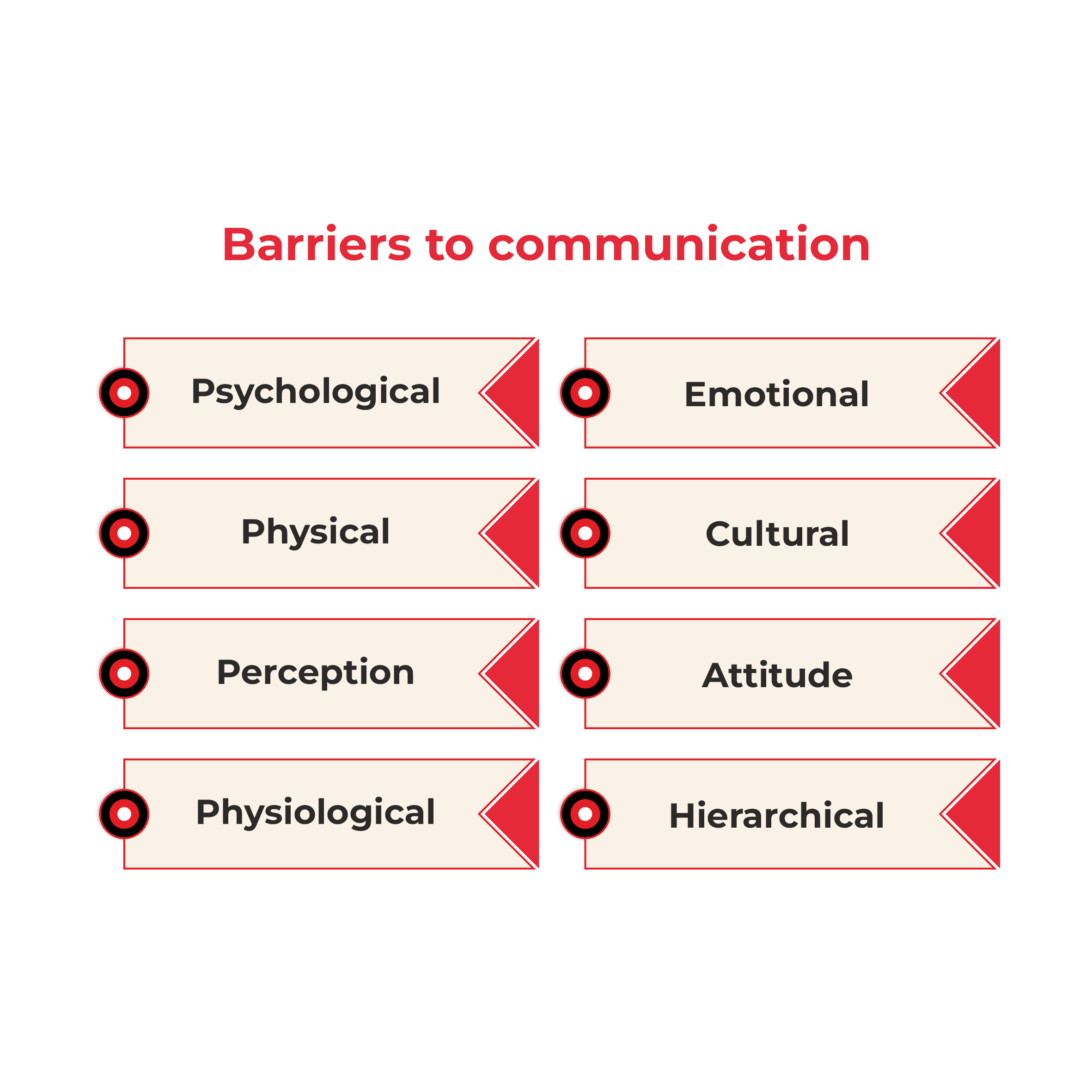
For effective business communication, there must be no barriers. The communication process may be prone to many barriers. The purpose of communication is to establish a shared understanding. But, if a communication barrier exists, the transmission of information can be less effective, which can negatively influence the working of a business. Moreover, the communication barrier can arise at any time in the communication process.
They can be classified into the issues created by the sender, issues in reception, issues in message transmission, the receiver's inability to comprehend the message, etc.
The solution to most communication barriers depends on the type of situation. However, a few common methods for solving them are available. These methods include knowing your subject, focusing on the purpose, knowing your audience, etc. Let’s get the details of some of the common communication barriers:
- Psychological Barriers:
Various psychological and mental issues can obstruct effective communication. The corresponding examples are speech disorders, stage fright, depression, phobias, jealousy, anger, shyness, insecurity, and close-mindedness. Occasionally, these conditions may be difficult to manage and will impede communication.
- Emotional Barriers:
The emotional IQ of individuals denotes the ease with which they can speak. Emotionally mature individuals can communicate effectively. But those individuals who allow their emotions to dominate their lives will encounter issues. Examples of emotional barriers are irritation, anger, and humour. These emotions can weaken an individual’s decision-making abilities and thereby limit their communication efficiency.
- Physical Barriers:
These are the most common barriers to effective business communication. The responsible factors are closed doors, closed cabins, outdoor noise, malfunctioning communication tools, and more. For example, in a big office, the use of faulty equipment and physical separation between employees can significantly impede communication.
Cultural Barriers:
The world has become globalised, and major business offices can comprise people from different corners of the world. Moreover, different cultures have different interpretations of some fundamental societal norms. For example, aspects like religions, clothing, eating habits, etc., differ in each culture. One must consider various cultures when communicating and develop cross-cultural sensitivity to overcome such cultural barriers.
- Perception Barriers:
Different people perceive the same things differently. The fundamentals of effective communication imply an understanding of the audience’s perception levels. Moreover, the messages should be straightforward. There must not be multiple interpretations of the same message.
Attitude Barriers:
Communication can hamper due to distrust, prejudice, emotional violence, or discrimination dependent on religion/gender/ethnicity. Commonly, attitude barriers arise due to a lack of drive or rejection to adapt. Certain people have an ego or show rude behaviour, which can impede communication.
- Physiological Barriers:
Certain diseases or other physical limits can obstruct good business communication between multiple channels in an organisation. Examples include dyslexia and shrillness of voice.
- Hierarchical Barriers:
Organisational hierarchy can impede communication among different levels. It can also exist in a family wherein a power hierarchy may lead to a communication barrier or a lack of transparency. The solution to hierarchical barriers is establishing a transparent discussion with the correct persons.

Communication Course Instructors
Learn From The Best
Learn from industry leaders in our communication courses, offering real-world insights and expertise. Be the best by learning from the best in the industry.
12
Instructors











Success Stories
What Our Learners Have To Say


Learner Support and Services
How Will upGrad Supports You
upGrad Elevate: Virtual hiring drive giving you the opportunity to interview with upGrad's 300+ hiring partners
Job Opportunities Portal: Gain exclusive access to upGrad's Job Opportunities portal which has 100+ openings from upGrad's hiring partners at any given time
FAQs about Communication Courses
1. How is admission in Diploma and PG Diploma business communication courses accomplished?
The admissions in Diploma and PG Diploma business communication courses are based on the merit list. The recognised institute or university releases the merit list after all applicants have filled out their applications. If you aim to pursue an undergraduate diploma course, then a class 12 score is required. A graduation score is required if you aim to pursue a PG diploma course.
2. What is the ultimate aim of the communication process?
The ultimate aim of the communication process is to have prevalence between the communicator and receiver of the message. With the communication, both the communicator and receiver enter into a mental agreement. So, the process aims to have a seamless exchange of information so that all the involved parties can perform effectively. The process of business communication aims to have formal communication processes between all the levels in the organisation
3. What are the biggest challenges to good communication?
One of the biggest challenges to good communication is that some people think communication is ‘what you say’, whereas some people consider it as ‘how you say it’. People focus excessively on being heard rather than listening to others. Using the wrong channel to send a message is also a challenge. Another significant challenge is not re-evaluating whether effective communication is taking place or not and not ascertaining whether the people understood the message or not.
4. Can teenagers benefit from communication courses?
Teenagers can significantly benefit from communication courses, irrespective of their future career or academic interest. This is because, at this tender age, they learn the fundamentals of communication required in whichever career paths they choose. From an early age, they will learn how to convey a message, understand, listen, behave, and so on. So, it is recommended that teenagers can join a suitable communication course as per their flexibility.
5. What are formal and informal communication?
For business organisation and communication, knowing the meaning of formal and informal communication is important. Formal communication works through official channels that are designed in the organisation chart. It can be defined into vertical and horizontal subtypes. On the other hand, informal communication is faster and freely flows in the organisation. It discusses a varied range of topics.
6. What are the types of formal communication networks?
Various types of formal communication networks include a single chain network, a wheel network, a circle network, a free flow network, and an inverted V network. A single chain network is present between a superior and subordinate. In a wheel network, all subordinates working under one superior communicate through them only as they work as a wheel hub. In a circle network, everyone can communicate with the other two beside him. No restriction in communication is applied in a free flow network. In an inverted V network, a subordinate can communicate to their superior as well as higher authority subordinates.
7. What are easy ways to improve communication?
Firstly, you need to ascertain that the ideas are explained before communicating them to the subordinates. Managers must adapt their communication as per their subordinates' understanding level and education. Obtaining advice before communicating will help elucidate the ideas and thus makes the communication clearer. It is also recommended to be aware of the messages' content, tone, and language. Furthermore, ensure the communication attains proper feedback, which also helps it solve communication issues in the future.
8. What is the purpose of feedback in communication?
The feedback is used to make recipients aware of their behaviour. Based on the feedback, they can determine whether to continue working with that behaviour or to modify it. Communicating with the influence of somebody’s behaviour and assuming that the individuals know the intent of your speech will not help. Instead, begin communicating by narrating the happenings using behavioural language and then recognise the influence of the behaviour.
9. How to become an active listener?
Firstly, don’t assume that your interpretations are their objectives, and try not to use attributions. If you find certain words or lines spoken by an individual, paraphrase them. If it appears relevant, you can add on a response or an advisory question. For instance, saying, "I got your viewpoint on this topic, but mine is different; I visualise the situation this way.” It provides the other person with an opportunity to explain your understanding of their position and to listen to your view.
10. What quick tips to follow to make communication effective?
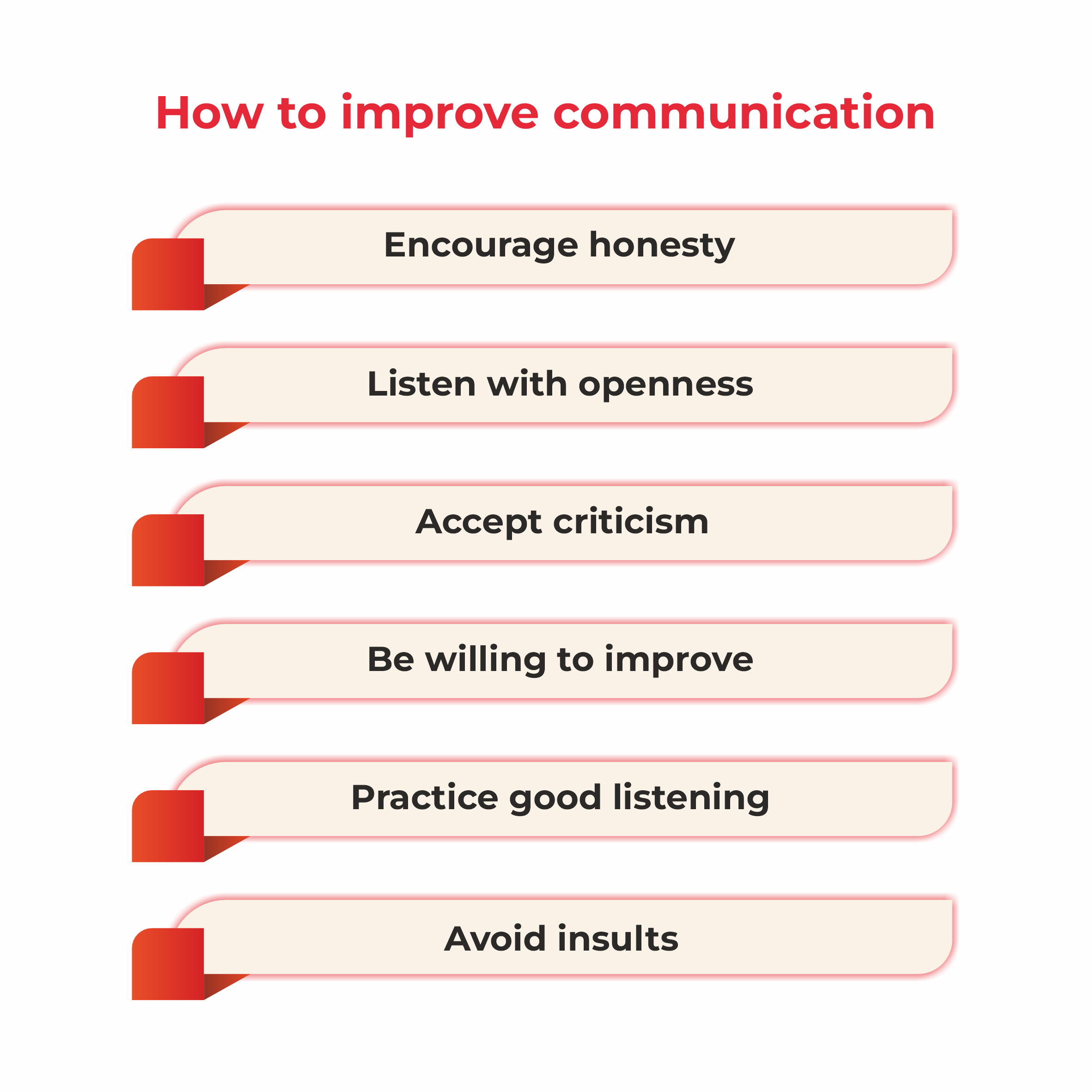
Here are some quick tips for effective communication. (i) Listen attentively and patiently. (ii) Thoroughly understand the point. (iii) Know your audience (iv) Minimise the potential of miscommunication (v) Positively accept the feedback (vi) Select the proper medium of communication (vii) Keep your tone in mind (viii) While communicating, be confident, clear, and concise. (ix) Be aware of possible misunderstandings and misinterpretations. (x) Use suitable gestures, tone, and body language during non-verbal communication.
11. What are the key things to take care of while communicating?
To establish effective communication, you must stay focused and prevent distractions. It is recommended to avoid inconsistent body language. Usually, non-verbal communication must highlight what is being said instead of contradicting it. Suppose you say one thing, but your body language conveys something else; your listener may feel that you are unreliable. To prevent misunderstandings and conflict, you can try to calm down before continuing the conversation quickly.
12. How does negative body language help in communication?
If you disagree with what’s being said, you can use negative body language to deny the other individual’s message. You can cross your arms, tap your feet, or avoid eye contact. Always agreeing with the speaker can be disadvantageous because the speaker’s viewpoint may not always be right. Using negative body language is beneficial for communicating effectively in places where verbal communication faces obstructions.
13. How to become an engaged listener?
Focusing on what the speaker is speaking about is one of the best tips for becoming an engaged listener. You can attentively listen if you continuously check your phone or think about something else. Avoiding interrupting or redirecting the conversation to your concerns is another great tip to becoming an engaged listener. You can gently smile at the speaker, nod occasionally, and make sure your posture is inviting.
14. How can you enhance your non-verbal communication?
One of the best ways to enhance your non-verbal communication is to be conscious of individual differences. People from different cultures and countries use different non-verbal communication gestures. Hence, it is essential to consider culture, age, gender, religion, and emotional state when decoding the body language signals. Make sure you don’t read excessively into a single nonverbal cue. You must consider all the nonverbal signals you perceive, from the tone of voice to eye contact. Also, you need to adjust your nonverbal signals according to the listener's age. For example, the tone of your voice should be different when addressing a child.
15. Is it possible to communicate effectively even with mental pressure?
Yes, you can communicate effectively by staying calm under mental pressure. You can use stalling strategies to take time to think. Before you respond, you can ask for a question to be iterated or for an explanation of a statement. You can pause to gather your thoughts. Pausing can make you appear more controllable than giving an immediate response.
16. How to relieve stress for effective communication?
Analyse the physical and mental states when you are stressed. Certain signs like stomach or muscle ache, shallow breathing, hands clenched, etc., indicate that you are under stress. So, you can take a moment to calm down before continuing a conversation, or you can postpone it. The superb way to effectively and quickly relieve stress is using the senses –sound, taste, touch, sight, smell, or movement. For instance, you can squeeze a stress ball in your pocket, pop a peppermint in your mouth, clench and relax your muscles, take a few deep breaths, or remember a soothing image.
17. Does being assertive make communication effective?
Yes, assertiveness is directly related to effectiveness in communication. You need to value your options. Properly know your wants and needs. Learn how to express them without intruding on the rights of others. Try to express negative thoughts positively and respectfully. Receiving feedback positively, accepting compliments cordially, asking for help when needed, and learning from your mistakes –all help you become assertive. Know your limits and learn to say ‘no’. Search for alternatives so that everybody feels convenient about the outcome.

upGrad Learner Support
Talk to our experts. We are available 7 days a week, 10 AM to 7 PM

Indian Nationals

Foreign Nationals
Disclaimer
The above statistics depend on various factors and individual results may vary. Past performance is no guarantee of future results.
The student assumes full responsibility for all expenses associated with visas, travel, & related costs. upGrad does not .