
All courses
Agentic AI
Agentic AI

IIIT Bangalore
Executive Programme in Generative AI for LeadersArtificial Intelligence
Degree / Exec. PG

IIIT Bangalore
Executive Diploma in Machine Learning and AI
OPJ Global University
Master’s Degree in Artificial Intelligence and Data Science
Liverpool John Moores University
Master of Science in Machine Learning & AI
Golden Gate University
DBA in Emerging Technologies with Concentration in Generative AIExecutive Certificate

IIITB & IIM, Udaipur
Chief Technology Officer & AI Leadership Programme
IIIT-B & IIM, Udaipur
Chief Data and AI Officer ProgrammeOffline Bootcamps

upGrad
Data Science and AI-MLDoctorate
For All Domains
IIITB & IIM, Udaipur
Chief Technology Officer & AI Leadership Programme
Swiss School of Business and Management
Global Doctor of Business Administration from SSBM
Edgewood University
Doctorate in Business Administration by Edgewood UniversityGolden Gate University
Doctor of Business Administration From Golden Gate University
Rushford Business School
Doctor of Business Administration from Rushford Business School, SwitzerlandGolden Gate University
Doctor of Technology in Applied & Agentic AI-d9bdeff6165f4eb1ba2adcebde78e961.svg)
University of Waterloo
Chief Technology and AI Officer ProgramLeadership / AI
Golden Gate University
DBA in Emerging Technologies with a concentration in Generative and Agentic AIMachine Learning
Machine Learning
Data Science
Degree / Exec. PG
O.P Jindal Global University
Master’s Degree in Artificial Intelligence and Data ScienceIIIT Bangalore
Executive Diploma in Data Science & AILiverpool John Moores University
Master of Science in Data ScienceExecutive Certificate

upGrad | Microsoft
Gen AI Foundations Certificate Program from MicrosoftIIIT-B & IIM, Udaipur
Chief Data and AI Officer ProgrammeupGrad | Microsoft
Gen AI Mastery Certificate for Data AnalysisupGrad | Microsoft
Gen AI Mastery Certificate for Software DevelopmentupGrad | Microsoft
Gen AI Mastery Certificate for Managerial ExcellenceupGrad | Microsoft
Gen AI Mastery Certificate for Content CreationBootcamp
Offline Bootcamps
upGrad
Data Science and AI-MLMBA
Masters

Liverpool John Moores University
Master of Business Administration from Liverpool John Moores University (LJMU) with IIM Udaipur CertificationO.P.Jindal Global University
MBA (with Career Acceleration Program by upGrad)Edgewood University
MBA from Edgewood UniversityO.P.Jindal Global University
MBA from O.P.Jindal Global UniversityExecutive Certificate
Marketing
Executive Certificate
Offline Bootcamps
upGrad
Digital MarketingManagement
Degree
O.P Jindal Global University
MSc in International Accounting & Finance (ACCA integrated)
Golden Gate University
Master of Arts in Industrial-Organizational PsychologyExecutive Certificate
IIIT-B & IIM, Udaipur
Chief Technology Officer & AI Leadership ProgrammeIIIT-B & IIM, Udaipur
Chief Data and AI Officer Programme
IIM Kozhikode
Human Resource Analytics Course from IIM-KupGrad | Microsoft
Gen AI Foundations Certificate Program from MicrosoftBootcamp
HDFC Life
Insurance Fundamentals ProgramEducation
Education

Northeastern University
Master of Education (M.Ed.) from Northeastern UniversityEdgewood University
Doctor of Education (Ed.D.)Edgewood University
Master of Education (M.Ed.) from Edgewood UniversityCertifications
Project Management
Certification

Knowledgehut
Leadership And Communications In ProjectsKnowledgehut
Microsoft Project 2007/2010-ae8d039bbd2a41318308f8d26b52ac8f.svg)
Knowledgehut
Financial Management For Project ManagersKnowledgehut
Fundamentals of Earned Value Management (EVM)Knowledgehut
Fundamentals of Portfolio ManagementKnowledgehut
Fundamentals of Program Management-35c169da468a4cc481c6a8505a74826d.webp&w=128&q=75)
Knowledgehut
CAPM® CertificationsKnowledgehut
Microsoft® Project 2016Certifications & Trainings
-7f4b4f34e09d42bfa73b58f4a230cffa.webp&w=128&q=75)
Knowledgehut
PMP® CertificationKnowledgehut
PMI-RMP® CertificationKnowledgehut
PMP Renewal Learning PathKnowledgehut
Oracle Primavera P6 V18.8Knowledgehut
Microsoft® Project 2013Knowledgehut
PfMP® Certification CourseKnowledgehut
Project Planning and MonitoringPrince2 Certifications

Knowledgehut
PRINCE2® FoundationKnowledgehut
PRINCE2® PractitionerKnowledgehut
PRINCE2 Agile Foundation and PractitionerKnowledgehut
PRINCE2 Agile® Foundation CertificationKnowledgehut
PRINCE2 Agile® Practitioner CertificationManagement Certifications
Knowledgehut
Project Management Masters Certification ProgramKnowledgehut
Change ManagementKnowledgehut
Project Management TechniquesKnowledgehut
Product Management Certification ProgramKnowledgehut
Project Risk Management- Study abroad
- Offline centres
- uGSOT - B.Tech
More

%20(2)-db0b6f38da9c485faf76e366793c9b9e.webp&w=128&q=75)




Free Certificate
Best Free Linear Algebra Courses Online with Certificates - 2025
Master the essentials of linear algebra in this free course! Learn about vectors, matrices, transformations, eigenvalues, and eigenvectors to enhance your analytics skills and problem-solving capabilities.
5 hours of learning
Data Manipulation
Vectors
Problem Solving

Key Highlights Of This Linear Algebra Free Course
What You Will Learn
Vectors & Vector Spaces
Start your linear algebra journey with the basics of vectors and their properties, essential for understanding various mathematical and scientific concepts.
Topics Covered
- The Foundation of Linear Algebra
Vectors are fundamental in linear algebra, serving as building blocks for more complex concepts. Understanding their properties is essential for anyone venturing into fields like data science, physics, and engineering. This section will establish the critical role of vectors in representing quantities with magnitude and direction, and how they form the foundation for vector spaces and transformations. - Vector Operations
Learn the core operations that can be performed with vectors, such as addition, scalar multiplication, and dot product. These operations allow vectors to interact with each other in meaningful ways, essential for solving systems of equations and manipulating data in various applications like machine learning algorithms. - Vector Spaces
Vector spaces are collections of vectors that follow certain rules of addition and scalar multiplication. This subtopic explains how vector spaces enable the formulation of systems and solutions in higher-dimensional spaces. You'll also explore key concepts like span, basis, and dimension, which help in understanding complex transformations.
Linear Transformation & Matrices
This session will explore matrices and their role in linear transformations, laying the groundwork for more advanced topics in data science and machine learning.
Topics Covered
- Importance of Linear Transformation
Linear transformations map vectors from one vector space to another. This section emphasizes how these transformations are represented using matrices. You will understand how linear transformations preserve the structure of vector spaces, which is crucial for solving equations and simplifying complex systems, especially in data transformations. - Matrices
Matrices are arrays of numbers arranged in rows and columns. They serve as a tool to represent linear transformations, and this subtopic will teach you how to work with matrices. You'll cover matrix multiplication, addition, and how matrices are used in various fields such as computer graphics, statistics, and optimization. - Matrix Operations
Learn the core matrix operations: addition, multiplication, and inversion. These operations are essential for solving linear equations, performing data transformations, and computing systems in fields like machine learning and computer vision. You'll understand the importance of matrix operations in manipulating data for various applications. - Determinants
Determinants provide useful information about matrices, such as whether a matrix has an inverse and its geometric interpretation. You'll learn how to calculate and interpret determinants to assess the solvability of linear systems and their implications in solving real-world problems. - Linear Independence
This subtopic explains linear independence, a key concept in determining whether a set of vectors forms a basis for a vector space. It also explores how linear independence relates to the solvability of systems of linear equations and how it is used to simplify and analyze data.
Eigenvalues & Eigenvectors
This session will introduce eigenvectors and eigenvalues, exploring how they are calculated and their relevance to data analysis techniques like Principal Component Analysis (PCA).
Topics Covered
- Eigenvectors: A Special Type of Vector
Eigenvectors are vectors that remain unchanged in direction when a linear transformation is applied, though their magnitude may change. This subtopic introduces the concept of eigenvectors and how they help in simplifying complex problems in data analysis, computer science, and physics by reducing the dimensions of data. - Calculation of Eigenvalues
Eigenvalues are scalar values that indicate how much an eigenvector is stretched or shrunk during a linear transformation. You'll learn how to compute eigenvalues using the determinant of a matrix and understand their significance in identifying system behaviors, such as stability in dynamic systems. - Applications
Eigenvalues and eigenvectors play a crucial role in techniques like Principal Component Analysis (PCA), which is widely used in data science for dimensionality reduction. This section explores how these concepts are used in real-world applications, such as image compression, machine learning, and network analysis.
Linear Algebra Free Course Certification
Earn and Share Your Certificate
Official & Verifiable
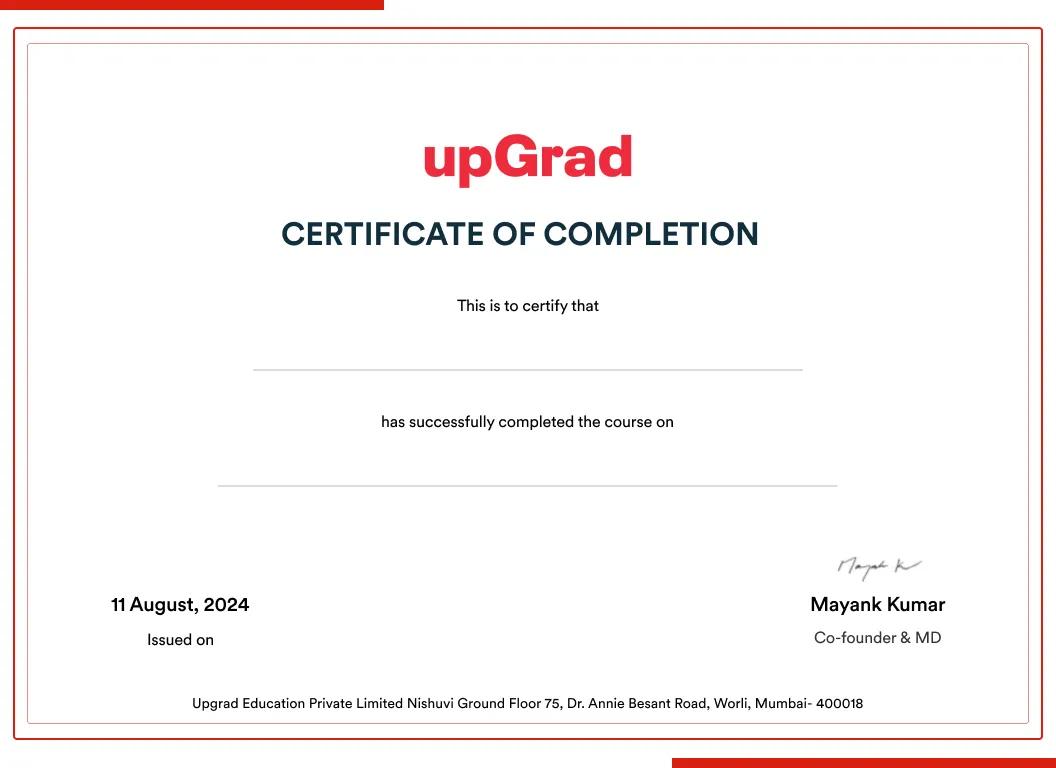
Receive a signed and verifiable e-certificate from upGrad upon successfully completing the course.
Share Your Achievement
Post your certificate on LinkedIn or add it your resume! You can even share it on Instagram or Twitter.
Stand Out to Recruiters
Use your certificate to enhance your professional credibility and stand out among your peers!
How Does This Linear Algebra for Analysis Course Boost Your Learning?
Who Should Enroll in This Course?
What Makes This Course Different From Other Courses?
Free vs. Paid Courses: What Sets Them Apart?
Maximize Your Learning Experience
Free Course | Paid Course | |
|---|---|---|
Access to Online Learning |  | |
Certificate at Completion | | |
Live Learning & Instructor Assistance |  | |
Recruitment Services | | |
Referral Benefits | | |
Frequently Asked Questions
1. Is this linear algebra free course completely free of charge?
Yes, this linear algebra free course is entirely free—no payment, subscription, or hidden charges involved. You’ll gain unrestricted access to all modules, lectures, and resources, and receive a free certificate of completion, making it an accessible and valuable option for learners worldwide.
2. Can I learn at my own convenience with this online linear algebra course?
Absolutely. The course is designed for self-paced learning, allowing you to progress through the content whenever and wherever it suits you. Whether you’re a student managing classes or a working professional balancing a job, you can complete the course without the pressure of fixed deadlines.
3. Does this linear algebra program focus on practical applications or just theory?
This linear algebra program goes beyond academic theory by integrating real-world examples and application-based learning. You’ll see how linear algebra plays a foundational role in data science, AI, engineering, and analytics, making the learning both engaging and career-oriented.
4. What topics are covered in this linear algebra free course syllabus?
The course covers essential topics such as:
- Vectors and vector spaces
- Matrix operations and properties
- Systems of linear equations
- Linear transformations
- Eigenvalues and eigenvectors
- Determinants and their significance Each topic is paired with examples that highlight their use in modern analytical and computational environments.
5. Will I receive a certificate upon completing the linear algebra course?
Yes. After successfully completing all modules and assessments, you will earn a free digital certificate of completion. This can be added to your resume, LinkedIn profile, or job portfolio to validate your expertise in linear algebra.
6. Is the linear algebra certification recognized or valuable for job roles?
Definitely. While the certification is not a formal university credential, it demonstrates practical knowledge and applied skills in linear algebra. It’s especially relevant for roles in data analytics, machine learning, AI, quantitative research, and engineering—fields that actively rely on linear algebra techniques.
7. What is the concept of linear algebra in simple terms?
Linear algebra is the branch of mathematics focused on vectors, matrices, and linear transformations. It helps you understand relationships between variables, solve systems of equations, and represent data in multi-dimensional space—making it a powerful tool for data modeling and problem-solving.
8. What is linear algebra in AI and how is it applied?
In Artificial Intelligence (AI), linear algebra is fundamental to building and training machine learning models. It powers operations like matrix multiplication used in neural networks, and helps in optimizing algorithms. It’s at the heart of deep learning frameworks and is used for data preprocessing, dimensionality reduction, and feature extraction.
9. What is linear algebra actually used for in real-world applications?
Linear algebra has wide-ranging use cases, including:
- Data science and big data analytics
- Machine learning and deep learning
- Signal processing and image recognition
- Quantum computing
- Robotics and control systems
- Engineering simulations and 3D modeling Its versatility makes it one of the most in-demand mathematical skills across technical careers.
10. Do I need a mathematics background to take this linear algebra course?
No prior experience is necessary. This linear algebra course is designed to be beginner-friendly, with step-by-step explanations, visual demonstrations, and intuitive analogies. The focus is on making the concepts easy to grasp, even for learners from non-mathematical backgrounds.
11. How does this linear algebra program compare to academic or textbook-based courses?
Unlike traditional classroom programs that emphasize rote learning and theoretical depth, this linear algebra program focuses on practical utility and application-driven learning. It’s designed for learners who want to build analytical thinking and apply their knowledge to real-world challenges, not just pass exams.
12. How does this course prepare me for data science roles?
The course covers core linear algebra topics that are fundamental to data science, such as matrix operations, vector spaces, and eigenvalues. These concepts are essential for machine learning algorithms, data modeling, and dimensionality reduction techniques like PCA, all of which are widely used in data science workflows.
13. Is this course helpful for engineering students?
Yes, this course can be helpful for engineering students. Engineering disciplines such as mechanical, electrical, and civil engineering rely heavily on linear algebra for simulations, system modeling, and signal processing. This course provides the mathematical groundwork needed to support those applications, helping students apply concepts with confidence in their domain.
14. Can I use this knowledge in AI or machine learning projects?
Yes. Many AI and machine learning techniques rely on linear algebra, especially for tasks like model training, data preprocessing, and feature extraction. Concepts such as eigenvalues and matrix decompositions are key to algorithms used in neural networks, image recognition, and recommendation systems.
15. Will I learn how to use linear algebra in programming or coding?
While the course does not focus on specific programming languages, it introduces mathematical foundations used in many coding applications. Understanding matrix operations, transformations, and eigenvectors will help you implement and optimize algorithms when using languages like Python, R, or MATLAB.
Ready to start learning and advance your skills?
upGrad Learner Support
Talk to our experts. We are available 7 days a week, 10 AM to 7 PM

Indian Nationals

Foreign Nationals