
All courses
Agentic AI
Agentic AI

IIIT Bangalore
Executive Programme in Generative AI for LeadersArtificial Intelligence
Degree / Exec. PG

IIIT Bangalore
Executive Diploma in Machine Learning and AI
OPJ Global University
Master’s Degree in Artificial Intelligence and Data Science
Liverpool John Moores University
Master of Science in Machine Learning & AI
Golden Gate University
DBA in Emerging Technologies with Concentration in Generative AIExecutive Certificate

IIITB & IIM, Udaipur
Chief Technology Officer & AI Leadership Programme
IIIT-B & IIM, Udaipur
Chief Data and AI Officer ProgrammeOffline Bootcamps

upGrad
Data Science and AI-MLDoctorate
For All Domains
IIITB & IIM, Udaipur
Chief Technology Officer & AI Leadership Programme
Swiss School of Business and Management
Global Doctor of Business Administration from SSBM
Edgewood University
Doctorate in Business Administration by Edgewood UniversityGolden Gate University
Doctor of Business Administration From Golden Gate University
Rushford Business School
Doctor of Business Administration from Rushford Business School, SwitzerlandGolden Gate University
Doctor of Technology in Applied & Agentic AI-d9bdeff6165f4eb1ba2adcebde78e961.svg)
University of Waterloo
Chief Technology and AI Officer ProgramLeadership / AI
Golden Gate University
DBA in Emerging Technologies with a concentration in Generative and Agentic AIMachine Learning
Machine Learning
Data Science
Degree / Exec. PG
O.P Jindal Global University
Master’s Degree in Artificial Intelligence and Data ScienceIIIT Bangalore
Executive Diploma in Data Science & AILiverpool John Moores University
Master of Science in Data ScienceExecutive Certificate

upGrad | Microsoft
Gen AI Foundations Certificate Program from MicrosoftIIIT-B & IIM, Udaipur
Chief Data and AI Officer ProgrammeupGrad | Microsoft
Gen AI Mastery Certificate for Data AnalysisupGrad | Microsoft
Gen AI Mastery Certificate for Software DevelopmentupGrad | Microsoft
Gen AI Mastery Certificate for Managerial ExcellenceupGrad | Microsoft
Gen AI Mastery Certificate for Content CreationBootcamp
Offline Bootcamps
upGrad
Data Science and AI-MLMBA
Masters

Liverpool John Moores University
Master of Business Administration from Liverpool John Moores University (LJMU) with IIM Udaipur CertificationO.P.Jindal Global University
MBA (with Career Acceleration Program by upGrad)Edgewood University
MBA from Edgewood UniversityO.P.Jindal Global University
MBA from O.P.Jindal Global UniversityExecutive Certificate
Marketing
Executive Certificate
Offline Bootcamps
upGrad
Digital MarketingManagement
Degree
O.P Jindal Global University
MSc in International Accounting & Finance (ACCA integrated)
Golden Gate University
Master of Arts in Industrial-Organizational PsychologyExecutive Certificate
IIIT-B & IIM, Udaipur
Chief Technology Officer & AI Leadership ProgrammeIIIT-B & IIM, Udaipur
Chief Data and AI Officer Programme
IIM Kozhikode
Human Resource Analytics Course from IIM-KupGrad | Microsoft
Gen AI Foundations Certificate Program from MicrosoftBootcamp
HDFC Life
Insurance Fundamentals ProgramEducation
Education

Northeastern University
Master of Education (M.Ed.) from Northeastern UniversityEdgewood University
Doctor of Education (Ed.D.)Edgewood University
Master of Education (M.Ed.) from Edgewood UniversityCertifications
Project Management
Certification

Knowledgehut
Leadership And Communications In ProjectsKnowledgehut
Microsoft Project 2007/2010-ae8d039bbd2a41318308f8d26b52ac8f.svg)
Knowledgehut
Financial Management For Project ManagersKnowledgehut
Fundamentals of Earned Value Management (EVM)Knowledgehut
Fundamentals of Portfolio ManagementKnowledgehut
Fundamentals of Program Management-35c169da468a4cc481c6a8505a74826d.webp&w=128&q=75)
Knowledgehut
CAPM® CertificationsKnowledgehut
Microsoft® Project 2016Certifications & Trainings
-7f4b4f34e09d42bfa73b58f4a230cffa.webp&w=128&q=75)
Knowledgehut
PMP® CertificationKnowledgehut
PMI-RMP® CertificationKnowledgehut
PMP Renewal Learning PathKnowledgehut
Oracle Primavera P6 V18.8Knowledgehut
Microsoft® Project 2013Knowledgehut
PfMP® Certification CourseKnowledgehut
Project Planning and MonitoringPrince2 Certifications

Knowledgehut
PRINCE2® FoundationKnowledgehut
PRINCE2® PractitionerKnowledgehut
PRINCE2 Agile Foundation and PractitionerKnowledgehut
PRINCE2 Agile® Foundation CertificationKnowledgehut
PRINCE2 Agile® Practitioner CertificationManagement Certifications
Knowledgehut
Project Management Masters Certification ProgramKnowledgehut
Change ManagementKnowledgehut
Project Management TechniquesKnowledgehut
Product Management Certification ProgramKnowledgehut
Project Risk Management- Study abroad
- Offline centres
- uGSOT - B.Tech
More
%20(2)-db0b6f38da9c485faf76e366793c9b9e.webp&w=128&q=75)




Artificial Intelligence Courses
The best Artificial Intelligence courses help you move from basic concepts to building and deploying real AI systems. You gain Generative AI skills and prepare for job-ready roles across industries.
Learn from faculty at globally top-ranked universities
Earn an average salary hike of 51% after completion
-d365049d54604e59b9241feaed93b89e.webp&w=3840&q=75)
1:1 Coaching
Mock Interviews
Access to Job Portal
Artificial Intelligence Course From Top Universities
Artificial Intelligence Courses (10)
bestseller
Executive Diploma
12 Months

bestseller
Certification
6 Months
IIIT-B & IIM, Udaipur
Chief Technology Officer & AI Leadership ProgrammeCertification
6 months
%20(2)-db0b6f38da9c485faf76e366793c9b9e.webp&w=3840&q=75)
popular
Executive Post Graduate Certificate
8 Months
popular
Certification
6 Months
popular
IIT Kharagpur
Executive Post Graduate Certificate in Building AI Products, Systems & Services - IIT KharagpurExecutive Post Graduate Certificate
6 Months
IIIT Bangalore
Executive Programme in Generative AI & Agentic AI for LeadersIndia’s #1 Tech University
Dual Certification
5 Months
Certification
Building AI Agent
popular
Master's Degree
18 Months
Executive Diploma
12 Months




Our Top University Partners
How AI-Ready Is Your Career?
The work you do today may already be easy for AI to replace. Find out where you truly stand.
Automation risk in your profile
Skill relevancy for AI roles
Ability to adapt
🧠 Discover how future-ready your career really is
-d7bcc89c78df4cff8b2140ff79f1ffb1.webp&w=1200&q=75)
Artificial Intelligence (AI) Course Projects: Learn by Doing
17+
Projects


Learn Artificial Intelligence From The Best Instructors
8
Instructors
8
Industry Experts
























-39a9e7a7278a441ea08a60a1f45b4913.png&w=128&q=75)
Services to Help You Achieve Your Goal
Access the various career developement support services offered by upGrad to help you achieve your professional goals
Receive unparalleled guidance from industry mentors, teaching assistants, and graders


What Our Learners Have To Say About Artificial Intelligence Course


Latest AI Industry Trends
The AI Industry is growing rapidly and is expected to continue to do so in the coming years. As Artificial Intelligence becomes more sophisticated and accessible, it is likely to have a major impact on all industries
95%
Businesses expect AI to have a positive impact on their industry in the next five years
37%
Organisations have adopted AI
16%
Expected to replace all US jobs in less than half a decade
77%
Businesses are using AI for automation
Artificial Intelligence Course Overview
The nature of work is changing fast for engineers, their products, and companies.
AI is not just about answering questions. It plans, acts, and even connects to machines, and it achieves results with little involvement from people. This change is setting the agenda for the future of Artificial Intelligence.
upGrad offers courses in Artificial Intelligence for professionals who need to get ready for this change. Whether you are a software engineer, a data analyst, or an entrepreneur, you will learn how to use Artificial Intelligence in your work.
This course is all about learning skills that you can use in your work.
What Is Artificial Intelligence (AI)?
AI (Artificial Intelligence) is a technology for simulating human intelligence with computing machines for carrying out activities like language comprehension, problem solving, pattern recognition, and decision making.
AI makes sense out of the data and creates outcomes based on the information gained. Unlike traditional systems that function within pre-set parameters, AI systems have the capability of improving with learning and dealing with new situations.
Some of the widely used AI models include GPT-4, Claude, Gemini, Llama, and many more. The common ability of these AI models includes language comprehension, creating text, programming, summarizing, translation, and much more.
How Does Artificial Intelligence Work?
In order to find patterns and produce results, artificial intelligence uses data, algorithms and machine learning models. Depending on the task, an AI system may process data, text, images, video or other information.
In an AI workflow, the following steps are performed:
- Data collection: Gather the information needed for the task.
- Data preprocessing: Clean and prepare the data for analysis or model training.
- Model building: Using machine learning or deep learning methods to create a model.
- Training: Train the model with the data to discover patterns.
- Evaluation: Test the model to see how it performs.
- Application: Use the trained model for prediction, classification, recommendation, automation or other AI tasks.
What Are the Main Applications of Artificial Intelligence?
Artificial Intelligence is used across many industries and helps you to complete tasks faster and with better accuracy. Some key applications of AI in different industries are:
Application | How AI Is Used |
Product and Technology | Create product features, make the user experience better, automate testing and learn about how users behave. |
Banking and Finance | Check risk, find activity, automate checks and help with making decisions. |
Retail | Learn about how customers act, suggest products, handle demand and help with planning inventory. |
Healthcare | Look at data to help with diagnosing and planning treatment and watch patient progress. |
Marketing | Understand audience needs, improve targeting, create campaigns, and track performance. |
Business Operations | Analyse data, reduce manual work, improve processes, and support business decisions. |
E-commerce | Make recommendations, personally study how customers behave and help with planning demand. |
Media and Content | Manage content and personalize user experiences. |
Who Should Take an Artificial Intelligence Course Online?
An Artificial Intelligence Course Online can be useful if you want to apply AI to your work to increase productivity or move towards Artificial Intelligence-focused roles. You should take an AI Course in India if you are:
1. Working Professionals
If you already work in technology, data, business, or another professional field, an AI course can help you understand how AI can be applied to your work, to make your work easy.
You can learn to:
- Apply AI to existing workflows
- Work with data and AI models
- Understand AI-based business applications
- Build practical projects
2. Developers and Technical Professionals
Software developers, engineers, system designers, and technical professionals can use AI learning to work on more complex applications.
You can learn to:
- Build AI-powered applications
- Work with machine learning and deep learning
- Understand model development and deployment
- Work with Python and AI frameworks
3. Data and Analytics Professionals
If you work with data, AI skills can help you move from data analysis towards predictive models and AI applications.
You can learn:
- Data preprocessing
- Feature engineering
- Machine learning algorithms
- Model training and evaluation
- Predictive analytics
4. Business and Product Professionals
Product managers, business heads, and professionals who work with business decisions can learn how AI supports products, operations, customer analysis, and decision-making.
You can learn to:
- Identify AI use cases
- Use data for product decisions
- Understand AI workflows
- Apply AI to business problems
5. Students and Career Switchers
If you are starting out and know basic Python, the upGrad’s Artificial Intelligence course for beginners helps you build your foundation step by step. You can:
- Learn how AI works from scratch
- Practice with simple projects
- Build confidence in using AI tools
What You Will Learn in Artificial Intelligence Online Courses?
In the AI course, you will learn concepts like programming, mathematics, machine learning, deep learning, and finally, you will build and train your model that will make decisions and solve the problem on its own.
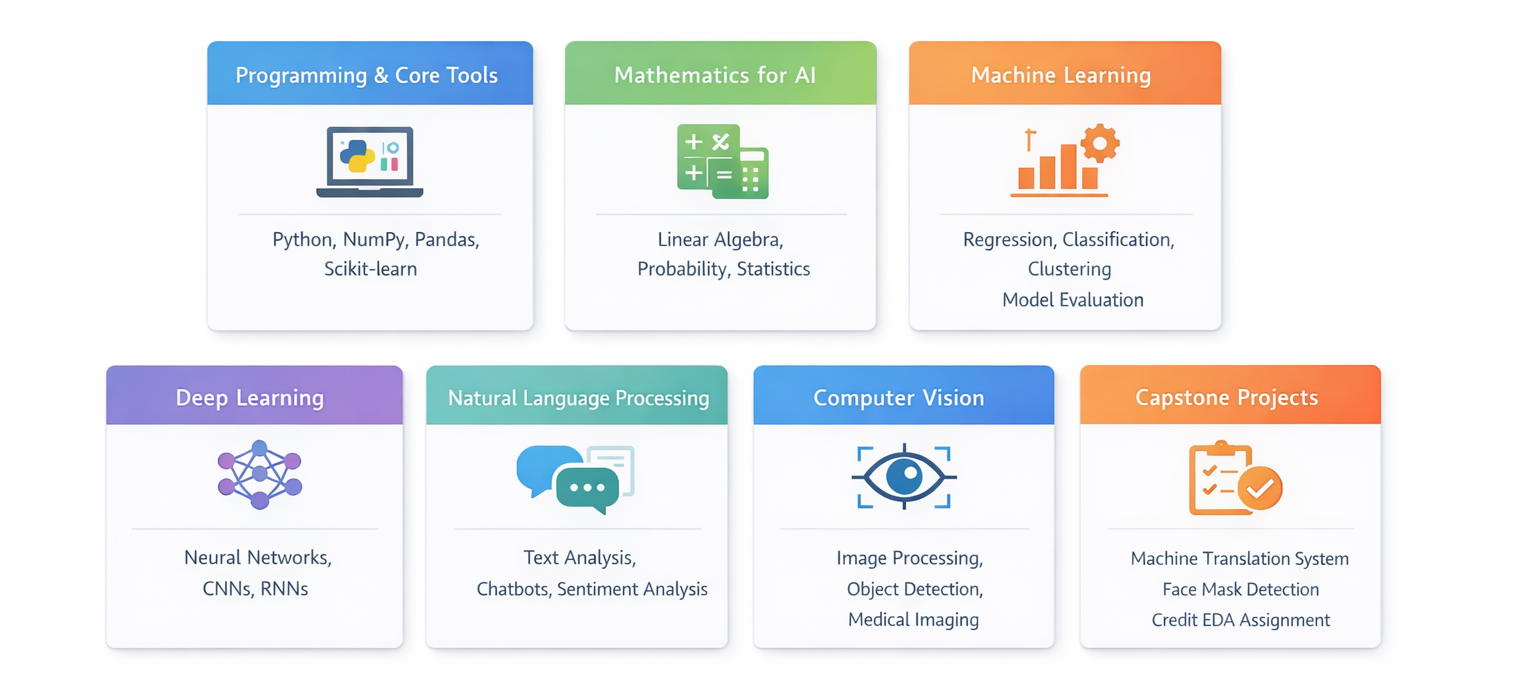
Learning Area | Skills Covered | Practical Outcome |
AI Foundations | AI concepts, applications, intelligent systems | Understand how AI is used to solve problems |
Python and Data | Python, data preprocessing, feature engineering | Prepare data for AI and ML workflows |
Machine Learning | ML algorithms, model building, training | Build models for prediction and classification |
Deep Learning | Neural networks, CNNs, RNNs | Work with complex data such as images, text, and video |
NLP | Text processing, language models, sentiment analysis | Build language-based AI applications |
Generative AI | LLMs, prompt engineering, content generation | Work with modern Generative AI applications |
Model Evaluation | Accuracy, precision, recall, F1 score, cross-validation | Measure and improve model performance |
Model Deployment | APIs, cloud platforms, containers, monitoring | Move AI models towards real-world use |
AI Tools and Technologies You Will Learn in Artificial Intelligence Course Online
Learning AI involves these common tools and technologies which are covered in upGrad’s AI courses:
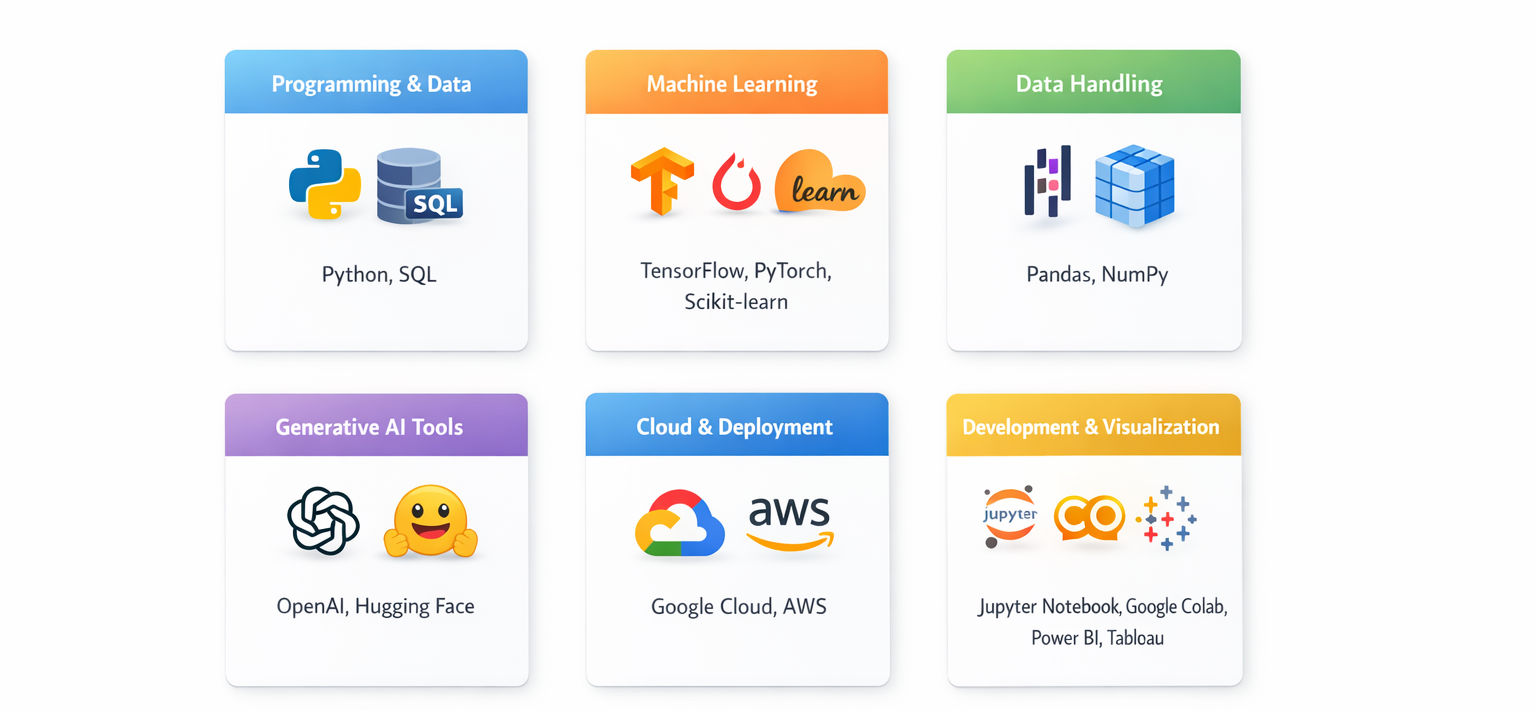
Tool or Technology Group | Examples | Purpose |
Programming Languages | Python, R, SQL | Programming, data analysis, and database work |
Data Tools | Pandas, NumPy | Data handling and numerical analysis |
Visualisation | Matplotlib, Seaborn | Exploring and presenting data |
Machine Learning | Scikit-learn | Building and evaluating ML models |
Deep Learning | TensorFlow, PyTorch | Building and training neural networks |
NLP Tools | NLP libraries, spaCy | Text processing and language applications |
Development Tools | Jupyter Notebook, Google Colab | Writing and testing AI code |
Development Platforms | Git, GitHub | Managing and maintaining projects |
Cloud Platforms | Cloud AI environments | Training and deploying larger AI models |
Hands-On Projects in upGrad Artificial Intelligence Courses
Learning any technology is not only sufficient by theory, that’s why upGrad’s Artificial Intelligence Course for beginners and advanced learners includes real-life projects to help you apply your learning and build a strong portfolio.
Here are some of the projects that the upGrad Artificial Intelligence Course Online include:
Project | Problem Statement | Tools / Techniques |
Credit EDA Assignment | Analyse credit data and identify patterns related to loan repayment | Pandas, NumPy, data cleaning, visualisation |
Telecom Churn Model Selection | Predict which customers may leave a telecom service | Classification, feature selection, Scikit-learn |
News Recommender System | Recommend news based on user interests | Recommendation systems, user behaviour analysis |
Face Mask Detection | Identify whether people are wearing masks from images | CNN, TensorFlow/Keras, computer vision |
Machine Translation System | Translate text from one language to another | NLP, sequence models, deep learning |
Gesture Recognition | Identify human gestures from video data | CNN/RNN, deep learning, video processing |
Artificial Intelligence Course Eligibility and Prerequisites
The eligibility criteria for an AI Course in India depends on the program you choose. upGrad Artificial Intelligence Courses includes programs ranging from certificate-level learning to executive diplomas and master's-level programs, so eligibility is different for all levels.
Below are some of the certificate, diploma, master’s and leadership programs with their eligibility criteria:
upGrad AI Program | Eligibility Criteria |
IIT Delhi - Certificate Programme in Cybersecurity & AI | Bachelor's or master's degree with a minimum of 50% marks and familiarity with any programming language. |
Executive Diploma in Machine Learning & AI | Bachelor's or master's degree or equivalent in any discipline with a minimum of 50% aggregate marks or equivalent CGPA. |
MSc in Machine Learning & AI from LJMU | Bachelor's degree with a minimum of 50%, successful completion of EPGP in ML from IIITB, and at least 1 year of technical work experience. |
Chief Technology Officer & AI Leadership Programme | Bachelor's degree in any discipline with a minimum of 8 years of professional experience. |
AI Courses vs AI Certification Course
The key difference between an AI course and an AI certification course is their duration. AI certification courses are mainly 3-6 months in duration, while the duration of AI courses ranges from 6 months to 3 years.
Here are some other key differences between an AI program and an AI certification course:
Criteria | Artificial Intelligence Course | Artificial Intelligence Certification Course |
Depth | Can cover AI from fundamentals to advanced topics | Usually validates a defined set of skills or learning |
Duration | From 6 months to 3 years | Upto 6 months |
Projects | May include multiple practical projects and assignments | May include projects depending on the program |
Credential | May lead to a certificate, diploma, postgraduate credential, or degree | Provides a certification credential |
Use | Build knowledge and practical AI skills | Demonstrate completion or knowledge in a defined area |
Career Outcomes After an Artificial Intelligence Course
Here are some of the top roles that you can explore once you complete your course:
Role | What You’ll Do |
AI Engineer | Create AI-powered applications, connect AI models with software, and add intelligent features to products. |
Computer Vision Engineer | Help computers understand images and videos. Typical work includes face recognition, object detection, and image classification. |
NLP Engineer | Make software understand human language through chatbots, text analysis, search systems, and language applications. |
Machine Learning Engineer | Prepare data, train ML models, test their performance, and deploy them for real-world use. |
Data Scientist | Turn large datasets into useful insights, identify patterns, and use data to answer business questions. |
AI Solutions Architect | Decide how different AI technologies should work together and design the architecture for complete AI solutions. |
Industries Hiring Artificial Intelligence Professionals
So many companies across different industries hire professionals skilled in Artificial Intelligence. Some of them are:
- IT and Software/Product: In this industry, you have to build AI systems, improve the existing software products by enabling AI, and handle large applications.
- E-Commerce and Retail: In this, you have to make models which can recommend products for customers based on previous purchase, improve the user experience by creating ML algorithms and manage inventory efficiently.
- Banking and Financial Services: Banking and Financial Services industry is using AI to detect frauds, manage risk and support customer services, that’s why it needs a skilled AI professional.
- Healthcare: Healthcare industry is using AI for managing the patient records, diagnosing the patient reports and scheduling appointments.
- Telecommunication: Telecommunication industry is relying heavily on AI nowadays for protecting their customers from fraud calls, SMS and phishing attacks/links.
Everything You Need to Know About Artificial Intelligence
Frequently Asked Questions about AI Course
1. What is an Artificial Intelligence course?
The Artificial Intelligence course will teach you how to build and deploy AI models that will help in predicting and classifying information and automating tasks and language processes. upGrad AI programs start with basic concepts, such as how AI systems function and how machines are trained using data, so you can build models that deliver accurate results.
2. What do you learn in an Artificial Intelligence course?
Artificial intelligence courses cover topics such as AI Fundamentals, Data Preprocessing, Feature Engineering, Machine Learning, Deep Learning, NLP, Generative AI, Model Training, and Evaluation and Deployment.
3. What are the best AI courses online for working professionals?
upGrad provides a wide range of Artificial Intelligence courses for working professionals, which include executive diplomas, certificates, executive postgraduate programs, and master's programs. These courses are offered in collaboration with the top institutes like IIIT Bangalore, IIT Kharagpur, IIM Kozhikode, IIT Delhi, and Liverpool John Moores University.
4. Which AI course online is best for beginners?
The best AI courses for beginners are the Generative AI Foundations Certificate Program and the Artificial Intelligence and Machine Learning Certification Program from upGrad. These courses not only cover advanced topics but also introduce the basics of AI, Python programming, and machine learning, along with real-world projects that help you learn the concepts practically, not just theoretically.
5. What are the eligibility requirements for an AI course?
The eligibility requirements vary across upGrad’s AI programs. For example, the Executive Diploma in Machine Learning & AI requires a bachelor’s or master’s degree with at least 50% marks. The MSc in Machine Learning & AI from LJMU requires a bachelor’s degree with 50% marks, completion of the EPGP in ML from IIIT Bangalore, and at least one year of technical work experience. The Chief Technology Officer & AI Leadership Programme requires a bachelor’s degree and a minimum of eight years of professional experience.
6. Do you need to know Python to learn Artificial Intelligence?
Having basic skills in Python programming is recommended while learning AI, especially when we talk about machine learning and deep learning. Many upGrad Artificial Intelligence Program cover the basics of Python programming, making it possible for people without any background in programming to build an adequate base before getting to more complicated AI topics
7. Do you need programming experience to learn Artificial Intelligence?
It is not always necessary to have programming experience to learn Artificial Intelligence. There are many introductory Online AI Programs where the basics of programming are taught before going into the machine learning part.
8. What mathematics do you need for AI?
Statistical, probabilistic, and linear algebraic fundamentals are good assets in dealing with AI. Some more complex topics could also include basic calculus knowledge. There is no need to have prior math skills before studying AI as the relevant math principles could be learned at the same time as AI learning and projects.
9. What technical skills are useful for AI?
Technical skills required in AI are Python Programming, Machine Learning, Deep Learning, and Data Analytics. Some basic understanding of Statistics and Linear Algebra would be beneficial. Skills like LLMs, Prompt Engineering, RAG, AI Agents, PyTorch, and Hugging Face could come handy for Generative AI.
10. How long does it take to complete an AI course online?
The duration of an Online AI Program depends on the particular course. For instance, upGrad’s AI courses in India are from five-months’ certificate courses to eighteen months’ master's degree courses, with some executive diploma courses taking twelve months to complete.
11. How much does an Artificial Intelligence course cost in India?
There is no single fee for an Artificial Intelligence Program because upGrad offers programs with different durations, credentials, and university partners. Check the individual programme page for the current fee, payment schedule, and available EMI options.
12. What is the difference between AI, ML and Deep Learning?
AI is the wider term for the creation of machines which can do things that normally require intelligence. Machine learning (ML) is a part of AI which allows systems to learn from data and make predictions or decisions.
Deep learning (DL) is a part of ML which involves using multi-layered neural networks for recognizing complex patterns in big amounts of data. To sum up, AI is the more general term, ML is the methodology, while DL is a particular method of ML.
13. What tools and technologies are taught in AI courses?
Depending on the course, some of the possible tools are: Python, R, SQL, Pandas, Numpy, Matplotlib, Seaborn, Scikit-learn, Tensorflow, PyTorch, natural language processing, Jupyter Notebook, Google Colab, Git, GitHub, cloud.
14. What projects can I build after an Artificial Intelligence course online?
upGrad's Artificial Intelligence Program includes projects such as Credit EDA, telecom churn prediction, face mask detection, machine translation, news recommendation, and gesture recognition. Other project examples include sales forecasting, GAN-based style transfer, and sentiment-based product recommendation.
15. What jobs can I get after completing an Online AI Program?
Career choices can range from AI Engineer, Machine Learning Engineer, Data Scientist, AI Analyst, Computer Vision Engineer, NLP Engineer, and AI Solutions Architect, among others, depending on individual competencies.
16. Is an online AI course useful for working professionals?
By taking online Artificial Intelligence Program, professionals get the option to study while working. Different programs offer various advantages ranging from structure to mentoring and interaction.
17. Which programming language should you learn for Artificial Intelligence?
Python is the main programming language used in AI training. In addition, there are some training programs that use R and SQL. The R is used in statistics while the SQL in databases. Python is used in machine learning, deep learning, and AI.
18. What is the difference between an AI course and an AI certification?
An Artificial Intelligence Program is a learning program through which you develop knowledge and practical skills, while an Artificial Intelligence Certification Course is a credential that confirms completion of defined training or assessment. AI courses may include projects, assignments, mentorship, and practical work beyond the credential.
upGrad Learner Support
Talk to our experts. We are available 7 days a week, 10 AM to 7 PM

Indian Nationals

Foreign Nationals
Disclaimer
This program does not constitute a dual, joint, or twinning degree program
upGrad does not grant credit; credits are granted, accepted or transferred at the sole discretion of an educational institution. upGrad is not a college or university i.