
All courses
Agentic AI
Agentic AI

IIIT Bangalore
Executive Programme in Generative AI for LeadersArtificial Intelligence
Degree / Exec. PG

IIIT Bangalore
Executive Diploma in Machine Learning and AI
OPJ Global University
Master’s Degree in Artificial Intelligence and Data Science
Liverpool John Moores University
Master of Science in Machine Learning & AI
Golden Gate University
DBA in Emerging Technologies with Concentration in Generative AIExecutive Certificate

IIITB & IIM, Udaipur
Chief Technology Officer & AI Leadership ProgrammeIIIT Bangalore
Executive Programme in Generative AI for Leaders
upGrad | Microsoft
Gen AI Foundations Certificate Program from MicrosoftupGrad | Microsoft
Gen AI Mastery Certificate for Data AnalysisupGrad | Microsoft
Gen AI Mastery Certificate for Software DevelopmentupGrad | Microsoft
Gen AI Mastery Certificate for Managerial ExcellenceOffline Bootcamps

upGrad
Data Science and AI-MLDoctorate
For All Domains
IIITB & IIM, Udaipur
Chief Technology Officer & AI Leadership Programme
Swiss School of Business and Management
Global Doctor of Business Administration from SSBM
Edgewood University
Doctorate in Business Administration by Edgewood UniversityGolden Gate University
Doctor of Business Administration From Golden Gate University
Rushford Business School
Doctor of Business Administration from Rushford Business School, SwitzerlandGolden Gate University
Master + Doctor of Business Administration (MBA+DBA)-d9bdeff6165f4eb1ba2adcebde78e961.svg)
University of Waterloo
Chief Technology and AI Officer ProgramLeadership / AI
Golden Gate University
DBA in Emerging Technologies with Concentration in Generative AIMachine Learning
Machine Learning
Data Science
Degree / Exec. PG
O.P Jindal Global University
Master’s Degree in Artificial Intelligence and Data ScienceIIIT Bangalore
Executive Diploma in Data Science & AILiverpool John Moores University
Master of Science in Data ScienceExecutive Certificate
upGrad | Microsoft
Gen AI Foundations Certificate Program from MicrosoftupGrad | Microsoft
Gen AI Mastery Certificate for Data AnalysisupGrad | Microsoft
Gen AI Mastery Certificate for Software DevelopmentupGrad | Microsoft
Gen AI Mastery Certificate for Managerial ExcellenceupGrad | Microsoft
Gen AI Mastery Certificate for Content CreationOffline Bootcamps
upGrad
Data Science and AI-MLupGrad
Data AnalyticsMBA
Masters

Paris School of Business
Master of Science in Business Management and TechnologyO.P.Jindal Global University
MBA (with Career Acceleration Program by upGrad)Edgewood University
MBA from Edgewood UniversityO.P.Jindal Global University
MBA from O.P.Jindal Global UniversityGolden Gate University
Master + Doctor of Business Administration (MBA+DBA)Executive Certificate

IMT, Ghaziabad
Advanced General Management ProgramMarketing
Executive Certificate
Offline Bootcamps
upGrad
Digital MarketingManagement
Degree
O.P Jindal Global University
MSc in International Accounting & Finance (ACCA integrated)Paris School of Business
Master of Science in Business Management and Technology
Golden Gate University
Master of Arts in Industrial-Organizational PsychologyExecutive Certificate

IIM Kozhikode
Human Resource Analytics Course from IIM-KupGrad | Microsoft
Gen AI Foundations Certificate Program from MicrosoftEducation
Education

Northeastern University
Master of Education (M.Ed.) from Northeastern UniversityEdgewood University
Doctor of Education (Ed.D.)Edgewood University
Master of Education (M.Ed.) from Edgewood UniversityCertifications
Project Management
Certification

Knowledgehut
Leadership And Communications In ProjectsKnowledgehut
Microsoft Project 2007/2010-ae8d039bbd2a41318308f8d26b52ac8f.svg)
Knowledgehut
Financial Management For Project ManagersKnowledgehut
Fundamentals of Earned Value Management (EVM)Knowledgehut
Fundamentals of Portfolio ManagementKnowledgehut
Fundamentals of Program Management-35c169da468a4cc481c6a8505a74826d.webp&w=128&q=75)
Knowledgehut
CAPM® CertificationsKnowledgehut
Microsoft® Project 2016Certifications & Trainings
-7f4b4f34e09d42bfa73b58f4a230cffa.webp&w=128&q=75)
Knowledgehut
PMP® CertificationKnowledgehut
PMI-RMP® CertificationKnowledgehut
PMP Renewal Learning PathKnowledgehut
Oracle Primavera P6 V18.8Knowledgehut
Microsoft® Project 2013Knowledgehut
PfMP® Certification CourseKnowledgehut
Project Planning and MonitoringPrince2 Certifications

Knowledgehut
PRINCE2® FoundationKnowledgehut
PRINCE2® PractitionerKnowledgehut
PRINCE2 Agile Foundation and PractitionerKnowledgehut
PRINCE2 Agile® Foundation CertificationKnowledgehut
PRINCE2 Agile® Practitioner CertificationManagement Certifications
Knowledgehut
Project Management Masters Certification ProgramKnowledgehut
Change ManagementKnowledgehut
Project Management TechniquesKnowledgehut
Product Management Certification ProgramKnowledgehut
Project Risk Management- Study abroad
- Offline centres
- uGSOT - B.Tech
More


Agentic AI Courses Online
Master the skill of designing intelligent systems
Develop autonomous AI Agents using LangChain, CrewAI and HuggingFace
Learn prompting, multi-agent collaboration & RAG pipelines
Integrate AI agents with external tools, APIs, and databases using MCP
Earn a Certificate through our Agentic AI and Gen AI course online
Max Hike %
500%
Avg Hike %
64%
Alumni base
6580
No. of batches
208
Talk to a Counsellor
By clicking, I accept the T&C and Privacy Policy




Our Top University Partners
How AI-Ready Is Your Career?
The work you do today may already be easy for AI to replace. Find out where you truly stand.
Automation risk in your profile
Skill relevancy for AI roles
Ability to adapt
🧠 Discover how future-ready your career really is
-d7bcc89c78df4cff8b2140ff79f1ffb1.webp&w=1200&q=75)
Agentic AI & Generative AI Course Curriculum
1
Foundations of AI
Builds a strong foundation in AI, Machine Learning, and Deep Learning
Explains how AI systems learn from data and how models are trained
Covers different AI approaches and their real-world applications
Helps learners gain the context needed to use modern AI tools and frameworks confidently
2
Generative AI Fundamentals
Large Language Models (LLMs): Understanding how models process and generate human-like text
Prompt engineering and optimisation: Learning how to design effective prompts to get accurate and relevant outputs
Text, image, and multimodal generation: Working with AI systems that create content across multiple formats
Fine-tuning and embeddings: Customising models to improve performance for specific use cases
3
Agentic AI Systems
How to design autonomous AI agents that can work toward defined goals
Multi-step planning and execution, where AI systems break down complex tasks into smaller actions
Tool usage and API integration, allowing agents to interact with external systems and data
Multi-agent collaboration, where multiple AI agents work together to solve complex problems
4
Programming & Model Development
Python for AI development, focusing on practical implementation rather than theory
Popular AI frameworks and libraries used in industry
Techniques for building reusable, scalable, and maintainable AI solutions
5
Deployment & Integration
Deploying AI models using cloud platforms
Integrating AI systems into real applications and workflows
Monitoring, evaluating, and improving AI performance over time
6
Capstone Projects & Case Studies
Create ShopAssist AI
Create PixxelCraft AI
Create ShrewdNews AI
Gen AI & Agentic AI Course Projects: Learn by Doing
10+
Projects


Tools & Technologies You'll Learn
Course Instructors

_IIITB Dweb-23e8f14f6d194bcbb04cc13548955de4.svg)




-74372a0bfeef42f1986750569a32403a.webp&w=128&q=75)









-8adb67d9d76c4c1290700b3236270a52.svg)














Gen AI & Agentic AI Course Curriculum Comparision: IIT KGP vs IIITB
Module 1 (Weeks 1-6)
Foundations of GenAI & LLMs
Understand how LLMs work: deep learning essentials, transformers, embeddings, and how to choose the right foundation model for a use case.
Module 2 (Weeks 7-12)
Advanced Prompting & RAG Systems
Design retrieval-aware prompts and build enterprise-grade RAG pipelines with hybrid search, re-ranking, and evaluation. Go beyond demos to production-ready implementations.
Module 3 (Weeks 13-18)
LLM Fine-Tuning & Alignment
Learn when to fine-tune versus when to use prompting or RAG, then implement PEFT methods (LoRA/QLoRA) and evaluate performance gains against a baseline.
Module 4 (Weeks 19-24)
Multimodal & Agentic AI
Build beyond chatbots: create vision-language systems and agents that can plan, use tools, coordinate tasks, and execute workflows.
Module 5 (Weeks 25-32)
Deployment, Optimization & AI Safety
Take systems to production with model serving, monitoring, latency and cost optimisation, and safety guardrails for responsible use.
Capstone
Build a Production-Ready AI System
Integrate LLM customisation, RAG, agentic workflows, and deployment into one end-to-end system. Design it, build it, and ship it.
Part A: Applied AI
Master Production ML
Module 1 (W1-4)
Foundations & Data
Python • SQL • Features
Module 2 (W5-9)
ML & Deep Learning Models
CNNs • Transformers
Module 3 (W10-14)
MLOps & Production
AWS • Docker • Monitor
Capstone A (W15)
End-to-End ML System
Deploy + Monitor + ROI
Part B: Agentic AI
Build Autonomous Systems
Module 4 (W16-18)
LLM Foundations & RAG
APIs • Embeddings • Vectors
Module 5 (W19-23)
Agent Frameworks & orchestration
LangChain • LlamaIndex • LangGraph
Module 6 (W24-28)
Fine-tuning & Scale LoRA
Bedrock • Security
Capstone B (W29-30)
Production Agent Platform
Multi-Agent + RAG + Deploy
Skills You'll Acquire: IIITB vs IITKGP
LLM fundamentals & transformers
Advanced Prompting & RAG
LLM fine-tuning with LoRA
Agentic AI system design
Multimodal AI applications
Production-ready AI deployment
Model serving & monitoring
AI safety & governance
Agentic AI & Generative AI Course Eligibility
Any graduate-level education (preferred, not mandatory)
Willingness to learn Python fundamentals
Basic understanding of data and logic
Curiosity about how AI systems work
Problem-solving mindset
Services to Help You Achieve Your Goal
Access the various career developement support services offered by upGrad to help you achieve your professional goals
Receive unparalleled guidance from industry mentors, teaching assistants, and graders


Agentic AI and Generative AI Course Overview
Work is changing fast across engineering, product, and business teams worldwide. AI systems no longer just answer questions. They now plan tasks, run workflows, connect with tools, and deliver real results with minimal human effort. This new way of working is called Agentic AI.
upGrad offers Agentic AI and Generative AI courses for professionals who want to stay ahead of this shift. Whether you are a software engineer who wants to build AI-native products, a data professional who wants to specialize in LLM systems, or a business leader who wants to understand and use intelligent automation, these programs help you gain practical skills that you can apply in real-world work.
What is Generative AI?
Generative AI refers to artificial intelligence systems that create new content such as text, code, images, audio, video, and more. These systems learn from large datasets and use that knowledge to produce new outputs. Unlike traditional AI systems that only classify or predict based on rules, generative AI creates new content based on input instructions, also known as prompts.
Some of the most widely used generative AI models today include Large Language Models (LLMs) such as GPT-4, Claude, Gemini, and Llama. These models understand context, generate clear and meaningful text, write working code, summarize content, translate languages, and support creative tasks.
Real Life Use Cases of Generative AI
Generative AI is not just limited to any single domain, it work across industries and help teams to improve their productivity.
- Software Engineering: It supports coding, reviews code, creates documentation, and writes test cases.
- Financial Services: It generates reports, analyzes documents, supports fraud-related narratives, and creates compliance summaries.
- E-commerce and Retail: It creates personalized product descriptions, supports pricing communication, and powers conversational shopping experiences.
- Healthcare: It summarizes clinical notes, improves patient communication, documents drug interactions, and supports medical research.
- Marketing and Communication: It creates content, writes campaign copy, adapts content into multiple languages, and supports SEO strategies.
- Legal and Consulting: It analyzes contracts, supports research, creates proposals, and manages knowledge systems.
What Is Agentic AI?
Generative AI models responds to prompts and gives a single output. Agentic AI works with goals. It plans tasks, uses tools, gathers data, takes actions, and improves results based on feedback. You do not need to guide every step.
For example, a generative AI model can summarize a customer complaint, whereas an Agentic AI model can resolve it. It reads the issue, checks order history, reviews policies, decides the next step, sends a response, and updates records. It completes the full process from start to finish.
Core Capabilities of Agentic AI Systems
Agentic AI systems bring together multiple capabilities that go beyond basic generative AI models:
- Goal understanding: It understands a high-level objective and identifies what it needs to do to achieve it.
- Planning and decomposition: It breaks a complex goal into smaller, clear, and actionable steps.
- Tool use and integration: It connects with tools like databases, search engines, email systems, calendars, and code environments to gather data and take action.
- Memory and context retention: It keeps track of information across steps and uses past context to make better decisions.
- Self-evaluation and improvement: It reviews its own outputs and improves results when needed.
- Multi-agent collaboration: It works with other AI agents to complete tasks that require coordination across different steps or domains.
Who Should Take an Agentic AI and Generative AI Course?
Agentic and Generative AI courses suit you if you want to build goal-driven AI systems while continuing your current work.
You will learn how to automate workflows using tools like LangChain, CrewAI, and Retrieval-Augmented Generation and can use these skills to create smarter systems and make better decisions in real scenarios.
Working Professionals in Tech
If you work in software, data, or AI and want to move beyond basic AI tasks, these courses will help you to grow faster and build autonomous AI systems and multi-agent apps. You can:
- Improve how you design intelligent workflows
- Work on real-world AI use cases
- Grow into advanced AI roles
Software Architects and Tech Leaders
If you design systems or lead technical teams, these courses will help you to build stronger AI solutions and Design production-ready AI systems. You can:
- Build scalable agent-based frameworks
- Lead AI-driven projects with clarity
- Improve your system architecture skills
Product and Business Leaders
If you manage products, teams, or business goals, these courses will help you use AI in a practical way and automate workflows using no-code or low-code tools. You can:
- Improve decision-making with AI insights
- Reduce manual effort in operations
- Drive business growth using AI systems
Beginners and Tech Professionals
If you are new to this space and have basic Python knowledge, these courses will give you a clear starting point and learn with hands-on projects. And you can:
- Build a strong base using Python
- Understand how generative AI works
- Enter the AI field with practical skills
Domain Specialists (Marketing, Finance, Cybersecurity, etc.)
If you work in fields like marketing, finance, or cybersecurity, these courses will help you to apply AI to your own area. You can:
- Build custom AI solutions
- Improve analysis and decision-making
- Stay relevant in your industry
Why Choose Agentic AI Course and Generative AI Courses in 2026?
Learning Agentic AI and Generative AI in 2026 is not just about staying updated, it is about staying relevant. Companies now use AI in real business workflows, and they need professionals who can build, manage, and scale these systems, not just use basic tools.
Today, AI has moved beyond experimentation. Businesses actively deploy it across operations, products, and decision-making. If you choose to learn agentic AI or generative AI skills, you can build the solution that the company demands.
Here are some reasons why working professionals are choosing Agentic AI and Generative AI courses in 2026:
- India’s AI job market has grown by over 40% year-on-year, with strong demand across industries.
- India leads globally in AI talent growth, with hiring rates around 33% annually.
- Companies now shift from pilot projects to real AI deployment, increasing demand for skilled professionals.
- Up to 40% of enterprise applications will include AI agents by 2026, making agentic AI a core business capability.
- Many companies already plan to scale AI agents, with adoption expected to reach 50% by 2027.
In simple terms, learning Agentic AI and Generative AI can helps you to:
- Build in-demand skills that companies actively look for
- Work on real AI systems, not just basic tools
- Move into higher-growth roles with better earning potential
- Stay competitive in a fast-changing, AI-driven job market
What You Will Learn in Agentic AI and Generative AI Courses?
Generative AI and Agentic AI courses are designed to help you move from understanding how AI works to actually building intelligent systems that can create, reason, and act autonomously.
These programs combine foundational knowledge, hands-on tools, and real-world applications to make you job-ready.
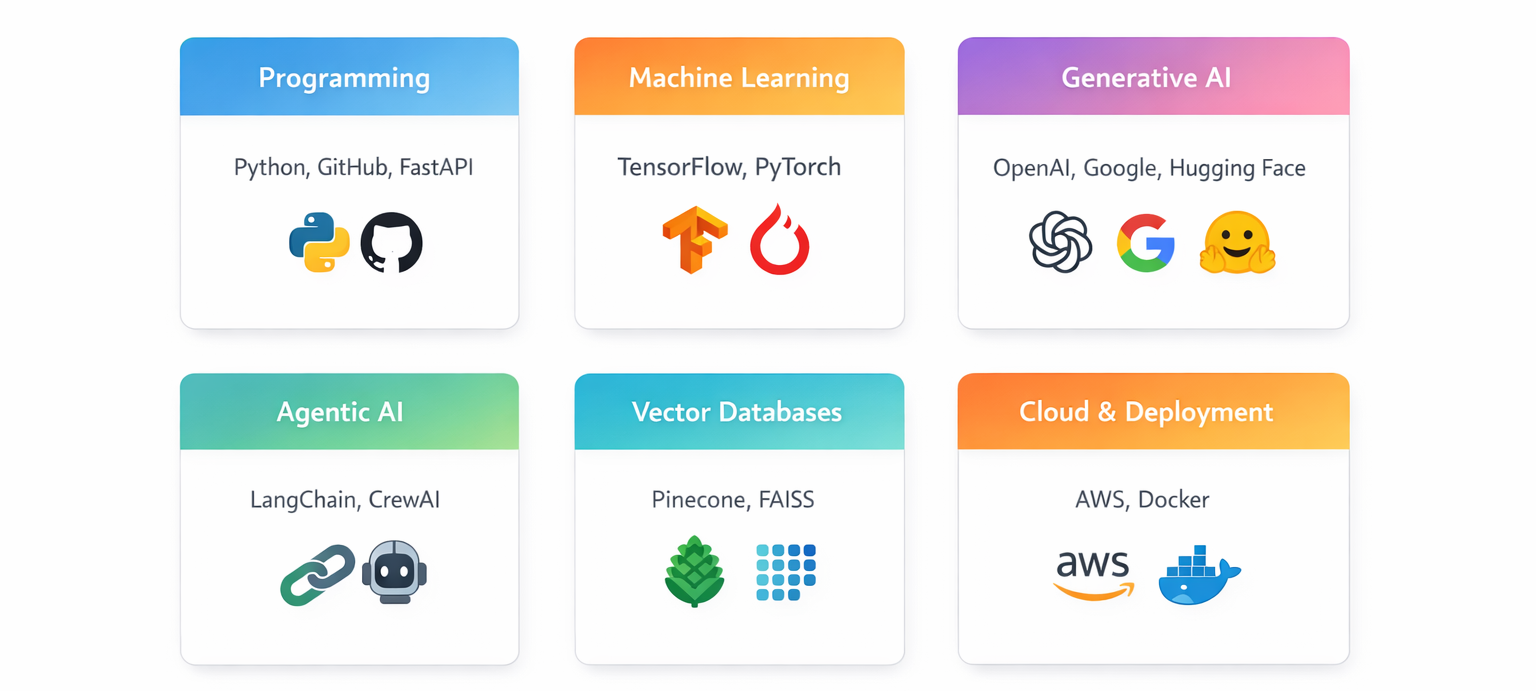
Tools and Technologies Covered in Agentic AI Course and Generative AI Courses
From AWS to LangChain- here is a list of all the tools that you'll learn:
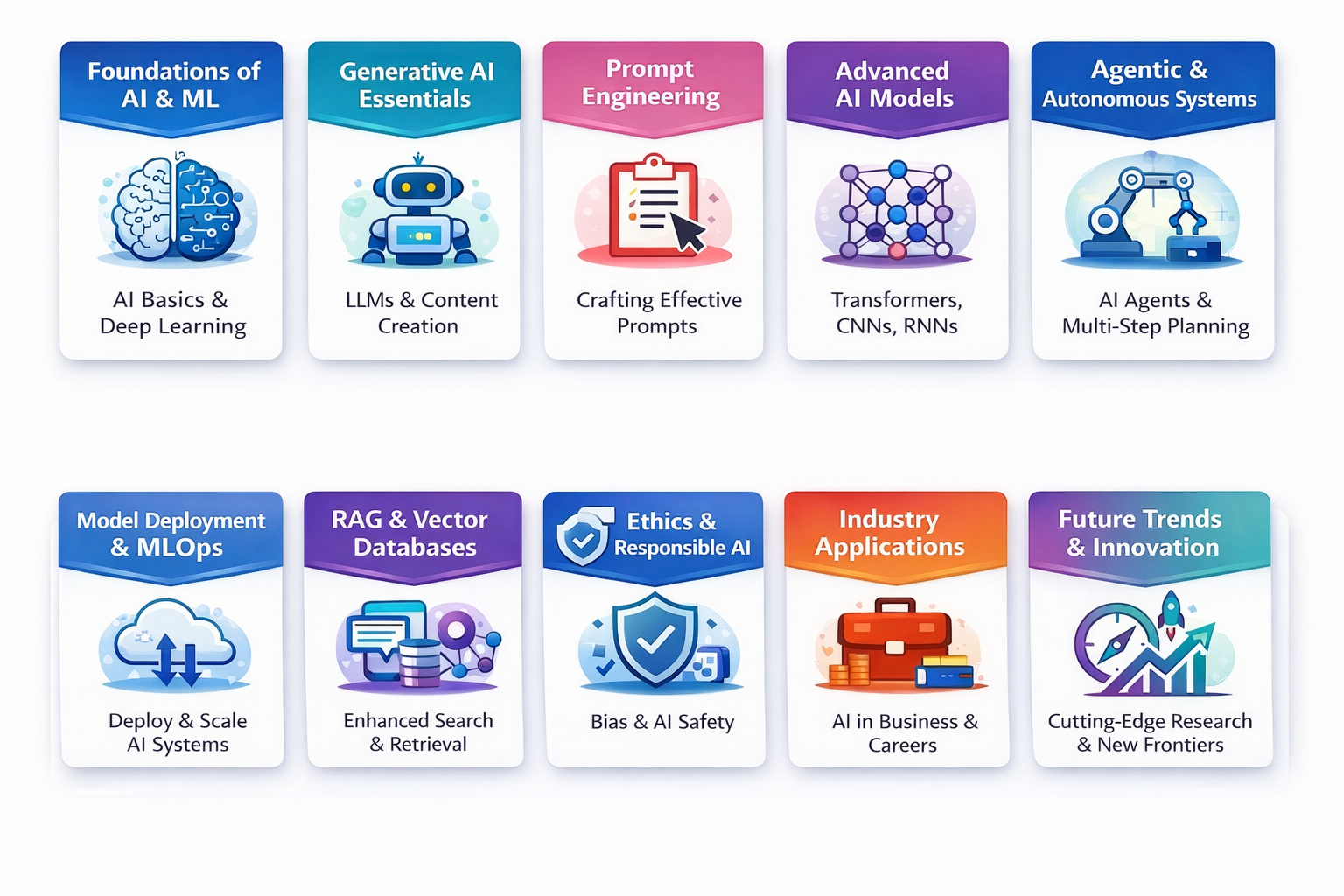
Hands-On Projects in upGrad Agentic AI and Generative AI Courses
You cannot learn Generative AI and Agentic AI through the theory alone. You need to build real systems to understand how things work. Employers also check your ability to create working projects, not just your knowledge.
Agentic AI courses include practical projects that help you apply what you learn and build a strong portfolio.
1. ShopAssist AI: Conversational Shopping Assistant
You will learn to build a chatbot that understands user needs and also suggests products through conversation. The system uses memory and data to improve responses over time.
Skills you learn: GPT-4 API, BERT, RLHF, Flask, Whisper
2. PixxelCraft AI: Product Image Generation System
In this project, you will learn to create a system that generates product images using text descriptions. You will also learn how to scale this process for large product catalogues.
Skills you learn: DALL·E, Midjourney, Stable Diffusion, OpenAI API
3. ShrewdNews AI: News Recommendation System
In this project, you will build a system that studies user behaviour and suggests relevant news. The system uses embeddings and search techniques to improve accuracy.
Skills you learn: OpenAI Embeddings, Pinecone, GPT-4, Vector Search
4. Mr. HelpMate AI: Knowledge Assistant
In this project, you will build an AI assistant that answers questions using internal documents. The system retrieves the right information and provides accurate responses.
Skills you learn: LangChain, Hugging Face, Pinecone, LlamaIndex, Embeddings
5. SemanticSpotter: Knowledge Retrieval System
In this project, you will design a system that collects data from different sources and answers complex queries. You will also learn how to improve search quality using advanced retrieval methods.
Skills you learn: LangChain, LlamaIndex, ChromaDB, Hybrid Retrieval
Career Outcomes After an Agentic AI and Generative AI Courses: Salaries and Roles
The job market for Generative AI and Agentic AI professionals in India is growing fast. Companies offer strong salaries because they need skilled people.
Many industries such as IT services, banking, e-commerce, healthcare, and consulting actively hire AI professionals. Companies build dedicated AI teams to work on real business problems.
The demand for skilled professionals is much higher than the number of people available. This creates more job opportunities and better salary growth for those with the right skills.
Here are some of the top roles that you can explore once you complete your course.
Role | What You Will Do | Average Salary in India (₹ LPA) |
Generative AI Engineer | Build LLM-powered applications, integrate AI into products, design and optimize AI pipelines for production use | ₹9 – 15 LPA |
Agentic AI Developer | Design and deploy autonomous AI agent systems, build multi-agent workflows, integrate agents with enterprise tools and APIs | ₹7 – 15+ LPA |
LLM Engineer | Fine-tune and evaluate large language models, design RAG systems, manage model serving and optimization | ₹15 – 36 LPA |
AI Product Engineer | Build AI-native products that combine generative and agentic capabilities with strong product thinking | ₹8 – 14 LPA |
Prompt Engineer | Design, test, and optimize prompts and prompt strategies for enterprise AI applications | ₹4 – 8 LPA |
AI Solutions Architect | Design end-to-end AI system architectures for enterprise deployment, advising on tool selection, infrastructure, and governance | ₹14 – 37 LPA |
Industries Hiring Agentic AI and Gen AI Professionals
Companies across all domains are currently hiring professionals with Generative AI and Agentic AI skills
- IT Services and Software Products: Both large services firms and product-led startups
- Banking, Financial Services, and Insurance: For automation, risk systems, and customer-facing AI
- E-commerce and Retail: For personalization, catalog management, and logistics optimization
- Healthcare and Life Sciences: For clinical support, documentation, and drug discovery workflows
- Consulting and Professional Services: For AI-led transformation and analytics practices
- Media and Content Platforms: For content generation, moderation, and personalization at scale
Frequently Asked Questions
1. What is an agentic AI and Gen AI course online?
An online Generative AI and Agentic AI course is a structured, career-focused program that teaches learners how to build intelligent AI systems using Large Language Models (LLMs), including GPT-style models, across two distinct capability levels. The course covers both content-generation systems and autonomous AI agents, helping learners understand how modern AI applications function in real-world environments.
Generative AI (Gen AI)
Generative AI focuses on building systems that create new content, including:
- Text (chatbots, content generators)
- Code
- Images
- Business reports
- Marketing copy
Learners develop skills in prompt design, fine-tuning model outputs, implementing Retrieval-Augmented Generation (RAG), and building applications powered by large language models.
Agentic AI
Agentic AI extends beyond content generation by enabling AI systems to plan, reason, use tools, access APIs, maintain memory, and execute multi-step tasks autonomously.
For example:
- A Generative AI system writes an email based on a prompt.
- An Agentic AI system reads an inbox, drafts replies, schedules meetings, updates CRM systems, and sends follow-ups automatically.
This combination equips learners with both foundational and advanced capabilities required to build next-generation AI solutions.
2. What topics are covered in a Generative AI and Agentic AI online course?
A well-constructed Generative AI and Agentic AI online course will include both basic concepts and advanced techniques for implementing AI systems. This will enable learners to gain a solid understanding of how to apply their knowledge practically.
Key topics will include:
- Foundations of Artificial Intelligence and Machine Learning
- Large Language Models (LLMs) and their architecture
- Prompt engineering techniques
- Retrieval-Augmented Generation (RAG)
- Autonomous AI agents and tool usage
- Multi-agent workflows and orchestration
- API integrations and external tool connectivity
- Deployment of AI applications on cloud platforms
- Responsible, ethical, and secure AI practices
3. How long do Agentic AI and Generative AI courses typically take to complete?
The time required to finish the Agentic AI and the Generative AI courses depends on the depth of the course material and the level of the course.
Typical time required to finish the course:
- Short courses for certification: 3 to 6 months
In these courses, the main topics to be studied are the tools used in Generative AI, prompt writing, and the basics of AI.
- Executive courses: 6 to 9 months
In these courses, the topics to be studied include the applications of LLMs, RAG systems, and the workflow of AI agents.
- Advanced courses: 9 to 12+ months
In these courses, the topics to be studied include the creation of production-ready AI systems, multi-agent systems, and the deployment of the same.
It is recommended that the average working individual should devote 8 to 12 hours per week to the course.
4. Do learners need prior AI or programming experience to join these courses?
No, prior experience is not required for most Generative AI and Agentic AI courses. These programs are designed to support beginners and help them learn step by step.
Courses offered by upGrad usually begin with foundational modules that cover:
- Basic AI concepts and terminology
- Introduction to programming, often using Python
- Fundamentals of machine learning and common AI tools
5. What tools and frameworks are taught in Generative AI and Agentic AI courses?
Industry-aligned Generative AI and Agentic AI courses teach tools and frameworks that professionals actively use in real-world AI development. These programs focus on practical implementation and ensure learners gain hands-on exposure to modern AI ecosystems.
Learners can typically expect to study:
- Python for AI application development
- Large Language Model (LLM) APIs for building AI-powered solutions
- LangChain and LangGraph for designing and orchestrating AI agents
- Vector databases such as FAISS or Pinecone for semantic search and retrieval
- Hugging Face for model access, experimentation, and fine-tuning
- Cloud platforms such as AWS or GCP for deployment and scalability
- API integration and automation frameworks for connecting AI systems with external tools
These tools enable learners to build, deploy, and manage autonomous AI agents and enterprise-grade AI applications effectively.
6. What is the difference between Generative AI and Agentic AI?
Generative AI creates content based on prompts. It generates text, images, code, reports, or summaries when users provide specific instructions. These systems focus on producing relevant and context-aware outputs in response to input queries.
Agentic AI goes beyond content creation. It plans, reasons, uses tools, accesses APIs, retains memory of past interactions, and completes multi-step tasks autonomously. Instead of only responding to prompts, it executes actions and manages workflows independently.
In simple terms:
- Generative AI responds.
- Agentic AI acts.
Agentic AI combines Generative AI capabilities with decision-making, memory, and automation to perform tasks with minimal human intervention.
7. Can beginners take an online Agentic AI course?
Beginners can take an online Agentic AI course, provided they choose a program that matches their current skill level. While prior experience in artificial intelligence is not mandatory, basic familiarity with programming, especially Python and logical thinking can make the learning process smoother.
Since Agentic AI focuses on building autonomous systems that plan, reason, use tools, and execute multi-step tasks, beginners should ideally start with foundational modules before progressing to advanced agent development.
A beginner-friendly course typically includes:
- AI and Large Language Model (LLM) fundamentals
- Basics of prompt engineering
- Introduction to agent frameworks and tool usage
After mastering these foundations, learners can transition more confidently into building and deploying autonomous AI agents.
8. What will learners be able to build after finishing a Generative AI and Agentic AI course?
After completing a Generative AI and Agentic AI course, learners can build practical, real-world AI applications that address modern business challenges. These programs focus on implementation and deployment, enabling learners to move beyond experimentation and create production-ready systems.
Learners can typically build:
- AI chatbots powered by Large Language Models (LLMs)
- Retrieval-Augmented Generation (RAG) systems for enterprise knowledge search
- Autonomous AI agents that plan, reason, and execute multi-step tasks
- Workflow automation tools integrated with APIs and external software
- Multi-agent systems designed for business operations
By the end of a structured program, learners become capable of designing, building, and deploying AI agents that solve practical business problems rather than merely testing prompts.
9. Are there free online Generative AI or Agentic AI courses with certificates?
Yes, there are many free courses available on Generative AI or Agentic AI, which provide a certificate on completion, helping you to get a basic understanding of AI concepts without incurring any cost.
Free AI Courses with Certificate on UpGrad
upGrad offers a number of courses on AI concepts and tools, which are available for free.
You can look at:
Covers core Generative AI concepts, prompt writing basics, and tools like ChatGPT and Microsoft Copilot. You receive a certificate after completing the course.
Introduces deep learning concepts and how neural networks work in AI systems.
Explains how AI is used across industries through simple examples and beginner-friendly lessons.
Short learning modules focused on ChatGPT and Generative AI basics with completion certificates.
These courses help you build basic AI knowledge and earn certificates that showcase your learning.
10. What is the role of prompt engineering in Agentic AI?
Prompt engineering plays a foundational role in Agentic AI because it shapes how an AI agent thinks, reasons, and behaves. In agentic systems, prompts define the agent’s role, goals, constraints, and expected output structure. A well-designed prompt directly influences the quality, accuracy, and reliability of the agent’s actions.
Effective prompt engineering enables an AI agent to:
- Clearly understand its role and objective
- Break down complex tasks into structured steps
- Use tools or APIs accurately
- Apply logical and step-by-step reasoning
- Minimise errors and reduce hallucinations
However, prompt engineering alone does not make a system fully agentic. Agentic AI also incorporates memory systems, planning modules, tool integration, and workflow orchestration to execute multi-step tasks autonomously and efficiently.
11. What are the best online platforms for Generative AI and Agentic AI courses?
One of the top platforms for learning structured courses on Generative AI and Agentic AI is upGrad, which is best suited for learners in India. Learners can gain practical skills to develop and deploy actual AI applications.
Why learners choose upGrad
- Programmes designed with IITs, IIITs, and universities globally
- Structured programs on Generative AI, LLMs, and AI Agents
- Practical projects to work on actual industry problems
- Mentorship and support for your learning journey
- Career support to help you prepare for your next role in AI
These programs can help you progress from learning about AI to actually working with AI systems.
12. Which course offers industry-recognized certification in Agentic AI?
upGrad offers industry-recognized certification programs in Generative AI and Agentic AI that support career advancement and practical skill development. These programs combine academic credibility with real-world application, making them highly relevant for professionals aiming to specialise in autonomous AI systems.
upGrad Generative AI & Agentic AI Certification Programs:
- Executive Post Graduate Certificate in Generative AI & Agentic AI (IIT Kharagpur) – A 32-week executive program designed to help learners build and deploy production-ready AI and agentic systems.
- Executive Post Graduate Programme in Applied AI and Agentic AI (IIIT Bangalore) – A 7-month advanced certification program that trains learners to design, develop, and deploy intelligent agent systems.
13. What are the prerequisites for official AI agent developer certifications?
Most official AI agent developer certifications require candidates to have basic programming knowledge, preferably in Python, along with a foundational understanding of artificial intelligence or machine learning concepts. These prerequisites ensure that learners can grasp agent architectures, tool integrations, and real-world implementation practices effectively.
Candidates are also expected to feel comfortable with API usage, logical problem-solving, and working with Large Language Model (LLM) frameworks. Advanced or executive-level certifications may require prior experience in software development, data science, automation systems, or related technical domains to support deeper learning and project execution.
14. Are Generative AI and Agentic AI courses beginner-friendly programs?
Yes. Most Generative AI and Agentic AI courses are designed to accommodate beginners through a structured, step-by-step learning approach. These programs begin with foundational modules that introduce core concepts before progressing to advanced topics.
Learners typically start with:
- Basics of Artificial Intelligence and Machine Learning
- Introduction to Large Language Models (LLMs)
- Python fundamentals
- Prompt engineering basics
After completing this foundation, the curriculum advances to more complex areas such as autonomous agents, tool integration, memory systems, and multi-step workflows.
15. Do these courses include hands-on projects or capstone assignments?
Online Generative AI and Agentic AI courses include hands-on projects and practical assignments. These projects help learners apply theoretical concepts in real-world scenarios and build job-ready skills.
If learners choose to pursue a Generative AI and Agentic AI program from upGrad, they work on industry-relevant projects such as:
Executive Post Graduate Certificate in Generative AI & Agentic AI (IIT Kharagpur)
- Build production-grade AI systems with real-world workflows
- Complete 5+ hands-on projects covering prompt engineering, RAG pipelines, and agent deployment
- Solve capstone projects that simulate real business challenges requiring autonomous agent solutions
Applied AI & Agentic AI Executive Program (IIIT Bangalore)
- Design and deploy intelligent AI agents in practical environments
- Build modules focused on multi-agent automation, decision-making systems, and integrated workflows
These hands-on components ensure that learners graduate with practical experience, not just theoretical knowledge.
16. How should learners choose between a Generative AI course and an Agentic AI course?
The choice depends on the type of AI work you want to pursue.
Choose a Generative AI course if you want to focus on:
- Prompt design and model interaction
- Building applications with Large Language Models (LLMs)
- Creating content generation tools
- Developing AI chatbots and virtual assistants
Choose an Agentic AI course if you want to:
- Build autonomous AI systems that perform tasks
- Design multi-step workflows and automation pipelines
- Integrate APIs, tools, and external systems
- Work on AI products and automation-driven applications
Programs from upGrad cover both areas, helping learners build skills in modern AI development and application design.
17. What’s the best Generative AI and Agentic AI program for career transition?
The best program for career transition combines an industry-aligned curriculum, hands-on projects, mentorship support, and structured career services. A strong program not only teaches concepts but also prepares learners for real job roles through practical implementation and portfolio development.
Learners can explore programs from upGrad such as:
- Executive Post Graduate Certificate in Generative AI & Agentic AI (IIT Kharagpur) — A comprehensive program that covers Generative AI, prompt engineering, agent design, deployment strategies, and real-world projects, with certification from Indian Institute of Technology Kharagpur.
- Applied AI & Agentic AI Executive PGP Certification (IIIT Bangalore) — A program focused on designing and deploying intelligent agents and automation systems through hands-on training, offered in collaboration with International Institute of Information Technology Bangalore.
- Data Science and Generative AI Certification (IIIT Bangalore) — A certification that integrates data science fundamentals with Generative AI concepts, ideal for learners aiming to transition into AI analytics and data-driven roles.
18. Which courses focus on real-world Agentic AI applications?
If you want to actually build AI agents, not just read about them, you need courses that focus on real use cases.
Here’s what you should look for:
- You work on hands-on projects based on real business problems
- You build AI agents that connect with APIs, databases, and external tools
- You create multi-step workflows where agents plan, decide, and act
- You deploy agents in environments that feel like real production setups
- You study case examples of how companies use AI agents in daily operations
Now, how does upGrad approach this?
You can explore programs like:
- Executive Post Graduate Programme in Applied AI and Agentic AI
- Executive Programme in Generative AI for Leaders
- IIT Kharagpur - Executive Post Graduate Certificate in Generative AI & Agentic AI
What you actually do inside these programs:
- Build practical projects using Generative AI and agent-based systems
- Work on real scenarios like automation, analytics, and AI assistants
- Design workflows where agents interact with tools and complete tasks step by step
- Learn how to take these agents from idea to deployment
You don’t just study theory. You build AI systems that can act, decide, and solve real problems.
19. Is there a Generative AI and Agentic AI online course with job guarantee?
There are many learners who are interested in a Generative AI and Agentic AI online course with a job guarantee while planning a career in AI. However, in reality, most online learning platforms do not offer a job guarantee because a job is based on your skills and experience, and how you perform in an interview.
What you get with upGrad
upGrad is an online course platform that helps learners become job ready.
You receive:
- Industry-relevant training in Generative AI, LLM, and AI Agents
- Hands-on projects to develop a strong portfolio in AI
- Resume building
- Interview and career guidance
- Placement assistance
These are the facilities provided by upGrad that will help learners become ready for an AI role and land a job after completing the course.
20. What are the Agentic AI courses for beginners vs advanced learners?
Agentic AI courses are designed for different experience levels. Some focus on basic AI concepts for beginners, while others teach advanced system design and AI agent development.
Agentic AI courses for beginners
Beginner-level courses like Professional Certificate Programme in Data Science with Generative AI help you understand the fundamentals before building complex systems.
You learn:
- Basics of Artificial Intelligence and Machine Learning
- Introduction to Large Language Models (LLMs)
- Prompt design and simple AI workflows
- Overview of AI agents and how they interact with tools
These courses are suitable if you are new to AI or want to build a strong foundation.
Agentic AI courses for advanced learners
Advanced courses like Executive Post Graduate Certificate in Generative AI & Agentic AI (IIT Kharagpur) focus on designing and deploying real AI systems.
You learn:
- Building autonomous AI agents
- Retrieval-Augmented Generation (RAG) systems
- Multi-agent orchestration and workflows
- API integration and tool connectivity
- Testing, evaluation, and deployment of AI applications
upGrad offers structured programs that help both beginners and experienced professionals develop the skills required to build practical Agentic AI applications.
21. Is there an Agentic AI course with real projects and placement support?
Yes. An Agentic AI course with real projects and placement support helps you build practical skills while preparing for AI roles.
Courses offered by upGrad include hands-on projects where you:
- Build autonomous AI agents
- Create AI applications using LLMs and Generative AI tools
- Design workflows that connect AI models with APIs and external tools
You also receive career support such as:
- Resume building
- Interview preparation
- Career guidance and placement assistance
This support helps you develop a strong project portfolio and prepare for AI job opportunities.
22. Do courses teach safety-first implementation of agentic systems?
Yes. Many Agentic AI courses, including programs offered by upGrad, teach safety-first design to ensure AI agents operate responsibly.
You learn how to:
- Add guardrails to control agent outputs
- Reduce bias and hallucinations
- Apply human-in-the-loop checks for sensitive actions
- Manage data privacy and secure API usage
- Monitor agent behavior in production systems
23. Are there courses that teach autonomous agent development without coding?
Yes. Some beginner-level programs introduce no-code or low-code platforms that allow learners to build simple AI workflows and experiment with basic agent behavior without writing code. These courses help learners understand core concepts before moving into technical implementation.
However, building production-ready autonomous agents for enterprise environments typically requires programming knowledge, especially in Python. Developers rely on coding to customise agent logic, integrate APIs, manage memory systems, and deploy scalable solutions.
24. Will learners learn how to build autonomous AI agents using LangChain in these courses?
Yes. In most advanced Generative AI and Agentic AI programs, you don’t stop at prompts. You move into building real AI agents using tools like LangChain. That includes programs from upGrad as well.
Here’s what you actually learn:
- Build autonomous AI agents that can plan and take actions
- Connect LLMs with APIs, databases, and external tools
- Add memory so your agents remember context across tasks
- Design multi-step workflows where agents think, decide, and execute
- Test and improve agent performance using real scenarios
What your practice looks like:
- You build agents that fetch data, call tools, and complete tasks
- You create workflows where agents break problems into steps
- You work with real use cases like chatbots, automation systems, and assistants
Through hands-on exercises and projects, you practice creating AI agents that interact with tools, retrieve information, and complete real tasks using industry-relevant frameworks like LangChain.
25. Do Generative AI courses teach Retrieval-Augmented Generation (RAG) techniques?
Most well-structured Generative AI courses include Retrieval-Augmented Generation (RAG) as an important part of the curriculum. This is because RAG helps improve the accuracy and reliability of AI applications by combining stored information with model outputs.
Programs offered by upGrad also cover RAG to prepare learners for real-world use cases.
Learners typically gain the ability to:
- Use vector databases to store and retrieve relevant information
- Combine retrieved data with LLM prompts to improve output quality
- Build applications like intelligent search systems, knowledge assistants, and context-aware AI tools
26. What programming languages are essential for Generative AI and Agentic AI?
Python serves as the most essential programming language for Generative AI and Agentic AI. Developers widely use it to work with Large Language Models (LLMs), build autonomous agents, integrate APIs, and deploy AI-powered systems. Its strong ecosystem of AI libraries and frameworks makes it the primary choice for modern AI development.
In addition to Python, learners can benefit from:
- JavaScript – Helps in building AI-powered web applications and integrating AI features into frontend or backend systems
- SQL – Supports working with structured databases and managing enterprise data
- Bash or basic scripting – Assists with automation, environment setup, and deployment tasks
Together, these languages enable professionals to design, develop, and deploy scalable AI solutions effectively.
27. How much of the course focuses on tool integration and automation?
A major part of Generative AI and Agentic AI courses focuses on tool integration and automation. This is because modern AI systems need to interact with external platforms, tools, and real-world data.
Key learning areas include:
- Connecting LLMs with APIs and external tools
- Using frameworks like LangChain to automate workflows
- Working with databases and vector stores
- Building AI agents that use real-world data
- Deploying automated solutions in production environments
28. Do these courses teach multi agent orchestration and workflows?
Yes, but only in advanced Agentic AI courses, including some programs by upGrad.
Here’s what you actually learn:
- Build systems where multiple agents collaborate
- Assign roles like planner, executor, and reviewer
- Share context between agents
- Design multi-step workflows to solve complex tasks
- Manage agent interactions through structured pipelines
You may also work with tools like:
- LangGraph
- AutoGen
Basic GenAI courses don’t cover this deeply. You need advanced, hands-on programs for real multi-agent workflows.
29. Do Agentic AI courses include ethical considerations and responsible AI?
Yes. upGrad Agentic AI courses include ethical and responsible AI as part of the curriculum to ensure autonomous systems are developed and deployed safely.
You learn topics such as:
- Data privacy and secure data usage
- Bias detection and mitigation
- Safety guardrails for AI agents
- Risk management and responsible deployment
This training helps learners build AI systems that operate responsibly in real-world environments.
30. How are autonomous decision-making systems covered in Generative AI programs?
In upGrad Generative AI programs, autonomous decision-making is taught through modules on agent architecture, planning logic, and workflow design.
You learn how AI systems:
- Analyse inputs and define task goals
- Break complex problems into smaller steps
- Select actions using reasoning frameworks
- Execute tasks by interacting with APIs and external tools
Hands-on exercises also help you build AI agents that perform structured decision-making in real applications.
31. Will learners study prompt engineering along with agent behavior modeling?
Yes. Generative AI and Agentic AI courses cover both prompt engineering and agent behavior modeling as interconnected components of modern AI system design. These programs ensure that learners understand not only how to generate high-quality outputs but also how to control agent actions.
32. Are deployment and production readiness part of the curriculum?
Yes. Most of the comprehensive Gen AI and Agentic AI programs include deployment and production readiness as important components of the curriculum, not optional add-ons.
Here’s how they are typically covered:
- From Prototype to Production: Learners move beyond Jupyter notebooks and build structured, deployable AI applications ready for real-world use.
- Cloud Deployment: Courses introduce deployment on cloud platforms, enabling learners to host AI models and autonomous agents in live environments.
- API and System Integration: Programs train learners to connect AI agents with external tools, databases, and enterprise systems.
- Monitoring and Optimization: Some curricula include logging, performance evaluation, debugging, and reliability improvements to ensure production stability.
33. What careers can learners pursue after completing a Generative AI and Agentic AI course?
After completing a Generative AI and Agentic AI course, learners can pursue a range of specialised and high-growth roles in the AI ecosystem. These programs prepare professionals to design, build, deploy, and manage intelligent AI systems across industries.
Common career paths include:
- Generative AI Engineer
- Agentic AI Developer / AI Automation Engineer
- LLM Engineer
- AI Product Engineer
- AI Solutions Architect
- Prompt Engineer
- AI Research Associate
34. What is the average salary for roles focusing on Generative AI and Agentic AI?
Salaries for roles in Generative AI and Agentic AI vary based on experience, technical expertise, company size, and location.
In India, typical salary ranges are:
- Entry-level AI/ML Engineer: ₹6–12 LPA
- Generative AI / LLM Engineer: ₹10–20 LPA
- Agentic AI / Automation Engineer: ₹12–24 LPA
- AI Solutions Architect / Senior AI Specialist: ₹20 LPA+
35. Does a certification in Agentic AI help with job placements?
A certification in Agentic AI can significantly improve job prospects, particularly when the program includes hands-on projects and real-world implementation. While a certificate alone does not guarantee placement, it strengthens a candidate’s overall professional profile.
Such certifications help by:
- Validating skills in Generative AI and autonomous systems
- Strengthening resume credibility
- Demonstrating structured learning from a recognised program
- Providing portfolio-ready projects that candidates can showcase during interviews
Recruiters prioritise practical experience, so certifications that emphasise real-world projects, system design, and deployment work tend to create the strongest impact in the hiring process.
36. Are Generative AI certificates recognized by industry recruiters?
Generative AI certificates are increasingly recognized by industry recruiters, particularly when they come from structured and credible programs. Recruiters value certifications that demonstrate practical competence rather than theoretical completion alone.
Programs gain stronger recognition when they include:
- Partnerships with reputed academic institutions
- Real-world, industry-aligned projects
- Extensive hands-on implementation experience
Hiring teams primarily look for demonstrable skills, so certifications that include deployable projects, agent workflows, and portfolio-ready work carry greater weight.
37. How can learners showcase Agentic AI projects in their portfolio?
Learners should present Agentic AI projects in a way that highlights real-world impact, technical depth, and practical implementation. A strong portfolio should clearly demonstrate how the agent solves a problem, integrates tools, and performs autonomous workflows.
Effective ways to showcase projects include:
- Hosting the code on GitHub with clear documentation, setup instructions, and usage guidelines
- Writing a concise case study that explains the problem statement, solution approach, tools used (LLMs, LangChain, APIs), and measurable outcomes
- Including architecture diagrams that illustrate agent workflows, memory systems, and tool integrations
- Deploying a live demo on a cloud platform and sharing the accessible link
- Highlighting performance metrics such as response accuracy, automation efficiency, latency improvements, or cost optimisation
38. What companies hire AI professionals skilled in agentic systems?
Here are examples of top employers across different categories where agentic AI skills are in high demand:
Technology & AI Platform Companies
These companies build core AI products and services:
- Google (DeepMind, AI research)
- Microsoft (Azure AI, Copilot)
- Meta (AI research and deployment)
- OpenAI
- Amazon (AWS AI services)
- NVIDIA (AI frameworks & tooling)
AI & Automation Startups
Startups focused on intelligent systems and autonomous workflows:
- Anthropic
- Cohere
- Inflection AI
- AI21 Labs
- Hugging Face
- LangChain ecosystem startups
Large Enterprises Using AI at Scale
Organizations leveraging agentic AI for business automation:
- JPMorgan Chase (finance automation)
- Deloitte & Accenture (AI consulting)
- Walmart (retail AI systems)
- Infosys & TCS (enterprise AI solutions)
- HDFC Bank & ICICI Bank (AI automation teams)
Cloud & SaaS Companies
Platforms where AI agents power business applications:
- Salesforce (Einstein AI)
- Oracle Cloud (AI-driven services)
- ServiceNow (workflow automation)
- SAP (AI enterprise tools)
Consulting & System Integrators
Firms implementing AI solutions for clients:
- McKinsey Analytics
- BCG Gamma
- EY AI Labs
- PwC’s AI practice
- KPMG Lighthouse
39. Do courses offer resume reviews or interview preparation?
Yes, many Generative AI and Agentic AI courses offer career support to help learners prepare for job opportunities.
Programs from upGrad include services like resume reviews and interview preparation. This support helps you present your skills effectively to employers.
You typically receive help to:
- Improve your resume by highlighting AI and project work
- Showcase technical skills that recruiters look for
- Practice interviews through mock sessions
- Prepare for behavioral questions and problem-solving discussions
40. Can professionals freelance or consult using Agentic AI skills?
Yes. Professionals can absolutely freelance or offer consulting services using Agentic AI skills. Many businesses actively seek experts who can design and implement AI-driven automation systems to reduce manual effort, improve efficiency, and streamline operations.
With expertise in Agentic AI, professionals can offer services such as:
- Building autonomous AI agents for workflow automation
- Developing Retrieval-Augmented Generation (RAG) powered knowledge assistants
- Creating AI chatbots integrated with CRMs and enterprise platforms
- Designing internal automation systems for small and mid-sized businesses
41. How does learning Agentic AI improve automation career prospects?
Learning Agentic AI significantly strengthens automation career prospects because it enables professionals to move beyond basic scripting and rule-based systems. Instead of building simple bots that follow fixed instructions, professionals gain the ability to design intelligent systems that adapt, reason, and act autonomously.
With Agentic AI expertise, professionals can:
- Build intelligent agents that plan and execute multi-step tasks
- Integrate AI systems with APIs and enterprise business tools
- Automate complex decision-making workflows
- Improve operational efficiency using LLM-powered automation systems
42. Are Generative AI and Agentic AI professionals in demand in 2026?
Yes. Demand for Generative AI and Agentic AI professionals continues to grow rapidly in 2026. Organizations across sectors are investing heavily in AI-powered automation, enterprise AI assistants, and Large Language Model (LLM)-based systems to improve efficiency and gain competitive advantage.
Industries actively hiring include:
- Technology and SaaS companies
- Banking and financial services
- E-commerce and retail
- Healthcare
- Consulting and digital transformation firms
43. Will the course include real-world Agentic AI projects?
Yes. Most Online Generative AI and Agentic AI courses, including programs offered by upGrad, include real-world projects as a core part of the learning experience. The focus is on hands-on work, so you learn how AI systems are built and applied in real scenarios.
You typically work on projects such as:
- Building autonomous agents using frameworks like LangChain or AutoGPT
- Creating multi-step task agents (planning → execution → memory)
- Developing chatbots that can take actions (bookings, research, automation)
- Integrating APIs (e.g., search, databases, tools) into agents
- Real-world use cases like:
- Personal productivity assistants
- AI research agents
- Customer support automation
- Workflow automation tools
The upGrad courses usually include:
- Capstone projects (end-to-end agent systems)
- Case studies from real companies
- Deployment (so your agent actually runs in production)
44. Does the online course teach how to deploy agents on cloud platforms?
Yes, but depth depends on the course level.
Advanced, hands-on programs (including from upGrad) go beyond basics and show you how to deploy agents on real cloud platforms.
Here’s what you typically learn:
- Package AI agents and connect them with APIs and databases
- Deploy on platforms like AWS, Azure, or GCP
- Use tools such as Docker and basic CI/CD workflows
- Monitor performance and handle scaling
- Maintain agents in production-style environments
What to watch for:
- Beginner courses → only demo or local deployment
- Advanced courses → full cloud setup, scaling, and production workflows
Check the syllabus for cloud tools and deployment topics to confirm depth.
45. What are example projects learners build in Agentic AI training?
Agentic AI training programs typically include projects that demonstrate how autonomous AI agents operate in practical, real-world environments. These projects focus on planning, reasoning, tool integration, and multi-step task execution.
Common examples include:
- RAG-based knowledge assistants that retrieve and summarise internal company documents
- Autonomous research agents that gather, analyse, and compile insights from multiple data sources
- AI workflow automation systems that execute multi-step processes using APIs and external tools
- Customer support AI agents integrated with CRM or ticketing platforms
- Multi-agent systems where different agents collaborate to plan, execute, and validate complex tasks
46. Do courses teach integration with external APIs and tool stacks?
Yes. Many Agentic AI courses, including programs offered by upGrad, teach how AI agents connect with external APIs and tools.
You learn how to:
- Connect AI agents with databases and third-party services
- Send and handle API requests and responses
- Manage authentication and secure access
- Build tool-calling logic inside agent workflows
47. Are there debugging and model evaluation modules in Agentic AI courses?
Yes. These are core parts of most serious Agentic AI courses including those from upGrad.
Here’s what you learn:
- Trace agent decisions and fix reasoning errors
- Detect hallucinations and tool/API issues
- Measure accuracy, task success rate, and latency
- Test agents using datasets and structured checks
- Monitor performance in real scenarios
Advanced programs, including those by upGrad, focus on making agents reliable, not just working.
48. Do courses teach safety first implementation of agentic systems?
Yes, safety-first design is an important part of agentic AI training because these systems can take actions that directly impact users and businesses.
Most courses focus on building safe and responsible systems by teaching how to:
- Set guardrails to control and limit agent outputs
- Reduce bias and errors in generated results
- Add human oversight for sensitive or high-risk actions
- Handle data privacy and use APIs securely
- Monitor system behavior in real-world environments
This approach ensures that AI systems are not only effective but also safe, reliable, and suitable for real-world use.
49. What advanced tools will learners study (e.g., LangGraph, multi-agent systems)?
Advanced Gen AI and Agentic AI courses typically introduce tools used to build scalable, autonomous AI systems.
Learners typically gain exposure to:
- LangChain for agent workflows and tool integration
- LangGraph for structured, stateful agent orchestration
- Vector databases for Retrieval-Augmented Generation (RAG)
- Multi-agent frameworks for coordinating task-based agents
- Memory management systems for contextual continuity
- Cloud deployment tools for hosting and scaling AI agents
50. What frameworks are used to build Agentic AI systems in courses?
Agentic AI courses teach the tools and frameworks used to build autonomous systems and agent workflows. These tools help learners create applications that can take actions, use data, and interact with other systems.
Common tools and frameworks include:
- LangChain – Used to build agent workflows and connect tools with language models
- LangGraph – Helps manage multi-step and stateful agent processes
- LLM APIs – Used to connect large language models with applications
- Vector databases – Used in Retrieval-Augmented Generation (RAG) for storing and retrieving data
- Python-based libraries – For automation and workflow logic
51. Does the course teach how Retrieval-Augmented Generation (RAG) improves agent outcomes?
Yes. Many Generative AI and Agentic AI courses, including programs offered by upGrad, explain how Retrieval-Augmented Generation (RAG) improves AI agent performance by connecting models with external knowledge sources.
You learn how RAG helps agents:
- Improve factual accuracy in responses
- Reduce hallucinations in generated outputs
- Access domain-specific knowledge from external data sources
- Provide more relevant answers in real business applications
52. How in-depth is the module on Large Language Models (LLMs) basics?
The LLM module usually goes beyond surface-level concepts and covers both theory and application.
What learners can expect to learn:
- How LLMs work at a high level (transformer architecture, tokens, embeddings)
- How prompts influence model behavior
- Limitations such as hallucinations and context constraints
- How LLMs integrate with tools, APIs, and RAG systems
- Practical implementation for building AI applications
53. Will learners study memory, tool calling, and API orchestration?
Most Agentic AI programs treat memory management, tool calling, and API orchestration as core components of the curriculum. These elements form the foundation of building truly autonomous and production-ready AI agents.
Learners typically develop the ability to:
- Implement short-term and long-term memory to maintain contextual continuity
- Enable agents to dynamically select and use external tools based on task requirements
- Orchestrate multiple APIs within structured and goal-driven workflows
- Design multi-step task execution pipelines that combine reasoning, action, and validation
54. How much of the course is Python-based vs no-code tools?
Most Generative AI and Agentic AI courses rely heavily on Python for building and deploying applications. It is the main programming language used because of its simplicity and strong ecosystem.
Python is commonly used for:
- Working with LLM APIs
- Building RAG pipelines
- Designing agent workflows
- Integrating external APIs
- Handling deployment and automation logic
Programs offered by upGrad also follow this approach. While some beginner modules may introduce low-code or no-code tools for basic experimentation, advanced agent development and deployment are usually done using Python.
55. Are there modules on advanced AI system design?
Yes. Many Gen AI and Agentic AI programs include dedicated modules on advanced AI system design, especially at the intermediate and advanced levels.
These modules typically cover:
- Designing scalable agent architectures
- Structuring multi-agent workflows
- Handling state management and memory systems
- Planning for performance, latency, and reliability
- Building production-ready AI pipelines
56. Will learners study how to make AI agents explainable and accountable?
Yes. Generative AI and Agentic AI programs teach learners not only how to build autonomous agents but also how to ensure their behavior remains transparent and accountable. These courses emphasise explainability as a critical requirement for enterprise and real-world deployment.
Training typically includes techniques such as capturing reasoning traces, validating outputs, implementing structured logging, detecting bias, and applying monitoring frameworks. Learners may also explore governance concepts like auditability, compliance controls, and responsible AI standards for enterprise environments.
57. Do courses cover workflow orchestration techniques?
Yes. Many Agentic AI courses, including those offered by upGrad, teach workflow orchestration for building autonomous AI systems.
You learn to:
- Design multi-step agent workflows
- Connect agents with APIs and tools
- Manage context and system state
- Handle failures in AI pipelines
58. Are there industry best practices included for real system deployments?
Yes. Online Gen AI and Agentic AI courses typically include industry best practices to ensure systems are stable and production-ready.
This may include:
- Version control and model updates
- Logging and monitoring agent activity
- Performance optimization and latency management
- Secure API handling and access control
- Scalability planning and infrastructure design
59. What are the best agentic AI courses online with certification in 2026?
The best Agentic AI course in 2026 is one that combines structured learning, real-world projects, practical tool application, cloud deployment skills, and an industry-recognized certification that signals your capability to employers.
Here is the list of best online Gen AI and Agentic AI Courses offered by upGrad:
- Executive Post Graduate Certificate in Generative AI & Agentic AI (IIT Kharagpur) – A professional certificate designed to teach production-ready AI systems and autonomous agent workflows.
- Executive Post Graduate Programme in Applied AI and Agentic AI (IIIT Bangalore) – A focused certification that covers both applied AI and agentic system design and deployment.
- Executive Programme in Generative AI for Leaders (IIIT Bangalore) – A program tailored for professionals who want AI leadership and strategic understanding of Generative and agent-oriented AI.
- Professional Certificate Programme in Data Science with Generative AI – A certificate combining data science fundamentals with generative AI skills relevant for agentic applications.
60. How to master Gen AI and agentic AI in online programs?
Mastery comes from structured progression and consistent hands-on practice, not just watching lectures.
Start with the foundations: understand AI basics, Python, and how Large Language Models (LLMs) work. Then move into prompt engineering and build small Gen AI applications to strengthen implementation skills.
Next, focus on:
- Building Retrieval-Augmented Generation (RAG) systems
- Designing autonomous agents with memory and tool integration
- Creating multi-step workflows and API orchestration
- Deploying projects on cloud platforms
61. Agentic AI vs Prompt Engineering course, which should learners choose?
The choice is yours depending on what you want to build with AI.
Prompt Engineering Course
Focus: improving how AI responds.
- You will concentrate on making AI respond better.
- You will learn to make better prompts, improve responses, and reduce errors.
- You will choose this course if you want to work with AI tools, make better responses in chats, and get into the field quickly.
Agentic AI Course
Focus: building AI systems that can take actions.
- You will concentrate on building AI that can take action.
- You will learn to build AI agents, make them talk to APIs and tools, build memory, and make them perform multi-step workflows.
- You will choose this course if you want to build AI, work in automation, and build AI that can plan and perform actions.
If you want to make AI responses better, choose prompt engineering.
If you want to build AI, choose agentic AI.
62. Which online courses teach autonomous AI applications?
AI applications are becoming more popular as companies continue to expand their capabilities. Autonomous AI applications refer to AI systems that perform tasks independently instead of simply generating outcomes based upon pre-defined criteria. Examples of learning modules focusing on building autonomous AI applications include those provided by upGrad which includes the following elements:
- Designing agents & reasoning about them (defining objectives, logic, and decisions).
- Automating work flows through external tools & APIs for executing but not generating actions in the real-world.
- Utilizing memory systems & multi-step task planning to handle context & complex tasks.
- Integration of Retrieval-Augmented Generation technology to increase the level of accuracy & provide the basis for knowledge.
- Deployment of AI agents into cloud environments that have been designed for production use.
63. What is Gen AI & Agentic AI learning path for careers?
A structured learning path helps you move from fundamentals to job-ready AI roles.
Step 1: Foundations: Start with Python basics, AI fundamentals, and understanding how Large Language Models (LLMs) work.
Step 2: Generative AI Skills: Learn prompt engineering, embeddings, and build simple LLM-based applications such as chatbots and content tools.
Step 3: RAG & Integration: Implement Retrieval-Augmented Generation (RAG), connect AI models to databases, and integrate external APIs.
Step 4: Agentic AI Systems: Design autonomous agents with memory, tool usage, multi-step workflows, and reasoning capabilities.
Step 5: Deployment & Optimization: Deploy AI agents on cloud platforms, monitor performance, and optimize for reliability and scalability.
64. Which Agentic AI course offers hands-on labs and mentorship?
upGrad offers structured Generative AI and Agentic AI programs that include practical labs and guided mentorship as part of the learning experience.
Programs such as:
- Executive Post Graduate Certificate in Generative AI & Agentic AI (IIT Kharagpur)
- Applied AI & Agentic AI Executive PGP Certification (IIIT Bangalore)
- Data Science and Generative AI Certification (IIITB)
These courses typically include:
- Hands-on projects and implementation labs
- Real-world capstone assignments
- Mentor-led doubt-clearing sessions
- Personalized feedback on projects
- Career support and interview preparation
upGrad Learner Support
Talk to our experts. We are available 7 days a week, 10 AM to 7 PM

Indian Nationals

Foreign Nationals
Disclaimer
1.upGrad does not grant credit; credits are granted, accepted, or transferred at the sole discretion of the relevant educational institution offering the diploma or degree. We advise you to enquire further regarding the suitability of this program for your academic, professional requirements and job prospects before .