
All courses
Agentic AI
Agentic AI
Artificial Intelligence
Degree / Exec. PG

IIIT Bangalore
Executive Diploma in Machine Learning and AI
OPJ Global University
Master’s Degree in Artificial Intelligence and Data Science
Liverpool John Moores University
Master of Science in Machine Learning & AI
Golden Gate University
DBA in Emerging Technologies with Concentration in Generative AIExecutive Certificate

IIITB & IIM, Udaipur
Chief Technology Officer & AI Leadership Programme
IIIT Bangalore
Executive Programme in Generative AI for Leaders
upGrad | Microsoft
Gen AI Foundations Certificate Program from MicrosoftupGrad | Microsoft
Gen AI Mastery Certificate for Data AnalysisupGrad | Microsoft
Gen AI Mastery Certificate for Software DevelopmentupGrad | Microsoft
Gen AI Mastery Certificate for Managerial ExcellenceOffline Bootcamps

upGrad
Data Science and AI-MLDoctorate
For All Domains
IIITB & IIM, Udaipur
Chief Technology Officer & AI Leadership Programme
Swiss School of Business and Management
Global Doctor of Business Administration from SSBM
Edgewood University
Doctorate in Business Administration by Edgewood UniversityGolden Gate University
Doctor of Business Administration From Golden Gate University
Rushford Business School
Doctor of Business Administration from Rushford Business School, SwitzerlandGolden Gate University
Master + Doctor of Business Administration (MBA+DBA)-d9bdeff6165f4eb1ba2adcebde78e961.svg)
University of Waterloo
Chief Technology and AI Officer ProgramLeadership / AI
Golden Gate University
DBA in Emerging Technologies with Concentration in Generative AIMachine Learning
Machine Learning
Data Science
Degree / Exec. PG
O.P Jindal Global University
Master’s Degree in Artificial Intelligence and Data ScienceIIIT Bangalore
Executive Diploma in Data Science & AILiverpool John Moores University
Master of Science in Data ScienceExecutive Certificate
upGrad | Microsoft
Gen AI Foundations Certificate Program from MicrosoftupGrad | Microsoft
Gen AI Mastery Certificate for Data AnalysisupGrad | Microsoft
Gen AI Mastery Certificate for Software DevelopmentupGrad | Microsoft
Gen AI Mastery Certificate for Managerial ExcellenceupGrad | Microsoft
Gen AI Mastery Certificate for Content CreationOffline Bootcamps
upGrad
Data Science and AI-MLupGrad
Data AnalyticsMBA
Masters

Paris School of Business
Master of Science in Business Management and TechnologyO.P.Jindal Global University
MBA (with Career Acceleration Program by upGrad)Edgewood University
MBA from Edgewood UniversityO.P.Jindal Global University
MBA from O.P.Jindal Global UniversityGolden Gate University
Master + Doctor of Business Administration (MBA+DBA)Executive Certificate
IMT, Ghaziabad
Advanced General Management ProgramMarketing
Executive Certificate
Offline Bootcamps
upGrad
Digital MarketingManagement
Degree
O.P Jindal Global University
MSc in International Accounting & Finance (ACCA integrated)Paris School of Business
Master of Science in Business Management and Technology
Golden Gate University
Master of Arts in Industrial-Organizational PsychologyExecutive Certificate

IIM Kozhikode
Human Resource Analytics Course from IIM-KupGrad | Microsoft
Gen AI Foundations Certificate Program from MicrosoftEducation
Education

Northeastern University
Master of Education (M.Ed.) from Northeastern UniversityEdgewood University
Doctor of Education (Ed.D.)Edgewood University
Master of Education (M.Ed.) from Edgewood UniversityCertifications
Project Management
Certification

Knowledgehut
Leadership And Communications In ProjectsKnowledgehut
Microsoft Project 2007/2010-ae8d039bbd2a41318308f8d26b52ac8f.svg)
Knowledgehut
Financial Management For Project ManagersKnowledgehut
Fundamentals of Earned Value Management (EVM)Knowledgehut
Fundamentals of Portfolio ManagementKnowledgehut
Fundamentals of Program Management-35c169da468a4cc481c6a8505a74826d.webp&w=128&q=75)
Knowledgehut
CAPM® CertificationsKnowledgehut
Microsoft® Project 2016Certifications & Trainings
-7f4b4f34e09d42bfa73b58f4a230cffa.webp&w=128&q=75)
Knowledgehut
PMP® CertificationKnowledgehut
PMI-RMP® CertificationKnowledgehut
PMP Renewal Learning PathKnowledgehut
Oracle Primavera P6 V18.8Knowledgehut
Microsoft® Project 2013Knowledgehut
PfMP® Certification CourseKnowledgehut
Project Planning and MonitoringPrince2 Certifications

Knowledgehut
PRINCE2® FoundationKnowledgehut
PRINCE2® PractitionerKnowledgehut
PRINCE2 Agile Foundation and PractitionerKnowledgehut
PRINCE2 Agile® Foundation CertificationKnowledgehut
PRINCE2 Agile® Practitioner CertificationManagement Certifications
Knowledgehut
Project Management Masters Certification ProgramKnowledgehut
Change ManagementKnowledgehut
Project Management TechniquesKnowledgehut
Product Management Certification ProgramKnowledgehut
Project Risk Management- Study abroad
- Offline centres
- uGSOT - B.Tech
More


Arduino Online Course
Learn Arduino programming and circuit design basics
Build skills in sensors, IoT, and embedded systems
Work on real hardware projects and automation setups
Train on microcontrollers and electronics tools
Talk to a Counsellor
By clicking, I accept the T&C and Privacy Policy
Learn From The Best
5
Instructors
3
Industry Experts





Learn by Doing
Experience practical learning with real-world projects in our courses in digital marketing. Get hands-on experience & build your portfolio.
6+
Projects


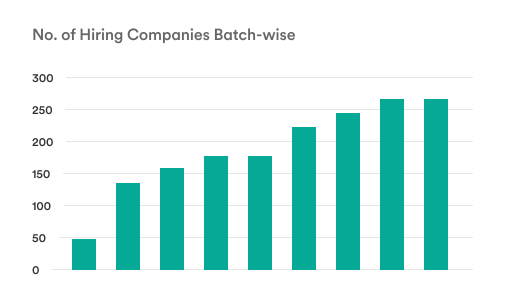
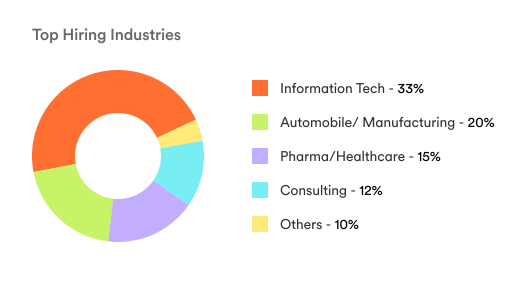
Our Placement Numbers
After completing the course, you can be placed in top companies with competitive salary packages. Get ahead in your career
Top Recruiters



What Our Learners Have To Say


How Will upGrad Supports You
Receive unparalleled guidance from industry mentors, teaching assistants, and graders
Receive one-on-one feedback from our seasoned faculty on submissions and personalized feedback to improvement
Our Syllabus is designed to provide you with ample of industry relevant knowledge with examples
Arduino Online Course Overview
Frequently Asked Questions
1. Are Arduino courses available at no cost?
Yes, many beginner Arduino resources are free, including tutorials, documentation, and community projects. However, structured courses with mentorship, hands-on kits, assessments, and certifications usually require payment to support guided learning and practical evaluation.
2. Is Arduino programming the same as writing pure C++?
Arduino programming is based on C++, but it uses a simplified structure. Many complex elements are abstracted through libraries, allowing beginners to write functional programs without deeply managing memory, classes, or advanced C++ syntax initially.
3. How much time does it typically take to learn Arduino?
Learning timelines depend on goals. Simple projects like LED control or basic sensors can be mastered quickly, while building reliable embedded systems with multiple components, communication protocols, and optimization may require consistent practice over several months.
4. Should beginners start with C or C++ for Arduino development?
Arduino learning does not require mastering C beforehand. Since Arduino uses a C++-based language with simplified syntax, beginners can directly start coding while gradually understanding core programming concepts organically through practice.
5. Can Arduino courses help with higher-level embedded systems later?
Yes. Arduino builds strong fundamentals in microcontroller logic, electronics interfacing, and debugging. These skills transfer well to advanced platforms like ARM-based controllers, ESP boards, and industrial embedded environments used in professional product development.
6. Do Arduino courses require owning hardware kits in advance?
Not always. Many introductory courses provide simulation-based learning initially. However, physical hardware becomes essential at later stages, as real-world troubleshooting, wiring errors, and component behavior cannot be fully replicated through virtual environments.
7. Is Arduino suitable only for students and beginners?
No. While Arduino is beginner-friendly, it is also widely used by professionals for rapid prototyping, proof-of-concept development, and experimental designs. Engineers often use Arduino to test ideas before migrating to custom or industrial-grade hardware.
8. Can Arduino be used to build commercial products?
Arduino is commonly used during early-stage product prototyping. Final commercial products often transition to custom microcontroller boards, but the logic, architecture, and firmware structure developed on Arduino frequently form the foundation of production designs.
9. Will Arduino courses improve problem-solving skills?
Yes. Arduino learning involves diagnosing circuit failures, debugging code, and understanding component behavior. This hands-on troubleshooting approach strengthens logical thinking, attention to detail, and systematic problem-solving skills valuable across engineering domains.
10. Are online Arduino courses effective without in-person labs?
Online courses can be effective when they include live guidance, project walkthroughs, and hardware assignments. The learning outcome depends more on structured practice and feedback than physical classroom presence alone.
11. Is Arduino still relevant with newer microcontroller platforms available?
Yes. Arduino remains relevant due to its vast ecosystem, strong community support, and ease of use. It continues to be a preferred learning and prototyping platform despite the availability of more advanced microcontrollers.
upGrad Learner Support
Talk to our experts. We are available 7 days a week, 10 AM to 7 PM

Indian Nationals

Foreign Nationals
Disclaimer
The above statistics depend on various factors and individual results may vary. Past performance is no guarantee of future results.
The student assumes full responsibility for all expenses associated with visas, travel, & related costs. upGrad does not .