All courses
Agentic AI
Agentic AI
Artificial Intelligence
Degree / Exec. PG

IIIT Bangalore
Executive Diploma in Machine Learning and AI
OPJ Global University
Master’s Degree in Artificial Intelligence and Data Science
Liverpool John Moores University
Master of Science in Machine Learning & AI
Golden Gate University
DBA in Emerging Technologies with Concentration in Generative AIExecutive Certificate

IIITB & IIM, Udaipur
Chief Technology Officer & AI Leadership Programme
IIIT Bangalore
Executive Programme in Generative AI for Leaders
upGrad | Microsoft
Gen AI Foundations Certificate Program from MicrosoftupGrad | Microsoft
Gen AI Mastery Certificate for Data AnalysisupGrad | Microsoft
Gen AI Mastery Certificate for Software DevelopmentupGrad | Microsoft
Gen AI Mastery Certificate for Managerial ExcellenceOffline Bootcamps

upGrad
Data Science and AI-MLDoctorate
For All Domains
IIITB & IIM, Udaipur
Chief Technology Officer & AI Leadership Programme
Swiss School of Business and Management
Global Doctor of Business Administration from SSBM
Edgewood University
Doctorate in Business Administration by Edgewood UniversityGolden Gate University
Doctor of Business Administration From Golden Gate University
Rushford Business School
Doctor of Business Administration from Rushford Business School, SwitzerlandGolden Gate University
Master + Doctor of Business Administration (MBA+DBA)-d9bdeff6165f4eb1ba2adcebde78e961.svg)
University of Waterloo
Chief Technology and AI Officer ProgramLeadership / AI
Golden Gate University
DBA in Emerging Technologies with Concentration in Generative AIMachine Learning
Machine Learning
Data Science
Degree / Exec. PG
O.P Jindal Global University
Master’s Degree in Artificial Intelligence and Data ScienceIIIT Bangalore
Executive Diploma in Data Science & AILiverpool John Moores University
Master of Science in Data ScienceExecutive Certificate
upGrad | Microsoft
Gen AI Foundations Certificate Program from MicrosoftupGrad | Microsoft
Gen AI Mastery Certificate for Data AnalysisupGrad | Microsoft
Gen AI Mastery Certificate for Software DevelopmentupGrad | Microsoft
Gen AI Mastery Certificate for Managerial ExcellenceupGrad | Microsoft
Gen AI Mastery Certificate for Content CreationOffline Bootcamps
upGrad
Data Science and AI-MLupGrad
Data AnalyticsMBA
Masters

Paris School of Business
Master of Science in Business Management and TechnologyO.P.Jindal Global University
MBA (with Career Acceleration Program by upGrad)Edgewood University
MBA from Edgewood UniversityO.P.Jindal Global University
MBA from O.P.Jindal Global UniversityGolden Gate University
Master + Doctor of Business Administration (MBA+DBA)Executive Certificate
IMT, Ghaziabad
Advanced General Management ProgramMarketing
Executive Certificate
Offline Bootcamps
upGrad
Digital MarketingManagement
Degree
O.P Jindal Global University
MSc in International Accounting & Finance (ACCA integrated)Paris School of Business
Master of Science in Business Management and Technology
Golden Gate University
Master of Arts in Industrial-Organizational PsychologyExecutive Certificate

IIM Kozhikode
Human Resource Analytics Course from IIM-KupGrad | Microsoft
Gen AI Foundations Certificate Program from MicrosoftEducation
Education

Northeastern University
Master of Education (M.Ed.) from Northeastern UniversityEdgewood University
Doctor of Education (Ed.D.)Edgewood University
Master of Education (M.Ed.) from Edgewood UniversityCertifications
Project Management
Certification

Knowledgehut
Leadership And Communications In ProjectsKnowledgehut
Microsoft Project 2007/2010-ae8d039bbd2a41318308f8d26b52ac8f.svg)
Knowledgehut
Financial Management For Project ManagersKnowledgehut
Fundamentals of Earned Value Management (EVM)Knowledgehut
Fundamentals of Portfolio ManagementKnowledgehut
Fundamentals of Program Management-35c169da468a4cc481c6a8505a74826d.webp&w=128&q=75)
Knowledgehut
CAPM® CertificationsKnowledgehut
Microsoft® Project 2016Certifications & Trainings
-7f4b4f34e09d42bfa73b58f4a230cffa.webp&w=128&q=75)
Knowledgehut
PMP® CertificationKnowledgehut
PMI-RMP® CertificationKnowledgehut
PMP Renewal Learning PathKnowledgehut
Oracle Primavera P6 V18.8Knowledgehut
Microsoft® Project 2013Knowledgehut
PfMP® Certification CourseKnowledgehut
Project Planning and MonitoringPrince2 Certifications

Knowledgehut
PRINCE2® FoundationKnowledgehut
PRINCE2® PractitionerKnowledgehut
PRINCE2 Agile Foundation and PractitionerKnowledgehut
PRINCE2 Agile® Foundation CertificationKnowledgehut
PRINCE2 Agile® Practitioner CertificationManagement Certifications
Knowledgehut
Project Management Masters Certification ProgramKnowledgehut
Change ManagementKnowledgehut
Project Management TechniquesKnowledgehut
Product Management Certification ProgramKnowledgehut
Project Risk Management- Study abroad
- Offline centres
- uGSOT - B.Tech
More


Statistics Courses
Learn core statistics concepts with real-world data examples
Build skills in probability, inference, and hypothesis testing
Work on practical datasets and analytical problem-solving
Train on interpreting results for business and research use
Talk to a Counsellor
By clicking, I accept the T&C and Privacy Policy
Learn From The Best
8
Instructors
10
Industry Experts





























-39a9e7a7278a441ea08a60a1f45b4913.png&w=128&q=75)


Learn by Doing
Our data science online certification programs have projects to apply theoretical knowledge in practical scenarios, helps you to tackle real-world problems.
16+
Industry projects to choose from


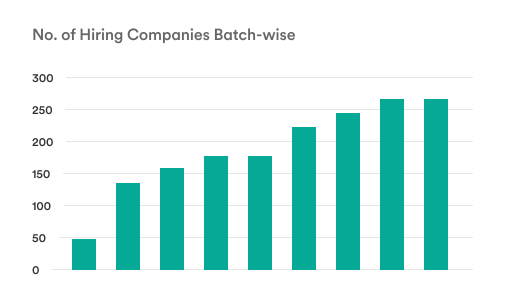
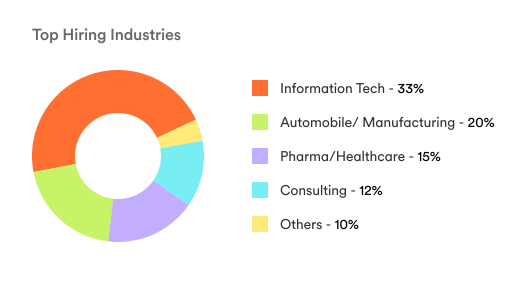
Our Placement Numbers
Excel in data-driven careers with our certification in Data Science, boasting a high rate of successful student placements. Get hired by top companies.
Top Recruiters










What Our Learners Have To Say


How Will upGrad Supports You
Receive unparalleled guidance from industry mentors, teaching assistants, and graders
Receive one-on-one feedback from our seasoned data science faculty on submissions and personalized feedback to improvement
Our Data Science Syllabus is designed to provide you with ample of industry relevant knowledge with examples
Statistics Courses Overview
Frequently Asked Questions
1. What are statistics courses designed to help learners achieve?
Statistics courses aim to build the ability to make sense of data rather than just calculate numbers. They train learners to question results, evaluate reliability, and draw accurate conclusions, which is essential when data is used to justify decisions in professional or academic settings.
2. What courses are under statistics?
Statistics includes courses such as descriptive statistics, probability theory, inferential statistics, business statistics, biostatistics, econometrics, applied statistics, statistical modeling, and experimental design. These courses vary in depth and application, serving learners across analytics, research, finance, healthcare, and product-based domains.
3. Do statistics courses focus more on theory or application?
Modern statistics courses emphasize application alongside theory. While concepts form the foundation, most programs focus on interpreting outputs, understanding assumptions, and applying methods to real-world datasets so learners can confidently justify insights rather than rely only on calculations.
4. Who should avoid taking a statistics course?
Statistics may not be suitable for learners expecting fast, tool-driven results without analytical thinking. It requires patience, curiosity, and logical reasoning. Those uninterested in problem-solving, interpretation, or data-driven reasoning may find the learning process disengaging over time.
5. How does studying statistics improve decision-making skills?
Statistics trains you to assess uncertainty, evaluate risk, and distinguish meaningful patterns from noise. This improves decision-making by replacing intuition with evidence, helping professionals justify choices, anticipate outcomes, and avoid common data misinterpretations in business or research environments.
6. Can statistics courses help with academic and research careers?
Yes. Statistics is essential for academic research, helping learners design sound experiments, analyze results correctly, and validate conclusions. Strong statistical skills improve research credibility, publication quality, and the ability to critically evaluate existing studies across disciplines.
7. Is learning statistics useful without learning programming?
Statistics can be learned without programming, especially at foundational and intermediate levels. Many concepts focus on reasoning and interpretation. However, combining statistics with tools or programming later enhances efficiency and career applicability, particularly in data-focused roles.
8. How do statistics courses support problem-solving ability?
Statistics strengthens structured thinking by teaching learners how to approach problems methodically—defining variables, forming hypotheses, testing assumptions, and interpreting results. This problem-solving framework transfers beyond data tasks into strategic thinking, analysis, and logical reasoning in everyday work.
9. What challenges do learners commonly face in statistics courses?
Learners often struggle with abstract reasoning, interpreting results correctly, or understanding assumptions behind methods. These challenges usually arise from rushing through concepts. Courses that prioritize intuition, visual understanding, and gradual complexity help overcome these difficulties effectively.
10. How important is practice when learning statistics?
Practice is critical in statistics because understanding comes from application. Repeated exposure to datasets, scenarios, and interpretations builds confidence. Without consistent practice, learners may remember formulas but struggle to apply reasoning accurately in unfamiliar or real-world situations.
11. When is the right time to enroll in a statistics course?
The right time is when your role or goals require evidence-based reasoning, such as analytics, research, finance, or strategy work. Learning statistics early in your career also builds long-term analytical confidence and supports smoother transitions into data-driven roles later.
upGrad Learner Support
Talk to our experts. We are available 7 days a week, 10 AM to 7 PM

Indian Nationals

Foreign Nationals
Disclaimer
The above statistics depend on various factors and individual results may vary. Past performance is no guarantee of future results.
The student assumes full responsibility for all expenses associated with visas, travel, & related costs. upGrad does not .