All courses
Agentic AI
Agentic AI
Artificial Intelligence
Degree / Exec. PG

IIIT Bangalore
Executive Diploma in Machine Learning and AI
OPJ Global University
Master’s Degree in Artificial Intelligence and Data Science
Liverpool John Moores University
Master of Science in Machine Learning & AI
Golden Gate University
DBA in Emerging Technologies with Concentration in Generative AIExecutive Certificate

IIITB & IIM, Udaipur
Chief Technology Officer & AI Leadership Programme
IIIT Bangalore
Executive Programme in Generative AI for Leaders
upGrad | Microsoft
Gen AI Foundations Certificate Program from MicrosoftupGrad | Microsoft
Gen AI Mastery Certificate for Data AnalysisupGrad | Microsoft
Gen AI Mastery Certificate for Software DevelopmentupGrad | Microsoft
Gen AI Mastery Certificate for Managerial ExcellenceOffline Bootcamps

upGrad
Data Science and AI-MLDoctorate
For All Domains
IIITB & IIM, Udaipur
Chief Technology Officer & AI Leadership Programme
Swiss School of Business and Management
Global Doctor of Business Administration from SSBM
Edgewood University
Doctorate in Business Administration by Edgewood UniversityGolden Gate University
Doctor of Business Administration From Golden Gate University
Rushford Business School
Doctor of Business Administration from Rushford Business School, SwitzerlandGolden Gate University
Master + Doctor of Business Administration (MBA+DBA)-d9bdeff6165f4eb1ba2adcebde78e961.svg)
University of Waterloo
Chief Technology and AI Officer ProgramLeadership / AI
Golden Gate University
DBA in Emerging Technologies with Concentration in Generative AIMachine Learning
Machine Learning
Data Science
Degree / Exec. PG
O.P Jindal Global University
Master’s Degree in Artificial Intelligence and Data ScienceIIIT Bangalore
Executive Diploma in Data Science & AILiverpool John Moores University
Master of Science in Data ScienceExecutive Certificate
upGrad | Microsoft
Gen AI Foundations Certificate Program from MicrosoftupGrad | Microsoft
Gen AI Mastery Certificate for Data AnalysisupGrad | Microsoft
Gen AI Mastery Certificate for Software DevelopmentupGrad | Microsoft
Gen AI Mastery Certificate for Managerial ExcellenceupGrad | Microsoft
Gen AI Mastery Certificate for Content CreationOffline Bootcamps
upGrad
Data Science and AI-MLupGrad
Data AnalyticsMBA
Masters

Paris School of Business
Master of Science in Business Management and TechnologyO.P.Jindal Global University
MBA (with Career Acceleration Program by upGrad)Edgewood University
MBA from Edgewood UniversityO.P.Jindal Global University
MBA from O.P.Jindal Global UniversityGolden Gate University
Master + Doctor of Business Administration (MBA+DBA)Executive Certificate
IMT, Ghaziabad
Advanced General Management ProgramMarketing
Executive Certificate
Offline Bootcamps
upGrad
Digital MarketingManagement
Degree
O.P Jindal Global University
MSc in International Accounting & Finance (ACCA integrated)Paris School of Business
Master of Science in Business Management and Technology
Golden Gate University
Master of Arts in Industrial-Organizational PsychologyExecutive Certificate

IIM Kozhikode
Human Resource Analytics Course from IIM-KupGrad | Microsoft
Gen AI Foundations Certificate Program from MicrosoftEducation
Education

Northeastern University
Master of Education (M.Ed.) from Northeastern UniversityEdgewood University
Doctor of Education (Ed.D.)Edgewood University
Master of Education (M.Ed.) from Edgewood UniversityCertifications
Project Management
Certification

Knowledgehut
Leadership And Communications In ProjectsKnowledgehut
Microsoft Project 2007/2010-ae8d039bbd2a41318308f8d26b52ac8f.svg)
Knowledgehut
Financial Management For Project ManagersKnowledgehut
Fundamentals of Earned Value Management (EVM)Knowledgehut
Fundamentals of Portfolio ManagementKnowledgehut
Fundamentals of Program Management-35c169da468a4cc481c6a8505a74826d.webp&w=128&q=75)
Knowledgehut
CAPM® CertificationsKnowledgehut
Microsoft® Project 2016Certifications & Trainings
-7f4b4f34e09d42bfa73b58f4a230cffa.webp&w=128&q=75)
Knowledgehut
PMP® CertificationKnowledgehut
PMI-RMP® CertificationKnowledgehut
PMP Renewal Learning PathKnowledgehut
Oracle Primavera P6 V18.8Knowledgehut
Microsoft® Project 2013Knowledgehut
PfMP® Certification CourseKnowledgehut
Project Planning and MonitoringPrince2 Certifications

Knowledgehut
PRINCE2® FoundationKnowledgehut
PRINCE2® PractitionerKnowledgehut
PRINCE2 Agile Foundation and PractitionerKnowledgehut
PRINCE2 Agile® Foundation CertificationKnowledgehut
PRINCE2 Agile® Practitioner CertificationManagement Certifications
Knowledgehut
Project Management Masters Certification ProgramKnowledgehut
Change ManagementKnowledgehut
Project Management TechniquesKnowledgehut
Product Management Certification ProgramKnowledgehut
Project Risk Management- Study abroad
- Offline centres
- uGSOT - B.Tech
More


R Language Courses
Learn R programming for statistical analysis and visualization
Build skills in data manipulation and exploratory analysis
Work on real datasets using R packages and workflows
Train on analytics, modeling basics, and reporting with R
Talk to a Counsellor
By clicking, I accept the T&C and Privacy Policy
Learn From The Best
8
Instructors
10
Industry Experts





























-39a9e7a7278a441ea08a60a1f45b4913.png&w=128&q=75)


Learn by Doing
Our data science online certification programs have projects to apply theoretical knowledge in practical scenarios, helps you to tackle real-world problems.
16+
Industry projects to choose from


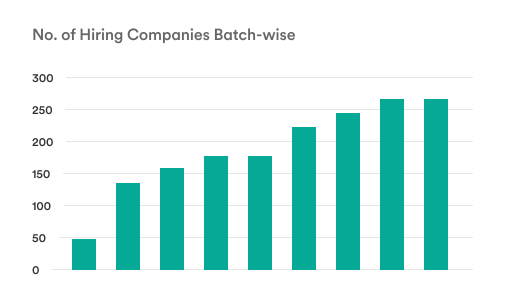
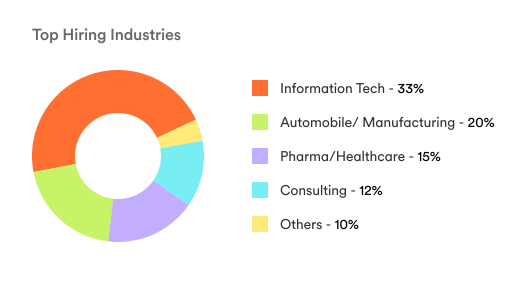
Our Placement Numbers
Excel in data-driven careers with our certification in Data Science, boasting a high rate of successful student placements. Get hired by top companies.
Top Recruiters










What Our Learners Have To Say


How Will upGrad Supports You
Receive unparalleled guidance from industry mentors, teaching assistants, and graders
Receive one-on-one feedback from our seasoned data science faculty on submissions and personalized feedback to improvement
Our Data Science Syllabus is designed to provide you with ample of industry relevant knowledge with examples
R Language Courses Overview
Frequently Asked Questions
1. How is learning R different from learning spreadsheet-based analysis?
R allows deeper analysis beyond spreadsheet limits by handling large datasets, complex statistical methods, and reproducible workflows. Unlike spreadsheets, R encourages structured analysis, automation, and consistency, which becomes essential when analyses grow in size, complexity, or need frequent updates.
2. Is R a good first programming language for data-focused learners?
Yes. R works well as a first programming language for learners interested in statistics and analytics. Its syntax is designed around data analysis tasks, which helps beginners connect code directly to data insights instead of focusing heavily on software engineering concepts.
3. How does R support reproducible analysis?
R enables reproducible analysis by allowing users to document data cleaning, analysis, and visualization steps in code. This makes results easier to review, validate, and repeat, which is especially important in research, audits, and collaborative analytical environments.
4. Can R handle unstructured or messy datasets effectively?
Yes. R is well suited for real-world datasets that contain missing values, inconsistencies, or formatting issues. Learners develop skills to clean, restructure, and validate data before analysis, which reflects how data is encountered in practical business and research settings.
5. Does learning R improve statistical intuition over time?
Learning R strengthens statistical intuition by encouraging experimentation and visualization. By rapidly testing assumptions, comparing outcomes, and viewing results graphically, learners gain a deeper understanding of how statistical methods behave across different datasets and scenarios.
6. How useful is R for interpreting surveys and experiments?
R is especially effective for survey and experimental analysis. It helps evaluate bias, compare groups, assess significance, and visualize outcomes clearly. This makes it popular in market research, social sciences, healthcare studies, and product experimentation environments.
7. Can R be used for storytelling with data?
Yes. R supports data storytelling by allowing users to combine analysis and visualization to present clear narratives. Learners can transform raw data into structured insights that explain trends, comparisons, and outcomes in a way that stakeholders can easily understand.
8. How does R help improve analytical accuracy?
R improves accuracy by reducing manual errors common in point-and-click tools. Since steps are coded and repeatable, calculations remain consistent. This encourages careful validation of assumptions and results, leading to more reliable conclusions across repeated analyses.
9. Is R commonly used in interdisciplinary roles?
R is widely used in interdisciplinary roles where data intersects with domain knowledge, such as economics, psychology, healthcare, and environmental studies. It allows professionals to apply statistical reasoning directly within their subject area without relying entirely on separate technical teams.
10. What learning pace works best for mastering R?
A steady pace works best, focusing on small datasets, repeated practice, and interpretation rather than speed. Learners benefit from revisiting concepts across different problems, which gradually builds confidence and reinforces analytical thinking instead of memorization.
11. How does R learning complement other data tools later?
R builds a strong analytical foundation that makes learning other tools easier. Concepts like distributions, modeling, and interpretation transfer well to visualization platforms, databases, or machine learning tools, enabling learners to adapt faster in evolving data environments.
upGrad Learner Support
Talk to our experts. We are available 7 days a week, 10 AM to 7 PM

Indian Nationals

Foreign Nationals
Disclaimer
The above statistics depend on various factors and individual results may vary. Past performance is no guarantee of future results.
The student assumes full responsibility for all expenses associated with visas, travel, & related costs. upGrad does not .