
All courses
Agentic AI
Agentic AI

IIIT Bangalore
Executive Programme in Generative AI for LeadersArtificial Intelligence
Degree / Exec. PG

IIIT Bangalore
Executive Diploma in Machine Learning and AI
OPJ Global University
Master’s Degree in Artificial Intelligence and Data Science
Liverpool John Moores University
Master of Science in Machine Learning & AI
Golden Gate University
DBA in Emerging Technologies with Concentration in Generative AIExecutive Certificate

IIITB & IIM, Udaipur
Chief Technology Officer & AI Leadership Programme
IIIT-B & IIM, Udaipur
Chief Data and AI Officer ProgrammeOffline Bootcamps

upGrad
Data Science and AI-MLDoctorate
For All Domains
IIITB & IIM, Udaipur
Chief Technology Officer & AI Leadership Programme
Swiss School of Business and Management
Global Doctor of Business Administration from SSBM
Edgewood University
Doctorate in Business Administration by Edgewood UniversityGolden Gate University
Doctor of Business Administration From Golden Gate University
Rushford Business School
Doctor of Business Administration from Rushford Business School, SwitzerlandGolden Gate University
Doctor of Technology in Applied & Agentic AI-d9bdeff6165f4eb1ba2adcebde78e961.svg)
University of Waterloo
Chief Technology and AI Officer ProgramLeadership / AI
Golden Gate University
DBA in Emerging Technologies with a concentration in Generative and Agentic AIMachine Learning
Machine Learning
Data Science
Degree / Exec. PG
O.P Jindal Global University
Master’s Degree in Artificial Intelligence and Data ScienceIIIT Bangalore
Executive Diploma in Data Science & AILiverpool John Moores University
Master of Science in Data ScienceExecutive Certificate

upGrad | Microsoft
Gen AI Foundations Certificate Program from MicrosoftIIIT-B & IIM, Udaipur
Chief Data and AI Officer ProgrammeupGrad | Microsoft
Gen AI Mastery Certificate for Data AnalysisupGrad | Microsoft
Gen AI Mastery Certificate for Software DevelopmentupGrad | Microsoft
Gen AI Mastery Certificate for Managerial ExcellenceupGrad | Microsoft
Gen AI Mastery Certificate for Content CreationBootcamp
Offline Bootcamps
upGrad
Data Science and AI-MLMBA
Masters

Liverpool John Moores University
Master of Business Administration from Liverpool John Moores University (LJMU) with IIM Udaipur CertificationO.P.Jindal Global University
MBA (with Career Acceleration Program by upGrad)Edgewood University
MBA from Edgewood UniversityO.P.Jindal Global University
MBA from O.P.Jindal Global UniversityExecutive Certificate
Marketing
Executive Certificate
Offline Bootcamps
upGrad
Digital MarketingManagement
Degree
O.P Jindal Global University
MSc in International Accounting & Finance (ACCA integrated)
Golden Gate University
Master of Arts in Industrial-Organizational PsychologyExecutive Certificate
IIIT-B & IIM, Udaipur
Chief Technology Officer & AI Leadership ProgrammeIIIT-B & IIM, Udaipur
Chief Data and AI Officer Programme
IIM Kozhikode
Human Resource Analytics Course from IIM-KupGrad | Microsoft
Gen AI Foundations Certificate Program from MicrosoftBootcamp
HDFC Life
Insurance Fundamentals ProgramEducation
Education

Northeastern University
Master of Education (M.Ed.) from Northeastern UniversityEdgewood University
Doctor of Education (Ed.D.)Edgewood University
Master of Education (M.Ed.) from Edgewood UniversityCertifications
Project Management
Certification

Knowledgehut
Leadership And Communications In ProjectsKnowledgehut
Microsoft Project 2007/2010-ae8d039bbd2a41318308f8d26b52ac8f.svg)
Knowledgehut
Financial Management For Project ManagersKnowledgehut
Fundamentals of Earned Value Management (EVM)Knowledgehut
Fundamentals of Portfolio ManagementKnowledgehut
Fundamentals of Program Management-35c169da468a4cc481c6a8505a74826d.webp&w=128&q=75)
Knowledgehut
CAPM® CertificationsKnowledgehut
Microsoft® Project 2016Certifications & Trainings
-7f4b4f34e09d42bfa73b58f4a230cffa.webp&w=128&q=75)
Knowledgehut
PMP® CertificationKnowledgehut
PMI-RMP® CertificationKnowledgehut
PMP Renewal Learning PathKnowledgehut
Oracle Primavera P6 V18.8Knowledgehut
Microsoft® Project 2013Knowledgehut
PfMP® Certification CourseKnowledgehut
Project Planning and MonitoringPrince2 Certifications

Knowledgehut
PRINCE2® FoundationKnowledgehut
PRINCE2® PractitionerKnowledgehut
PRINCE2 Agile Foundation and PractitionerKnowledgehut
PRINCE2 Agile® Foundation CertificationKnowledgehut
PRINCE2 Agile® Practitioner CertificationManagement Certifications
Knowledgehut
Project Management Masters Certification ProgramKnowledgehut
Change ManagementKnowledgehut
Project Management TechniquesKnowledgehut
Product Management Certification ProgramKnowledgehut
Project Risk Management- Study abroad
- Offline centres
- uGSOT - B.Tech
More

%20(2)-db0b6f38da9c485faf76e366793c9b9e.webp&w=128&q=75)




-b37c7281cd104fdc931dc54ab2d62fc7.webp&w=3840&q=75)
Generative AI and Agentic AI Courses Online
Master the skill of designing intelligent systems
Develop autonomous AI Agents using LangChain, CrewAI and HuggingFace
Learn prompting, multi-agent collaboration & RAG pipelines
Integrate AI agents with external tools, APIs, and databases using MCP
Earn a Certificate through our Agentic AI and Gen AI course online
Max Hike %
500%
Avg Hike %
64%
Alumni base
6580
No. of batches
208
Talk to a Counsellor
By clicking, I accept the T&C and Privacy Policy
Gen AI & Agentic AI Courses from Top Institutions
All Courses (5)
IIIT Bangalore
EPGP in Applied AI and Agentic AICertification
Building AI Agent
popular
IIM Kozhikode
PCP in AI for Business ProfessionalsCertification
6 Months
Certification
DS for Beginers
IIIT Bangalore
Executive Programme in Generative AI & Agentic AI for LeadersIndia’s #1 Tech University
Dual Certification
5 Months
Golden Gate University
DBA in Emerging Technologies with a concentration in Generative and Agentic AISpecialisation in Generative and Agentic AI
Doctorate
27 Months




Our Top University Partners
How AI-Ready Is Your Career?
The work you do today may already be easy for AI to replace. Find out where you truly stand.
Automation risk in your profile
Skill relevancy for AI roles
Ability to adapt
🧠 Discover how future-ready your career really is
-d7bcc89c78df4cff8b2140ff79f1ffb1.webp&w=1200&q=75)
Agentic AI & Generative AI Course Curriculum
1
Foundations of AI
Builds a strong foundation in AI, Machine Learning, and Deep Learning
Explains how AI systems learn from data and how models are trained
Covers different AI approaches and their real-world applications
Helps learners gain the context needed to use modern AI tools and frameworks confidently
2
Generative AI Fundamentals
Large Language Models (LLMs): Understanding how models process and generate human-like text
Prompt engineering and optimisation: Learning how to design effective prompts to get accurate and relevant outputs
Text, image, and multimodal generation: Working with AI systems that create content across multiple formats
Fine-tuning and embeddings: Customising models to improve performance for specific use cases
3
Agentic AI Systems
How to design autonomous AI agents that can work toward defined goals
Multi-step planning and execution, where AI systems break down complex tasks into smaller actions
Tool usage and API integration, allowing agents to interact with external systems and data
Multi-agent collaboration, where multiple AI agents work together to solve complex problems
4
Programming & Model Development
Python for AI development, focusing on practical implementation rather than theory
Popular AI frameworks and libraries used in industry
Techniques for building reusable, scalable, and maintainable AI solutions
5
Deployment & Integration
Deploying AI models using cloud platforms
Integrating AI systems into real applications and workflows
Monitoring, evaluating, and improving AI performance over time
6
Capstone Projects & Case Studies
Create ShopAssist AI
Create PixxelCraft AI
Create ShrewdNews AI
Gen AI & Agentic AI Course Projects: Learn by Doing
10+
Projects


Tools & Technologies You'll Learn
Course Instructors

_IIITB Dweb-23e8f14f6d194bcbb04cc13548955de4.svg)




-74372a0bfeef42f1986750569a32403a.webp&w=128&q=75)









-8adb67d9d76c4c1290700b3236270a52.svg)














Agentic AI & Generative AI Course Eligibility
Any graduate-level education (preferred, not mandatory)
Willingness to learn Python fundamentals
Basic understanding of data and logic
Curiosity about how AI systems work
Problem-solving mindset
Services to Help You Achieve Your Goal
Access the various career developement support services offered by upGrad to help you achieve your professional goals
Receive unparalleled guidance from industry mentors, teaching assistants, and graders


Agentic AI and Generative AI Course Overview
Work practices are changing at a fast pace across engineering, product, and business teams across the globe. AI systems have advanced beyond just answering queries; they are now able to plan work, coordinate workflows, interact with tools and produce tangible results with little human intervention. This emerging field is called Agentic AI.
upGrad offers online courses on Agentic AI and Generative AI for those who want to be prepared for this revolution. Be it a software engineer who wants to create AI native products, a data professional trying to specialize in Large Language Model (LLM), or a business leader who wants to understand and implement intelligent automation, such programs provide skills relevant to the actual professional world.
Compare Gen AI and Agentic AI Courses: Duration and Eligibility
upGrad’s online Generative AI and Agentic AI courses for working professionals in India run 5 to 27 months (as of October 2026). Programmes lead to certificates from IIIT Bangalore and IIM Kozhikode, or a doctorate from Golden Gate University. Most ask for a bachelor’s degree; senior and leadership programmes also require 3 to 10 years of work experience.
Course | University | Credential | Duration | Eligibility |
Executive Post Graduate Programme in Applied AI and Agentic AI | IIIT Bangalore | Certificate | 7 Months | Bachelor’s or master’s degree with 50% marks from a UGC-recognised university |
Professional Certificate Programme in AI for Business Professionals | IIM Kozhikode | Certificate | 6 Months | Bachelor’s degree and 3+ years of work experience |
Professional Certificate Programme in Data Science & Agentic AI | IIIT Bangalore | Certificate | 30 Weeks | Bachelor’s degree, or final-year undergraduate |
Executive Programme in Generative AI & Agentic AI for Leaders | IIIT Bangalore | Dual Certificate | 5 Months | Bachelor’s or master’s degree with 50% marks and 4+ years of work experience |
DBA in Emerging Technologies with a Concentration in Generative and Agentic AI | Golden Gate University | Doctorate | 27 Months | Bachelor’s degree and 10+ years of experience |
Which Gen AI or Agentic AI Programme Fits You?
The choice of the program depends on the career phase you are in. For example, if you are a beginner, you need to learn the fundamentals of agentic AI. But if you have 5+ years of experience or are currently in a managerial position, you want to learn how to build agentic AI models to increase productivity and efficiency.
So, here are the recommended courses based on your years of experience and the profile you are in:
- Beginner - Professional Certificate Programme in Data Science & Agentic AI from IIIT Bangalore is a suitable starting point if you want to build skills in data science and AI. This is a 6 months certificate program which will help you to build RAG pipelines, multi-agent systems and production ready ML models.
- Engineers and experienced professionals - The Executive Post Graduate Programme in Applied AI and Agentic AI from IIIT Bangalore is suitable for professionals who want to build AI solutions. This 30 week program takes you from applied AI foundations to deploying AI agents in production. This program also allows you to build AI models across 12+ domains like retail, BFSI, healthcare, and more.
- Business leaders and managers - The Executive Programme in Generative AI & Agentic AI for Leaders from IIIT Bangalore or the AI for Business Professionals programme from IIM Kozhikode can help you understand how to use AI at work. In these programs, you will learn to identify AI use cases, improve business processes, and apply AI to business decisions.
- Professionals Looking for a Doctorate - Golden Gate University offers a DBA in emerging technologies with a concentration in GenAI and Agentic AI. After completing the course, you can teach in the UGC recognised college and can publish your doctoral dissertation as a book.
What Is the Difference Between Generative AI and Agentic AI?
Generative AI and Agentic AI are related but focus on different capabilities. The key difference between both technologies are:
Technology | What It Does | Examples of Use |
Generative AI | Creates new content based on user inputs and available information | Text generation, code generation, images, reports, marketing content |
Agentic AI | Plans and performs multi-step tasks using models, tools, APIs, and workflows | AI assistants, workflow automation, multi-agent systems, tool-based tasks |
What Is Generative AI?
Generative AI is the type of Artificial Intelligence that has the capability to generate new content based on the information it was trained on. It can comprehend the user query and produce output accordingly and hence is used for performing work related to content creation, coding, research, design, and similar areas. Large Language Models (LLMs) are often used in Generative AI systems.
How Does Generative AI Work?
The generative AI uses trained models for identifying patterns within existing data and generating new data based on user instructions or inputs. The process of working with a generative AI typically involves:
- Data: Models learn patterns from large amounts of training data.
- Training: AI models are trained to understand language, images, code, audio, or other types of data.
- Prompt: You provide an instruction or input to the model.
- Processing: The model understands the input and identifies relevant patterns.
- Generation: The model creates new content based on the given prompt.
What Is Agentic AI?
Agentic AI means AI systems capable of achieving the goal using task planning, reasoning, tool use, API calls, context, and action. Unlike the system that can only provide output for the user's input, an AI agent breaks down the task into smaller pieces and works in a particular workflow with minimum human intervention.
How Do AI Agents Work?
An AI agent combines an AI model with instructions, tools, memory, data, and actions to complete a task. A typical AI agent workflow includes:
- Goal: Understand what needs to be completed.
- Planning: Break the goal into smaller tasks.
- Reasoning: Decide what steps are required.
- Tool Use: Access APIs, databases, search systems, or other tools.
- Memory: Maintain relevant information and context.
- Action: Execute the required tasks.
- Evaluation: Check the result and take further action when needed.
What Are the Main Applications of Agentic AI and Generative AI?
Agentic AI and Generative AI can be used across technology, business, operations, customer service, and other areas where tasks require multiple steps.
Some key applications include:
Application | How Agentic AI Is Used |
AI Assistants | Build systems that understand requests and complete tasks using connected tools. |
Business Operations | Automate workflows that involve multiple steps, systems, and decisions. |
Customer Service | Build AI systems that understand customer requests and take actions through connected systems. |
Software and Technology | Develop AI-powered applications that can use APIs, databases, and other tools. |
Data and Analytics | Create systems that gather information, analyse it, and complete tasks based on the results. |
E-commerce and Retail | Support personalised experiences, shopping assistants, and workflow automation. |
Enterprise Workflows | Connect AI agents with business tools and systems to complete defined tasks. |
Multi-Agent Systems | Use multiple AI agents that collaborate on complex tasks and workflows. |
Who Should Take a Gen AI & Agentic AI Course Online?
An Agentic AI course online can be useful if you want to understand modern AI systems and build skills for the new era of AI.
You should consider an Agentic or Generative AI course online if you are:
1. Working Professionals
If you work in technology, data, product, business, or another professional field, an Agentic AI course can help you understand how AI agents can be used in your work.
You can learn to:
- Understand AI agent workflows
- Apply AI to existing processes
- Work with AI tools and frameworks
- Build practical AI applications
2. Developers and Technical Professionals
Software developers, engineers, and technical professionals can learn how to build AI-powered applications and agentic workflows.
You can learn to:
- Build AI agents
- Work with LangChain and CrewAI
- Connect agents with APIs and tools
- Develop and deploy AI applications
3. Data and AI Professionals
If you work with data or AI, Agentic AI can help you move towards LLM applications, RAG systems, and autonomous AI workflows.
This includes:
- LLM application development
- RAG
- Embeddings and vector-based retrieval
- Agent design
- Multi-agent orchestration
4. Business and Product Professionals
Business leaders and product professionals can learn how Generative AI and Agentic AI can be applied to products, workflows, and business operations.
The course can help you to:
- Identify AI use cases
- Understand AI agent capabilities
- Explore AI-led automation
- Apply Generative AI to business problems
5. Beginners and Career Switchers
Some upGrad Generative AI and Agentic AI course in India are designed to introduce learners to AI and Generative AI fundamentals before moving towards advanced applications. Basic data and logic understanding and a willingness to learn Python fundamentals can help you build the required foundation.
What Will You Learn in a Generative AI and Agentic AI Course?
Generative AI and Agentic AI Course in India are designed to help you move from understanding how AI works to actually building intelligent systems that can create, reason, and act autonomously.
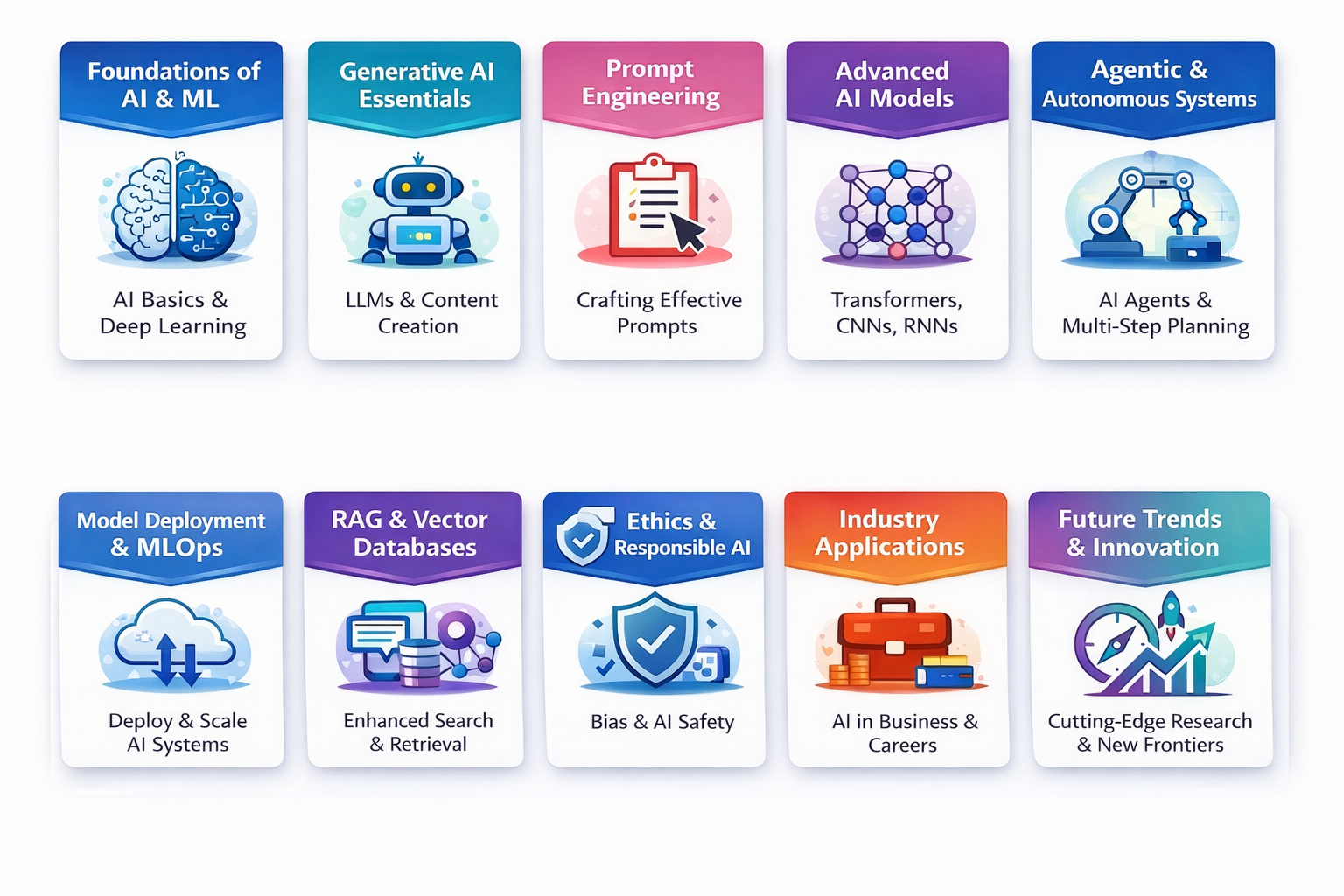
Learning Area | Skills Covered | Practical Outcome |
AI Foundations | AI, Machine Learning, Deep Learning | Understand how AI systems learn and work |
Generative AI | LLMs, text generation, image generation, multimodal generation | Build applications using Generative AI |
Prompt Engineering | Prompt design and optimization | Create better prompts for AI systems |
RAG | Embeddings, retrieval, vector-based information access | Build AI applications that work with external information |
Agentic AI | Goal setting, planning, tool use, execution | Build AI agents for multi-step tasks |
Multi-Agent Systems | Agent collaboration and orchestration | Create workflows where multiple agents work together |
Programming | Python and AI frameworks | Build practical AI applications |
Fine-Tuning | Fine-tuning and embeddings | Customise AI models for specific use cases |
Deployment | Cloud platforms, integration, monitoring | Move AI systems towards real-world use |
AI Safety | Evaluation, monitoring, safety practices | Build and manage AI systems responsibly |
Tools and Technologies You Will Learn in Agentic AI & Generative AI Course Online
From AWS to LangChain- here is a list of all the tools that you'll learn in Gen AI and Agentic AI Course Online:
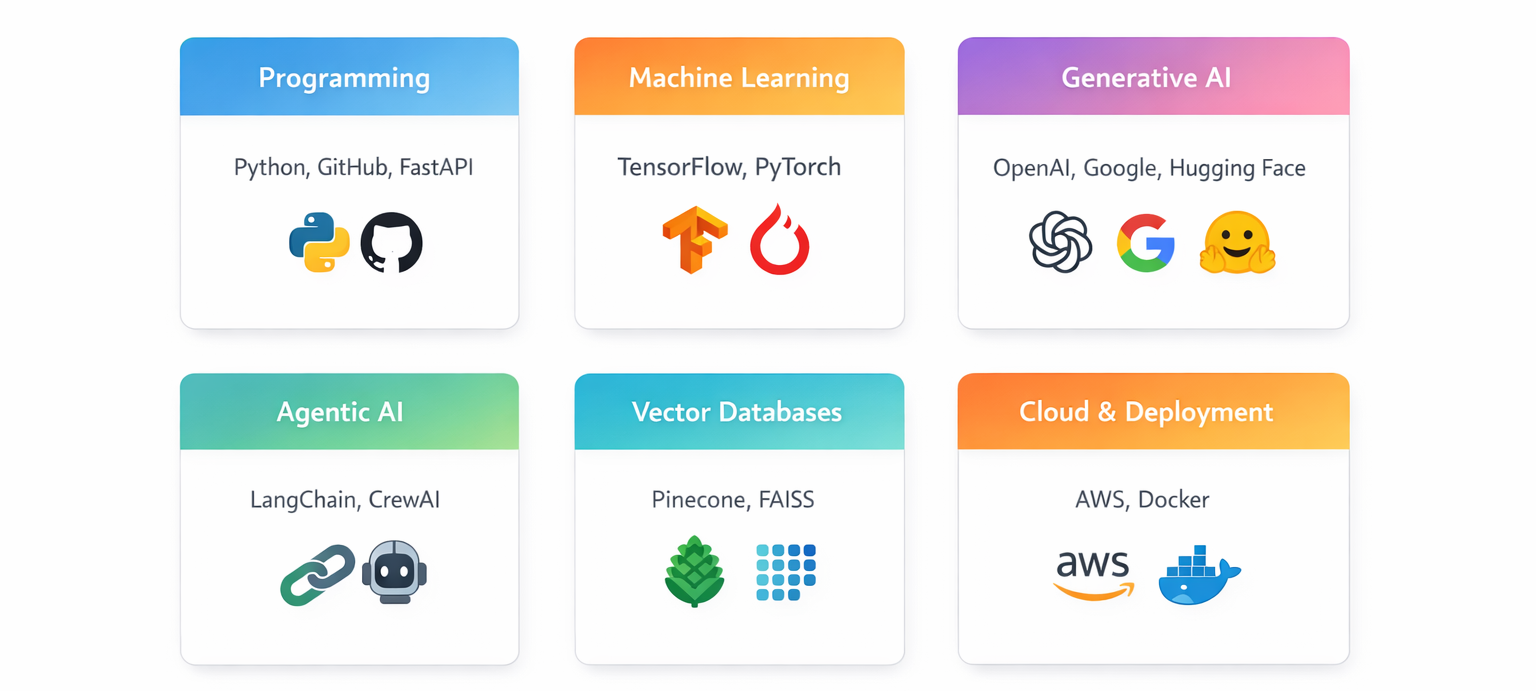
Tool or Technology Group | Examples | Purpose |
LLM Platforms | GPT-3.5, GPT-4 | Building applications with large language models |
Agent Frameworks | LangChain, CrewAI, LangGraph | Building and managing AI agent workflows |
AI Libraries | HuggingFace | Working with AI and language models |
RAG Tools | Embeddings, vectors | Retrieving information for AI applications |
Integration Tools | APIs, MCP | Connecting AI agents with external systems and tools |
Programming | Python | Building and implementing AI applications |
Cloud Platforms | AWS, Bedrock | Deploying and working with AI systems |
Development Tools | LlamaIndex | Building LLM and retrieval-based applications |
Deployment Tools | Docker and model serving tools | Deploying and monitoring AI applications |
Hands-On Projects in upGrad Agentic AI and Generative AI Course Online
Learning Generative AI and Agentic AI will be easy when you work on practical projects along with the theory.
Below are some of the projects that you will explore in upGrad’s GenAI and Agentic AI Course Online:
Project | Problem Statement | Tools / Techniques |
ShopAssist AI | Build an AI system for shopping assistance | Generative AI, LLMs, agentic workflows |
PixxelCraft AI | Build a practical Generative AI application | Generative AI and AI application development |
ShrewdNews AI | Build an AI-based news application | LLMs, AI workflows |
Production-Ready AI System | Combine different AI capabilities into one system | LLM customisation, RAG, agentic workflows, deployment |
Production Agent Platform | Build a production-oriented agent platform | Multi-agent systems, RAG, deployment |
Eligibility and Prerequisites for Agentic AI Course Online
The eligibility requirements can vary depending on the program you choose.
Below are eligibility criteria of the Agentic AI and Generative AI Course Online offered by upGrad:
Programme | Eligibility Criteria |
Executive Post Graduate Programme in Applied AI and Agentic AI | Bachelor’s or master’s degree or its equivalent in any discipline from a UGC-recognised university with a minimum of 50% aggregate marks or equivalent CGPA. |
IIM Kozhikode Strategic AI for Business Professionals - Leadership for an AI-First World | Bachelor’s degree with a minimum of 3 years of work experience. |
Professional Certificate Programme in Data Science & Agentic AI | Bachelor’s degree or currently pursuing an undergraduate degree in the final year. |
Executive Programme in Generative AI & Agentic AI for Leaders | Bachelor’s or master’s degree or its equivalent in any discipline with a minimum of 50% aggregate marks or equivalent CGPA, along with 4+ years of mandatory work experience. |
DBA in Emerging Technologies with a concentration in Generative and Agentic AI | Valid bachelor’s degree with a minimum of 10 years of professional experience. Candidates with less than 10 years of experience but exceptional profiles and a strong leadership background may also be considered. All applicants must submit a Statement of Purpose (SOP). |
Career Outcomes after Generative AI and Agentic AI Course in India
Learning Generative AI and Agentic AI can help you explore technical and AI-focused roles. The type of role you pursue depends on your existing skills, experience, and the area of AI you specialize in.
Role | What You Will Do |
Generative AI Engineer | Build LLM-powered applications, integrate AI into products, and work on AI pipelines. |
Agentic AI Developer | Design AI agents, build multi-agent workflows, and connect agents with tools and APIs. |
LLM Engineer | Work with LLMs, RAG systems, model evaluation, fine-tuning, and model optimisation. |
AI Product Engineer | Build AI-powered products that use Generative AI and agentic capabilities. |
Prompt Engineer | Design, test, and improve prompts and prompt strategies for AI applications. |
AI Solutions Architect | Design AI system architectures and define technologies, infrastructure, and governance requirements. |
Industries Hiring Agentic AI Professionals
Companies across different industries are using AI Agents to automate the repetitive tasks and handle different workflows with less manual intervention.
Some of the industries with Agentic AI skilled professionals are:
- IT and Software/Product: Companies are using AI agents to automate software development tasks, manage workflows and connect to AI systems with APIs.
- E-Commerce and Retail: In E-Commerce and retail, AI agents can handle customer queries, recommend products, track orders, and support inventory and sales workflows.
- Banking and Financial Services: Financial organizations are using AI agents to support customer service, analyze financial information and automate repetitive banking processes.
- Healthcare: In healthcare, AI agents are supporting workflows such as patient scheduling, documentation, and coordination between different healthcare processes.
- Telecommunication: Telecom companies are using AI agents to handle customer support, troubleshoot common issues, analyze service requests, and automate workflows.
Updated By: Vikram Singh
Updated On: 16-October-2026
Frequently Asked Questions
1. What is a Generative AI course online?
A Generative AI Course Online will teach students how AI generates different types of data in different fields like texts, codes, images, and reports. This course includes topics like Large Language Models, Prompt Engineering, Retrieval Augmented Generation (RAG), Fine-Tuning, Embeddings, and Applications of Generative AI.
2. What is an Agentic AI course online?
An Agentic AI course online looks into the designing of artificial intelligence which can comprehend goals, generate plans, use tools, interact with application programming interfaces, keep context, and perform multi-step operations. It might also include lessons on AI agents, multi-agent systems, retrieval augmented generation (RAG), deployment, and agent frameworks.
3. What is the difference between Generative AI and Agentic AI?
While generative AI focuses on content generation such as texts, coding, images, and reporting, Agentic AI goes one step further as it helps the system to plan, make use of tools, interact with external systems, keep the context, and do multi-step operations.
4. What do you learn in a Generative AI and Agentic AI Course in India?
You will learn AI foundations, LLMs, prompt engineering, Generative AI, RAG, embeddings, AI agents, planning, tool use, multi-agent collaboration, Python, AI frameworks, fine-tuning, deployment, monitoring, and AI safety. The exact curriculum varies by programme.
5. What are the best Generative AI course online for working professionals?
There are Generative AI and Agentic AI courses available from upGrad which can benefit working professionals, comprising executive postgraduate programs, executive programs, and professional certificate programs. The programs offered by upGrad are designed in partnership with institutes like IIIT Bangalore and IIM Kozhikode.
6. Which Agentic AI course online is suitable for beginners?
The Professional Certificate Programme in Data Science & Agentic AI can be ideal for people starting to learn about AI. The program covers Data Science and Agentic AI concepts, which makes it relevant for people who want to have foundational knowledge before proceeding with AI agents.
7. Do I need coding experience to learn Generative AI and Agentic AI?
Coding experience can be useful, especially for advanced Agentic AI development. Python fundamentals are helpful for working with AI models, agents, and workflows. The upGrad Generative AI and Agentic AI Course in India also support learners in building these skills progressively, so prior advanced programming knowledge is not required for every programme.
8. What are the eligibility requirements for an Agentic AI course online?
The criteria depend on the program itself. For example, the Executive Post Graduate Programme in Applied AI and Agentic AI needs candidates who must have either a bachelor’s or master’s degree with at least 50% marks. Similarly, the Professional Certificate Programme in Data Science & Agentic AI also includes final year bachelor’s students. There are some courses which require a minimum of four years of work experience in the professional world like the Executive Programme in Generative AI & Agentic AI for Leaders.
9. How long does it take to learn Generative AI and Agentic AI?
It depends on the GenAI and Agentic AI Certification or course and the level of knowledge of the learner. There are many formats and timelines offered by upGrad for different programs which include 6 months Professional Certificate Programme in AI for Business Professionals and 5 months Executive Programme in Generative AI & Agentic AI for Leaders.
10. What tools are taught in Generative AI and Agentic AI Course in India?
Depending on the AI Agents Course, you may work with LangChain, CrewAI, LangGraph, LlamaIndex, HuggingFace, Python, AWS, Bedrock, APIs, MCP, embeddings, vector systems, and other tools used to build and deploy AI applications.
11. What is RAG and how is it different from an AI agent?
Retrieval-Augmented Generation, or RAG, helps an AI application retrieve relevant information and use it while generating a response. An AI agent can use RAG as part of a larger workflow while also planning tasks, using tools, accessing APIs, and taking actions.
12. What projects can I build after a Generative AI course online?
upGrad's Agentic AI Certification and Agentic AI Course Online include projects such as ShopAssist AI, PixxelCraft AI, and ShrewdNews AI. The capstone projects involve LLM customisation, RAG, agentic workflows, multi-agent systems, deployment, monitoring, and AI safety.
13. What jobs can I get after learning Generative AI and Agentic AI?
Depending on one’s capabilities and experience, possible positions might include Generative AI Engineer, Agentic AI Developer, LLM Engineer, AI Product Engineer, Prompt Engineer, and AI Solutions Architect.
14. Is an Agentic AI course online useful for working professionals?
The value of an Agentic AI course online is that it gives employed individuals insight into how to utilize AI agents for products, operations, automation, and workflows within a company. The upGrad online Agentic AI and Generative AI course online offers students projects, mentorship, expert reviews, Q&A sessions, and live classes.
15. What is the difference between an AI course and a Generative AI course?
AI courses usually cover all the scope of Artificial Intelligence and might include machine learning, deep learning, NLP, etc. On the other hand, Generative AI course online focuses on specific aspects, namely large language models, retrieval-augmented generation, fine-tuning, and content generation and parts of prompt engineering courses.
16. Why is Agentic AI training important in 2026?
Agentic AI training helps professionals understand how AI systems can plan tasks, use tools, and automate complex workflows with minimal human intervention.
These skills can help developers, AI professionals, and business teams build AI-powered solutions and improve work efficiency.
upGrad Learner Support
Talk to our experts. We are available 7 days a week, 10 AM to 7 PM

Indian Nationals

Foreign Nationals
Disclaimer
1.upGrad does not grant credit; credits are granted, accepted, or transferred at the sole discretion of the relevant educational institution offering the diploma or degree. We advise you to enquire further regarding the suitability of this program for your academic, professional requirements and job prospects before .