
All courses
Agentic AI
Agentic AI

IIIT Bangalore
Executive Programme in Generative AI for LeadersArtificial Intelligence
Degree / Exec. PG

IIIT Bangalore
Executive Diploma in Machine Learning and AI
OPJ Global University
Master’s Degree in Artificial Intelligence and Data Science
Liverpool John Moores University
Master of Science in Machine Learning & AI
Golden Gate University
DBA in Emerging Technologies with Concentration in Generative AIExecutive Certificate

IIITB & IIM, Udaipur
Chief Technology Officer & AI Leadership Programme
IIIT-B & IIM, Udaipur
Chief Data and AI Officer ProgrammeOffline Bootcamps

upGrad
Data Science and AI-MLDoctorate
For All Domains
IIITB & IIM, Udaipur
Chief Technology Officer & AI Leadership Programme
Swiss School of Business and Management
Global Doctor of Business Administration from SSBM
Edgewood University
Doctorate in Business Administration by Edgewood UniversityGolden Gate University
Doctor of Business Administration From Golden Gate University
Rushford Business School
Doctor of Business Administration from Rushford Business School, SwitzerlandGolden Gate University
Doctor of Technology in Applied & Agentic AI-d9bdeff6165f4eb1ba2adcebde78e961.svg)
University of Waterloo
Chief Technology and AI Officer ProgramLeadership / AI
Golden Gate University
DBA in Emerging Technologies with a concentration in Generative and Agentic AIMachine Learning
Machine Learning
Data Science
Degree / Exec. PG
O.P Jindal Global University
Master’s Degree in Artificial Intelligence and Data ScienceIIIT Bangalore
Executive Diploma in Data Science & AILiverpool John Moores University
Master of Science in Data ScienceExecutive Certificate

upGrad | Microsoft
Gen AI Foundations Certificate Program from MicrosoftIIIT-B & IIM, Udaipur
Chief Data and AI Officer ProgrammeupGrad | Microsoft
Gen AI Mastery Certificate for Data AnalysisupGrad | Microsoft
Gen AI Mastery Certificate for Software DevelopmentupGrad | Microsoft
Gen AI Mastery Certificate for Managerial ExcellenceupGrad | Microsoft
Gen AI Mastery Certificate for Content CreationBootcamp
Offline Bootcamps
upGrad
Data Science and AI-MLMBA
Masters

Liverpool John Moores University
Master of Business Administration from Liverpool John Moores University (LJMU) with IIM Udaipur CertificationO.P.Jindal Global University
MBA (with Career Acceleration Program by upGrad)Edgewood University
MBA from Edgewood UniversityO.P.Jindal Global University
MBA from O.P.Jindal Global UniversityExecutive Certificate
Marketing
Executive Certificate
Offline Bootcamps
upGrad
Digital MarketingManagement
Degree
O.P Jindal Global University
MSc in International Accounting & Finance (ACCA integrated)
Golden Gate University
Master of Arts in Industrial-Organizational PsychologyExecutive Certificate
IIIT-B & IIM, Udaipur
Chief Technology Officer & AI Leadership ProgrammeIIIT-B & IIM, Udaipur
Chief Data and AI Officer Programme
IIM Kozhikode
Human Resource Analytics Course from IIM-KupGrad | Microsoft
Gen AI Foundations Certificate Program from MicrosoftBootcamp
HDFC Life
Insurance Fundamentals ProgramEducation
Education

Northeastern University
Master of Education (M.Ed.) from Northeastern UniversityEdgewood University
Doctor of Education (Ed.D.)Edgewood University
Master of Education (M.Ed.) from Edgewood UniversityCertifications
Project Management
Certification

Knowledgehut
Leadership And Communications In ProjectsKnowledgehut
Microsoft Project 2007/2010-ae8d039bbd2a41318308f8d26b52ac8f.svg)
Knowledgehut
Financial Management For Project ManagersKnowledgehut
Fundamentals of Earned Value Management (EVM)Knowledgehut
Fundamentals of Portfolio ManagementKnowledgehut
Fundamentals of Program Management-35c169da468a4cc481c6a8505a74826d.webp&w=128&q=75)
Knowledgehut
CAPM® CertificationsKnowledgehut
Microsoft® Project 2016Certifications & Trainings
-7f4b4f34e09d42bfa73b58f4a230cffa.webp&w=128&q=75)
Knowledgehut
PMP® CertificationKnowledgehut
PMI-RMP® CertificationKnowledgehut
PMP Renewal Learning PathKnowledgehut
Oracle Primavera P6 V18.8Knowledgehut
Microsoft® Project 2013Knowledgehut
PfMP® Certification CourseKnowledgehut
Project Planning and MonitoringPrince2 Certifications

Knowledgehut
PRINCE2® FoundationKnowledgehut
PRINCE2® PractitionerKnowledgehut
PRINCE2 Agile Foundation and PractitionerKnowledgehut
PRINCE2 Agile® Foundation CertificationKnowledgehut
PRINCE2 Agile® Practitioner CertificationManagement Certifications
Knowledgehut
Project Management Masters Certification ProgramKnowledgehut
Change ManagementKnowledgehut
Project Management TechniquesKnowledgehut
Product Management Certification ProgramKnowledgehut
Project Risk Management- Study abroad
- Offline centres
- uGSOT - B.Tech
More

%20(2)-db0b6f38da9c485faf76e366793c9b9e.webp&w=128&q=75)





Machine Learning Courses Online
Understand Data, Features, and how models learn from patterns
Use ML libraries to train, test, and improve model performance
Master neural networks, NLP & reinforcement learning with Python
Earn a recognized Machine Learning certification
Learner count
6K+
Avg. pay hike
64%
Top pay hike
500%
Talk to a Counsellor
By clicking, I accept the T&C and Privacy Policy
Machine Learning Courses From Top Universities
Machine Learning Courses (7)
bestseller
Executive Diploma
12 Months
Executive Diploma
12 Months
IIIT-B & IIM, Udaipur
Chief Technology Officer & AI Leadership ProgrammeCertification
6 months
popular
Master's Degree
18 Months
IIIT Bangalore
Executive Programme in Generative AI & Agentic AI for LeadersIndia’s #1 Tech University
Dual Certification
5 Months
Certification
Building AI Agent
-4c349343809f452a8b692e3368cd8097.webp&w=3840&q=75)
MIT Open Learning
Universal AI by MIT Open LearningCertification
200+ Hours




Our Top University Partners
How AI-Ready Is Your Career?
The work you do today may already be easy for AI to replace. Find out where you truly stand.
Automation risk in your profile
Skill relevancy for AI roles
Ability to adapt
🧠 Discover how future-ready your career really is
-d7bcc89c78df4cff8b2140ff79f1ffb1.webp&w=1200&q=75)
Our Placements in Machine learning Course
Transform your career with our Machine learning certification, boasting strong placement records. Level up now by getting offers.
Top Recruiters







-80c197eb148547d1a5c1d66c7f8dddeb.png&w=128&q=75)

Machine Learning Course Projects: Learn by Doing
17+
Projects


Machine Learning Course Instructors: Learn From The Best
8
Instructors
8
Industry Experts
























-39a9e7a7278a441ea08a60a1f45b4913.png&w=128&q=75)
Services to Help You Achieve Your Goal
Access the various career developement support services offered by upGrad to help you achieve your professional goals
Receive unparalleled guidance from industry mentors, teaching assistants, and graders


Success Stories: What Our Learners Have To Say


Latest ML Industry Trends
The ML Industry is growing rapidly and is expected to continue to do so in the coming years. As machine learning becomes more sophisticated and accessible, it is likely to have a major impact on all industries
95%
Businesses expect AI/ML to have a positive impact on their industry in the next five years
37%
Organisations have adopted AI
16%
Expected to replace all US jobs in less than half a decade
77%
Businesses are using AI/ML for automation
Machine Learning Course Overview
Data is the most important thing nowadays, companies rely on data to make decisions, build products and improve the existing business processes.
Machine learning helps systems to learn from the data, identify patterns and make predictions without being explicitly programmed. It uses different types of algorithms such as supervised learning, unsupervised learning and reinforcement learning.
upGrad’s Machine learning course online are built to train software engineers, developers, career switchers and beginners who want to understand about the ML models, different algorithms using programming languages such as Python and R. Completing a machine learning course in India can prepare you for roles such as Machine Learning Engineer, AI Engineer, Data Scientist etc.
What is Machine Learning?
Machine Learning is a sub field of Artificial Intelligence, which helps the systems to learn from the existing data and predict outcomes based on the data it was trained on.
Instead of following fixed rules, like when we make a program in C it is fixed, it learns from examples, patterns present in the data. It uses different machine learning algorithms or techniques such as supervised learning, unsupervised learning, and reinforcement learning. These algorithms are then used for problems such as fraud detection, product recommendation, demand forecasting and customer analysis.
How Does Machine Learning Work?
Machine learning algorithms commonly used a fixed sequence of steps to train on data. The steps included in the working are:
- Collect Data: First, we have to collect raw data such as image, text, audio or numbers.
- Prepare Data: Then, we have to prepare the collected data by cleaning the errors, removing the duplicate data and converting the data into numerical format.
- Train the model: After the data is prepared, feed the model using different algorithms which we have to select according to the data. Here the model will spot patterns, compare to actual outcomes and prepare itself to reduce mistakes.
- Test and Run: Now, we have to test the model on the unseen data and check how it is performing on the new and unseen data.
What Are the Main Applications of Machine Learning?
Machine Learning is used in different fields and industries including IT, E-Commerce, Financial and Banking wherever the data is important.
Some common applications of machine learning includes:
Application | How Machine Learning Is Used |
Image Recognition | Used for facial recognition, disease detection in healthcare and fine management in traffic systems. |
Sentiment Analysis | Used for reviewing sentiments of a particular post on social media or reviews on an ecommerce platform. |
Anomaly Detection | Used majorly in fraud detection in banking processes such as credit card fraud detection or loan default prediction. |
Natural Language Processing (NLP) | Used in voice assistance like Siri and Alexa, by which machines understand the human language efficiently. |
Autonomous Vehicles | Used in self driving cars like Tesla, which uses real time traffic data to improve their existing model. |
Predictive Maintenance | Used by machineries in industries to reduce the downtime of machines by learning from the previous downtimes and errors. |
Who Should Take a Machine Learning Certification Course?
A machine learning course online is suitable for someone who is interested in data, machine learning models and wants to explore the latest technology.
Machine Learning Course in India is suitable for:
1. Data and Analytics Professionals
If you work with data, reporting, or analytics, a Machine Learning course online can help you move beyond basic analysis and work with predictive models.
This includes:
- Train and test Machine Learning models
- Work with real-world datasets
- Move towards advanced ML roles
2. Engineering and Development Leads
If you design systems or manage development teams, Machine Learning courses can help you understand how to build and deploy ML solutions.
You can learn to:
- Design ML systems for practical use
- Lead Machine Learning projects
- Improve model performance
3. Product Owners and Business Decision Makers
If you work with products or teams, Machine Learning Course Online can help you use data to make decisions and improve processes efficiently.
This can help you:
- Use data to guide decisions
- Apply predictions to business processes
- Understand ML-driven insights
4. Students and Early-Career Professionals
If you are starting your career and have a basic understanding of Python, Machine Learning Certification Course will help you to build your fundamentals through practical learning.
You can learn to:
- Understand core ML concepts
- Work on simple projects
- Build a foundation for advanced ML topics
5. Domain Experts
Professionals working in areas such as marketing, finance, or cybersecurity can learn how to apply Machine Learning to their existing domain through an ML Course.
This can help you:
- Apply ML to daily tasks
- Improve insights from data
- Use ML concepts in your field
What You Will Learn in Machine Learning Courses?
Machine Learning Course in India will help you to build models that can learn from data and make outcomes.
upGrad Machine Learning Certification Courses include these key topics:
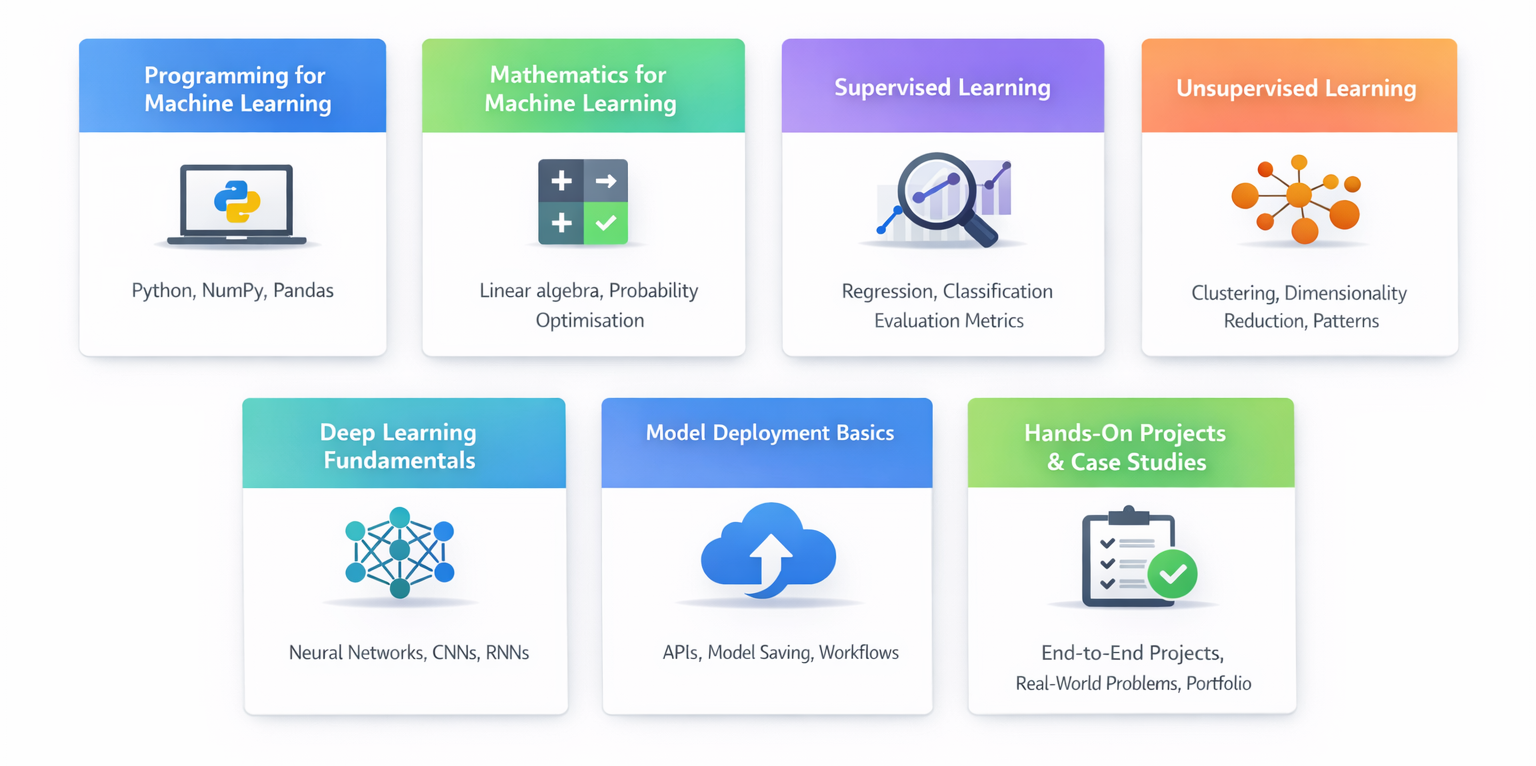
Learning Topics | What You Will Learn |
Python and Data | Python programming, data handling, and working with datasets |
Mathematics for ML | Linear Algebra, Probability, Statistics |
Data Preprocessing | Cleaning data, handling missing values, feature scaling, and encoding |
Machine Learning Algorithms | Supervised and unsupervised learning algorithms |
Model Evaluation | Accuracy, precision, recall, F1-score, cross-validation, and overfitting |
Neural Networks | Neurons, layers, activation functions, and basic neural network concepts |
Deep Learning | CNNs, RNNs, and deep learning applications |
NLP | Working with text data and language-related Machine Learning tasks |
Deployment | Applying and deploying Machine Learning models for practical use |
Tools and Technologies Covered in Machine Learning Courses
From data tools to ML frameworks, here are the tools you will learn in a Machine Learning Engineer Course:
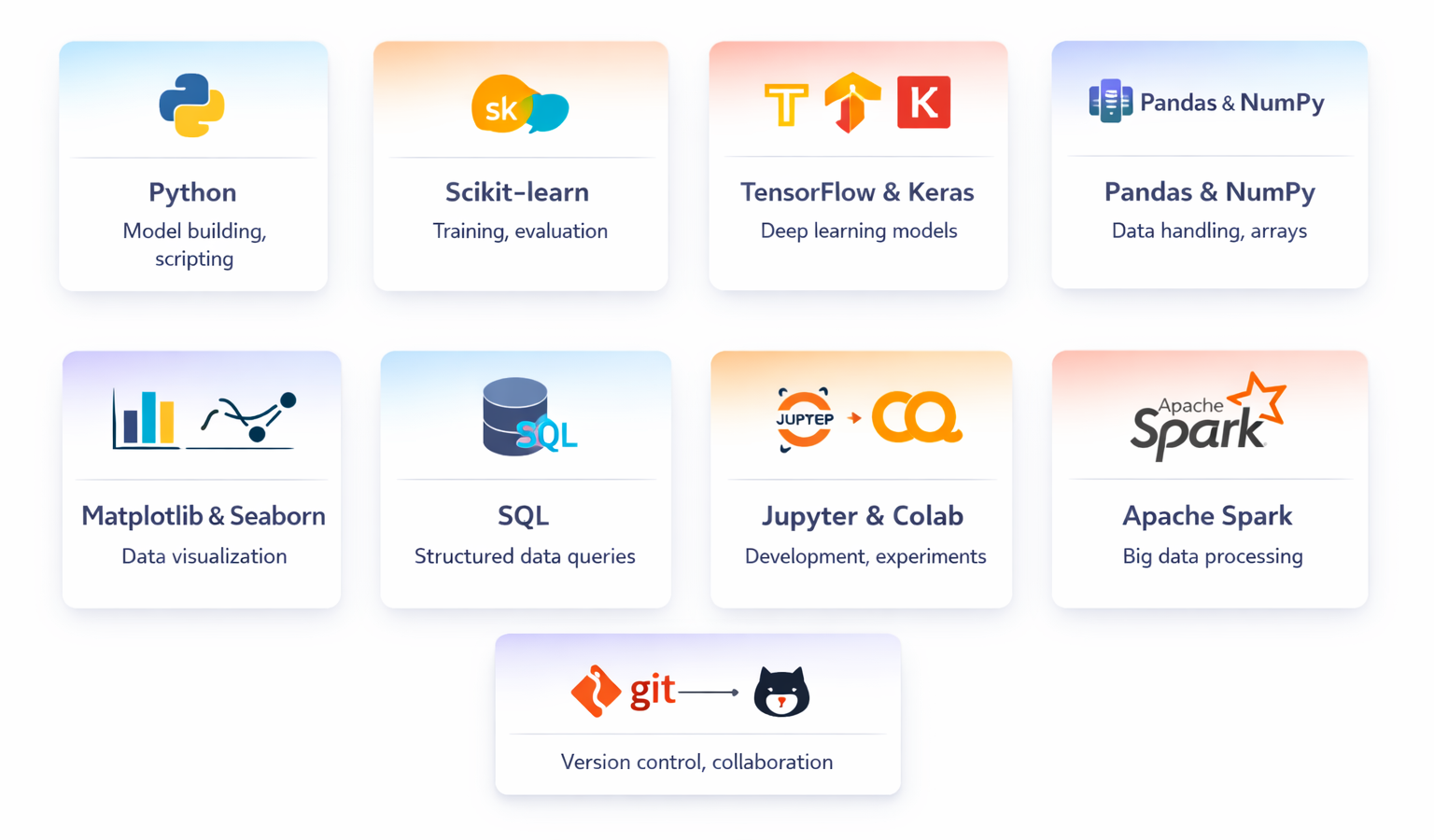
Tool / Technology | Purpose |
Python | Model building and scripting |
Scikit-learn | Model training and evaluation |
TensorFlow & Keras | Building deep learning models |
Pandas & NumPy | Data handling and numerical operations |
Matplotlib & Seaborn | Data visualisation |
SQL | Working with structured data and queries |
Jupyter & Google Colab | Development, experimentation, and model building |
Apache Spark | Big data processing |
Hands-On Projects in upGrad Machine Learning Courses
Machine learning is a topic which can be understood better using practical knowledge along with theory. Once you train a machine learning model and run it for unseen data it will help you to understand the topic more clearly.
For this upGrad have included Hand-On projects in its Machine Learning Certification Courses. Below are some of the projects included:
Project | Problem Statement | Skills You Learn |
Style Transfer using GANs | Build a model that applies artistic styles to images using deep learning and works with visual data. | GANs, Deep Learning, Image Processing, TensorFlow/Keras |
Custom Entity Detection in Healthcare Data | Create a system that identifies key medical terms from healthcare data and extracts information from text. | NLP, Entity Recognition, Text Processing, Deep Learning |
Maximising Profit of Cab Driver using RL | Build a model that helps a cab driver choose routes to maximize profit using decision-making techniques. | Reinforcement Learning, Q-learning, Decision Models |
Melanoma Detection Assignment | Develop a model that detects skin cancer from images and apply computer vision to healthcare data. | CNN, Image Classification, Deep Learning, Keras |
Customer Churn Prediction | Build a model that predicts which customers may leave a service and use data to support customer retention. | Classification Models, Feature Selection, Scikit-learn |
Airbnb Case Study | Analyze Airbnb data to identify pricing patterns and user trends and understand how data analysis supports business decisions. | EDA, Data Visualisation, Pandas, NumPy |
Eligibility and Prerequisites for Machine Learning Course Online
The eligibility requirements are different depending on the machine learning course in India you choose.
Below are eligibility criteria of the best machine learning course for beginners and advanced learners offered by upGrad:
upGrad Machine Learning Course Online | Eligibility Criteria |
Executive Diploma in Machine Learning & AI with MLOps, Gen AI & Agentic AI | Bachelor’s or master’s degree or its equivalent in any discipline with a minimum of 50% aggregate marks or equivalent CGPA. |
Executive Diploma in Data Science & Artificial Intelligence from IIIT Bangalore | Bachelor’s or master’s degree or its equivalent in any discipline with a minimum of 50% aggregate marks or equivalent CGPA. |
Chief Technology Officer & AI Leadership Programme | Bachelor’s degree with a minimum of 8 years of work experience. |
Master of Science in Machine Learning & AI from LJMU |
|
Executive Programme in Generative AI & Agentic AI for Leaders |
|
Executive Post Graduate Programme in Applied AI and Agentic AI | Bachelor’s or master’s degree or its equivalent in any discipline from a UGC-recognised university with a minimum of 50% aggregate marks or equivalent CGPA. |
Career Outcomes after Machine Learning Course in India
After completing a Machine Learning Engineer Course you can explore these roles:
Role | What You Will Do |
Machine Learning Engineer | Build and train models, work with data pipelines, and deploy ML solutions |
Data Analyst | Work with data, create reports, and identify trends and patterns |
Computer Vision Engineer | Build systems that process images and videos for detection and recognition |
NLP Engineer | Develop models that work with text data and language-related tasks |
Data Scientist | Analyze data, build models, and generate insights for business decisions |
ML Solutions Architect | Design ML systems, select suitable tools, and guide teams in building solutions |
Industries Hiring Machine Learning Professionals
Machine Learning is used across different industries to solve data-driven problems. Some of the industries which are hiring ML professionals are:
- Healthcare: Companies are using ML to support diagnosis, and improve treatment outcomes.
- E-commerce: In ecommerce, companies ML is used for recommending products, managing demand, and improving user experience.
- Banking: In banking, Machine Learning is used to detect fraud, assess risk, and support financial decisions.
- Manufacturing: Manufacturing industries use ML to predict equipment failures, improve quality, and reduce the machines downtime.
- Logistics: In logistics ML is used to improve routes, manage supply chains, and reduce delivery time of couriers.
Everything You Need to Know About Machine Learning
Frequently Asked Questions about Machine Learning Course
1. What is a machine learning course online?
A machine learning course online helps you to work with data, train models, evaluate the model performance and use them to solve real world problems. These Machine Learning Engineer Courses train you for roles such as Machine Learning Engineer, AI Engineer, NLP Engineer, Data Scientist, which offers a good pay package.
2. What is the difference between machine learning and artificial intelligence?
Artificial Intelligence is a broad field which enables computers and machines to think, plan, reasoning and problem solving, which basically mimics human beings. But, Machine Learning is a sub field of AI which uses data to train machine learning models and predict outcomes based on that pattern without being explicitly programmed.
3. What is the difference between machine learning and data science?
Data Science is the field in which the main focus is on gaining insights and patterns from the data, while machine learning is a narrow field under the category of artificial intelligence in which algorithms help the systems to learn from data and predict based on that data.
4. Are online machine learning courses suitable for beginners?
Yes, upGrad offers one of the best Machine Learning course for beginners such as Executive Post Graduate Programme in Applied AI and Agentic AI, which is specifically designed to start from scratch with foundational and basic Python programming.
5. Do I need coding experience to learn machine learning?
No, courses such as Executive Post Graduate Programme in Applied AI and Agentic AI from upGrad do not require any kind of coding experience or less familiarity with any programming language. This is one of the best Machine Learning course for beginners which start every concept from the basics.
6. How much math is required for a machine learning course online?
You need not be an expert in mathematics to start learning machine learning. Most of the machine learning courses require elementary high school algebra and a basic understanding of statistics and probability.
7. Which programming language is used for machine learning?
Python is one of the most popular programming languages used for machine learning because of its simple syntax and vast ecosystem of libraries like TensorFlow, PyTorch, Scikit-Learn, and Pandas. Apart from Python, R is also a popular programming language mainly used by statisticians and mathematicians who are building machine learning models.
8. What is the difference between supervised and unsupervised learning?
Supervised learning uses labeled datasets along with the output that should be achieved in order to develop a predictive model, while unsupervised learning involves the analysis of unlabeled datasets with the objective of detecting hidden structures and patterns.
9. How long does it take to complete a machine learning course online?
The duration of the program depends on the type of program you want to pursue. For example, upGrad’s Executive Programme in Generative AI & Agentic AI for Leaders has a duration of 5 to 7 months, but an advanced Machine Learning course such as the Executive Diploma in Machine Learning and AI is of 12 months.
10. How do I choose the right online machine learning course?
For choosing the right and best Machine Learning course for beginners and advanced learners, you must first start by evaluating your skills. If you are good at basics you can go with the advanced courses such as Executive Diploma or if you are someone with good industry experience you can pursue courses such as Chief Technology Officer & AI Leadership Programme. But if you are a beginner you must start by exploring the Machine Learning certification course first.
11. Is a Deep Learning course online different from a Machine Learning course?
Yes. Machine Learning covers a wider range of algorithms and methods for learning from data. Deep Learning focuses on neural networks and is commonly used for complex tasks involving images, text, and other data.
12. Does a Machine Learning course cover MLOps?
Yes, advanced upGrad Machine Learning Course Online combines Machine Learning and AI with MLOps. For example, the Executive Diploma in Machine Learning & AI with MLOps, Gen AI & Agentic AI includes MLOps as one of the specialization in the course.
13. Does a Machine Learning course also cover Generative AI?
No. Not all machine learning courses include generative AI in their syllabus. But there are some courses, like upGrad's Executive Programme in Generative AI & Agentic AI for Leaders, that help you to architect, govern & scale enterprise-ready genAI and agentic AI systems in your organizations.
14. Can a Machine Learning course help me to build a professional portfolio?
Yes. Hands-on projects, case studies, and assignments can help you build work that you can showcase in a professional portfolio. upGrad's Machine Learning courses include practical projects and case studies based on real-world problems.
15. Should I choose a certificate, diploma, or Master's programme in Machine Learning?
Your program choice depends on your learning goal. A certificate can suit focused upskilling, while an executive diploma can provide broader professional training. A Master's programme offers a longer and more structured academic pathway. upGrad offers programmes across all these levels.
upGrad Learner Support
Talk to our experts. We are available 7 days a week, 10 AM to 7 PM

Indian Nationals

Foreign Nationals
Disclaimer
1.upGrad does not grant credit; credits are granted, accepted, or transferred at the sole discretion of the relevant educational institution offering the diploma or degree. We advise you to enquire further regarding the suitability of this program for your academic, professional requirements and job prospects before .