
All courses
Agentic AI
Agentic AI

IIIT Bangalore
Executive Programme in Generative AI for LeadersArtificial Intelligence
Degree / Exec. PG

IIIT Bangalore
Executive Diploma in Machine Learning and AI
OPJ Global University
Master’s Degree in Artificial Intelligence and Data Science
Liverpool John Moores University
Master of Science in Machine Learning & AI
Golden Gate University
DBA in Emerging Technologies with Concentration in Generative AIExecutive Certificate

IIITB & IIM, Udaipur
Chief Technology Officer & AI Leadership Programme
IIIT-B & IIM, Udaipur
Chief Data and AI Officer ProgrammeOffline Bootcamps

upGrad
Data Science and AI-MLDoctorate
For All Domains
IIITB & IIM, Udaipur
Chief Technology Officer & AI Leadership Programme
Swiss School of Business and Management
Global Doctor of Business Administration from SSBM
Edgewood University
Doctorate in Business Administration by Edgewood UniversityGolden Gate University
Doctor of Business Administration From Golden Gate University
Rushford Business School
Doctor of Business Administration from Rushford Business School, SwitzerlandGolden Gate University
Doctor of Technology in Applied & Agentic AI-d9bdeff6165f4eb1ba2adcebde78e961.svg)
University of Waterloo
Chief Technology and AI Officer ProgramLeadership / AI
Golden Gate University
DBA in Emerging Technologies with a concentration in Generative and Agentic AIMachine Learning
Machine Learning
Data Science
Degree / Exec. PG
O.P Jindal Global University
Master’s Degree in Artificial Intelligence and Data ScienceIIIT Bangalore
Executive Diploma in Data Science & AILiverpool John Moores University
Master of Science in Data ScienceExecutive Certificate

upGrad | Microsoft
Gen AI Foundations Certificate Program from MicrosoftIIIT-B & IIM, Udaipur
Chief Data and AI Officer ProgrammeupGrad | Microsoft
Gen AI Mastery Certificate for Data AnalysisupGrad | Microsoft
Gen AI Mastery Certificate for Software DevelopmentupGrad | Microsoft
Gen AI Mastery Certificate for Managerial ExcellenceupGrad | Microsoft
Gen AI Mastery Certificate for Content CreationBootcamp
Offline Bootcamps
upGrad
Data Science and AI-MLMBA
Masters

Liverpool John Moores University
Master of Business Administration from Liverpool John Moores University (LJMU) with IIM Udaipur CertificationO.P.Jindal Global University
MBA (with Career Acceleration Program by upGrad)Edgewood University
MBA from Edgewood UniversityO.P.Jindal Global University
MBA from O.P.Jindal Global UniversityExecutive Certificate
Marketing
Executive Certificate
upGrad | Microsoft
Gen AI Foundations Certificate Program from MicrosoftupGrad | Microsoft
Gen AI Mastery Certificate for Content CreationOffline Bootcamps
upGrad
Digital MarketingManagement
Degree
O.P Jindal Global University
MSc in International Accounting & Finance (ACCA integrated)
Golden Gate University
Master of Arts in Industrial-Organizational PsychologyExecutive Certificate
IIIT-B & IIM, Udaipur
Chief Technology Officer & AI Leadership ProgrammeIIIT-B & IIM, Udaipur
Chief Data and AI Officer Programme
IIM Kozhikode
Human Resource Analytics Course from IIM-KupGrad | Microsoft
Gen AI Foundations Certificate Program from MicrosoftBootcamp
HDFC Life
Insurance Fundamentals ProgramEducation
Education

Northeastern University
Master of Education (M.Ed.) from Northeastern UniversityEdgewood University
Doctor of Education (Ed.D.)Edgewood University
Master of Education (M.Ed.) from Edgewood UniversityCertifications
Project Management
Certification

Knowledgehut
Leadership And Communications In ProjectsKnowledgehut
Microsoft Project 2007/2010-ae8d039bbd2a41318308f8d26b52ac8f.svg)
Knowledgehut
Financial Management For Project ManagersKnowledgehut
Fundamentals of Earned Value Management (EVM)Knowledgehut
Fundamentals of Portfolio ManagementKnowledgehut
Fundamentals of Program Management-35c169da468a4cc481c6a8505a74826d.webp&w=128&q=75)
Knowledgehut
CAPM® CertificationsKnowledgehut
Microsoft® Project 2016Certifications & Trainings
-7f4b4f34e09d42bfa73b58f4a230cffa.webp&w=128&q=75)
Knowledgehut
PMP® CertificationKnowledgehut
PMI-RMP® CertificationKnowledgehut
PMP Renewal Learning PathKnowledgehut
Oracle Primavera P6 V18.8Knowledgehut
Microsoft® Project 2013Knowledgehut
PfMP® Certification CourseKnowledgehut
Project Planning and MonitoringPrince2 Certifications

Knowledgehut
PRINCE2® FoundationKnowledgehut
PRINCE2® PractitionerKnowledgehut
PRINCE2 Agile Foundation and PractitionerKnowledgehut
PRINCE2 Agile® Foundation CertificationKnowledgehut
PRINCE2 Agile® Practitioner CertificationManagement Certifications
Knowledgehut
Project Management Masters Certification ProgramKnowledgehut
Change ManagementKnowledgehut
Project Management TechniquesKnowledgehut
Product Management Certification ProgramKnowledgehut
Project Risk Management- Study abroad
- Offline centres
- uGSOT - B.Tech
More

%20(2)-db0b6f38da9c485faf76e366793c9b9e.webp&w=128&q=75)



Machine Learning Courses Online
Understand Data, Features, and how models learn from patterns
Use ML libraries to train, test, and improve model performance
Master neural networks, NLP & reinforcement learning with Python
Earn a recognized Machine Learning certification
Learner count
6K+
Avg. pay hike
64%
Top pay hike
500%
Talk to a Counsellor
By clicking, I accept the T&C and Privacy Policy
Machine Learning Courses From Top Universities
Machine Learning Courses (7)
bestseller
Executive Diploma
12 Months
Executive Diploma
12 Months
IIIT-B & IIM, Udaipur
Chief Technology Officer & AI Leadership ProgrammeCertification
6 months
popular
Master's Degree
18 Months
IIIT Bangalore
Executive Programme in Generative AI & Agentic AI for LeadersIndia’s #1 Tech University
Dual Certification
5 Months
Certification
Building AI Agent
-4c349343809f452a8b692e3368cd8097.webp&w=3840&q=75)
MIT Open Learning
Universal AI by MIT Open LearningCertification
200+ Hours




Our Top University Partners
How AI-Ready Is Your Career?
The work you do today may already be easy for AI to replace. Find out where you truly stand.
Automation risk in your profile
Skill relevancy for AI roles
Ability to adapt
🧠 Discover how future-ready your career really is
-d7bcc89c78df4cff8b2140ff79f1ffb1.webp&w=1200&q=75)
Our Placements in Machine learning Course
Transform your career with our Machine learning certification, boasting strong placement records. Level up now by getting offers.
Top Recruiters







-80c197eb148547d1a5c1d66c7f8dddeb.png&w=128&q=75)

Machine Learning Course Projects: Learn by Doing
17+
Projects


Machine Learning Course Instructors: Learn From The Best
8
Instructors
8
Industry Experts
























-39a9e7a7278a441ea08a60a1f45b4913.png&w=128&q=75)
Services to Help You Achieve Your Goal
Access the various career developement support services offered by upGrad to help you achieve your professional goals
Receive unparalleled guidance from industry mentors, teaching assistants, and graders


Success Stories: What Our Learners Have To Say


Latest ML Industry Trends
The ML Industry is growing rapidly and is expected to continue to do so in the coming years. As machine learning becomes more sophisticated and accessible, it is likely to have a major impact on all industries
95%
Businesses expect AI/ML to have a positive impact on their industry in the next five years
37%
Organisations have adopted AI
16%
Expected to replace all US jobs in less than half a decade
77%
Businesses are using AI/ML for automation
Machine Learning Course Overview
Work across industries is changing as data becomes central to decisions. Teams in engineering, product, and business now rely on machine learning to build smarter systems and improve outcomes.
Machine learning allows systems to learn from data, identify patterns, and make accurate decisions without constant manual input. It supports tasks like predictions, recommendations, and automation in real work environments.
upGrad offers one of the best Machine Learning courses for professionals who want to build these skills. Whether you work with data, develop products, or manage teams, these programs help you learn practical concepts and apply them through real-world projects.
What is Machine Learning?
Machine learning is a part of Artificial Intelligence that helps systems learn from data and improve over time without being directly programmed. It uses data to find patterns and make decisions or predictions.
Unlike traditional systems that follow fixed rules, machine learning models learn from examples and get better with more data. They can handle tasks like prediction, classification, and recommendation.
Some common machine learning methods include supervised learning, unsupervised learning, and reinforcement learning. These methods help systems solve real problems such as fraud detection, demand forecasting, and customer analysis.
Real Life Use Cases of Machine Learning
Machine learning works across industries and helps you improve accuracy, speed, and decision-making. Key use cases include:
- Software: It helps you detect bugs, improve code quality, and automate testing processes.
- Manufacturing: It helps you predict machine failures, reduce downtime, and improve production quality.
- Education: It helps you personalize learning, track student progress, and improve outcomes.
- Logistics: It helps you optimize routes, manage supply chains, and reduce delivery time.
- Agriculture: It helps you predict crop yield, monitor soil health, and improve farming decisions.
- Cybersecurity: It helps you detect threats, prevent attacks, and monitor unusual activity.
- Human Resources: It helps you screen resumes, predict attrition, and improve hiring decisions.
Who Should Take a Machine Learning Course?
Artificial intelligence and machine learning courses suit you if you want to work with data, build predictive models, and solve real problems while continuing your current role.
You will learn how to train models, work with datasets, and apply machine learning techniques to make better decisions in real scenarios.
Data and Analytics Professionals
If you work with data, reporting, or analytics and want to move beyond basic tasks, these machine learning online courses will help you grow faster and build data-driven systems. You can:
- Train and test machine learning models
- Work on real-world datasets
- Move into advanced ML roles
Engineering and Development Leads
If you design systems or manage development teams, these courses will help you build strong ML solutions and deploy them in real environments. You can:
- Design ML systems for real use
- Lead projects with clear direction
- Improve model performance
Product Owners and Business Decision Makers
If you handle products, teams, or business goals, these courses will help you use machine learning in a practical way. You can:
- Use data to guide decisions
- Improve processes with predictions
- Drive growth with ML insights
Students and Early Career Professionals
If you are starting out and have basic Python knowledge, these courses will give you a clear start with hands-on learning. You can:
- Learn core ML concepts
- Practice with simple projects
- Build a strong foundation
Domain Experts (Marketing, Finance, Cybersecurity, etc.)
If you work in fields like marketing, finance, or cybersecurity, these courses will help you apply ML in your area. You can:
- Apply ML in daily tasks
- Improve insights from data
- Stay updated in your field
Why Choose Machine Learning Courses in 2026?
Machine learning is now at the core of how companies use data to work smarter. Teams depend on it to build systems that learn, predict outcomes, and improve results over time.
Businesses no longer treat machine learning as optional. They use it across products, operations, and planning. When you learn ML, you gain the ability to work with data and create solutions that directly impact business results.
Here are some reasons why professionals are choosing Artificial intelligence and machine learning courses in 2026:
- LinkedIn reports a 70% increase in roles requiring AI literacy
- Around 75% of businesses now use data-driven models in some form
- Demand for ML and data skills is expected to keep rising across sectors
- Over 45% of companies use ML for forecasting and automation
- Over the next three years, 92% of companies plan to increase their AI investments.
In simple terms, learning Machine Learning can help you:
- Build skills that companies actively need
- Work on real data and practical problems
- Move into roles with strong career growth
- Stay competitive in a data-driven job market
What You Will Learn in Machine Learning Courses?
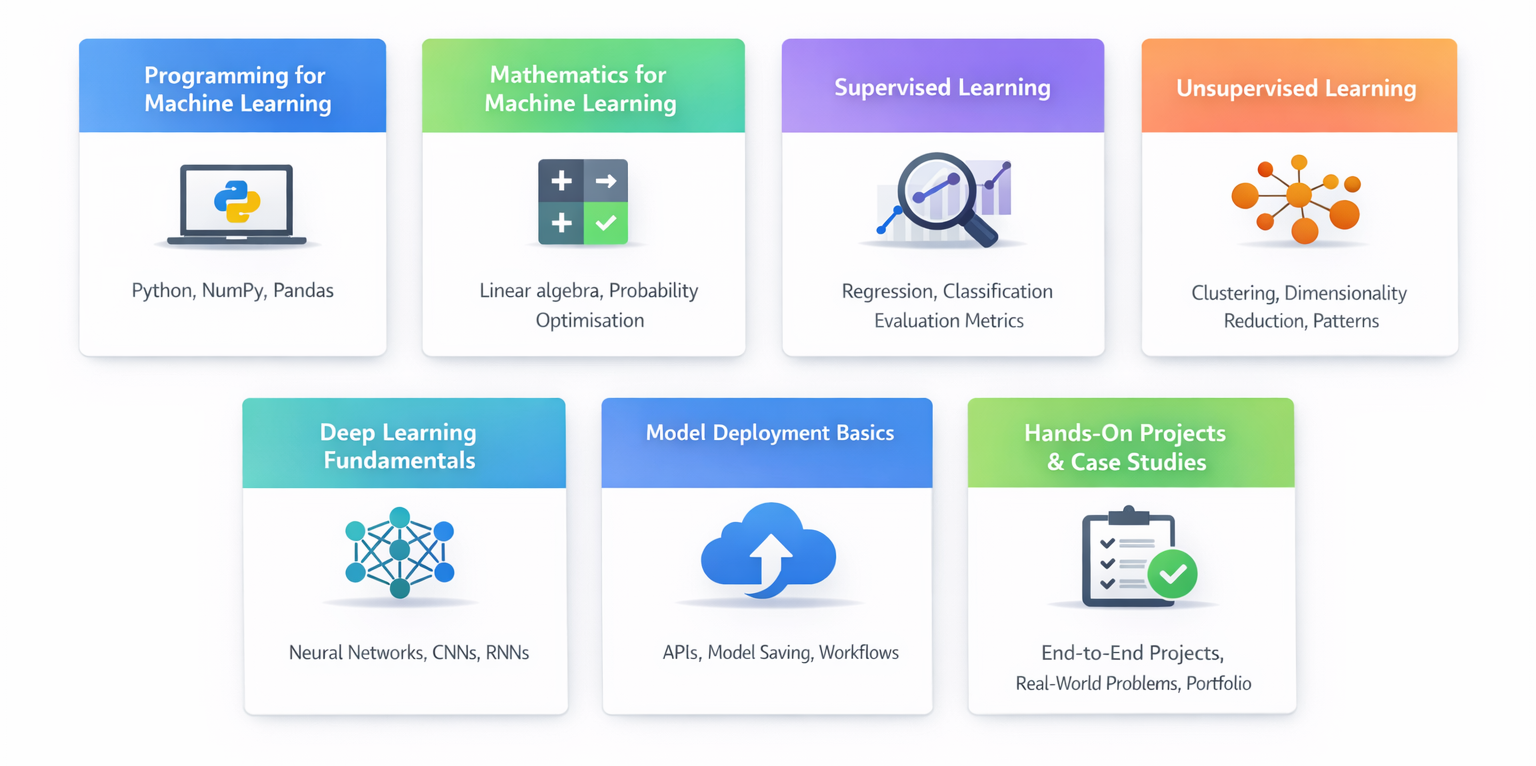
Machine learning courses help you move from basic understanding to building models that can learn from data and make predictions.
These programs combine core concepts, hands-on tools, and real-world use cases to help you build practical skills and become job ready.
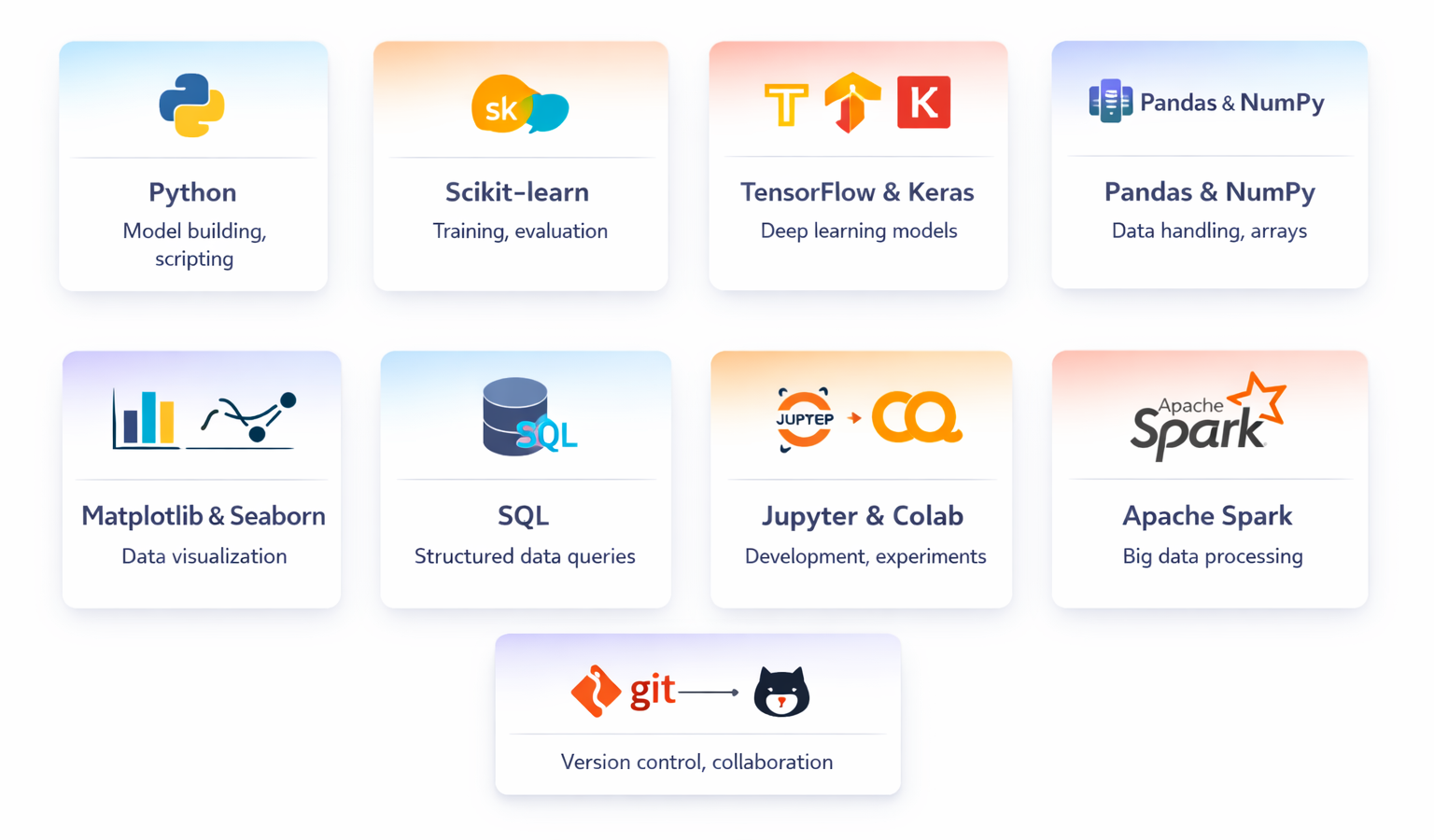
Tools and Technologies Covered in Machine Learning Courses
From data tools to ML frameworks, here are the tools you will learn:
Hands-On Projects in upGrad Machine Learning Courses
You cannot learn Machine Learning through theory only. You need to build real models to understand how they work. Employers also look at your ability to create working solutions, not just your knowledge.
Artificial intelligence and machine learning courses include hands-on projects that help you apply your learning and build a strong portfolio.
1. Style Transfer using GANs
You will build a model that applies artistic styles to images using deep learning. This project helps you understand how generative models work with visual data.
Skills you learn: GANs, deep learning, image processing, TensorFlow/Keras
2. Custom Entity Detection in Healthcare Data
You will create a system that identifies key medical terms from healthcare data. This project helps you understand how models process and extract information from text.
Skills you learn: NLP, entity recognition, text processing, deep learning
3. Maximising Profit of Cab Driver using RL
You will build a model that helps a cab driver choose the best routes to maximize profit. This project helps you learn decision-making using reinforcement learning.
Skills you learn: Reinforcement learning, Q-learning, decision models
4. Melanoma Detection Assignment
You will develop a model that detects skin cancer from images. This project helps you apply computer vision to real healthcare problems.
Skills you learn: CNN, image classification, deep learning, Keras
5. Customer Churn Prediction
You will build a model that predicts which customers may leave a service. This project helps you understand how businesses use data to retain users.
Skills you learn: Classification models, feature selection, Scikit-learn
6. Airbnb Case Study
You will analyze Airbnb data to find pricing patterns and user trends. This project helps you understand how data analysis supports business decisions.
Skills you learn: EDA, data visualization, Pandas, NumPy
Career Outcomes After a Machine Learning Course: Salaries and Roles
The job market for Machine Learning professionals in India is growing fast. Companies offer strong salaries because they need skilled people.
Many industries such as IT services, banking, e-commerce, healthcare, and consulting actively hire ML professionals. Companies build teams to solve real business problems using data.
Here are some of the top roles that you can explore once you complete your machine learning online course.
Role | What You Will Do | Average Salary in India (₹ LPA) |
Data Analyst | Work with data, create reports, and help teams understand trends and patterns | ₹4 – 9 LPA |
Computer Vision Engineer | Build systems that process images and videos for detection and recognition tasks | ₹5 – 11 LPA |
NLP Engineer | Develop models that work with text data for tasks like classification and language understanding | ₹6 – 12 LPA |
Machine Learning Engineer | Build and train models, work with data pipelines, and deploy ML solutions for real use cases | ₹7 – 18 LPA |
Data Scientist | Analyze data, build models, and generate insights to support business decisions | ₹7 – 18 LPA |
ML Solutions Architect | Design ML systems, choose tools, and guide teams in building and deploying solutions | ₹12 – 20 LPA |
Note: These salary figures are based on data from Glassdoor and may vary depending on experience, location, and company.
Industries Hiring Machine Learning Professionals
Companies across many sectors hire professionals with Machine Learning skills.
- Healthcare: Analyze patient data, support diagnosis, and improve treatment outcomes
- E-commerce: Recommend products, manage demand, and improve user experience
- Banking: Detect fraud, assess risk, and support financial decisions
- Manufacturing: Predict failures, improve quality, and optimize production
- Telecom: Reduce churn, improve networks, and analyze customer data
- Logistics: Optimize routes, manage supply chains, and improve delivery time
Everything You Need to Know About Machine Learning
Frequently Asked Questions about Machine Learning Course
1. What is a machine learning course online?
A machine learning course online is a structured program that teaches learners how to build systems that learn from data. Programs like the Executive Diploma in Machine Learning and AI by upGrad help learners understand algorithms, model training, and real-world applications. Students attend live online classes or access recorded sessions. These courses prepare learners for industry roles in AI and data-driven fields.
2. What do learners study in an online machine learning course?
An online machine learning course teaches Python programming, data preprocessing, and core machine learning algorithms. Learners study supervised and unsupervised learning techniques, model evaluation methods, and deployment fundamentals. Advanced programs such as the Master of Science in Machine Learning & AI also cover deep learning and generative AI concepts. Hands-on projects enable learners to apply theoretical knowledge to real-world business problems.
3. What prerequisites are required for a machine learning online course?
Most machine learning online programs do not require a specific degree background. Basic knowledge of algebra and statistics is helpful. Learners should be willing to learn Python and practice regularly. upGrad programs such as the Executive PG Program in Machine Learning and AI often start with foundational modules to support beginners.
4. Is prior coding experience required to start a machine learning course?
For many beginner-friendly machine learning programs, no previous coding experience is required. The machine learning courses at upGrad start with an introduction to Python at an introductory level before moving on to advanced machine learning concepts.
If you already have basic knowledge of a programming language, you will probably be able to progress more quickly than someone who has no prior programming experience; However, the single most important factor for successful completion will be that the learner participates in the required amount of hands-on practice throughout the course.
5. Can beginners take machine learning online courses?
Yes, beginners can enroll in machine learning online courses. Many programs are designed to start from the basics and gradually build your skills.
Programs offered by upGrad begin with foundational modules that cover Python basics, core math concepts, and an introduction to machine learning. As you progress, the curriculum moves to algorithms, case studies, and industry projects.
6. Which programming languages should someone know before a machine learning course?
Machine Learning uses primarily python programming. Python is a very popular programming language used for data analysis, training models and creating ML applications. Some specialists use R to conduct statistical analysis.
If you are beginning to program, you do not need to be concerned. The upGrad Machine Learning courses include subject material on Python basics, so beginners will learn Python while they learn about Machine Learning and create projects.
7. What tools are taught in machine learning courses (Python, TensorFlow, etc.)?
Machine learning courses teach several tools used for data analysis, model development, and AI applications. In upGrad machine learning programs, learners typically work with:
- Python for machine learning programming
- NumPy and Pandas for data handling and analysis
- Scikit-learn for implementing machine learning algorithms
- Jupyter Notebook for coding and experimentation
- TensorFlow and PyTorch for deep learning models
- Basic cloud deployment tools for running ML applications
8. Is math mandatory for online machine learning courses?
Mathematics helps you understand how machine learning models work. Concepts like linear algebra, probability, and statistics are used to explain how algorithms function and how models make predictions. However, you do not need advanced math to get started.
Most programs, including those offered by upGrad, teach these concepts in a simple and practical way. The focus is on understanding how models work and applying them in real projects, rather than going deep into complex mathematical theory.
9. What is supervised vs unsupervised learning?
Supervised learning trains models using labeled data to make predictions. Examples include spam detection and price forecasting. Unsupervised learning works with unlabeled data to find hidden patterns, such as customer segmentation. upGrad’s machine learning programs cover both approaches with practical case studies and projects.
10. What’s the difference between machine learning and deep learning?
Machine learning is a broad field that focuses on algorithms that learn from data. Deep learning is a subset of machine learning that uses multi-layer neural networks. Deep learning is commonly used in image recognition and speech processing. Advanced programs like the Master of Science in Machine Learning & AI include both ML and deep learning modules.
11. How long does it take to complete an online machine learning course?
The duration depends on the type of program and your study schedule.
Timelines include:
- Certificate courses: 3–6 months
- Executive programs such as the Executive Diploma in Machine Learning and AI (IIIT Bangalore): about 12 months
- Master’s programs such as the Master of Science in Machine Learning and AI: 18 months or more
12. What kind of projects will someone build in a machine learning course?
During your time in a machine learning course, you'll develop practical skills through hands-on projects with actual industry applications, such as:
1. Creating predictive models to identify customers who are likely to cancel their services
2. Developing an analytical tool to evaluate the creditworthiness of potential borrowers
3. Designing systems to suggest products or other content based on similar users' preferences
4. Using deep learning to identify and classify objects in photos
5. Evaluating businesses' performance with real-world examples
The courses offered by upGrad also include numerous opportunities to build a portfolio in machine learning; these portfolios can consist of assignments and project work, known as capstones.
13. What jobs can someone get after completing a machine learning online course?
After completing a machine learning online course, you can apply for roles such as Machine Learning Engineer, Data Scientist, or AI Engineer.
Industries like IT, banking, healthcare, and e-commerce actively hire professionals with machine learning skills. Programs from upGrad also focus on project-based learning, which helps you build practical experience and improve your chances of getting hired.
14. Online machine learning course vs in-person bootcamp: which is better?
The better option depends on your learning style and schedule.
Online machine learning courses offer:
- Flexible learning schedules
- Access from anywhere
- Ability to learn while continuing your job
In-person bootcamps offer:
- Classroom interaction with instructors
- Fixed schedules and structured sessions
- Face-to-face collaboration with peers
Many learners choose online programs from upGrad because they combine flexibility with structured learning and industry projects.
15. Are there free machine learning courses with certificates?
Yes, you can find free machine learning courses with certificates that help you understand basic concepts without paying a fee. These courses usually cover key topics like algorithms, model training, and commonly used ML tools, making them ideal for beginners starting their learning journey.
Free options from upGrad include beginner-friendly AI and machine learning modules with certificates. Popular examples are Artificial Intelligence in the Real World, which introduces core concepts, Fundamentals of Deep Learning and Neural Networks, covering neural networks and deep learning basics, and Linear Regression for Machine Learning, which explains regression models and their practical use. These courses are designed with structured content and practical insights, making them widely recommended across learning platforms.
16. Which platform has the best online machine learning course?
The best platform for an online machine learning course depends on a learner’s career goals and individual learning needs. upGrad offer programs in partnership with reputed institutions such as the International Institute of Information Technology Bangalore (IIIT Bangalore) and Liverpool John Moores University (LJMU), provide strong academic credibility and industry relevance. upGrad’s machine learning and AI programs combine comprehensive curriculum depth, live mentorship, hands-on projects, and career support, making them a strong choice for many learners.
17. What are the best online machine learning courses for 2026?
The best online machine learning courses for 2026 focus on machine learning, deep learning, and generative AI skills. upGrad offers industry-relevant programs such as the Executive Diploma in Machine Learning and AI, the Master of Science in Machine Learning & AI, and the Executive Programme in Generative AI for Leaders. These programs combine strong ML foundations, hands-on projects, mentorship, and career support to help learners stay aligned with evolving AI trends.
18. What is the best beginner machine learning course online?
The best beginner course starts with Python and basic math concepts. It should explain ML algorithms in simple terms. Hands-on projects and guided practice help beginners gain confidence. Programs with structured learning paths and mentor support are ideal for new learners.
19. Does an online machine learning course teach Python?
The majority of online courses for machine learning utilize Python for the development of a model, which makes it the standard programming language for usage in this field.
Examples of programs that contain an organized curriculum along with hands-on coding experience through projects and/or assignments would be from upGrad - such as the Executive Diploma in Machine Learning and AI offered by IIIT Bangalore.
20. Does the course teach data preprocessing techniques?
Yes. Data preprocessing is an essential part of machine learning training.
You learn how to:
- Clean and prepare raw datasets
- Handle missing values
- Apply feature scaling and normalization
- Encode categorical variables
Programs from upGrad include these techniques so you can prepare data properly before building machine learning models.
21. How is model evaluation covered in machine learning courses?
Machine learning courses teach how to measure and improve model performance.
You learn techniques such as:
- Accuracy, precision, recall, and F1-score for model evaluation
- Cross-validation to test model reliability
- Detecting and reducing overfitting
- Comparing models to select the best-performing one
These concepts are included in upGrad machine learning programs to help learners build reliable and effective ML models.
22. Do machine learning courses cover neural networks basics?
Yes, most structured AI programs include the basics of neural networks. Learners understand how neurons, layers, and activation functions work together to process data.
As the course progresses, advanced programs introduce multi-layer networks and optimization techniques. This strong foundation helps learners move easily into deep learning topics and build more complex models.
23. Do online machine learning courses include deep learning modules?
Yes, many advanced programs include deep learning modules. Learners study concepts like CNNs and RNNs for image and text processing. For example, the Master of Science in Machine Learning & AI covers deep learning in detail. These skills are valuable for AI-focused roles.
24. Will learners study TensorFlow or PyTorch in a machine learning course?
Yes. Most advanced machine learning courses introduce frameworks such as TensorFlow and PyTorch, which are widely used for building and training neural networks. Programs from upGrad include hands-on labs and practical assignments where learners apply these tools to develop and evaluate deep learning models, helping them gain practical experience in real AI applications.
25. Are real-world datasets included in online machine learning training?
Yes, quality machine learning courses use real-world datasets. Learners work on industry-inspired case studies such as churn prediction or fraud detection. This practical exposure builds problem-solving ability. Real datasets prepare learners for job-ready performance.
26. Which course teaches machine learning with projects and portfolios?
Several online machine learning courses focus on hands-on projects and portfolio building. Programs offered by upGrad include real-world assignments, case studies, and capstone projects that help you showcase your skills to employers.
Popular options include:
- Executive Diploma in Machine Learning and AI (IIIT Bangalore): Includes 12+ capstone projects and 80+ real-world case studies to help you build a strong project portfolio.
- Master of Science in Machine Learning and AI from LJMU: Covers machine learning, deep learning, NLP, and practical AI applications through project-based learning.
- Executive Diploma in Data Science and AI: Teaches machine learning with real datasets and industry case studies to help learners build job-ready portfolios.
These courses combine technical training with practical projects, so you can build a portfolio that demonstrates machine learning skills to recruiters.
27. Do online machine learning courses help with portfolio building?
Yes. Many online machine learning courses, including programs offered by upGrad, help you build a professional portfolio.
You will work on:
- Industry-relevant machine learning projects
- Capstone assignments using real datasets
- Case studies based on real business problems
28. How to showcase machine learning projects from online courses?
You can showcase your machine learning projects by presenting them clearly and professionally.
Useful approaches include:
- Upload projects to GitHub with clean and well-documented code
- Share project summaries on LinkedIn to highlight your work
- Explain the problem statement and solution approach
- Include visualizations and model performance metrics
Projects completed in upGrad machine learning programs can also be added to your portfolio to demonstrate practical skills to employers.
29. Which online machine learning course offers certification?
Many online machine learning courses offer certificates once you complete the program. These certificates can help you show your skills and project experience to employers in a clear and practical way.
Courses from upGrad also provide certifications in collaboration with well-known universities, which adds extra credibility and makes your profile more trustworthy in the job market.
Examples include:
- Executive Diploma in Machine Learning and AI (IIIT Bangalore)
- Executive Diploma in Data Science and AI (IIIT Bangalore)
- Master of Science in Machine Learning and AI (Liverpool John Moores University)
30. Can learners take an online machine learning course for free?
Yes, upGrad offers free introductory ML courses. These courses cover basic concepts and sometimes provide certificates. However, advanced programs with mentorship and placement services usually require payment. Free courses are ideal for beginners exploring the field.
31. What are the top online machine learning courses with placement assistance?
Top online machine learning courses with placement assistance combine technical training with career preparation. upGrad offers several programs that include resume support, interview preparation, and career guidance.
Popular options include:
- Ex. Diploma in Machine Learning & AI with MLOps, Gen AI & Agentic AI (IIIT Bangalore): Covers ML algorithms, deep learning, NLP, Gen AI & Agentic AI and real-world AI projects with hands-on case studies.
- Executive Diploma in Data Science and AI (IIIT Bangalore): Teaches Python, machine learning, deep learning, and data engineering with practical projects.
These programs also provide career support such as resume building, mock interviews, and placement assistance to help learners prepare for machine learning roles.
32. What is the salary after completing a machine learning online course?
Salaries depend on your skills, experience, and job role.
Typical salary ranges in India include:
- Entry-level roles: ₹6–10 LPA
- Mid-level professionals: ₹12–20 LPA
- Experienced ML or AI engineers: ₹20–35 LPA or more
Programs from upGrad help learners build project experience and practical skills, which can improve opportunities for machine learning roles.
33. Do employers accept online machine learning certifications?
Yes, employers accept online certifications if they demonstrate real skills. Recruiters focus more on practical knowledge and project experience. Certifications from reputed universities add extra credibility. A strong portfolio often matters more than the format of learning.
34. What skills do employers look for in machine learning roles?
Employers look for strong Python programming and data analysis skills. They expect understanding of algorithms and model evaluation. Knowledge of deep learning frameworks is also valuable. Problem-solving ability and communication skills improve hiring chances.
35. Can learners get a job as a machine learning engineer after completing an online course?
Yes, learners can secure machine learning roles after completing a structured online program. Success depends on the quality of projects, practical implementation skills, and strong technical understanding. Programs that offer career support services help learners prepare for interviews and job applications. Continuous practice and portfolio development significantly improve job readiness.
36. What companies hire machine learning practitioners?
Companies across IT, banking, healthcare, and e-commerce hire ML professionals. Technology firms, fintech companies, and AI startups actively recruit talent. Organizations use ML for automation, analytics, and predictive systems. Demand continues to grow globally.
37. Can an online machine learning course replace a degree?
An online machine learning course can help you build strong practical skills through projects and real datasets. Many employers today focus on demonstrated skills rather than only formal degrees.
Programs offered by upGrad provide structured learning, industry projects, and recognized certifications that strengthen your profile. When combined with a solid project portfolio, these credentials can help you compete for machine learning roles.
38. Is machine learning the same as AI?
No, machine learning is a part of artificial intelligence. AI is a broader field focused on building intelligent systems. Machine learning specifically enables systems to learn from data. Deep learning is a further subset within machine learning.
39. How hard is it to learn machine learning online?
Machine learning can feel challenging at first because it includes math, coding, and algorithms. However, structured programs break topics into simple steps. Courses like the Executive Diploma in Machine Learning and AI start with foundations before moving to advanced concepts. With regular practice and patience, most learners can master it successfully.
40. What is the ideal sequence of topics for machine learning?
A proper sequence begins with Python programming and basic statistics. Learners then study data preprocessing and supervised learning algorithms. After that, they move to unsupervised learning and model evaluation. Advanced topics like deep learning and deployment come at the end.
41. What’s the best study plan for machine learning courses online?
A strong study plan includes consistent daily practice and project work. Learners should divide time between theory and coding exercises. Weekly revision improves retention of concepts. Structured programs help by providing milestone-based learning paths.
42. What is the best way to learn machine learning online for free?
Beginners can start with free introductory ML courses available on upGrad. They should focus on Python basics and simple machine learning models first. Practicing on open datasets strengthens conceptual understanding and implementation skills. While free resources are useful for exploration, advanced career-focused programs with mentorship and industry projects typically require paid enrollment.
43. How much time should be spent daily on a machine learning course?
You should spend around 1–2 hours each day learning and practicing machine learning. Studying a little every day helps you understand concepts more clearly and build skills step by step.
With consistent practice, you can improve your coding, get better at building models, and stay on track with your course. Many learners also use weekends to spend extra time on projects and assignments. Programs from upGrad are structured in a way that makes it easier to follow this routine and learn effectively.
44. How many hours does an online machine learning course usually take?
The total time depends on the course level and depth.
Typical ranges include:
- Short certification courses: about 60–120 learning hours
- Advanced executive programs: several months of structured learning
- Diploma programs such as the Executive Diploma in Machine Learning and AI (IIIT Bangalore): around 12 months with weekly sessions
The exact time varies based on your learning pace and time spent on projects and practice.
45. Can learners study machine learning while working full time?
Yes, many online machine learning courses are designed for working professionals. Flexible schedules and recorded sessions allow learners to study alongside their jobs. upGrad programs, such as the Executive Diploma in Machine Learning and AI, support part-time learning with structured guidance. Effective time management and consistent effort play a key role in successful completion.
46. Do machine learning courses teach dimensionality reduction?
Yes. Most structured machine learning programs include dimensionality reduction techniques. Learners study methods such as Principal Component Analysis (PCA) to reduce the number of features while preserving important information in the dataset. This helps simplify models, reduce data complexity, and improve overall model performance. Programs from upGrad also cover these concepts as part of practical machine learning training.
47. What is cross validation and why is it important?
Cross-validation is a technique used to test model performance on different data samples. It helps ensure the model works well on unseen data. This method reduces overfitting and improves reliability. Machine learning courses teach cross-validation as part of model evaluation.
48. Will I learn deep learning in an Online Machine Learning Course?
Yes, many online machine learning courses include deep learning as an important part of the curriculum. These modules help learners understand how advanced AI systems are built and used.
You typically learn topics such as:
- Neural networks and how they learn from data
- Deep learning frameworks used in AI development
- Applications like image recognition and text processing
Programs offered by upGrad, such as the Executive Diploma in Machine Learning and AI with MLOps, Generative AI, and Agentic AI, also include deep learning concepts along with practical projects to build real-world skills.
49. Are there online machine learning courses with cloud computing modules?
Yes, many online machine learning courses include cloud computing as part of the curriculum. These modules help learners understand how AI systems are built and used in real-world environments.
Learners typically study how to:
- Deploy models on cloud platforms
- Manage data pipelines for scalable workflows
- Run and monitor applications in cloud environments
Programs offered by upGrad, such as the Executive Diploma in Machine Learning and AI and the Executive Diploma in Data Science and AI, also include cloud-based deployment concepts. This helps learners gain practical skills needed for real industry use cases.
50. What are the top machine learning courses for remote learners?
Top machine learning courses for remote learners offer flexible online learning with live sessions and projects.
Examples from upGrad include:
- Executive Diploma in Machine Learning and AI (IIIT Bangalore)
- Executive Diploma in Data Science and AI (IIIT Bangalore)
- Master of Science in Machine Learning and AI (Liverpool John Moores University)
These programs include recorded lectures, mentorship, and hands-on projects so you can learn machine learning remotely.
51. What machine learning course offers certification and jobs?
Machine learning programs from upGrad, such as the Executive Diploma in Machine Learning and AI (IIIT Bangalore) and the Executive Diploma in Data Science and AI (IIIT Bangalore), provide industry-recognized certification along with career support. Learners also receive help with resume building, interview preparation, and career guidance to prepare for machine learning roles.
52. Machine learning vs data science courses, which is better?
The better choice depends on your career goals.
Machine learning courses focus on:
- Algorithms and predictive modeling
- Model training and AI system development
Data science courses cover a wider scope, including:
- Data analysis and visualization
- Statistical methods and business insights
53. Do machine learning courses cover neural network basics?
Yes. Most machine learning courses like those from upGrad cover the basics of neural networks.
You learn concepts such as:
- How artificial neurons and layers work
- Activation functions used in neural networks
- Structure of simple and multi-layer networks
This foundation helps you understand deep learning models and more advanced AI techniques.
54. Can I get a job as a machine learning engineer after an online course?
Yes, an online machine learning course can help you build job-ready skills, especially if it includes hands-on projects and real datasets instead of just theory. Learning by doing makes it easier to understand how models work in real situations.
Programs from upGrad focus on core areas like machine learning algorithms, model building, and practical problem-solving. You also work on industry-based projects and case studies, which help you create a strong portfolio. Along with this, features like resume support, interview preparation, and placement assistance make it easier to prepare for roles such as machine learning engineer or AI engineer.
upGrad Learner Support
Talk to our experts. We are available 7 days a week, 10 AM to 7 PM

Indian Nationals

Foreign Nationals
Disclaimer
1.upGrad does not grant credit; credits are granted, accepted, or transferred at the sole discretion of the relevant educational institution offering the diploma or degree. We advise you to enquire further regarding the suitability of this program for your academic, professional requirements and job prospects before .