Destinations
Exams
Resources
More
Destinations
Exams
Resources
More
Join top-ranked universities, study in-demand courses and explore high-paying jobs with our Pathway Programs in the USA.
-a1b09d27a74440af9c1fee50ad71b09b.webp)
Quick facts, key domains and top programs.
MBA, Supply Chain, Marketing, Project Management
Analytics, AI/ML, Informatics
Computer Science, IT, Cybersecurity
Robotics, IoT, Civil, Industrial
Public Health, Biotechnology, MBA HCM
Most students take the traditional path but what if you can earn the same degree, only faster and flexibly?
Lesser cost, shorter duration and greater flexibility.
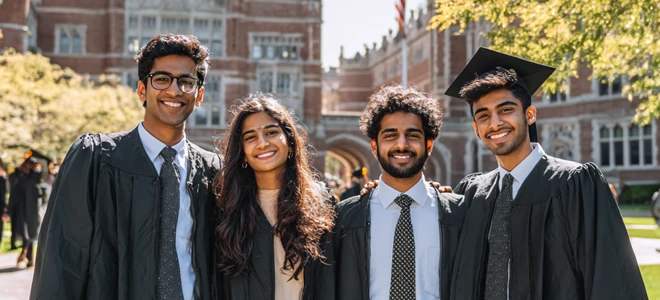
98% admit rate because of established credit-record. No requirement of GRE/GMAT/SAT.
Higher on-campus scholarships, shorter on-campus duration, early internships, same degree.
Earn the same PSW Visa with faster career outcomes and easier career transition.
University and program selection.
Online cohort starts with IELTS prep.
Submit application to the university.
Receive your I-20 and apply for Visa.
Transfer on-campus to the USA.
Explore globally coveted programs designed to empower your success. Start online, complete your degree on-campus abroad.
Select your ideal city and institution for your on-campus transfer.

New York

Boston
-b63abf2795b94391ab379b89ca574901.webp)
San Francisco

Philadelphia

Seattle
Get ahead with exam waivers, top scholarships, savings & internships.
Total Expense
Over 2 years
₹64.5 L
Total Earnings
In 3 years
₹3.92 Cr
When on-campus, immerse in research, internships & global community.
Research-driven learning, internships & co-ops.
Clubs, networking events & top-notch facilities.
Affordable housing, diversity and inclusivity.
Hear from our learners who turned their study-abroad dreams into reality.
Read expert guides, blogs, FAQs, and resources for every step.

Cost of Living in USA

Cost of Studying in USA

Why Study in USA

Fully Funded Scholarship in USA

Exams Required to Study in USA

USA Study Visa
 (1)-3dd0034113bf41b087b4ac1db807d357.webp)
Loan Refinancing Option
Pivot to other study destinations flexibly with upGrad.
Everything you need to know about studying in the USA
To study in USA, choose universities, meet eligibility criteria, take required tests (IELTS, TOEFL, SAT, GRE, or GMAT), prepare documents, apply through portals like Common App, receive admission, and complete the F-1 student visa process.
The cost of studying in USA depends on the university and program. Tuition ranges from $15,000–$35,000 (₹14.1L–₹33.0L) for public universities and $30,000–$60,000 (₹28.3L–₹56.6L) for private universities, while top programs may reach $80,000–$115,000 (₹75.5L–₹108.6L). Living costs are around $2,000–$3,000 per month (₹1.88L–₹2.83L).
Yes, some scholarships in USA offer full funding, covering tuition, living expenses, travel, and insurance. Programs like Fulbright and university-specific scholarships are highly competitive and based on academic merit, leadership, and financial need.
Settling in USA without a job is not typically possible for international students. After graduation, students can stay through OPT (up to 12–36 months) and must secure employment for long-term work visas like H-1B.
Studying MBBS in USA for free is rare, but students can reduce costs through fully funded scholarships, assistantships, or financial aid. High academic performance, entrance exams, and strong applications are essential to secure such funding.
After 12th, students must complete a pre-med bachelor's degree in biology or related fields, followed by the MCAT exam and applying to medical schools. The pathway typically takes 7–9 years, including clinical training.
International students need an F-1 student visa to study in USA. After admission, students receive the I-20 form, pay the SEVIS fee, complete the DS-160 form, and attend a visa interview.
Free education is not common in USA, but scholarships, grants, and financial aid can significantly reduce costs. Some universities offer fully funded programs, especially at the graduate level, based on merit or financial need.
To pursue a bachelor's degree in USA, complete 12th grade, take required tests (SAT/ACT, IELTS/TOEFL), apply through Common App or university portals, submit documents, receive admission, and apply for an F-1 visa.
Students need academic transcripts, English proficiency scores (IELTS/TOEFL), and sometimes SAT, GRE, or GMAT scores. Additional requirements include SOP, LORs, CV (for graduates), and financial proof to support tuition and living expenses.
After 12th, students can apply for undergraduate programs by meeting academic requirements, taking SAT/ACT and English tests, preparing documents, and applying to universities. Admission is followed by obtaining an F-1 student visa.
Check out articles on IELTS, TOEFL, PTE, Duolingo, GRE, GMAT & SAT

Advance your career with our expert guidance & global programs.
USA is one of the most preferred study abroad destinations for Indian students, offering world-class education, diverse course options, and strong career opportunities. With over 1 million international students and 5,000+ universities, it continues to attract students looking to study in USA through globally recognised degrees and industry-relevant programs.
Tuition fees in USA vary significantly based on the university and program, ranging from $14,500–$115,000 per year (₹13.7L–₹108.6L). Popular fields such as engineering, computer science, business, and healthcare are closely aligned with global industries, while opportunities for research, internships, and practical learning further strengthen its appeal.
In the sections ahead, we will look at everything from top universities and courses to costs, scholarships, visa process, and career opportunities to plan your study journey effectively.
Studying in USA brings together strong academics, global recognition, and practical exposure.
The system goes beyond classroom learning, with a clear focus on research, internships, and real-world experience, along with post-study work options like OPT.
Here’s why thousands of Indian students choose to study in USA every year:
USA has a flexible, student-focused higher education system, with over 4,000+ institutions offering diverse programs. Students can apply directly to bachelor’s, master’s, or doctoral degrees based on their qualifications.
Unlike rigid systems, US model allows students to explore subjects before choosing a major, while combining academics with research, internships, and practical exposure.
US education system is structured across different degree levels, each designed to support academic progression and career goals.
Here’s a breakdown of the main education levels in USA:
Education Level | Course Duration | Credits |
4 years | 120–130 credits | |
1–2 years | 30–60 credits | |
PhD | 3–6 years | Research-based |
USA follows a credit-based system combined with GPA grading, which helps track academic performance across universities.
Here’s how the credit and grading system works in USA:
USA offers different types of institutions, allowing students to choose based on budget, academic goals, and preferred learning environment.
Here are the main types of universities and colleges in USA:
USA is home to some of the world’s top-ranked universities, with 150+ institutions in the global top 1,000. It offers strong academics, research opportunities, and global career exposure across fields like engineering, business, technology, and healthcare.
Here’s a look at some of the top universities in USA across popular fields of study:
Here are some of the top ones:
Universities in USA | QS World Ranking by Subject 2026: Arts & Humanities |
2 | |
4 | |
5 | |
6 | |
7 |
Ideal for: Literature, history, philosophy, psychology, sociology, political science, and interdisciplinary humanities programs.
Here are some of the most chosen options:
Universities in USA | QS World Ranking by Subject 2026: Engineering & Technology |
1 | |
Stanford University | 2 |
University of California, Berkeley | 6 |
Harvard University | 9 |
14 |
Ideal for: Mechanical, civil, electrical, computer engineering, robotics, and technology-driven specialisations.
Here are some of the best options to choose from:
Universities in USA | QS World Ranking by Subject 2026: Life Sciences & Medicine |
Harvard University | 1 |
3 | |
Stanford University | 4 |
University of California, San Francisco | 6 |
Yale University | 10 |
Ideal for: Medicine, nursing, public health, biotechnology, psychology, and biomedical sciences.
Here are the top universities:
Universities in USA | QS World Ranking by Subject 2026: Natural Sciences |
Harvard University | 1 |
Massachusetts Institute of Technology (MIT) | 2 |
Stanford University | 5 |
University of California, Berkeley | 7 |
California Institute of Technology (Caltech) | 8 |
Ideal for: Chemistry, physics, mathematics, environmental science, earth sciences, and interdisciplinary scientific research.
Here are the best options to choose from:
Universities in USA | QS World Ranking by Subject 2026: Social Sciences & Management |
Harvard University | 1 |
Stanford University | 3 |
Massachusetts Institute of Technology (MIT) | 6 |
Yale University | 7 |
University of California, Berkeley | 9 |
Ideal for: Business, management, economics, finance, political science, sociology, and public policy.
USA offers some of the most in-demand courses globally, especially in fields like computer science, engineering, business analytics, and healthcare.
These programs are widely chosen for their strong career outcomes, growing job markets, and added advantage of extended work opportunities through STEM OPT.
If planning to pursue an undergraduate degree, the following courses are among the most popular choices across universities in USA:
Top Bachelors Courses in USA | Career Opportunities After Graduation |
Software Developer, Data Analyst, AI Engineer | |
Mechanical Engineer, Design Engineer | |
BBA / Bachelor’s in Business Administration | Business Analyst, Marketing Executive |
Electrical Engineer, Robotics Engineer | |
BA Economics / Political Science | Economist, Policy Analyst, Research Analyst |
For students looking to specialise after graduation, these are some of the most sought-after master’s programs offered by US universities:
Top Masters Courses in USA | Career Opportunities After Graduation |
Software Engineer, Tech Consultant | |
Data Scientist, Machine Learning Engineer | |
Consultant, Product Manager, Business Development Manager | |
R&D Engineer, Project Engineer | |
MSc Public Health / Healthcare | Public Health Analyst, Healthcare Consultant |
Note: These courses are among the most popular globally, but the right program depends on academic background, interests, and long-term career goals.
Studying in USA requires preparation across academics, test scores, and documentation. Universities expect a strong academic record, English proficiency, a well-rounded profile, and proof of financial readiness.
Applications are submitted through university portals or platforms like the Common App, followed by the F-1 visa process after admission.
Admission requirements vary depending on the program and level of study. Here’s how eligibility is generally structured:
Before applying, it’s important to have all key documents ready, as most universities require a complete application set.
Academic Documents
Application Documents
Personal & Financial Documents
Most universities require this combination of academic and English proficiency test scores as part of the application:
Applying to study in USA involves planning timelines carefully and following a clear step-by-step process, from shortlisting universities to securing a student visa.
Starting early helps manage tests, documents, and deadlines more effectively.
Here’s how the application process works:
Universities in USA offer multiple intakes throughout the year, allowing students to plan their applications based on timelines and course availability.
Here are the main intakes in USA:
Once students know their target intake, the next step is planning everything around it. upGrad can help them shortlist the right universities, prepare applications, manage visa steps, and get ready for their move to USA.
Studying in USA involves both tuition fees and living expenses, which can vary based on city, university, and lifestyle.
While costs are higher compared to many countries, understanding the breakdown helps plan finances more effectively.
Tuition fees depend on the type of university and program chosen.
Here’s an overview of approximate tuition costs in USA:
Living expenses vary depending on the city and lifestyle, with major cities like New York and San Francisco being more expensive.
A single person spends around $1,182 per month (₹1.11L) excluding rent, while rent can range from $1,300–$1,600+ (₹1.2L–₹1.5L) depending on location.
Here’s a general monthly cost breakdown in USA:
Hence, the estimated total monthly cost of living in USA is $2,000–$3,000 (₹1.88L–₹2.83L) for a single person.
In addition to tuition and living costs, students should plan for some of these one-time expenses:
Note: While the overall cost can be high, proper planning, scholarships, and part-time work options can help manage expenses effectively.
Not sure how to plan your budget or choose the right university? Book a 1:1 free counselling session with upGrad experts today!
Worried about the cost of studying in USA? Scholarships can help reduce expenses by covering tuition fees, living costs, travel, and health insurance.
Universities and organisations offer both merit-based and need-based funding options for international students.
Here are some of the top scholarships in USA:
1. Knight-Hennessy Scholars Program (Stanford University)
2. Harvard University Need-Based Financial Aid (Harvard University)
3. Fulbright Foreign Student Program
4. AAUW International Fellowships
Once admission is confirmed, the next step is applying for a US student visa. The process involves submitting required documents, paying visa fees, and attending an interview at the US embassy.
Planning early is important, as visa appointments and processing times may vary depending on the intake and location.
Applying for an F-1 Student Visa is a step-by-step process that begins after receiving admission from a US university.
Here’s how the process works:
Before attending the visa interview, it’s important to gather all required documents.
Here are the key documents needed:
Here are the key fees and timelines involved in USA student visa process:
Applying early and keeping documents ready can help avoid delays and ensure a smooth visa process.
This the is one of the world’s largest and most diverse economies, with strong demand across industries like technology, engineering, healthcare, business, and finance.
Students can work part-time during their studies, gain experience through internships, and stay back through OPT (12–36 months) after graduation, making it a strong destination for long-term career growth.
USA continues to experience skill demand across multiple sectors, creating strong career opportunities for graduates.
Here are the key in-demand industries in USA:
Graduates in USA can explore a wide range of roles depending on their field of study and experience.
Here are some of the popular job roles in USA along with average salary ranges:
Top Job Roles in USA | Approx. Annual Salary (USD) | Approx. Annual Salary (INR) |
Data Scientist | $96,000–$100,000 | ₹90.6L–₹94.4L |
Software Engineer | $94,000–$100,000 | ₹88.7L–₹94.4L |
Mechanical Engineer | $82,000–$100,000 | ₹77.4L–₹94.4L |
Electrical Engineer | $78,000–$100,000 | ₹73.6L–₹94.4L |
Financial Analyst | $71,000–$100,000 | ₹67.0L–₹94.4L |
Business Consultant | $64,000–$100,000 | ₹60.4L–₹94.4L |
Source: Glassdoor
Salary ranges vary based on experience, location, and industry, but USA offers strong earning potential across most fields.














-ba88bd26fcd94211b2206646ea1eae57.webp)