Destinations
Exams
Resources
More
Destinations
Exams
Resources
More
Study at top universities with co-op programs. Earn while you learn and fast-track your global career.

Quick facts, key domains and top programs.
Finance, Marketing, Supply Chain, HR & Entrepreneurship
BA, AI & ML, Health Informatics, Big Data & Computational Modelling
Cloud Computing, Cybersecurity, Software Developement
Software Engineering, Artificial Intelligence, Robotics & Data Engineering
Most students take the traditional path but what if you can earn the same degree, only faster and flexibly?
Lesser cost, shorter duration and greater flexibility.

98% admit rate because of established credit-record. No requirement of GRE/GMAT/SAT.
Higher on-campus scholarships, shorter on-campus duration, early internships, same degree.
Earn the same PSW Visa with faster career outcomes and easier career transition.
University and program selection.
Online cohort starts with IELTS prep.
Secure university admit.
Secure PAL/TAL & apply for visa.
Transfer on-campus to Canada.
Explore globally coveted programs designed to empower your success. Start online, complete your degree on-campus abroad.
Select your ideal city and institution for your on-campus transfer.

Toronto

Vancouver

Montreal
Get ahead with exam waivers, top scholarships, savings & internships.
Total Expense
Over 2 years
₹37.7 Lac
Total Earnings
In 3 years
₹1.51 Cr
Disclaimers
When on-campus, immerse in research, internships & global community.
Research-driven learning & university internships.
Clubs, networking events & top-notch facilities.
Affordable housing, diversity and inclusivity.
Hear from our learners who turned their study-abroad dreams into reality.
Read expert guides, blogs, FAQs, and resources for every step.

Cost of Living in Canada

Cost of Studying in Canada

Canada Visa Interview Questions
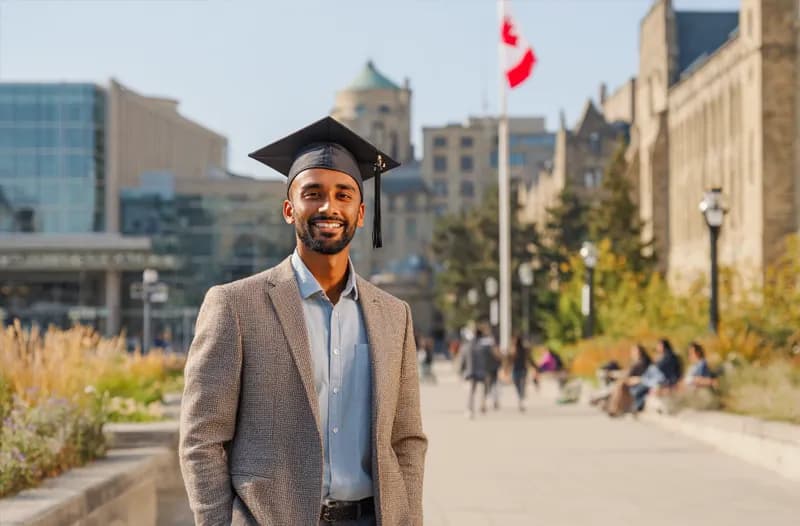
How to Study in Canada for Free

Fully Funded Scholarships in Canada

Packaging List for Indian Students
Pivot to other study destinations flexibly with upGrad.
#1 Economy with 3.5M STEM Jobs
-bd758e31628f498897b6cefdb655e7a5.webp&w=1080&q=75)
Europe’s #1 Economy with 1M Jobs

Up to 5 Yrs PSW Visa

Europe's #1 Tech & Gaming Hub
1 year Masters at Top Universities
Up to 5 Years of PSW Visa

Thriving $19B+ ICT market
Everything you need to know about studying in Canada
In Canada, international students can work up to 20 hours per week during classes and full-time during vacations. Average pay ranges from 15 to 22 CAD per hour (INR 915 to 1,342), depending on your role, city, and employer. Jobs in retail and hospitality pay more.
Yes. To study in Canada, you need a valid study permit. You must have an acceptance letter from a Designated Learning Institution (DLI) , proof of funds (INR 8–10 lakhs/year), no criminal record, a medical exam (if needed), and personal statement or SOP to demonstrate you will leave Canada after your studies.
Canada checks if you’re a genuine student by reviewing your past academic record, financial ability (INR 8–10 lakhs/year), intent to study, future goals, and ties to India. It’s part of proving you’ll return home after completing your education.
Yes, medical insurance is compulsory for international students in Canada. Some provinces offer government health plans, while others require private coverage. On average, private student health insurance can cost between CAD 600–900 per year (INR 37,000–55,000) depending on the province and coverage.
Yes, you can apply for a Post-Graduation Work Permit (PGWP) valid for up to 3 years, depending on course duration. This allows you to work full-time in Canada. A longer PGWP helps with Canadian permanent residency through Express Entry or PNPs.
Yes, you can bring your spouse and children while studying in Canada. Your spouse can apply for a work permit, and children can go to school. You must show proof of funds of about CAD 8607 for the first dependent per year followed by CAD 6170 for every additional dependent.
Canada generally offers three intakes: Fall (September), Winter (January), and Summer (May). Fall is the main intake with maximum courses and scholarships. Application deadlines are usually 6–9 months prior, so planning early is key for securing your preferred course and university.
Yes, IELTS is widely accepted and often mandatory for a Canada student visa. A minimum overall score of 6.0 with no band below 5.5 is usually required under the SDS (Student Direct Stream). Some institutions may also accept TOEFL or PTE scores.
A PAL (Provincial Attestation Letter) or TAL (Territorial Attestation Letter) is a critical document that confirms that your student visa application is approved under a province or territory’s study cap. You must submit it with your study permit application, and it must be valid at the time of applying. Each student needs their own PAL or TAL.
A GIC (Guaranteed Investment Certificate) is a Canadian bank account that holds your first-year living expenses. To secure a GIC, you must deposit CAD 20,600. Starting September 1, 2025, the revised GIC deposit will be CAD 22,895.
The average cost of studying in Canada for Indian students ranges between CAD 29,000–56,500 per year (₹18–35L). This includes tuition, living expenses, health insurance, and visa fees. Costs vary by program type, city, and lifestyle, with Toronto and Vancouver being more expensive than smaller provinces.
No, Canada is not rejecting 80% of Indian student visas. In 2026, IRCC introduced a cap system with provincial allocations to manage international student numbers. While competition is higher, genuine applicants with proper documentation, proof of funds, and admission to DLIs continue to secure study permits successfully.
Eligibility depends on the program level. For undergraduate studies, students need a 12th grade completion certificate with minimum GPA requirements. For master’s or PhD, a recognized bachelor’s/master’s degree, language proficiency (IELTS/TOEFL), and proof of funds are mandatory. Some programs may also require GRE/GMAT scores.
Courses in Computer Science, Data Science, Engineering, Healthcare, and Business Analytics are in high demand. Canada’s growing tech hubs, healthcare needs, and financial services sector ensure strong employability for graduates in these fields. Green technology and sustainability programs are also emerging as future focused options.
Yes, Indian students can work parttime while studying. As of 2026, IRCC allows up to 24 hours per week offcampus during academic sessions. During scheduled breaks, students can work fulltime. This helps offset living costs and gain valuable Canadian work experience.
A Canadian study permit is usually valid for the length of your program plus 90 days. This extra time allows students to prepare for departure or apply for a Post Graduation Work Permit (PGWP). The PGWP can extend up to 3 years depending on program length.
Yes, many Canadian universities offer meritbased and needbased scholarships to Indian students. Popular options include the Lester B. Pearson Scholarship (Toronto), Vanier Graduate Scholarships, and UBC International Leader of Tomorrow Award. These can cover tuition and living expenses, making education more affordable.
Processing times vary, but most Indian students receive a decision within 6–12 weeks. Using the Student Direct Stream (SDS) can speed up approvals if you meet requirements like IELTS 6.0+, upfront medicals, and a CAD 10,000 GIC deposit. Early applications improve chances of timely approval.
Canada is often seen as more affordable and immigration friendly compared to the USA. Tuition fees and living costs are lower, and the PGWP provides clear pathways to permanent residency. However, the USA offers larger job markets in tech and finance. The choice depends on career goals and budget
Students must submit a Letter of Acceptance (LOA) from a DLI, valid passport, proof of funds, academic transcripts, language test scores, and medical exam results. Biometrics and visa fees are also mandatory. Organizing these documents properly increases approval chances.
Yes, many Indian students transition to permanent residency after completing their studies. The Express Entry system and Provincial Nominee Programs (PNPs) prioritize international graduates with Canadian education and work experience. This makes Canada one of the most immigrationfriendly destinations for Indian students.
Check out articles on IELTS, TOEFL, PTE, Duolingo, GRE & GMAT

Advance your career with our expert guidance & global programs.
Studying in Canada for Indian students has become one of the most popular choices worldwide, with over 155,000 new Indian enrolments in 2026 as per IRCC data. The process begins with selecting a Designated Learning Institution (DLI), securing an acceptance letter, and preparing essential documents like a passport, Statement of Purpose (SOP), and IELTS/TOEFL scores. Since 2026, Canada requires a Provincial Attestation Letter (PAL) along with proof of funds, demonstrating financial ability of CAD 25,000–40,000 per year (₹15–24L) to cover tuition and living expenses.
Beyond academics, Canada offers clear pathways for post-study work permits (PGWP up to 3 years) and eventual permanent residency (PR), making it a highly attractive destination for Indian students.
Key Highlights (2026):
Category | Key Stats |
Universities | ~250 total; 30+ globally ranked |
Top Universities | McGill (#27 QS), University of Toronto (#29 QS), UBC (#40 QS), University of Alberta (=94 QS), University of Waterloo (#150 QS) |
Top Courses | Engineering, Computer Science/Data Science, MBA, Medicine, Nursing, Finance |
Approx. Tuition/Year | UG: CAD 36K (₹21.6L); PG: CAD 21K (₹12.6L) |
Living Costs/Year | CAD 10K–15K (₹6–9L) |
Visa Fees | CAD 150 study permit (₹9,000) + biometrics CAD 85 (₹5,100) |
PostStudy Work Permit (PGWP) | Up to 3 years, depending on program length |
Part-Time Work | 24 hrs/week offcampus during sessions (new 2026 rule) |
Study in Canada continues to be a leading choice for international students, especially Indians. According to IRCC’s 2026 Immigration Levels Plan, Canada will issue up to 408,000 study permits, including 155,000 new international students, with Indians forming one of the largest cohorts. The country’s reputation for academic excellence, affordability, and post-study work opportunities makes it a premier destination.
Key reasons to study in Canada:
The education system in Canada for international students includes diplomas, bachelor’s, master’s, and doctoral programs. Students can choose between universities, colleges, and polytechnic institutes, depending on their career goals and budget.
Canadian higher education emphasizes research, skill development, and industry partnerships, making it attractive for Indian students planning to study in Canada after 12th or pursue postgraduate studies. Master’s programs (1–2 years, 30–60 credits) blend coursework and thesis, while PhDs (3–6 years) combine advanced courses with original research.
Education Levels: Key Duration & Outcomes
Level | Duration | Credits Required |
Diploma / Advanced Diploma | 2–3 years | 60–90 |
Bachelor’s Degree | 3–4 years | 90–120 |
Master’s Degree | 1–2 years | 30–60 |
Doctorate (PhD) | 3–6 years | Coursework + dissertation |
Credits measure workload, with fulltime loads required for visa compliance. GPA systems vary by province but generally follow a 4.0 scale.
Aspect | Details |
Credit Hours | 1 credit = ~3 hours/week (class + study); fulltime: 12–15 credits/semester; bachelor’s needs ~120 credits |
GPA Scale | 4.0 (A excellent) to 0.0 (F fail); some provinces use 4.3 or 9.0 scales |
Full Load | 12+ credits/semester required for study permit compliance |
Canada’s institutions vary by funding and focus, offering diverse options for international students.
Type | Key Features | Examples |
Public Universities | Provincial funding, large enrollment, broad programs, strong research | University of Toronto, UBC, McGill |
Colleges & Institutes | Applied learning, diplomas, vocational training, and industry partnerships | Seneca College, George Brown College |
Polytechnic Institutes | Technical and professional focus, coop programs | British Columbia Institute of Technology (BCIT) |
Private Universities/Colleges | Tuitionfunded, smaller classes, specialized programs | Quest University, Trinity Western University |
Community Colleges | Affordable entry, transfer pathways to universities | Humber College, Fanshawe College |
Canada has emerged as a leading destination for Indian students, offering world-class education, diverse programs, and strong career pathways. Universities such as the University of Toronto, McGill University, University of British Columbia, University of Waterloo, and University of Alberta consistently rank among the global top 100, attracting thousands of Indian learners each year. These institutions provide excellent academic resources, coop internships, and scholarships, while fostering multicultural environments with vibrant Indian communities.
Top engineering programs in Canada suit Indian STEM students with strong industry ties and coop internships.
QS 2025 Rank (Engineering) | University | Annual Tuition (Approx CAD/INR) |
#29 | University of Toronto | CAD 35K–45K (₹21–27L) |
#34 | University of British Columbia | CAD 30K–40K (₹18–24L) |
#37 | McGill University | CAD 32K–42K (₹19–25L) |
#94 | University of Alberta | CAD 25K–35K (₹15–21L) |
#150 | University of Waterloo | CAD 28K–38K (₹17–23L) |
MBA programs in Canada accelerate careers through global networks and finance hubs in Toronto and Vancouver.
QS 2025 Rank (Business) | University | Annual Tuition (Approx CAD/INR) |
#29 | University of Toronto (Rotman School of Management) | CAD 40K–50K (₹24–30L) |
#37 | McGill University (Desautels Faculty of Management) | CAD 35K–45K (₹21–27L) |
#34 | University of British Columbia (Sauder School of Business) | CAD 32K–42K (₹19–25L) |
#94 | University of Alberta (School of Business) | CAD 25K–35K (₹15–21L) |
#150 | York University (Schulich School of Business) | CAD 30K–40K (₹18–24L) |
MS programs target AI/ML roles with access to Canada’s growing tech hubs in Toronto, Waterloo, and Vancouver.
QS 2025 Rank (Computer Science) | University | Annual Tuition (Approx CAD/INR) |
#29 | University of Toronto | CAD 35K–45K (₹21–27L) |
#34 | University of British Columbia | CAD 30K–40K (₹18–24L) |
#37 | McGill University | CAD 32K–42K (₹19–25L) |
#150 | University of Waterloo | CAD 28K–38K (₹17–23L) |
#94 | University of Alberta | CAD 25K–35K (₹15–21L) |
LLM programs in Canada enhance global legal practice with exposure to international law firms and Canadian legal systems.
QS 2025 Rank (Law) | University | Annual Tuition (Approx CAD/INR) |
#29 | University of Toronto (Faculty of Law) | CAD 35K–45K (₹21–27L) |
#37 | McGill University (Faculty of Law) | CAD 32K–42K (₹19–25L) |
#34 | University of British Columbia (Peter A. Allard School of Law) | CAD 30K–40K (₹18–24L) |
#150 | York University (Osgoode Hall Law School) | CAD 28K–38K (₹17–23L) |
#94 | University of Alberta (Faculty of Law) | CAD 25K–35K (₹15–21L) |
MIM programs in Canada build analytics and leadership skills for young professionals.
QS 2025 Rank (Management) | University | Annual Tuition (Approx CAD/INR) |
#29 | University of Toronto (Rotman School of Management) | CAD 40K–50K (₹24–30L) |
#37 | McGill University (Desautels Faculty of Management) | CAD 35K–45K (₹21–27L) |
#34 | University of British Columbia (Sauder School of Business) | CAD 32K–42K (₹19–25L) |
#150 | University of Waterloo | CAD 28K–38K (₹17–23L) |
#94 | University of Alberta | CAD 25K–35K (₹15–21L) |
Tuition ranges are approximate and based on official university fee schedules for 2025-2026.
Acceptance rates in Canada vary by institution type, program demand, and intake cycle. The Fall intake (September) remains the most competitive, with over 70% of international students, especially Indians, applying during this period.
Rate Breakdown by Tier:
Tier | Rate Range | Examples (Indian Friendly) |
Top | 20–40% | University of Toronto (~25%), McGill (~28%), UBC (~30%) |
Mid | 50–70% | University of Alberta (~55%), University of Waterloo (~50%), York University (~60%) |
Base | 75–90% | Seneca College (~85%), Humber College (~80%), Fanshawe College (~88%) |
Key Influencing Factors:
Popular courses to study in Canada for Indian students span STEM, business, healthcare, and applied sciences, balancing the cost of study in Canada for Indian students with strong career returns. Canadian universities like Toronto, McGill, UBC, Waterloo, and Alberta offer globally recognized programs with coop internships and PGWP eligibility.
Top 10 Courses & Universities (2026):
Course | Universities | Tuition (Total Approx CAD/INR) |
MS Computer Science | University of Toronto, UBC, Waterloo | CAD 30K–45K (₹18–27L) |
MS Data Science | McGill, Waterloo, UBC | CAD 28K–40K (₹17–24L) |
MS Engineering Management | University of Alberta, Toronto | CAD 25K–35K (₹15–21L) |
MS Business Analytics | York (Schulich), McGill, UBC | CAD 30K–42K (₹18–25L) |
MBA | Rotman (Toronto), Sauder (UBC), Desautels (McGill) | CAD 35K–50K (₹21–30L) |
MS Mechanical Engineering | Waterloo, Alberta, Toronto | CAD 28K–38K (₹17–23L) |
MS Electrical Engineering | UBC, McGill, Toronto | CAD 30K–42K (₹18–25L) |
MS Finance | Rotman (Toronto), McGill, York (Schulich) | CAD 32K–45K (₹19–27L) |
Public Health (MPH) | University of Toronto, McGill | CAD 28K–40K (₹17–24L) |
Biotechnology MS | McMaster, Toronto, UBC | CAD 25K–35K (₹15–21L) |
Note: Tuition amounts are approximate, and costs vary by program length, province, and exchange rates
Studying in Canada mandates academic qualifications, proof of English/French language skills, and a study permit via IRCC-approved institutions. Applications are streamlined through EduCanada and direct university portals for Indian students.
Requirements scale with degree level, from diplomas to doctoral programs.
Level | GPA | Key Requirements |
Diploma / Advanced Diploma | 2.5+ | High school completion (12th grade) |
Bachelor’s Degree | 2.7–3.2 | High school diploma + transcripts |
Master’s Degree | 3.0+ | 4-year bachelor’s degree |
Doctorate (PhD) | 3.5+ | Master’s degree + research experience |
Core documents prove academics, intent, and finances for both admission and visa stages.
Category | Items Needed |
Academic | Transcripts, diplomas, certificates |
Personal | Passport, Statement of Purpose (SOP), 2–3 Letters of Recommendation |
Financial | Bank statements, a Guaranteed Investment Certificate (GIC), and a sponsor letter |
Most Canadian universities do not mandate the GRE/GMAT except for MBA/PhD programs.
Exam | Level | Competitive Scores |
SAT/ACT | UG (optional at many universities) | 1200+ SAT |
GRE | MS/PhD (select programs) | Programspecific |
GMAT | MBA | 600+ |
English mastery is mandatory for all levels; French is accepted in Quebec institutions.
Test | Elite Universities | MidTier |
TOEFL | 100+ | 80–90 |
IELTS | 7.0+ | 6.5 |
PTE Academic | 65+ | 58+ |
The Canadian study permit follows admission, proving genuine student status and funding at interview via structured steps.
Step | Requirement | Details |
1 | Secure Letter of Acceptance | From a Designated Learning Institution (DLI) |
2 | Pay Canada Visa Fees | CAD 150 (₹9,000) + CAD 85 biometrics (₹5,100) |
3 | Proof of Funds | Minimum CAD 20,635 (₹12.3L) for living + tuition |
4 | Submit Online Application | Via the IRCC portal |
5 | Biometrics + Interview | Demonstrate genuine intent and financial capacity |
The Cost of Studying in Canada for Indian Students (2026) averages ₹18–35 lakh per year (CAD 29,000–56,500), covering tuition and living expenses. Undergraduate tuition averages CAD 36,100 (₹21.6L) annually, while postgraduate programs average CAD 21,100 (₹12.6L). Professional programs such as MBA, Medicine, Dentistry, and Engineering generally cost more compared to arts and humanities.
Total Annual Cost Breakdown:
Category | Approx. Annual Cost (CAD/INR) |
Tuition | CAD 20K–45K (₹12–27L) |
Rent | CAD 6K–10K (₹3.6–6L) |
Insurance | CAD 600–1,000 (₹36K–60K) |
Services/Amenities | CAD 2K–3K (₹1.2–1.8L) |
Study Materials | CAD 1K–2K (₹60K–1.2L) |
Visa & Biometrics | CAD 150 + CAD 85 (₹14.1K) |
Total annual cost: CAD 29K–56.5K (₹18–35L)
Canadian universities bill per semester (12–15 credits); full-time loads are required for study permit compliance.
Type | Per Semester (CAD) | Annual (CAD/INR) |
Public Universities (UG) | CAD 9K–18K | CAD 36.1K (₹21.6L) |
Postgraduate Programs | CAD 10K–12K | CAD 21.1K (₹12.6L) |
STEM and MBA programs command premiums; 1–2 year programs reflect annual rates.
Course | Annual Tuition (CAD/INR) |
MS Computer Science | CAD 28K–40K (₹17–24L) |
MS Engineering | CAD 25K–35K (₹15–21L) |
MBA | CAD 35K–50K (₹21–30L) |
MS Data Science | CAD 28K–38K (₹17–23L) |
Medicine/Dentistry | CAD 40K–55K (₹24–33L) |
Figures are based on EduCanada and university fee schedules for 2026; exchange rates may affect INR values.
The international students, including Indians, must budget for housing, food, transport, and mandatory health insurance. Living costs of Canada vary by province, with Ontario and British Columbia at the higher end.
Monthly Cost Breakdown:
Expense | Monthly Cost (CAD/INR) |
Housing (1BR apartment) | CAD 1,200–1,800 (₹72K–1.1L) |
Housing (shared 2BR) | CAD 700–1,200 (₹42K–72K) |
Utilities | CAD 150–250 (₹9K–15K) |
Groceries | CAD 300–450 (₹18K–27K) |
Transportation (public transit) | CAD 100–150 (₹6K–9K) |
Health Insurance (mandatory provincial plans) | CAD 70–120 (₹4.2K–7.2K) |
Dining Out | CAD 100–200 (₹6K–12K) |
Internet/Phone | CAD 70–100 (₹4.2K–6K) |
Entertainment | CAD 50–150 (₹3K–9K) |
Total Monthly Cost: CAD 1,200 approx (₹72K) shared; CAD 1,800 single (₹1.1L).
Canada remains a top destination for Indian students, with Montreal, Toronto, Vancouver, and Ottawa ranking among the QS Best Student Cities 2026. These cities attract the majority of Indian enrollees thanks to globally ranked universities, multicultural communities, and strong job markets.
Based on 2026 data, here are the best cities in Canada to live and study, ranked by overall quality of life
1. Toronto: Finance & Tech Hub
Toronto is Canada’s largest city and home to the University of Toronto and York University (Schulich). It offers strong opportunities in finance, consulting, and tech, supported by Canada’s largest Indian diaspora. Costs are higher, but salaries in finance and IT offset expenses.
2. Vancouver: Gateway to Innovation
Vancouver hosts the University Canada West and the University of British Columbia (UBC). It is a hub for software, gaming, and green tech, with scenic living and strong coop programs. Housing costs are high, but the city ranks among the world’s most desirable for students.
3. Montreal: Affordable Academic Cluster
Montreal consistently ranks as Canada’s #1 student city (QS 2026 =18). It is home to McGill University and Université de Montréal, offering biotech, AI, and engineering programs. Living costs are ~30% lower than in Toronto/Vancouver, making it highly attractive for Indian students.
4. Ottawa: Policy & Research Capital
Ottawa, with institutions like Carleton University (CanadaIndia Centre), is Canada’s political and research hub. It offers strong programs in public policy, law, and engineering, alongside affordable living costs compared to Toronto.
5. Calgary & Edmonton: Energy & Engineering Leaders
Although not in the QS top 100, these Alberta cities are home to the University of Alberta and the University of Calgary, offering strong programs in petroleum engineering, energy, and applied sciences. Living costs are moderate, and job opportunities in energy remain robust.
H2: Scholarships in Canada for Indian Students (2026)
For students planning to study in Canada from India, scholarships and study loans play a crucial role in affordability. Canada offers numerous merit-based, need-based, and research-focused scholarships for international students.
Popular options include fully-funded scholarships, government-funded programs like Vanier Canada Graduate Scholarships, university-specific awards such as the University of Toronto Lester B. Pearson Scholarship, and private initiatives like the Shastri Indo-Canadian Institute awards.
Major Scholarships for Indian Students Studying in Canada:
Name | Main Eligibility | Scholarship Amount & Duration |
Vanier Canada Graduate Scholarships (Vanier CGS) | Doctoral students with strong academics & leadership | CAD 50,000/year (₹30L); up to 3 years |
Lester B. Pearson International Scholarship (University of Toronto) | Exceptional international undergraduates | Full tuition + living; 4 years |
Ontario Graduate Scholarship (OGS) | Master’s/PhD students in Ontario universities | CAD 10,000–15,000/year (₹6–9L); 1 year renewable |
Shastri IndoCanadian Institute Scholarships | Indian students in Canadian partner universities | CAD 500–1,000 (₹30K–60K); shortterm research |
CanadaASEAN Scholarships & Educational Exchanges for Development (SEED) | Students from partner countries including India | CAD 10,200–12,700 (₹6–7.5L); 1 academic year |
University of British Columbia (UBC) International Leader of Tomorrow Award | Highachieving undergraduates | Tuition + living costs; program duration |
McGill University Entrance Scholarships | Strong academic UG applicants | CAD 3,000–12,000 (₹1.8–7.2L); renewable |
York University Global Leader of Tomorrow Award | International UG students | CAD 20,000/year (₹12L); up to 4 years |
University of Waterloo International Master’s Award of Excellence | Master’s students | CAD 2,500/term (₹1.5L); up to 5 terms |
Pierre Elliott Trudeau Foundation Doctoral Scholarships | PhD students in social sciences/humanities | CAD 40,000/year (₹24L); 3 years |
Scholarship applications follow structured timelines; government awards open annually, while university awards align with admission cycles. Start 12–18 months early via university portals for the highest success.
Application Steps:
Step | Action | Timeline |
1. Research | EduCanada.ca + university sites | 12–18 months before |
2. Gather Docs | Transcripts, SOP, 2–3 LORs, CV | 6–9 months before |
3. Submit Online | EduCanada portals/university apps | Deadlines vary |
4. Interviews | University/consulate panels | Shortlisted only |
Key Deadlines (2026 Cycle):
Getting a Canadian student visa is a key step if you want to study in Canada for Indian students. While the process may seem complex, it becomes straightforward when broken into four stages: preparing documents, paying fees and biometrics, application submission, and attending the visa interview (if required). Knowing each step helps you meet all requirements to study in Canada and increases your chances of approval.
1. Before the Application: Documents You Need
Make sure you have these ready before submitting your study permit application:
2. Visa Fee Payment & Biometrics
3. Preparing for the Visa Process
4. After Submission & Interview (if required)
Studying in Canada opens diverse career paths for Indian students. With access to global companies, coop internships, and research opportunities, students can gain hands-on experience while building a strong international profile. International graduates are highly employable, and Canada’s Post-Graduation Work Permit (PGWP) allows up to 3 years of work after studies.
The jobs in Canada for Indians are constantly evolving. Currently, the sectors with high demand for skilled professionals include:
Below are the highest-paying jobs in Canada for Indian students:
Job Role / Title | Approximate Annual Salary (CAD) | Approximate Annual Salary (INR) |
Data Scientist (range entry–senior) | CAD 96,500 – 170,500 | ₹58L – ₹1.02Cr |
Software Engineer / Developer (midlevel) | CAD 95,000 – 120,000 | ₹57L – ₹72L |
Senior Software / Data Engineer (lead roles) | CAD 130,000 – 150,000+ | ₹78L – ₹90L+ |
Data Analyst (average) | CAD 65,000 – 80,000 | ₹39L – ₹48L |
Data Analyst (entry to midlevel) | CAD 50,000 – 70,000 | ₹30L – ₹42L |
Looking ahead, certain domains are projected to see rapid growth in Canada: