

.png)













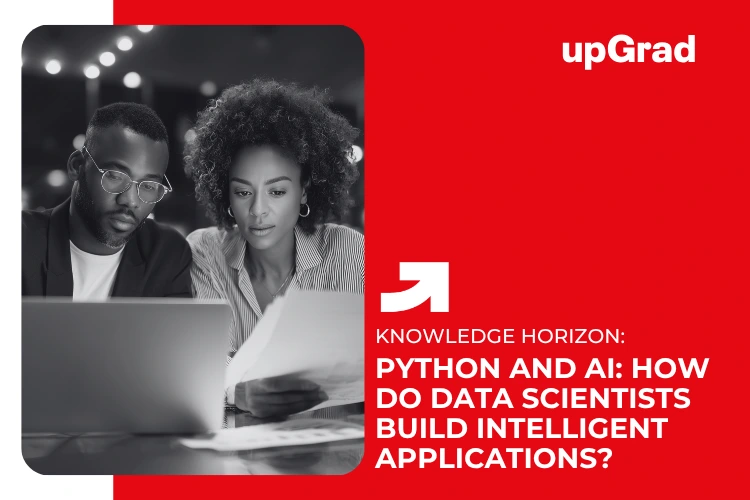
Python has become one of the most widely used languages for developing intelligent applications, especially in data science and artificial intelligence. Thanks to its simple syntax, vast libraries, and powerful AI ecosystem, data scientists can analyze data, build machine learning models, and automate complex tasks. Python makes it easy to develop various intelligent applications, including predictive analytics, recommendation systems, chatbots, and computer vision applications. By integrating artificial intelligence and machine learning with Python programming skills, data scientists can convert raw data into useful information and develop applications that learn and adapt.
This blog discusses Python for AI and how data scientists build intelligent applications from data to deployment.
Python for AI: How Data Scientists Build Intelligent Applications from Data to Deployment
Python gives data scientists the right environment to carry out AI projects. Python can support every stage of AI development, from data preparation to model deployment for commercial use.
Step 1: Preparing High-Quality Data for AI Models
Data scientists use Python libraries such as Pandas and NumPy to clean, transform, and analyze data. They handle missing values, remove duplicates, identify outliers, and select meaningful features to improve data quality and accuracy. Scikit-learn also supports data processing, feature generation, and splitting the dataset for training and testing.
Step 2: Training Machine Learning and Deep Learning Models
Once the data is ready, data scientists begin developing AI models using Python libraries such as Scikit-learn, TensorFlow, and PyTorch. Data scientists choose algorithms to train models, use historical data to train models, and use performance metrics to evaluate model performance. Python allows data scientists to test various models and adjust parameters to manage the process more efficiently.
Also Read: What Is Predictive Analytics and Its Role in Business Strategies?
Step 3: Deploying and Monitoring Intelligent Applications
Deploying and monitoring intelligent applications is the third step in building AI systems. Once the model performs well, data scientists deploy it into a program or business process. Python frameworks like Flask and FastAPI provide services for developing APIs that let applications access AI models. After deployment, the model should be monitored to ensure it continues delivering accurate, effective results.
Challenges Data Scientists Face When Building AI Applications
Specialists face many challenges when building AI applications. The task is more complicated than just writing Python code. For instance, data scientists may face low-quality data, limited datasets, the need for powerful CPUs, model overfitting, and the risk of hacking.
Real-World AI Applications Built with Python Across Industries
Python’s vast range of AI libraries and frameworks makes it suitable for developing smart applications in multiple sectors. Companies use Python to automate workflows, process large amounts of data, and create unique customer experiences in industries such as healthcare, finance, e-commerce, and customer service.
Building Intelligent Chatbots and Virtual Assistants
Using Python, software engineers can create chatbots and virtual assistants that can understand user inquiries and respond automatically. Various NLP libraries and frameworks enable these technologies to analyze text, capture users’ intentions, and provide appropriate responses.
Computer Vision Applications
The computer vision software is created using the programming language Python. Libraries such as OpenCV, TensorFlow, and PyTorch support image classification, object detection, face recognition, quality control, and other tasks. These computer vision applications find use in healthcare, manufacturing, security, and retail.
Also Read: Python Libraries US Data Science Employers Expect You to Know in 2026
Predictive AI and Recommendation Systems
In predictive analytics, data scientists use Python to build predictive models that identify trends in historical data and forecast future outcomes. Businesses can apply these models for demand forecasting, fraud detection, predicting attrition, and evaluating risk. Similarly, recommendation systems analyze customer activity to recommend suitable products, movies, and services.
Generative AI Applications Built with Python
Generative AI applications have grown thanks to Python. Generative AI applications deal with content creation in textual, visual, or audio form. Computer vision software is created with the help of libraries such as PyTorch, TensorFlow, and Hugging Face, which enable interaction with large-scale language models.
Also Read: Best Work-from-Home Data Science Jobs for US Professionals
Learn Python for AI with upGrad and Build Industry-Ready AI Skills
Combining Python learning with AI and machine learning helps you build skills you can later use to create data-driven applications. With upGrad, students will get practical exposure to Python programming, data analysis, machine learning, and AI concepts through industry-specific education. Hands-on projects and real-world applications can help you develop the skills needed for an AI career or a data science job.
Here are some popular online courses through upGrad in the US:
- Executive Post Graduate Program in Applied AI and Agentic AI from IIIT Bangalore
- Master of Science in Machine Learning & AI from LJMU
- Executive Post Graduate Certificate in Generative AI & Agentic AI from IIT Kharagpur
- Executive Diploma in Machine Learning and AI with IIIT-B
🎓 Explore Our Top-Rated Courses in United States
Take the next step in your career with industry-relevant online courses designed for working professionals in the United States.
- DBA Courses in United States
- Data Science Courses in United States
- MBA Courses in United States
- AI ML Courses in United States
- Digital Marketing Courses in United States
- Product Management Courses in United States
- Generative AI Courses in United States
FAQs On Python and AI
Python is the preferred language for AI development primarily because it strikes a perfect balance between high-level simplicity for developers and low-level performance for heavy mathematical computations.
Data scientists use Python as their primary tool to build AI applications by leveraging its massive ecosystem of open-source libraries, clean syntax, and seamless integration with cloud platforms. Python connects data ingestion, mathematical modeling, and production deployment.
Yes, Python is the dominant language and the industry standard for generative AI development. It underpins training core models, orchestrating complex workflows, and integrating pre-trained Large Language Models (LLMs) into production-ready software.
Python is the industry-standard language and interface layer for machine learning (ML) and deep learning, bridging human developers and high-performance, low-level computational engines.
Yes, absolute beginners can easily learn Python for AI development. Python is widely considered the best language for beginners because its clean syntax reads like plain English.