









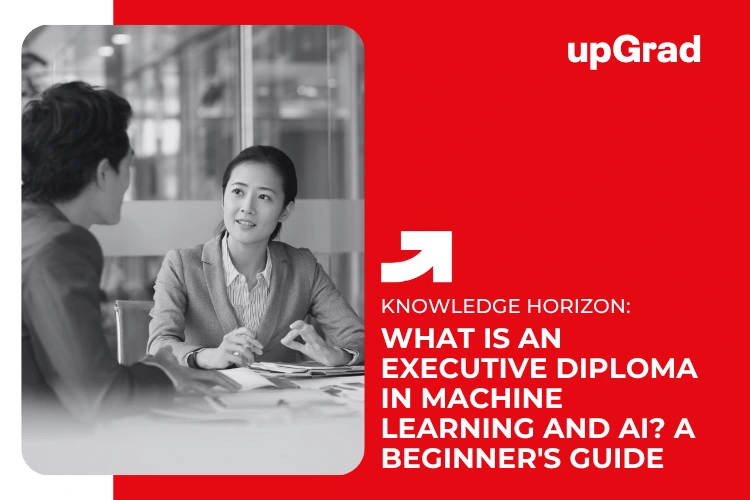
Artificial Intelligence (AI) and Machine Learning (ML) are changing how businesses operate, decisions are made, and products and services are developed. An Executive Diploma in Machine Learning and AI provides working professionals with valuable know-how related to the field. This program covers machine learning algorithms, data analysis, AI applications, and other emerging technologies. In general, an executive diploma focuses on practical, application-based training rather than the traditional degree format. It suits both beginners and those who want to hone their technical skills or prepare for technology roles without leaving their current jobs.
Understanding an Executive Diploma in Machine Learning and AI: Meaning, Curriculum, and Who It Is For
An Executive Diploma in AI and Machine Learning offers a career-oriented program that prepares students to learn the practical aspects of artificial intelligence, machine learning, data analysis, and more. An Executive Diploma suits working professionals who want to keep learning while continuing to work.
What Is an Executive Diploma in Machine Learning and AI?
An Executive Diploma in Machine Learning and AI is a specialized program that provides theoretical knowledge in artificial intelligence and machine learning, along with practical industry application. Depending on the institution, the syllabus may include Python, statistics, machine learning, deep learning, data analytics, natural language processing, generative AI, and other related subjects.
This program is generally designed for working professionals who want to continue learning while working. . Students learn through practical approaches like projects, case studies, and hands-on exercises.
Who Should Consider This Diploma?
An Executive Diploma in Machine Learning and AI can be suitable for:
- Working professionals looking to transition into AI- or ML-related roles.
- IT and software professionals who want to add AI capabilities to their existing technical expertise.
- Data and analytics professionals seeking to advance their knowledge of machine learning.
- Business professionals and managers who want to understand AI applications and support technology-driven decision-making.
- Entrepreneurs and business owners interested in using AI to improve products, processes, and customer experiences.
- Graduates and early-career professionals looking for practical, industry-relevant AI and ML skills.
Also Read: Top 10 Highest-Paying CS Jobs in the UAE
What Will You Learn During the Program?
Although the exact curriculum varies by institution, an Executive Diploma in Machine Learning and AI may cover the following areas:
| Learning Area | What you may learn |
| Python Programming | Python fundamentals, libraries, and programming for AI applications |
| Statistics & Mathematics | Probability, statistics, and mathematical concepts used in ML |
| Machine Learning | Supervised, unsupervised, and reinforcement learning concepts |
| Deep Learning | Neural networks and deep learning techniques |
| Data Analytics | Data preparation, exploration, analysis, and visualization |
| Natural Language Processing | Techniques for processing and analyzing human language |
| Generative AI | Large language models, AI applications, and generative AI concepts |
| AI Applications | Real-world applications of AI across business and technology |
| Projects & Case Studies | Practical projects that demonstrate how AI and ML solve business problems |
Skills You Can Build Throughout the Program
An Executive Diploma in Machine Learning and AI can help you develop a combination of technical, analytical, and problem-solving skills. These may include:
- Programming skills: Using Python and relevant AI/ML libraries.
- Data analysis: Cleaning, analyzing, and interpreting datasets.
- Machine learning: Selecting and applying appropriate ML algorithms.
- Model development: Building, testing, and evaluating predictive models.
- AI problem-solving: Identifying opportunities to apply AI to real-world challenges.
- Analytical thinking: Using data and models to support informed decision-making.
- Business understanding: Connecting AI solutions with organizational goals.
- Project skills: Applying concepts through practical projects and case studies.
Career Opportunities After Completing an Executive Diploma in Machine Learning and AI
An Executive Diploma in Machine Learning and AI can lead to job opportunities in fields such as technology, analytics, and business. This qualification can help individuals enter AI-based careers or improve their existing technology skills.
Top Career Paths in AI and Machine Learning
Based on their past job experience, graduates can take up any of the following careers:
- Machine Learning Engineer.
- AI Engineer
- Data Scientist
- Data Analyst.
- AI Product Manager
- NLP Engineer.
- AI Consultant
Also Read: The Future of Data Analytics and Artificial Intelligence in the UAE Job Market
Industries Hiring AI and Machine Learning Professionals
AI and ML skills are increasingly relevant across industries, including:
- Information Technology and Software
- Banking and Financial Services
- Healthcare and Pharmaceuticals
- E-commerce and Retail
- Manufacturing and Automotive
- Telecommunications
- Logistics and Supply Chain
- Media and Entertainment
- Education
- Consulting
How an Executive Diploma Supports Career Growth?
An Executive Diploma in Machine Learning and AI helps individuals build skills that complement their existing credentials and experience.It may support career transitions, promotions, technology upskilling, and the transition into AI-related responsibilities. Learners can also apply their knowledge through projects and demonstrate their ability to use AI and ML to solve business problems.
Is an Executive Diploma in Machine Learning and AI Right for You?
If you are planning to learn AI and ML skills, an Executive Diploma can be a good choice for you. The program can benefit those preparing for career progression or ready to move into a technology-oriented position in AI.
Also Read: Is an Artificial Intelligence Degree Worth It in the UAE?
Build Future-Ready AI Skills with upGrad UAE
Embark on your AI journey with upGrad UAE. Gain insights into machine learning, AI, data analytics, and new technologies through relevant industry knowledge. Build practical skills and gain experience to prepare yourself for the rapidly changing technology landscape.
Here are some relevant AI and Machine Learning programs:
- Master’s Degree in Artificial Intelligence and Data Science from O.P. Jindal Global University
- Generative AI Mastery Certificate for Software Development
- Master of Science in Machine Learning & AI from Liverpool John Moores University
- Executive Diploma in Machine Learning and AI with IIIT-B
- Executive Post Graduate Certificate in Generative AI & Agentic AI from IIT Kharagpur
🎓 Explore Our Top-Rated Courses in UAE
Take the next step in your career with industry-relevant online courses designed for working professionals in the UAE.
- DBA Courses in UAE
- Data Science Courses in UAE
- MBA Courses in UAE
- AI ML Courses in UAE
- Digital Marketing Courses in UAE
- Product Management Courses in UAE
- Generative AI Courses in UAE
FAQs On Executive Diploma in Machine Learning
An Executive Diploma in Machine Learning and AI is a post-graduate, professional certification program designed for working individuals.
An Executive Diploma in Machine Learning and AI is ideal for working software developers, data analysts, IT professionals, and technical managers who want to upskill or transition into advanced roles like Machine Learning Engineer, Data Scientist, or AI Product Manager without pausing their careers.
No, you do not need prior programming experience to enroll in most Executive Diplomas in Machine Learning and AI.
An Executive Diploma in Machine Learning and AI teaches you core programming, predictive modeling, deep learning architectures, and strategic deployment. You will learn how to build intelligent systems, analyze complex datasets, and lead AI-driven business projects.
An Executive Diploma in Machine Learning and AI typically takes 12 to 15 months to complete. These programs are designed for working professionals and generally require a weekly commitment of 10 to 15 hours of study across self-paced modules, live sessions, and practical projects.